
Choosing the best stationary air compressor for a home garage starts with matching airflow and electrical needs to the tools you plan to run. A small, oil-free unit can suit occasional nailing and inflation, while a larger tank and higher CFM output are more useful for demanding shop work. The options below range from compact 110–120V models to large 60- and 80-gallon compressors, so check the specs—and the space and wiring you have—before you buy.
Table of Contents
Quick Comparison
| Compressor | Tank | Power and Output | Best Fit |
|---|---|---|---|
| Klutch 20-Gallon Air Compressor | 20 gallons | 2 HP; 4.2 SCFM at 90 PSI; 175 PSI max | General garage tasks and lighter-duty tools |
| DEWALT 60-Gallon Single-Stage Compressor | 60 gallons | 3.7 HP; 11.5 CFM at 90 PSI; 175 PSI max | Higher airflow for a home shop |
| DEWALT 60-Gallon Two-Stage Compressor | 60 gallons | 5 HP; 13.5 SCFM at 175 PSI; 15.3 SCFM at 100 PSI | Demanding, frequent shop use |
| Quincy QT 80-Gallon Compressor | 80 gallons | 7.5 HP; 230V; 1 phase; two-stage | A larger, fixed workshop setup |
| MZB 18.5-Gallon Ultra Quiet Air Compressor | 18.5 gallons | 3 HP; 11.3 CFM at 115 PSI; 115 PSI max | 110V shop tasks where oil-free operation matters |
CFM figures are listed at different pressures, so they are not direct apples-to-apples comparisons. Check the compressor’s airflow at the pressure your tool requires.
Our Picks: Best Stationary Air Compressors For Home Garages reviews
Klutch 20-Gallon: A Practical Pick for Lighter Garage Work

The Klutch pairs a 20-gallon tank with a 2 HP motor and a 120V power requirement. Its oil-free pump avoids routine pump-oil changes, and the stated output is 4.2 SCFM at 90 PSI. That makes it a more modest option than the large-tank DEWALT and Quincy models, but a possible fit for a garage where space, simpler maintenance, and lighter tool use matter.
The design is described as portable, with large rubber wheels, an ergonomic handle, and rubber foot stabilizers. Those features can help when you need to move the compressor around a work area, though this is still a 20-gallon unit rather than a small handheld inflator. Its 175 PSI maximum is not a substitute for checking airflow: a tool’s CFM demand and duty cycle matter just as much as pressure.
This compressor is best suited to tasks that do not require a high, continuous volume of air. If your plans include running air-hungry tools for long stretches, compare their requirements with the Klutch’s 4.2 SCFM at 90 PSI before choosing it. The larger compressors in this list offer substantially more stated airflow, but they also require more room and, in some cases, different electrical service.
Pros:
- Oil-free pump reduces routine pump maintenance.
- Uses a 120V power supply.
- Wheels, a handle, and rubber foot stabilizers support easier placement and movement.
- Provides up to 175 PSI, with 4.2 SCFM at 90 PSI.
Cons:
- Its stated 4.2 SCFM at 90 PSI is lower than the output listed for the larger shop compressors.
- A 20-gallon tank may be limiting for prolonged, high-demand tool use.
Verdict: Choose the Klutch if you want a movable, oil-free compressor for lighter garage work and do not need the airflow of a large stationary shop unit.
DEWALT 60-Gallon Single-Stage: Higher Airflow for a Home Shop

This vertical, belt-drive DEWALT has a 60-gallon tank, a 3.7 HP motor, and a single-stage, oil-lubricated pump. Its listed output is 11.5 CFM at 90 PSI, with a maximum pressure of 175 PSI. Compared with the Klutch, it offers a much larger tank and higher stated airflow, which can make it a better match for a garage that uses pneumatic tools more often.
The motor is listed as compatible with 208V or 230V power. That flexibility can help when fitting a compressor to a suitable shop electrical setup, but it is not the same as plugging it into a standard 120V outlet. Confirm your circuit, wiring, and installation requirements before purchase. The compressor also has an ASME tank, as stated in the product information.
An oil-lubricated pump requires more attention than the Klutch’s oil-free design, so factor in the maintenance instructions and the space needed for a tall, stationary tank. The two-stage DEWALT offers higher listed output at its stated pressure points, but the single-stage model may be sufficient if its airflow meets your tools’ needs. Compare tool specifications rather than choosing by tank size alone.
Pros:
- 60-gallon tank and 11.5 CFM at 90 PSI.
- 175 PSI maximum pressure.
- Motor is listed for 208V or 230V setups.
- ASME tank and oil-lubricated pump.
Cons:
- Requires a compatible higher-voltage electrical setup.
- Oil lubrication adds maintenance compared with an oil-free pump.
Verdict: Consider this DEWALT if you need a large tank and strong airflow for a home shop, and your garage can support its electrical and installation requirements.
DEWALT 60-Gallon Two-Stage: More Output for Demanding Air Tools

This vertical DEWALT has a 60-gallon tank, a two-stage belt-drive pump, and a 5 HP oil-lubricated motor. Its listed output is 13.5 SCFM at 175 PSI and 15.3 SCFM at 100 PSI. Those figures make it the stronger-output DEWALT in this group, though they should be compared with a tool’s stated pressure requirements before you decide it is the right match.
The compressor runs on 230V, so plan for a compatible electrical connection and a suitable permanent location. The product information also lists thermal overload protection and a 65 dB operating-noise figure. That noise figure may be useful when planning your shop, but the compressor will still be a powered machine in a home environment; placement and the surrounding space matter.
Like the other large DEWALT, this model uses an oil-lubricated pump, so it is not the lowest-maintenance choice here. Its higher output and two-stage design make it a more compelling option for frequent or demanding pneumatic work than the smaller Klutch. For occasional inflation or light nailing, however, its size, wiring needs, and capacity may be more than you need.
Pros:
- Two-stage pump and 5 HP motor.
- Lists 13.5 SCFM at 175 PSI and 15.3 SCFM at 100 PSI.
- Thermal overload protection is included.
- Vertical tank design uses floor space efficiently relative to a horizontal layout.
Cons:
- Requires 230V power and a fixed installation area.
- Oil lubrication requires routine care.
Verdict: Pick this DEWALT over the single-stage model if your tools need its higher stated output and you have the space and electrical setup for a 230V compressor.
Quincy QT 80-Gallon: Large Capacity for a Dedicated Workshop
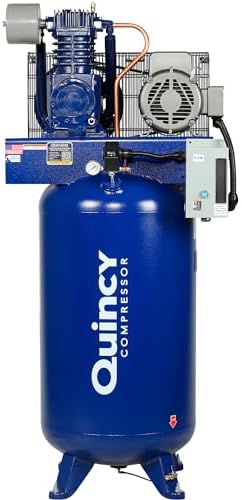
The Quincy QT is the largest-capacity option in this lineup, with an 80-gallon tank, a 7.5 HP motor, a two-stage design, and a 230V single-phase specification. Those headline specs point to a substantial, fixed workshop compressor rather than a compact garage unit. Its larger tank may suit a shop with regular air-tool use, provided the compressor’s output and electrical requirements match the job and installation site.
The product information supplied for this model does not include CFM, maximum PSI, noise, pump lubrication, or other operating details. That makes it harder to compare directly with the DEWALT models, which have more performance specifications listed. Before making a decision, check the product listing and manufacturer information for airflow at your tools’ working pressure, as well as installation and maintenance requirements.
An 80-gallon tank also calls for enough room and a suitable permanent location. This is likely excessive for occasional inflation or light-duty projects, and its 230V power requirement needs to be planned for. If you want a large-capacity compressor but do not need the Quincy’s listed motor size, the 60-gallon DEWALT models provide more published output details for comparison.
Pros:
- 80-gallon tank provides the largest stated capacity in this group.
- 7.5 HP motor and two-stage design.
- 230V single-phase specification is stated.
Cons:
- Supplied product details do not state CFM or maximum PSI.
- Large tank and 230V power requirement call for a dedicated installation plan.
Verdict: The Quincy is worth considering for a spacious, dedicated shop, but verify its airflow, pressure, and maintenance specifications before comparing it with the better-documented options.
MZB 18.5-Gallon: Oil-Free Operation on a 110V Supply

The MZB is an 18.5-gallon, oil-free compressor listed for 110V power. The product information gives it a 3 HP motor, a maximum pressure of 115 PSI, and an airflow claim of 11.3 CFM at 115 PSI. It also states that the tank fills in 81 seconds and lists a noise level of 83 dB. Treat the airflow and fill-time figures as product claims and confirm that the compressor meets your tools’ requirements before buying.
Its oil-free design can reduce pump maintenance, and the 110V specification may suit a garage without a 230V connection, subject to the electrical requirements in the product instructions. The listing describes the unit as compact and lightweight, but it does not provide a weight or details about wheels or a handle. Despite its “ultra quiet” name, 83 dB is worth considering when deciding where to run it, especially in an attached or shared space.
At 115 PSI maximum, this model has a lower pressure ceiling than the 175 PSI Klutch and DEWALT choices. It may be an option for tools that operate within its pressure and airflow limits, but it is not the right pick if your tool requires higher pressure. Its smaller tank also sets it apart from the larger stationary compressors, even though the listing describes a broad range of possible shop applications.
Pros:
- Oil-free design avoids pump-oil changes.
- 110V power specification and 18.5-gallon tank.
- Lists 11.3 CFM at 115 PSI and a 115 PSI maximum.
- Product information states an 83 dB noise level.
Cons:
- 115 PSI maximum pressure is lower than the other listed models.
- The listed 83 dB noise level may be a concern in a home garage.
Verdict: Consider the MZB if oil-free operation and a 110V specification suit your setup, but make sure its 115 PSI limit and stated noise level fit your work area and tools.
How to Choose a Stationary Air Compressor for Your Home Garage
Match Airflow to Your Tools
Start with the air requirements for the tools you plan to use. Look for each tool’s required CFM and PSI, then compare those figures with the compressor’s output at the same pressure. A compressor’s maximum PSI alone does not tell you how much air it can deliver over time. If you plan to run a tool continuously, leave a reasonable margin rather than choosing a compressor that only just meets the tool’s stated demand.
Choose a Tank Size That Fits Your Work
A larger tank stores more compressed air, which can help support bursts of use before the motor needs to refill it. Tank size does not replace adequate airflow, though: a compressor with a large tank can still struggle to keep up with a high-demand tool. For occasional inflation and lighter jobs, a smaller tank may be easier to fit into a home garage. Frequent shop work may justify a 60- or 80-gallon model if you have the space.
Check Voltage and Electrical Needs First
Power requirements can narrow your choices quickly. The products here list 110V or 120V for the smaller models and 208V, 230V, or 230V single-phase for the larger ones. Do not assume that a compressor will work with the outlets already in your garage. Check the manufacturer’s installation instructions and your circuit requirements, and ask a qualified electrician if you are unsure whether your wiring can support the unit.
Compare Oil-Free and Oil-Lubricated Pumps
Oil-free pumps avoid routine pump-oil changes, which can make maintenance simpler. Oil-lubricated pumps require attention to oil and the care procedures in the manual, but they remain common on larger shop compressors. Neither pump type removes the need to follow the manufacturer’s maintenance schedule. Consider how much upkeep you are comfortable doing and how frequently you expect to use the compressor.
Plan for Noise and Location
A stationary compressor needs a stable location with enough room for the tank, controls, and maintenance access. Consider how sound may carry through an attached garage or nearby living space. One model here lists 65 dB and another lists 83 dB, but noise specifications should be considered alongside the compressor’s location and operating conditions. Follow the manufacturer’s instructions for setup and clearance.
Consider Duty Cycle and the Type of Work
Some garage jobs use air in short bursts, while others place a more continuous demand on a compressor. Think about how long your tools run and how often you will use them. A compressor that suits intermittent nailing may not be a good fit for prolonged use of an air-hungry tool. Check the tool and compressor documentation for operating limits, and avoid assuming that a higher tank capacity alone will handle a longer workload.
Check the Installation and Safety Details
Before buying a large unit, confirm that it can be moved into the garage and installed in the intended spot. Review the product specifications, electrical requirements, tank information, and maintenance instructions. Follow the manufacturer’s guidance for operating and caring for the tank and compressor. For models with limited published details, verify key figures such as CFM, maximum pressure, and pump type before making a final choice.
Frequently Asked Questions
What size air compressor is best for a home garage?
It depends on your tools and how often you use them. A 20-gallon model may be enough for lighter, intermittent tasks, while a 60- or 80-gallon compressor may better suit a dedicated shop with higher air demand. Compare CFM at the pressure your tools require instead of choosing by tank size alone.
Is a 20-gallon compressor enough for air tools?
It can be enough for some air tools, particularly when they are used briefly and their airflow requirements fit the compressor’s output. The Klutch in this guide lists 4.2 SCFM at 90 PSI. Check your tool’s CFM and PSI requirements to see whether that output is suitable.
Does a larger tank mean a more powerful compressor?
No. Tank capacity describes how much air the tank stores, while motor and pump output affect how quickly the compressor can supply air. A larger tank can provide more stored air, but sustained tool use depends on the compressor’s airflow at the needed pressure.
Can I run a 230V air compressor from a standard garage outlet?
Do not assume you can. The 230V models in this guide require a compatible electrical setup, and the DEWALT single-stage model is listed for 208V or 230V. Check the manufacturer’s instructions and your garage wiring before installation, and consult a qualified electrician if needed.
Should I choose an oil-free or oil-lubricated compressor?
An oil-free pump can simplify routine maintenance because it does not need pump-oil changes. An oil-lubricated model requires oil-related care according to its manual. Compare the maintenance requirements with your intended use and your willingness to maintain the equipment.
Are these compressors all truly stationary?
No. The Klutch is described as portable and includes wheels and a handle, while the MZB is described as compact and lightweight. The DEWALT and Quincy models are large-tank compressors intended for a more permanent shop setup. Check each product’s dimensions and installation details to confirm it fits your garage.
What should I verify before choosing the Quincy QT?
The supplied details identify an 80-gallon tank, a 7.5 HP motor, a two-stage design, and 230V single-phase power, but do not state its CFM or maximum PSI. Check those figures, along with pump lubrication and installation requirements, in the product and manufacturer information before comparing it with other models.
Final Recommendation
For a lighter-duty garage setup, the Klutch 20-gallon compressor stands out for its 120V power specification, oil-free pump, and easier movement. If you need more airflow for regular shop work, compare the two 60-gallon DEWALT models against your tools’ CFM needs and your electrical setup. The Quincy offers the largest stated tank and motor in this group, but confirm its missing performance details before choosing it. For any of these compressors, the best choice is the one that matches your tools, available power, space, and maintenance expectations.
