
Choosing the best bottom paint for a freshwater boat depends on how long it stays in the water, how often you use it, and what coating is already on the hull. The picks below include water-based and traditional formulas, plus hard and ablative finishes. Check each product’s directions and compatibility requirements before painting—especially if your boat has an aluminum hull or an older coating.
Table of Contents
Quick Comparison
| Bottom Paint | Type | Best For | Notable Detail |
|---|---|---|---|
| Pettit Hydrocoat Water-Based Ablative | Water-based ablative | Boaters who want easier cleanup and flexible launch timing | Designed for use in fresh, salt, and brackish water |
| Rust-Oleum Marine Boat Bottom Paint | Hard antifouling paint | Fiberglass, wood, or steel hulls | Recoat in four hours; launch in 16 hours |
| Pettit Vivid Hybrid Dual Biocide | Hybrid hard and ablative | Trailering, rack storage, or a burnishable finish | Aluminum use requires the recommended primer system |
| TotalBoat Spartan Multi-Season | Ablative | Boats needing multi-season protection | Not for aluminum; scuff if stored out of water for more than two weeks |
| TotalBoat JD Select Water-Based | Water-based ablative | DIY projects that call for low-odor application and cleanup | Single-season protection; not for aluminum |
Our Picks: Best Bottom Paint For Freshwater Boats reviews
1. Pettit Hydrocoat: Water-Based Ablative With Flexible Launch Timing

Pettit Hydrocoat is a water-based, copper-based ablative paint made to reduce marine growth on the hull. Its coating wears gradually as the boat moves through the water, exposing fresh biocide over time. That self-polishing action can also help limit paint buildup between maintenance cycles.
Its practical appeal is the combination of easier cleanup and flexible scheduling. The formula is designed for soap-and-water cleanup and has no maximum dry time before launch, so you can paint well ahead of putting the boat in the water. Pettit also describes it as suitable for frequent trailering, beaching, launching, and hauling.
Hydrocoat is a strong option if your boat spends much of the season in the water but also gets trailered or hauled. The trade-off is that the supplied product information does not specify coverage, and the quart size may not be enough for a larger hull. Check the label and calculate your needs before starting the job.
Pros:
- Water-based formula allows soap-and-water cleanup.
- Ablative coating exposes fresh biocide as it wears.
- No maximum dry time before launch.
- Designed for fresh, salt, and brackish water.
Cons:
- Coverage is not stated in the supplied product details.
- Check compatibility and surface-preparation directions for your existing coating.
Verdict: Choose Hydrocoat if you want an ablative paint with low-fuss cleanup and the freedom to paint well before launch.
2. Rust-Oleum Marine Bottom Paint: A Hard Finish for Common Hull Materials

This flat-black antifouling paint is formulated for use below the waterline on fiberglass, wood, and steel. It slowly releases copper to help prevent barnacles, algae, and other marine growth. Unlike the ablative options in this roundup, its product description emphasizes a hard, smooth finish over many aged antifouling coatings.
The stated application schedule is useful when you need a defined work window: the paint can be recoated after four hours and is listed as ready to launch after 16 hours. It covers up to 110 square feet, according to the product information. Confirm that the existing paint is compatible and follow the label’s preparation instructions before applying it.
This is a straightforward choice for a boat owner who wants a hard finish and has a compatible fiberglass, wood, or steel hull. It is less flexible than the water-based picks for cleanup, and the hard finish does not offer the self-wearing action of an ablative coating.
Pros:
- Designed for fiberglass, wood, and steel surfaces.
- Helps protect against barnacles, algae, and other marine growth.
- Listed coverage is up to 110 square feet.
- Provides a hard, smooth finish over many aged antifouling coatings.
Cons:
- Does not have the self-polishing wear of an ablative paint.
- Follow the stated recoat and launch times rather than treating it as a no-limit dry-time formula.
Verdict: Pick Rust-Oleum if you want a hard antifouling finish for a compatible fiberglass, wood, or steel hull and can work within its stated timing.
3. Pettit Vivid: A Hybrid Finish for Trailering and Rack Storage

Pettit Vivid combines features of hard and ablative paints. Its hybrid coating is designed to provide a durable finish while still wearing in a self-renewing way. The product uses two biocides and is intended to protect against common marine growth, including algae, slime, and barnacles.
This paint stands out for boats that are frequently trailered, hauled, or stored on a rack. Its hard, smooth finish is described as suitable for burnishing, which can create a slicker surface. The range of bright colors, including true white and deep black, also gives you more choice than a standard flat-black coating.
Vivid can be used on aluminum only with the recommended primer system, so do not treat it as a direct-to-aluminum paint. Its hybrid design is more specialized than a basic single-season ablative option, and you should follow the manufacturer’s primer and application guidance to get the intended result.
Pros:
- Combines hard-finish durability with ablative wear.
- Designed for trailering, hauling, and rack storage.
- Can be burnished to a smooth finish.
- Offered in several vivid colors, including white and black.
Cons:
- Aluminum hulls and outdrives require the recommended primer system.
- Its hybrid features may be more than you need for a simple single-season project.
Verdict: Choose Pettit Vivid if your boat is often trailered or rack-stored and you want a durable, burnishable finish with more color options.
4. TotalBoat Spartan: Multi-Season Ablative Protection
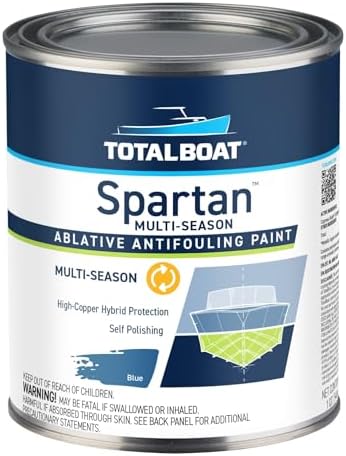
TotalBoat Spartan is an ablative bottom paint formulated for multi-season use and high-fouling conditions. It contains 38% cuprous oxide, and its coating gradually wears as the boat moves through fresh, salt, or brackish water. This action exposes fresh biocide and can help reduce paint buildup over time.
The paint has no maximum dry time before launch, which can make offseason preparation easier. The product information says it dries in as little as two hours and can be applied with a roller, brush, or sprayer. If the boat stays out of the water for more than two weeks, the instructions call for lightly scuff-sanding before relaunching.
Spartan may suit owners looking for an ablative coating that can cover multiple seasons, especially when the boat sees heavy growth conditions. Its limitations matter: it is not for aluminum, and bare surfaces need the specified epoxy barrier coat. The listed coverage is up to 500 square feet per gallon, so account for hull size and the number of coats when estimating how much to buy.
Pros:
- Designed for multi-season protection in fresh, salt, and brackish water.
- Ablative wear exposes fresh copper biocide.
- No maximum dry time before launch.
- Can be applied by roller, brush, or sprayer.
Cons:
- Not for use on aluminum.
- Requires light scuff-sanding if stored out of water for more than two weeks.
Verdict: Consider Spartan if you want multi-season ablative protection for a non-aluminum hull and are comfortable following its preparation requirements.
5. TotalBoat JD Select: Water-Based Paint for a Single Season

TotalBoat JD Select is a water-based ablative paint for single-season protection. It is designed for fiberglass, wood, and steel hulls in fresh, salt, and brackish water. As the coating wears, it exposes fresh copper biocide, helping limit buildup compared with a paint that stays as a hard layer.
For a DIY job, the water-based formula offers low odor and soap-and-water cleanup. It can be applied with a roller, brush, or sprayer, and the product information says it dries in as little as two hours. There is no maximum dry time before launch, which gives you flexibility when scheduling the work.
JD Select is a practical pick if you want a simpler cleanup process and expect to repaint each season. It is not intended for aluminum, and bare surfaces need the specified barrier coat. If you want a multi-season coating, Spartan or Hydrocoat may be a closer fit.
Pros:
- Water-based formula with soap-and-water cleanup.
- Designed for single-season use in fresh, salt, and brackish water.
- No maximum dry time before launch.
- Can be applied by roller, brush, or sprayer.
Cons:
- Single-season protection, rather than a multi-season coating.
- Not for use on aluminum.
Verdict: Choose JD Select if you want a low-odor, easy-cleanup paint for a single season and have a compatible non-aluminum hull.
How to Choose Bottom Paint for a Freshwater Boat
Match the Paint to Your Hull Material
Start with the boat’s hull material. Rust-Oleum is described for fiberglass, wood, and steel, while TotalBoat Spartan and JD Select are specifically not for aluminum. Pettit Vivid can be used on aluminum only with the recommended primer system. If you are unsure what is already on the hull, check the product label or ask the paint manufacturer before applying a new coating.
Choose Between Ablative, Hard, and Hybrid Paint
Ablative paint wears gradually as the boat moves, exposing fresh biocide. Hydrocoat, Spartan, and JD Select use this approach. Rust-Oleum emphasizes a hard, smooth finish, while Pettit Vivid combines hard and ablative features. Your choice depends on how the boat is used and whether you prefer a coating that wears over time or a harder surface designed to remain smooth.
Think About How Often You Use and Store the Boat
If the boat stays in the water for much of the season, prioritize a formula whose stated protection period fits your plans. JD Select is described as single-season paint; Hydrocoat and Spartan are positioned for multi-season protection. If you trailer, haul, or rack-store your boat often, consider products that specifically describe those uses, such as Hydrocoat or Vivid.
Consider Application, Cleanup, and Launch Timing
Water-based options such as Hydrocoat and JD Select are designed for soap-and-water cleanup. Several products in this roundup allow you to paint well ahead of launch, but Rust-Oleum lists specific recoat and launch times. Follow the exact product directions for the temperature, number of coats, and drying conditions involved in your project.
Check Existing Paint and Surface Preparation
Do not assume every bottom paint can go over every old coating. Hydrocoat is described as compatible with most existing hard and ablative paints, and the TotalBoat products also describe compatibility with most existing bottom paints. “Most” is not “all,” so confirm the existing coating and use the required primer or barrier coat on bare surfaces.
Estimate Coverage Before You Buy
Measure the area below the waterline and compare it with the product’s stated coverage. Rust-Oleum lists coverage up to 110 square feet, while Spartan and JD Select list up to 500 square feet per gallon. Coverage can vary with the hull and application, so check the label and account for the number of coats you plan to apply.
Frequently Asked Questions
Does a freshwater boat need bottom paint?
It depends on how the boat is stored and used. A boat that stays in the water may benefit from antifouling protection, while a boat that is regularly trailered may have different needs. Choose a coating based on the product directions and your boat’s use.
Which paint in this list is water-based?
Pettit Hydrocoat and TotalBoat JD Select are described as water-based. Both offer soap-and-water cleanup, but JD Select is described as single-season paint while Hydrocoat is positioned for multi-season protection.
Can I apply bottom paint over an older coating?
Some products are described as compatible with most existing bottom paints, but compatibility depends on what is already on your hull. Identify the old coating and check the new paint’s directions before applying it. Bare surfaces may need a primer or barrier coat.
Which options can be used on aluminum?
TotalBoat Spartan and JD Select are not for aluminum. Pettit Vivid can be used on aluminum only with the recommended primer system. Check the product label for the correct preparation and primer requirements.
What is the difference between ablative and hard bottom paint?
Ablative paint wears gradually as the boat moves and exposes fresh biocide. A hard paint is designed to leave a more durable, smooth coating. Pettit Vivid is a hybrid option, combining features of both types.
Can I paint the hull long before launching?
Hydrocoat, Spartan, and JD Select are described as having no maximum dry time before launch. Rust-Oleum lists a 16-hour launch time. Always follow the instructions for the exact paint you select.
Final Recommendation
For a versatile freshwater option with water-based cleanup and flexible launch timing, Pettit Hydrocoat is the strongest all-around fit in this group. Choose TotalBoat JD Select if you prefer a water-based paint for one season, Rust-Oleum if you want a hard finish, Pettit Vivid for frequent trailering or rack storage, or TotalBoat Spartan for multi-season ablative protection on a non-aluminum hull. Before buying, confirm hull compatibility, existing-paint compatibility, and the preparation steps for your boat.
