
A worn or poorly fitted front-door seal can let drafts, dust, light, and outdoor noise into your home. The best replacement depends on how your door frame is built: kerf seals press into a groove, while adhesive strips stick to a clean, flat surface. Measure the closed-door gap and check for a kerf slot before choosing. The five options below cover both installation styles, with different lengths and gap ranges.
Table of Contents
Quick Comparison
| Product | Seal type | Fit or coverage | Best for |
|---|---|---|---|
| Litaibai 40 ft Kerf Weather Stripping | Press-in kerf | 1/8-inch kerf slot; 1/4–1/2-inch closed gap | Replacing a seal in a grooved frame |
| Aureyata Large Gap D-Shaped Seal | Self-adhesive EPDM | 5/16–15/32-inch gap; 20 feet | Large or uneven gaps on a flat surface |
| VITAM AMO Weather Stripping Seal | Self-adhesive EPDM | 5/16–15/32-inch gap; 18 feet | A large-gap adhesive option |
| LSGCQ 26 ft Kerf Weather Stripping | Press-in kerf | For grooves from 1/4 to 9/16 inch | Grooved frames needing a longer foam seal |
| Home Expert 40 ft Kerf Foam Strip | Press-in kerf | 1/4–1/2-inch gaps; 40 feet | Large gaps and multi-door projects |
Our Picks: Best Door Seal For Front Door reviews
1. Litaibai 40 ft Kerf Seal: Best Overall for Grooved Frames

The Litaibai seal is a press-in replacement strip for exterior door frames with a kerf groove. Its flexible foam core has a PE cover, and the product is intended for a 1/8-inch kerf slot and a closed-door gap of 1/4 to 1/2 inch. It is not self-adhesive, so it will not work as a stick-on strip for a smooth frame.
The 40-foot roll can be cut to fit one or more doors. Installation involves removing the old seal, cleaning the groove, cutting the new strip, and pressing its flange into the slot. That makes it a practical option if your existing kerf seal is cracked, compressed, or damaged but the frame groove is still usable.
Compared with the adhesive options below, this model avoids relying on a sticky backing to hold the strip in place. Its main limitation is fit: check both the groove and the closed-door gap before ordering. A kerf seal that is too large or too small for the frame may not sit securely or seal as intended.
Pros:
- Long 40-foot roll can cover multiple sections or doors.
- Press-in design needs no adhesive.
- Made for a stated 1/4–1/2-inch closed-door gap.
- PE-covered foam is designed to compress and rebound.
Cons:
- Only suitable for frames with the specified kerf slot.
- Requires removing the old strip and cutting the replacement to length.
Verdict: Choose the Litaibai if your frame has a 1/8-inch kerf and you want a long, press-in replacement for an exterior door.
2. Aureyata D-Shaped Seal: Best Adhesive Pick for Larger Gaps

This 20-foot strip uses a hollow D-shaped profile made from flexible EPDM rubber. It is designed for gaps from 5/16 to 15/32 inch, including uneven gaps around doors and windows. The hollow shape compresses when the door closes and is meant to spring back as the seal is released.
Unlike the kerf options, the Aureyata attaches with an adhesive backing. For a better bond, the surface should be clean and dry; the product instructions also recommend warming the adhesive in cold conditions and allowing 24 hours for it to bond. Measure carefully and test the fit before removing the backing, since adhesive placement is less forgiving than a press-in strip.
This is a reasonable choice if your frame has no kerf groove and the gap falls within the stated range. It can also be cut for other listed uses, such as window frames and RV entry doors. It is not a fix for gaps outside its size range or for a surface that cannot hold adhesive.
Pros:
- Self-adhesive installation does not require a kerf groove.
- EPDM material is described as flexible in hot and cold conditions.
- Hollow D profile is designed to compress and rebound.
- Suitable for the stated 5/16–15/32-inch gap range.
Cons:
- Needs a clean, dry surface and time for the adhesive to bond.
- At 20 feet, it may provide less coverage than the 40-foot kerf rolls.
Verdict: Pick the Aureyata when you need a stick-on seal for a measured large gap and your door frame has no suitable kerf slot.
3. VITAM AMO EPDM Strip: An Alternative for Wide Gaps

The VITAM AMO strip is an adhesive-backed EPDM seal intended for gaps from 5/16 to 15/32 inch. Its 18-foot length is shorter than the Aureyata roll, but the stated gap range is the same. The product describes a multi-hole profile intended to reduce sound transfer and lower the force between the door and frame when closing.
It is listed for indoor or outdoor use on residential and commercial doors, as well as windows and other applications. Because it is adhesive-backed, the surface should be suitable for a firm bond. Plan the route and measure before peeling the backing so you can place the strip evenly around the frame.
The listing information provided for this item marks it as unavailable, so check whether it can be purchased before choosing it. If it is not available, the Aureyata has a similar stated gap range and adhesive installation, while offering a longer roll. Neither strip should be treated as a substitute for a properly fitted door sweep at the bottom of the door.
Pros:
- EPDM material is described as suitable for low-temperature conditions.
- Fits the stated 5/16–15/32-inch large-gap range.
- Adhesive-backed design requires no kerf groove.
- Multi-hole profile is designed to help reduce sound transfer and closing pressure.
Cons:
- The supplied listing data marks the product as unavailable.
- The 18-foot length is shorter than the other adhesive option in this list.
Verdict: Consider the VITAM AMO if it is available and you want an adhesive EPDM strip for a gap in its stated range; otherwise, compare the Aureyata before deciding.
4. LSGCQ 26 ft Kerf Seal: Best for Frames with Wider Grooves
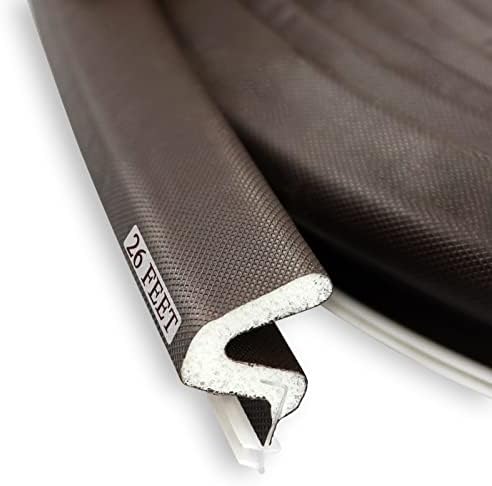
The LSGCQ strip uses resilient PU foam with a PE cover and a rigid PVC flange. It is designed to insert into a grooved frame without adhesive. The listed groove fit is 1/4 to 9/16 inch, so check the groove itself rather than assuming that this measurement refers to the gap between the closed door and frame.
The 26-foot roll can be cut to length and is intended for doors with slots, including wooden, screen, and glass doors. Its inserted design should be a cleaner option than stick-on weather stripping when a compatible groove is already present. The foam is described as compressing and returning to shape during use.
Compared with the Litaibai and Home Expert options, this roll offers less total length, and its stated groove range differs. That makes careful measuring especially important. Choose it only if the flange and groove are compatible and the seal does not prevent the door from closing properly.
Pros:
- Press-in flange avoids adhesive.
- 26 feet can cover a standard frame and some additional sections.
- Foam and PE cover are designed for repeated compression.
- Specified for grooves from 1/4 to 9/16 inch.
Cons:
- Not suitable for smooth frames without a compatible groove.
- Its groove-size specification is different from the other kerf options, so confirm your measurements.
Verdict: Choose the LSGCQ if your frame groove measures within its stated range and you prefer a press-in seal over adhesive weather stripping.
5. Home Expert 40 ft Kerf Strip: Best for Long Runs and Large Gaps

This 40-foot foam strip is made for kerf-style door frames and is listed for gaps from 1/4 to 1/2 inch. Its PE-covered foam core is designed to compress around the frame and help limit drafts, light leaks, and some outside noise. An included scraper tool is intended to help with installation.
The long roll can suit a multi-door job or give you extra material for careful trimming. It does not use messy adhesive, but that also means you need a compatible groove. The product description does not specify the kerf slot width, so check the listing and compare the strip with your frame before buying.
Against the Litaibai, the Home Expert offers the same listed gap range and roll length, plus an installation tool, while the Litaibai provides a specific kerf-slot measurement. If groove fit is uncertain, that detail may matter more than the extra tool. Do not force the strip into a frame if the flange does not fit cleanly.
Pros:
- 40-foot length is useful for multiple doors or long runs.
- Listed for gaps from 1/4 to 1/2 inch.
- Includes a scraper tool for installation.
- PE cover is designed to resist wear and cracking.
Cons:
- Requires a compatible kerf groove.
- The supplied description does not state the kerf slot width.
Verdict: The Home Expert is a practical option for a long kerf-seal job if its flange fits your frame and your measured gap is within the stated range.
How to Choose a Door Seal for Your Front Door
Identify the Frame Type Before You Buy
Look at the door frame where the old seal sits. A kerf frame has a narrow groove that accepts a seal flange; a replacement for this style presses into the groove. A smooth surface without a groove may need an adhesive-backed strip instead. Choosing the wrong installation type can leave the seal loose or make it impossible to attach.
Measure the Closed-Door Gap
Close the door and measure the space between the door and frame at several points, since the gap may vary around the perimeter. Compare your measurements with the product’s stated range. For kerf products, also measure the groove: the Litaibai lists a 1/8-inch kerf slot, while the LSGCQ specifies grooves from 1/4 to 9/16 inch. The Home Expert description gives a gap range but does not state a kerf-slot width.
Choose Adhesive or Press-In Installation
Adhesive strips can work on a suitable flat surface without a groove, but the surface needs to be clean and dry, and placement matters. Kerf strips do not rely on adhesive; they depend on a compatible groove and a secure press-in fit. If you are replacing a seal that was already fitted into a groove, a kerf-style replacement is usually the more direct match.
Match the Seal Profile to the Gap
A hollow D-shaped adhesive strip and a foam kerf strip compress in different ways. Use the product’s stated gap range as a guide, and avoid choosing a thicker seal just because the gap feels drafty. If a seal is too thick, the door may become difficult to close; if it is too thin, it may not make consistent contact.
Plan the Length and Color
Measure the sections you intend to seal and allow for careful cuts. A longer roll can be useful for multiple doors or extra trimming, but the length does not matter if the strip does not fit your frame. Check the listed color as well, especially if the seal will be visible around a light or dark door.
Consider What the Seal Can—and Cannot—Do
Weather stripping can help reduce air leaks, light, dust, and some noise around the sides and top of a door. It cannot correct a warped door, a damaged frame, or a gap that is too large for the product’s range. If air is coming through beneath the door, you may need a separate door sweep or threshold solution.
Frequently Asked Questions
How do I know whether my front door needs a kerf seal?
Check the frame where the existing weather stripping sits. If there is a narrow groove holding a strip flange, it is likely a kerf-style setup. Remove a small section of the old seal if needed to inspect the groove and measure it before ordering a replacement.
Should I choose adhesive weather stripping or a press-in seal?
Choose a press-in seal if your frame has a compatible kerf groove. Choose an adhesive strip if the frame offers a suitable flat surface but no groove. In either case, the gap and surface or groove dimensions need to match the product.
How do I measure the gap around a door?
Close the door and measure the distance between the door and frame at the top and along both sides. Check several points because the gap can vary. Use the measurements to compare against the product’s stated gap range rather than relying on a visual estimate.
Can weather stripping stop noise from outside?
A well-fitted seal can help reduce some sound that travels through gaps around a door, but it is not a complete soundproofing solution. Noise may also pass through the door itself, the bottom threshold, or nearby walls and windows.
Why is my new door seal making the door hard to close?
The strip may be too thick for the gap, may not be seated correctly, or may be placed in a way that prevents the door from latching. Check the fit around the full frame and confirm that the seal matches the product’s stated gap range.
Do I need a separate seal for the bottom of the door?
Possibly. These products are described as frame weather stripping, while drafts beneath a door may need a door sweep or threshold seal. Inspect the source of the draft before buying so you address the right part of the door.
How long should I wait before using a self-adhesive seal?
Follow the product’s installation instructions. The Aureyata description recommends allowing 24 hours for the adhesive to bond. A clean, dry surface and careful placement can help the strip attach as intended.
Final Recommendation
For a front door with a compatible kerf frame, the Litaibai is the strongest all-around starting point in this group: it offers a 40-foot roll, a stated 1/8-inch slot fit, and a clear 1/4–1/2-inch gap range. If your frame has no groove, consider the Aureyata adhesive strip after confirming that your gap falls within its range and the surface can hold adhesive. In either case, accurate measurements are the key to a seal that fits without making the door difficult to close.
