
A magnetic stud finder is a simple way to locate the metal screws or nails that attach drywall to framing. It needs no batteries and has no electronic settings to adjust, but it finds fasteners rather than sensing the full width of a stud. That makes careful, slow scanning important—especially if you plan to hang something heavy. These five options range from a compact single tool to multi-packs and a model with a built-in level.
Table of Contents
Quick Comparison
| Product | What stands out | Best for |
|---|---|---|
| CH Hanson Magnetic Stud Finder | Battery-free design with rare earth magnets | A straightforward single finder |
| Calvana Magnetic Stud Finder, 2 Pack | Two magnetic finders; listed 27-pound pull | Keeping a spare or sharing a set |
| Calvana Magnetic Stud Finder, 4 Pack | Four finders with ergonomic grips | Having several tools on hand |
| DANGBYANG Magnetic Stud Finder, 2 Pack | Two battery-free finders for drywall | Basic magnetic locating in a pair |
| The StudBuddy Pro Magnetic Stud Finder with Level | Magnetic finder with a built-in level | Locating fasteners and checking alignment |
Our Picks: Best Magnetic Stud Finder For Drywall reviews
CH Hanson Magnetic Stud Finder: A Simple, No-Battery Pick

The CH Hanson 3040 is a battery-free magnetic stud finder designed to locate nails and screws behind a wall surface. Rather than scanning for a stud’s full outline, it responds to the metal fasteners that hold drywall to the framing. That makes it a simple tool to keep ready for common hanging and home-improvement jobs.
Its rare earth magnets are the key feature listed for this model. You move the finder slowly across the drywall and look for the point where the magnet responds to a hidden fastener. Once you find one, checking for another fastener above or below it can help you identify the stud’s vertical path before you mark a mounting spot.
The product information is brief, so details such as a built-in level or a multi-pack are not part of this option. It is a reasonable choice if you want one basic magnetic locator without electronics or batteries. Like other magnetic models, it depends on finding metal fasteners, so it may not identify a stud where fasteners are absent or difficult to detect.
Pros:
- Battery-free operation
- Uses rare earth magnets to find nails and screws
- Simple approach with no electronic settings to manage
Cons:
- Product details provide limited information about its shape and added features
- Finds metal fasteners rather than mapping the full stud
Verdict: Choose the CH Hanson if you want a straightforward, single magnetic finder and do not need extras such as a level or multiple tools.
Calvana Magnetic Stud Finder 2 Pack: Strong Pull in a Pair

This Calvana set includes two magnetic finders and is listed with a 27-pound pull. The product description also specifies a 20 mm sphere, a stated magnetic force of 6,800 gauss, and a nickel-copper-nickel coating. These are manufacturer-provided specifications, not a guarantee that every fastener will be found through every wall.
The description says the finder can detect fasteners through 5/8-inch drywall and lists use through materials such as 3/4-inch ceramic tile and plywood paneling. Wall layers, fastener type, and the location of the screw or nail can affect what a magnet detects, so scan slowly and confirm the location with more than one fastener when possible.
Having two tools may suit a household with more than one person working or someone who wants a spare. Compared with the single CH Hanson, this pack emphasizes its stated magnetic-strength figures and quantity. Its practical limitation is the same as any magnetic finder: it locates metal fasteners, not the edges or center of a stud directly.
Pros:
- Includes two magnetic finders
- Battery-free operation
- Lists a 27-pound pull and 20 mm sphere
- Description specifies several wall materials and thicknesses
Cons:
- Performance still depends on locating a metal fastener
- Strength figures do not remove the need to verify the stud location
Verdict: Consider this Calvana set if you want two tools and value the listed magnetic-strength specifications, while keeping in mind that careful confirmation is still essential.
Calvana Magnetic Stud Finder 4 Pack: A Set for Multiple Projects

This four-pack is aimed at people who want several basic magnetic finders rather than one standalone tool. The description says the magnets locate screw and nail heads and that the finder attaches to the wall when it detects one. It also highlights an ergonomic grip and a plastic body intended to help protect the wall surface.
No batteries, moving parts, or calibration are required according to the product information. That keeps the process simple: move the finder over drywall, watch for a magnetic response, and mark the fastener location. To map a stud, look for additional fasteners in a vertical line rather than assuming that one detected point reveals the entire framing member.
The description says this model is intended for drywall and is not recommended for lath-and-plaster walls. That restriction matters if you are working in an older home or are unsure what is beneath the wall surface. Compared with the two-pack options, the main distinction here is quantity; the listed information does not provide a pull-force figure.
Pros:
- Four finders included
- No batteries or calibration needed
- Ergonomic grip and wall-conscious plastic body
- Designed to find metal fasteners behind drywall
Cons:
- Not recommended for lath-and-plaster walls
- No magnetic pull-force figure is provided in the description
Verdict: Pick this set if having several simple finders matters more than extra features or a stated magnetic-strength rating.
DANGBYANG Magnetic Stud Finder 2 Pack: Basic Drywall Locating
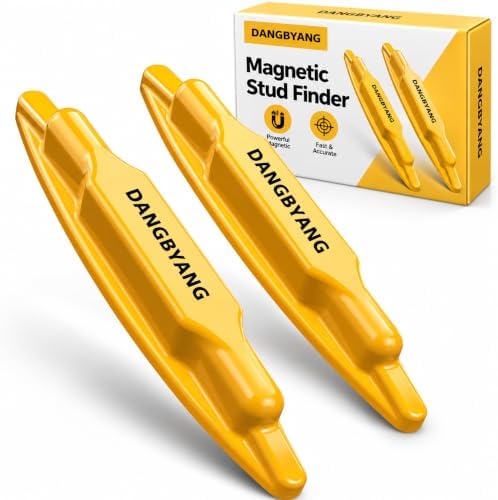
The DANGBYANG package contains two magnetic stud finders. Its description says the neodymium magnets detect screw and nail heads concealed behind drywall, and the tool sticks to the wall at the detected location. It is made for locating fasteners associated with wood or metal studs in drywall construction.
The tool is designed to work without batteries or calibration. The product information also describes an ergonomic grip and a plastic construction intended to help avoid marks or scratches. These features make it a simple option for routine drywall projects, although the description does not give a magnetic-strength figure or list a built-in level.
DANGBYANG specifically says this finder is not intended for lath-and-plaster walls. That is a useful limit to note before buying: a magnetic tool relies on finding metal fasteners, and the wall construction can affect how well that approach works. Compared with the Calvana four-pack, this set includes fewer tools; compared with the StudBuddy Pro, it does not list a level.
Pros:
- Two finders in the set
- Neodymium magnets locate metal fasteners
- No batteries or calibration required
- Ergonomic grip and plastic body
Cons:
- Not intended for lath-and-plaster walls
- No pull-force specification or level is listed
Verdict: This is a practical option for basic drywall work if you want a pair of no-battery finders and do not need a level or detailed strength specifications.
StudBuddy Pro with Level: A Magnetic Finder with an Alignment Aid
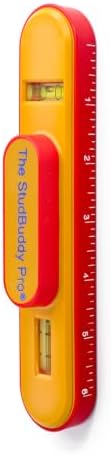
The StudBuddy Pro uses neodymium magnets to locate the screws or nails used to hang drywall on wood or metal studs. When it detects a fastener, the description says the tool sticks to the wall and points to its location. It runs without batteries and has no moving parts or calibration process.
Its distinguishing feature is the built-in level. That can be handy when you are marking a position for a shelf, picture, or other item that needs to sit straight. The level helps with alignment, but it does not replace checking that the fastener location is suitable for the load you plan to hang.
The product is described as made in the USA and intended for drywall and wood, not lath-and-plaster walls. Compared with the other picks, it is the clearest choice if you want a level as part of the tool. If you only need a basic magnetic locator or want multiple finders in one package, one of the multi-packs may fit better.
Pros:
- Built-in level for checking alignment
- Uses neodymium magnets to find nails and screws
- No batteries, moving parts, or calibration
- Made in the USA according to the product description
Cons:
- Not intended for lath-and-plaster walls
- Finds fasteners rather than showing the full stud width
Verdict: Choose the StudBuddy Pro if you want a simple magnetic finder that also includes a level for marking and alignment tasks.
How to Choose a Magnetic Stud Finder for Drywall
Know what a magnetic finder detects
A magnetic stud finder responds to metal fasteners, such as screws or nails, rather than detecting the wood or metal framing itself. After locating one fastener, scan above or below it for another point in line. Those points can help you follow the stud, but they do not show its exact edges.
Match the tool to your wall type
These products are described for drywall, and some explicitly rule out lath-and-plaster walls. If you do not know what your walls are made of, check before relying on a magnetic finder. Different wall layers and construction methods can change how easy it is to detect a fastener.
Consider the number of tools you need
A single finder can be enough for occasional home projects. A two-pack may be useful if you want a spare or are working with another person, while a four-pack provides more tools for multiple work areas. The extra quantity does not necessarily mean each finder has stronger magnets, so compare the listed features as well.
Look at useful extras and specifications
Some models emphasize magnetic-strength figures, while the StudBuddy Pro includes a level. Think about which detail would help with your task. A stated pull force or magnetic rating may help distinguish products, but it does not guarantee that a fastener will be easy to find through every wall surface.
Use a careful scanning method
Move the tool slowly across the wall instead of sweeping quickly. When it responds, mark the location and check for another fastener in the same vertical line. For a heavy item, take time to confirm the mounting location and use hardware appropriate for the item and wall rather than relying on a single magnetic response.
Choose a tool you can use comfortably
An ergonomic grip can make repeated scanning easier, while a compact design may be simpler to keep with other household tools. If you expect to check alignment during installation, a built-in level can be useful. Keep the choice focused on your project instead of paying attention only to the number of tools in a package.
Frequently Asked Questions
How does a magnetic stud finder work?
It uses a magnet to detect metal nails or screws behind the drywall. Those fasteners are typically attached to framing, so their locations can help you identify where a stud runs.
Can a magnetic stud finder locate the center of a stud?
Not on its own. It locates individual metal fasteners, not the stud’s full width. Finding more than one fastener along a vertical line can help you follow the stud, but the magnet does not directly map its edges.
Do magnetic stud finders need batteries?
The models in this roundup are described as battery-free. They use magnets rather than electronic scanning, so there are no batteries to replace for their basic locating function.
Will these tools work on lath-and-plaster walls?
Some listed products specifically say they are not intended for lath-and-plaster walls. Check the product’s stated wall compatibility before buying, especially if you are working in an older home.
Is a magnetic stud finder suitable for hanging heavy items?
It can help you locate fasteners associated with framing, but it does not confirm that a particular mounting point or fastener is suitable for a heavy load. Verify the stud location and use mounting hardware appropriate for the item.
What is the benefit of a finder with a built-in level?
A built-in level can help you check whether a mark or mounted item is straight. It is an alignment aid, separate from the magnet’s job of locating metal fasteners.
How should I confirm a stud location?
After detecting one fastener, scan nearby for another in the same vertical line and mark both points. If the wall or fastener pattern makes the result unclear, do not treat a single magnetic response as conclusive.
Final Recommendation
For a straightforward single tool, the CH Hanson is a simple battery-free choice with rare earth magnets. The StudBuddy Pro is the better fit if you also want a built-in level, while the Calvana and DANGBYANG packs make sense if you would rather have more than one finder. Whichever model you choose, scan slowly and confirm multiple fastener locations before deciding where to mount something.
