
A non-contact voltage tester pen lets you check for AC voltage without touching a conductor, making it useful for quick checks around outlets, switches, cords, and wiring. The best choice depends on the voltage range you need, how clearly you want the tester to signal, and whether extras like a flashlight or temperature reader would help with your work. These pens are screening tools—not proof that a circuit is safe to touch.
Table of Contents
Quick Comparison
| Product | Voltage detection | Standout feature | Best for |
|---|---|---|---|
| YOWEXA Non Contact Voltage Tester Pen | 12–1000V AC high sensitivity; 48–1000V AC low sensitivity | Dual sensitivity, audible and visual signals | Flexible everyday checks |
| Klein Tools NCVT1P Voltage Tester | 50–1000V AC | Simple green-to-red status indication | Basic household AC checks |
| Klein Tools NCVT3P Dual Range NCVT Pen | 12–1000V or 70–1000V AC | Dual range and built-in flashlight | Low-voltage and general AC work |
| Klein Tools NCVT-4IR Voltage Tester | 12–1000V AC | Infrared thermometer with laser pointer | HVAC tasks and temperature checks |
| BSIDE Voltage Tester | Voltage ranges not specified in the supplied product details | Screen, rechargeable battery, and 3-phase rotation indicator | Users who want more on-screen information |
Our Picks: Best Non Contact Voltage Tester Pen reviews
1. YOWEXA Non Contact Voltage Tester Pen: Best for Adjustable Sensitivity
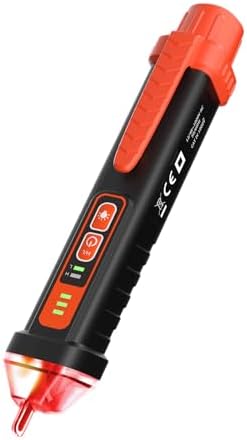
The YOWEXA pen offers two sensitivity settings for non-contact AC checks. High sensitivity covers 12–1000V AC, while low sensitivity covers 48–1000V AC. That gives you an option for lower-voltage detection or a less sensitive setting when you want to narrow down a signal.
When it detects AC voltage, the pen uses beeps and signal lights to show detection strength. Faster beeps and more lights indicate a stronger or closer signal, which can help you compare nearby wires. The product details also list a flashlight, pocket clip, low-battery alert, and automatic shutoff. Its stated safety ratings are CAT III 1000V and CAT IV 600V for AC checks.
This is the most adjustable option in the group for general electrical checks. The main caveat is that signal strength is not a precise voltage reading, and a quiet or dark indicator does not prove that a wire is de-energized. The instructions also say not to change sensitivity while detecting.
Pros:
- Two sensitivity settings cover different AC detection needs.
- Audible and visual signals communicate detection strength.
- Includes a flashlight, pocket clip, low-battery alert, and auto shutoff.
- Stated CAT III 1000V and CAT IV 600V ratings.
Cons:
- Signal strength does not provide a precise voltage measurement.
- A no-alarm result cannot confirm that voltage is absent.
Verdict: Choose the YOWEXA if you want a dual-sensitivity pen with clear audible and visual alerts for preliminary AC checks.
2. Klein Tools NCVT1P: Best for Straightforward AC Checks

The NCVT1P is a simple non-contact tester for AC voltage from 50–1000V. It is designed for checks on items such as cables, cords, circuit breakers, lighting fixtures, switches, and some outlets. Its range makes it a practical fit for common household and general electrical screening, but it is not the pick here for lower-voltage detection.
The status light is easy to interpret: green indicates that the tester is operational, while a red flash and beep signal detected voltage. The compact, clipped design is intended to be easy to carry, and the listed features include automatic shutoff and 6.6-foot drop protection.
Compared with the dual-range Klein NCVT3P, this model keeps things simpler but offers less range flexibility and no listed flashlight. That may suit you if your priority is a basic AC detector rather than extra functions. As with any non-contact pen, it should be treated as a screening device, not a substitute for verifying a circuit with an appropriate meter.
Pros:
- Clear green operational and red voltage-detection signals.
- Detects AC voltage across a 50–1000V range.
- Compact design with a pocket clip and automatic shutoff.
- Listed 6.6-foot drop protection.
Cons:
- Does not cover the lower 12V range offered by some alternatives.
- No flashlight or adjustable sensitivity is listed.
Verdict: Pick the NCVT1P if you want a compact, easy-to-read tester for routine AC checks and do not need low-voltage detection.
3. Klein Tools NCVT3P: Best Dual-Range Pen with a Flashlight

The Klein NCVT3P gives you a choice between a 12–1000V AC range and a 70–1000V AC range. The lower range is intended to help with checks involving security, entertainment, communications, environmental control, and irrigation systems, while the higher range can be used for more targeted detection.
Its green operational light changes to a red flash with a beep when voltage is detected. A built-in flashlight can operate independently of the voltage-detection function, a useful extra when you are working in a dim area. The pen also has a pocket clip, automatic shutoff, and a stated CAT IV 1000V rating.
Compared with the NCVT1P, this model offers more range flexibility and a flashlight, making it a more capable everyday option. It still provides a detection signal rather than a measured voltage value, so use a properly rated meter when you need a confirmed reading or need to establish that a circuit is safe.
Pros:
- Two selectable ranges, including a 12–1000V AC setting.
- Built-in flashlight works independently of detection.
- Visual and audible voltage alerts with an operational indicator.
- Stated CAT IV 1000V rating and automatic shutoff.
Cons:
- Does not provide a numeric voltage measurement.
- Has fewer specialized features than the HVAC-focused NCVT-4IR or screen-equipped BSIDE.
Verdict: Choose the NCVT3P if you want a versatile dual-range tester and expect to work in low light.
4. Klein Tools NCVT-4IR: Best for HVAC and Temperature Checks

The NCVT-4IR combines a non-contact AC voltage tester with an infrared thermometer, making it the most specialized choice in this group. It detects AC voltage from 12–1000V and is described for use with cables, switches, outlets, wires, and systems such as security, communications, and environmental controls.
For temperature checks, its infrared thermometer covers -22°F to 482°F (-30°C to 250°C). A 4:1 distance-to-spot ratio and laser pointer help target the measurement area, and the temperature display can be set to Fahrenheit or Celsius. The product is designed with HVAC applications in mind, where checking voltage and surface temperature can both be useful.
This combination can save space in a tool kit if you need both functions. It is less compelling if you only want a basic voltage pen, since the extra thermometer features may go unused. Keep in mind that infrared readings measure surface temperature, not the temperature inside a component.
Pros:
- Detects AC voltage from 12–1000V.
- Includes an infrared thermometer with selectable Fahrenheit or Celsius.
- Laser pointer helps target the temperature measurement area.
- Designed with HVAC applications in mind.
Cons:
- More specialized than a basic voltage tester pen.
- Infrared temperature readings are surface measurements.
Verdict: The NCVT-4IR makes the most sense if you work on HVAC tasks and can use both non-contact voltage detection and surface temperature checks.
5. BSIDE Voltage Tester: Best for On-Screen Signal Information

The BSIDE tester stands out for its color screen, which displays a voltage signal percentage and analog bar. It also has a 3-phase rotation indicator that shows left or right rotation, a feature that separates it from the simpler pen-style detectors in this comparison.
Its listed features include a rechargeable battery, high and low sensitivity modes, and three ranges within each mode. The alarm combines the screen, colored flashlight signals, and different buzzer frequencies to indicate varying signal strength. These extra readouts can make it easier to see changes in a detected signal than with a simple light-and-beep design.
The supplied product details do not state the tester’s voltage range, so check the manufacturer’s specifications before buying to confirm it suits your intended work. Its signal percentage and analog bar are indicators, not a substitute for a dedicated meter’s verified voltage measurement. The added screen and rotation function may also be more than you need for occasional home checks.
Pros:
- Screen displays a signal percentage and analog bar.
- Includes a 3-phase rotation indicator.
- Rechargeable battery and high/low sensitivity modes.
- Uses visual and audible alerts to signal changes in detection strength.
Cons:
- The supplied details do not specify its voltage detection range.
- Its extra functions may be unnecessary for basic household checks.
Verdict: Consider the BSIDE if its screen and 3-phase rotation function match your needs, but confirm its voltage range before choosing it.
How to Choose a Non-Contact Voltage Tester Pen
Match the detection range to your work
Check the tester’s stated AC voltage range before buying. A pen with a lower starting voltage may be useful for detecting signals in low-voltage systems, while a higher minimum may be enough for common household checks. Do not assume every model covers the same range; the BSIDE details provided here do not list one, so confirm it with the manufacturer before purchase.
Decide whether adjustable sensitivity will help
Dual-sensitivity or dual-range settings let you choose between broader, more sensitive detection and a higher threshold. That can help when you want to compare signals or reduce detection of nearby sources. Follow the product instructions for changing settings, and remember that sensitivity controls do not turn a voltage pen into a precise meter.
Choose the signal style you can read easily
Testers may use lights, beeps, a screen, or a mix of these signals. A simple red light and beep may be easy to understand, while a screen or different alert strengths can offer more information about the detected signal. No alarm should never be treated as proof that a conductor is safe or de-energized.
Consider useful extras, not just more features
A flashlight can help in dim work areas, while a pocket clip makes a pen easier to carry. An infrared thermometer may be useful for HVAC work, and a 3-phase rotation indicator may suit specific electrical tasks. If you will not use these functions, a simpler tester may be easier to choose and use.
Understand safety ratings and limitations
Look at the stated CAT rating and voltage rating, then confirm that they suit the electrical environment and task. A rating is not a guarantee of safety in every situation. Follow the tester’s instructions, test it on a known live source before use, and use an appropriately rated contact meter to verify circuits before touching conductors. If you are unsure how to perform the work safely, contact a qualified electrician.
Frequently Asked Questions
How does a non-contact voltage tester pen work?
It detects an electric field associated with AC voltage without requiring direct contact with the conductor. The tester signals detection with lights, sounds, or a screen, depending on the model. It is a screening tool and does not provide the same confirmation as a properly used contact meter.
Can a voltage tester pen prove that a wire is safe to touch?
No. A lack of an alarm does not prove that voltage is absent. Detection can be affected by conditions such as the wire, insulation, distance, and tester sensitivity. Use the correct testing procedure and a properly rated meter to verify a circuit is de-energized before working on it.
Should I test the pen before using it?
Yes. The YOWEXA product details specifically advise testing it on a known live source before use. Follow the instructions for whichever tester you own, and confirm it works before and after checking a circuit.
What is the benefit of dual sensitivity or dual range?
It gives you a choice between detection settings. Lower-range settings can help detect lower AC signals, while a higher threshold can be useful when you want a more targeted check. The exact ranges differ by model, so compare the specifications rather than assuming the settings are interchangeable.
Can these testers identify a live wire and a neutral wire?
Some testers can help you compare signal strength near two wires or between outlet openings. A stronger signal may indicate the live side in that comparison, but this is not a substitute for proper circuit testing. Do not rely on a weak or absent signal to confirm a neutral wire or safe condition.
Are non-contact voltage tester pens suitable for DC voltage?
The products in this comparison are described for AC voltage detection. Do not use one to check DC voltage unless its manufacturer specifically states that it supports DC and explains how to use it.
Final Recommendation
For most people choosing a flexible pen for preliminary AC checks, the YOWEXA is a strong starting point because it offers two sensitivity settings, audible and visual alerts, and a listed flashlight. The Klein NCVT3P is a good alternative if you want a dual-range Klein model with a flashlight, while the NCVT-4IR is better suited to HVAC work that also calls for surface temperature checks. Whichever you choose, treat a non-contact pen as an initial screening tool—not as proof that a circuit is safe to touch.
