
Choosing the best septic tank lid removal tool depends on the lid itself: its material, weight, and whether it has a slot or lifting hole. A long hook can help lift covers with an accessible opening, while a magnetic dolly is useful only for compatible steel or iron covers. Below, we compare five options and explain what to check before you buy.
Table of Contents
Quick Comparison
| Product | Type | Best for | Key consideration |
|---|---|---|---|
| T&T Tools 36-Inch Manhole Cover Hook | Long, single-hook lifter | Heavy covers with a suitable opening | Requires a slot or edge the hook can engage |
| SEDAMORALLY Magnetic Cover Dolly | Telescoping magnetic dolly | Compatible iron or steel covers | Not for concrete, plastic, or nonmagnetic covers; listed as unavailable in the supplied product information |
| WLCGYD Blunt-Tip Septic Cover Hook | Stainless steel hook | Openings suited to a blunt hook | Confirm the tip style and length offered on the listing |
| Heavy-Duty T-Handle Manhole Lid Extractor | Compact T-handle lifter | Portable lifting and access work | Shorter tools may offer less reach than a long hook |
| MP BATT 8-Inch T Hook Tool | Short pointed hook | Narrow slots and small lifting holes | Its compact length may limit leverage on heavy covers |
Our Picks: Best Septic Tank Lid Removal Tool reviews
1. T&T Tools 36-Inch Hook for Reach and Leverage

The T&T Tools lifter is a 36-inch, single-hook tool made for manhole covers, septic lids, and drain grates. Its length gives you more reach than a compact hook, which can help you work without putting your hands directly under the cover.
The shaft is made from 5/8-inch hex alloy steel and is heat-treated, according to the product details. A beveled J-shaped hook is designed to catch an opening or edge, while the oversized D-shaped handle leaves room for a gloved grip. The bright blue finish may also make the tool easier to spot among other equipment.
This is a practical choice when your lid has a compatible slot or lifting point and you want a long, straightforward tool. It is less suitable for covers without an opening the hook can catch. A hook also cannot make an unusually heavy or stuck cover safe to lift by yourself; use help or a professional when needed.
Pros:
- 36-inch length provides useful reach
- Heat-treated alloy steel construction
- J-shaped beveled hook is designed for lifting access covers
- Oversized handle can accommodate gloved hands
Cons:
- Needs a compatible opening or edge for the hook to engage
- Less compact to store than a short T-handle tool
Verdict: Choose this long hook if your cover has a suitable lifting point and you want a simple, extended-reach tool.
2. SEDAMORALLY Magnetic Dolly for Compatible Steel Covers

This option uses a magnetic base, a support wheel, and a telescoping handle rather than a hook. The listed handle range is 605 to 1,010 mm, and the aluminum-alloy body is listed at 3.8 kg. Its design is intended to help lift and roll compatible covers while reducing repeated bending and pulling.
The key limitation is material. The magnet is described for iron and steel covers, so it will not attach to concrete, plastic, or other nonmagnetic lids. The listed pull-off force is a product specification, not a guarantee that every cover can be lifted; surface condition, cover design, and the magnet’s contact all matter.
The supplied product information marks this item as unavailable. If you are considering it, check the listing before planning a purchase. It is the most specialized option here: potentially useful for frequent work with compatible steel covers, but not a flexible choice for the many septic lids that are not magnetic.
Pros:
- Telescoping handle can be extended for use or retracted for storage
- Wheel and handle are designed to help move compatible covers
- Magnetic attachment avoids needing a hook opening
Cons:
- Works only with compatible ferrous covers
- Supplied product information lists it as unavailable
Verdict: Consider this dolly only if you handle steel or iron covers and confirm the product is available; it is not a general-purpose septic lid lifter.
3. WLCGYD Blunt-Tip Hook for Larger Openings

The WLCGYD is a stainless steel cover hook with a reinforced welded construction and a rubber-coated grip. The product information describes multiple length and tip options, including a blunt tip intended for larger openings and rounded holes. The listed product title specifies the blunt-tip version, so check the selected option before ordering.
A blunt tip can be a sensible match when a cover has a larger opening and you do not need to push a sharp point into a narrow slot. The handle’s rubber coating is intended to improve grip, and the hanging hole offers a simple storage option. Because the supplied description does not give an exact length, compare the listing dimensions with your working space before buying.
This is a flexible hook-style choice for someone who knows the opening on their lid will accept the selected tip. It does not have the reach information or specific handle design given for the T&T Tools model, so the two are difficult to compare on leverage alone. As with any hook, it cannot help if the lid has no accessible point to catch.
Pros:
- Stainless steel construction is suited to outdoor use
- Blunt-tip version is intended for larger openings and rounded holes
- Rubber-coated handle is designed for a secure grip
- Hanging hole supports convenient storage
Cons:
- Exact dimensions are not specified in the supplied product details
- Tip style must match the opening on your cover
Verdict: This is a reasonable option when you want a stainless steel hook and have confirmed that the blunt tip fits your lid’s opening.
4. Heavy-Duty T-Handle Extractor for Portable Use
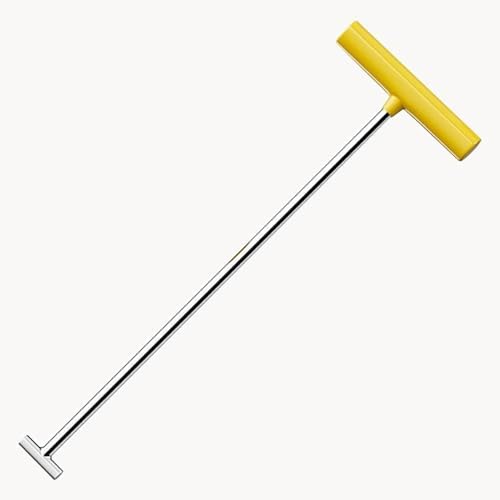
This compact extractor has a T-shaped head and handle, with the product details describing stainless steel construction and a rubber outer grip. The design is intended to help apply leverage while keeping the tool easy to carry in a toolbox or vehicle.
Its portable format may suit property maintenance or occasional access work where a full-length hook is inconvenient to store. The supplied description does not specify its dimensions or explain which opening shapes the head fits, so verify that detail against your lid before ordering. A short tool can also provide less reach than a 36-inch hook.
Compared with the T&T Tools model, this extractor emphasizes compact storage and a T-handle rather than a long shaft. It may be a better fit for a small tool kit, but the available information is not detailed enough to say it will offer the same leverage on a heavy cover.
Pros:
- Compact format is designed for portable storage
- Stainless steel construction
- Rubber-covered T-handle is intended to improve grip
- Designed for several types of utility covers and grates
Cons:
- Exact dimensions and head fit are not specified in the supplied details
- May offer less reach than a long-shaft hook
Verdict: Pick this extractor if portability matters most, but confirm its size and head fit before relying on it for a particular septic lid.
5. MP BATT 8-Inch T Hook for Narrow Slots

The MP BATT is a short, 8-inch hook made from 8 mm manganese steel, with a 10 cm T-style handle. Its pointed tip is designed to enter narrow gaps and small lifting holes. The listing also describes a reinforced welded joint where the handle and hook meet.
The compact size is useful when a longer tool is awkward to carry or when the lid has a small opening that suits a pointed hook. But length matters: an 8-inch tool gives you less reach and leverage than a long-shaft lifter. That makes it a less compelling first choice for a very heavy or stuck septic cover.
This tool may also be useful for other lifting and pulling tasks, as described in the product information. For septic work, focus on whether the tip fits the lid and whether you can lift it safely. Do not force the hook into a cover or use it where the opening could slip off the tip.
Pros:
- Pointed tip is designed for narrow slots and small holes
- Compact 8-inch size is easy to carry
- Manganese steel body and reinforced welded joint
- T-style handle provides a defined grip
Cons:
- Short length limits reach compared with long hooks
- May not provide enough leverage for a heavy or stuck cover
Verdict: Choose the MP BATT for a compatible small opening and portable use, not as your main tool for lifting especially heavy lids.
How to Choose a Septic Tank Lid Removal Tool
Match the tool to the lid material
Start by identifying what the cover is made from. A magnetic lifter is only useful with compatible iron or steel; it will not attach to concrete, plastic, or other nonmagnetic materials. Hook tools do not rely on magnetism, but they still need an opening, slot, or edge they can safely catch.
Check the opening and tip shape
Look for the lid’s lifting point before choosing a hook. A pointed tip may fit a narrow slot, while a blunt hook is intended for a larger opening or rounded hole. Do not assume that one tip works with every cover. If you cannot confirm the opening size, measure it or ask the cover manufacturer or a septic professional.
Consider reach and leverage
A longer shaft can provide more reach and may let you keep your hands farther from the cover. Short tools are easier to store, but they can be harder to use on heavy lids because they offer less reach. Tool length alone does not determine safe lifting capacity, so do not use a small hook to force a cover that is stuck or too heavy to control.
Look at materials and grip
Steel and stainless steel are common choices in the products listed here. Check the product details for construction, joints, and grip features, especially if the tool will be stored or used outdoors. A comfortable handle can help you maintain control, but it does not replace a secure fit between the tool and the lid.
Think about storage and how often you will use it
For occasional home maintenance, a simple hook may be easier to store than a wheeled dolly. A telescoping or compact design may suit people who carry tools between locations, but make sure its working length and lid compatibility fit your needs. If you service different cover types, a specialized magnetic tool may be too limiting to serve as your only option.
Use safe lifting practices
Septic lids can be heavy, awkward, or stuck in place. Keep your hands and feet clear of pinch points, use a second person when appropriate, and stop if the cover shifts unpredictably. Never enter a septic tank; its gases and confined space can be deadly. If a lid is damaged, difficult to remove, or too heavy to handle safely, contact a septic professional.
Frequently Asked Questions
Can I use a magnetic lid lifter on any septic tank cover?
No. A magnetic lifter requires a compatible ferrous metal surface, such as iron or steel. It will not attach to concrete, plastic, or other nonmagnetic covers.
Will a hook tool work if my lid has no lifting hole?
Only if there is another suitable edge or opening for the hook to catch. Do not wedge a hook into a fragile edge or force it into a gap that does not fit. Check the lid design or ask a professional about the right method.
Is a longer septic lid tool always better?
Not always. A longer tool can provide more reach, but it may be less convenient to store and still needs a secure contact point. Choose a length that fits the cover and gives you control during lifting.
Is the 8-inch MP BATT hook suitable for a heavy lid?
Its short length may limit leverage compared with a long-shaft tool. It is designed for narrow slots and small lifting holes, but the product details do not establish that it is suitable for every heavy cover. Use a tool matched to the lid and get help if the cover is difficult to move.
What should I do if a septic tank lid is stuck?
Do not keep increasing force if the hook slips, the lid begins to crack, or the cover will not move. Check for visible obstructions without reaching into the opening, and contact a septic professional if it remains stuck or appears damaged.
Can I open a septic tank myself?
Opening an access lid for inspection or service is different from entering the tank. Never enter a septic tank, and keep people and pets away from an open access point. Follow local requirements and contact a qualified septic professional when you are unsure how to proceed.
Final Recommendation
For a general hook-style option with clearly specified length and construction, the T&T Tools 36-inch hook is the most straightforward pick—provided your lid has a compatible opening. Choose the WLCGYD if its blunt-tip configuration fits your cover, or the MP BATT when a compact pointed hook suits a small slot. The magnetic dolly is a specialized choice for compatible steel or iron covers, and its supplied product information lists it as unavailable. Before buying, identify your lid material and lifting point; if the cover is stuck, damaged, or too heavy to handle safely, call a septic professional.
