
A cold bathroom can make an early start or a post-shower routine uncomfortable. The right electric heater can add warmth, but bathrooms need extra care: a heater’s safety features, location, and installation requirements matter as much as its heat output. These five options include portable heaters with ALCI safety plugs, wall-mounted models, and a lower-wattage plug-in heater. Compare their features and limitations below, and always follow the manufacturer’s instructions for bathroom use.
Table of Contents
Quick Comparison
| Product | Type | Key features | Best suited for |
|---|---|---|---|
| DREO Bathroom and Indoor Space Heater | Portable, 1500W | ALCI plug, five modes, oscillation, timer | Portable bathroom and indoor warmth |
| DREO Smart Wall Heater | Wall-mounted | IP24 rating, app and voice control, remote | Fixed heating with smart controls |
| Feeligivin 9815WH Wall Heater | Recessed wall heater | 1500W, manual thermostat, dual-voltage support | Space-saving fixed installation |
| Brightown 450W Plug-In Heater | Outlet-mounted | Rotating plug, thermostat, remote, timer | Small spaces needing supplemental heat |
| Reaks Bathroom Space Heater | Portable, 1500W | ALCI plug, two heat settings, ECO mode | Portable bathroom-focused heating |
Our Picks: Best Electric Heater For Bathroom reviews
1. DREO Portable Heater with an ALCI Safety Plug

This portable DREO is the most flexible option in the group for someone who wants a heater they can move between rooms. Its ALCI safety plug is designed to cut power if it detects contact with water or a short. That added protection is useful in a bathroom, but it does not make the heater safe to place where it can be splashed or knocked into water. Follow the manual’s placement guidance.
The heater uses a 1500W ceramic element and offers three heat levels, ECO mode, and fan-only operation. You can set the thermostat from 41 to 95°F, choose a timer from one to 12 hours, and use 70-degree oscillation to spread warmth. The listing also specifies a detachable filter, a handle, tip-over and overheat protection, and a 24-hour automatic shutoff.
Its compact, freestanding design makes it easier to store or move than a wall unit. The trade-off is that it takes up floor or counter space, so you’ll need a stable spot away from water, towels, and other objects. At 1500W, it is also a more powerful choice than the small plug-in model, so check that your outlet and circuit can support its use.
Pros:
- ALCI safety plug is designed for bathroom use.
- Three heat levels, ECO mode, and fan-only mode offer flexibility.
- Thermostat, timer, and oscillation provide useful control options.
- Portable design has a built-in handle and detachable filter.
Cons:
- Needs a safe, stable place on the floor or another surface.
- Its safety plug does not remove the need to keep the heater away from water.
Verdict: Choose this DREO if you want a portable, feature-rich heater with an ALCI plug and multiple ways to adjust the warmth.
2. DREO Smart Wall Heater with App and Voice Control

This DREO is a fixed wall-mounted heater rather than a portable bathroom unit. It has an IP24 rating, overheat protection, flame-retardant materials, and a 70.8-inch power cord. The listing describes it for bedrooms and offices, so check the manual and local requirements before choosing it for a bathroom. An IP rating should not be treated as permission to install a heater near a shower or tub.
For everyday control, you can use the included remote, the DREO app, or Alexa voice commands. ECO mode adjusts heating toward a chosen room temperature, and the heater has 30-degree manual oscillation. The listing specifies a 28 dB noise level and recommends it as a primary source for 150 square feet or a supplemental source for up to 750 square feet; actual results depend on room conditions.
A wall-mounted design keeps the heater off the floor, which can help in a tight room, but it requires drilling and secure installation. This is a better fit if you want a fixed heater with connected controls than if you need a unit to move between rooms. Confirm that the proposed mounting location and bathroom conditions are allowed by the manufacturer.
Pros:
- Wall-mounted design avoids taking up floor space.
- Control options include a remote, app, and Alexa.
- IP24 rating and overheat protection are listed safety features.
- ECO mode and manual oscillation support adjustable comfort.
Cons:
- Requires wall mounting rather than simple placement and use.
- The listing focuses on bedrooms and offices, so bathroom suitability needs to be confirmed.
Verdict: Consider this model if you want smart, wall-mounted heating and can verify that its installation is suitable for your bathroom.
3. Feeligivin 9815WH Recessed Wall Heater for a Fixed Setup

The Feeligivin 9815WH is a recessed wall heater intended to save floor space. Its listed 1500W nickel-chromium heating element works with a cross-flow fan, and a manual dial thermostat keeps the controls simple. The product description names bathrooms among its possible locations, but it does not list an ALCI plug or a water-resistance rating. Check the installation instructions and local electrical requirements before using it in a bathroom.
The unit supports 1500W operation at 120V and is described as supporting 240V conversion. Because the listing calls for wiring instructions, this is not the same kind of plug-in setup as the portable models. Have the installation handled according to the manual and applicable electrical codes, and do not assume that dual-voltage support means it can be connected either way without the correct wiring.
The manufacturer describes the heater as able to raise the temperature in a 350-square-foot room, but room size, insulation, and other conditions affect real heating performance. The fixed, recessed format is less convenient if you are renting or want to move the heater later. In return, it can be a practical option when you want a permanent heater that does not occupy floor space.
Pros:
- Recessed design keeps the heater out of the way.
- Manual thermostat is straightforward to operate.
- Listed for 120V operation with support for 240V conversion.
- Overheat protection is included.
Cons:
- Wiring and recessed installation make setup more involved than a portable heater.
- No ALCI plug or water-resistance rating is listed.
Verdict: Pick this model for a planned, space-saving wall installation, not for a quick, movable source of bathroom heat.
4. Brightown 450W Plug-In Heater for Small Spaces
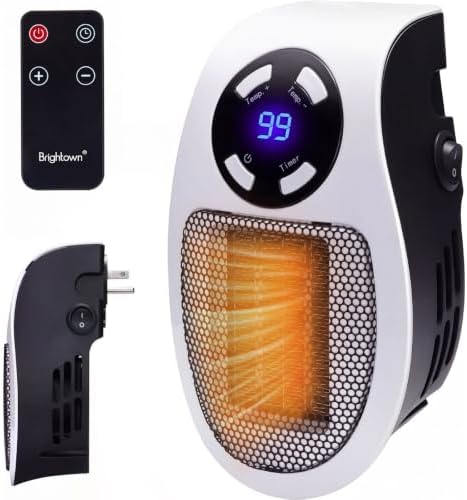
Brightown’s compact heater plugs directly into a wall outlet and uses 450W, making it the lowest-powered option here. The plug rotates 180 degrees to help it fit different outlet orientations. Its small size can suit a tight area, but the listing describes it as supplemental heat for small, enclosed spaces—not as a primary source for a large or drafty bathroom.
The heater has a built-in thermostat, a remote, an LED display, and a timer that can be set for up to 12 hours. The product description also lists a flame-retardant housing and overheat protection. Unlike the two portable heaters with ALCI plugs, this model’s listed safety features do not include that type of water-contact protection.
Because it sits at the outlet, the heater does not take up floor space, but its location is determined by the outlet. Do not use it near a sink, tub, shower, or wet area unless the manual specifically permits the placement. Its lower wattage may be useful for modest supplemental warmth, while a larger room may need a different type of heating solution.
Pros:
- Compact plug-in format takes up no floor space.
- Rotating plug can help with outlet positioning.
- Remote, thermostat, display, and timer add convenient controls.
- Lower 450W output is suited to small spaces and supplemental heat.
Cons:
- Not listed with an ALCI plug or water-resistance rating.
- Its low output is not intended to heat large or open areas.
Verdict: Choose Brightown for a small, dry indoor area where modest supplemental warmth and a compact outlet-mounted design matter most.
5. Reaks Portable Bathroom Heater with an ALCI Plug

The Reaks is a portable ceramic heater marketed for bathroom use. Its ALCI safety plug is designed to cut power quickly if it comes into contact with water. The listing also specifies ETL certification, overheat protection, and a tip-over switch. These features add safeguards, but they do not make it appropriate to place beside a shower or anywhere it could be immersed.
For heat control, you get a 1500W high setting, a 900W low setting, ECO mode, and a timer of up to 12 hours. The product description says its PTC ceramic element and fan spread heat through the room. It does not provide the same detailed temperature range, oscillation, or filter information as the DREO portable model, so it is a more straightforward choice if you mainly want adjustable heat and bathroom-focused protection.
The portable format can also work in other rooms, according to the listing. As with any freestanding heater, plan for a stable location with clearance around the unit and a suitable outlet. If you want more detailed temperature settings and oscillation, compare it with the DREO; if you prefer fewer listed controls, the Reaks may be a better match.
Pros:
- ALCI safety plug is designed to respond to water contact.
- High and low heat settings offer a choice of output.
- ECO mode and a 12-hour timer provide basic control.
- Tip-over and overheat protection are listed.
Cons:
- Provides fewer listed comfort controls than the DREO portable heater.
- Still needs careful placement away from water and obstructions.
Verdict: Consider the Reaks if you want a portable heater marketed for bathroom use with an ALCI plug and simple heat settings.
How to Choose an Electric Heater for a Bathroom
Check whether the heater is suitable for bathroom use
Start with the manufacturer’s instructions, not just the product name. Look for clear guidance on bathroom placement and any stated water-protection features. An ALCI plug is designed to cut power in certain water-contact conditions, while an IP rating describes a different type of protection. Neither feature means you can put a heater in a shower, beside a tub, or where it can be splashed. If the listing does not clearly address bathroom use, check with the manufacturer before buying.
Choose between portable and fixed installation
A portable heater is easier to move and does not require mounting, but it needs a stable spot and takes up floor or counter space. A wall-mounted or recessed model can keep the floor clear, but installation may involve drilling or wiring. Think about whether you own the home, where the heater can be placed, and whether you are prepared to follow the required installation steps.
Match power to the space and your heating needs
The products here range from a 450W plug-in heater to 1500W models. Lower wattage can suit a small, enclosed area as supplemental heat, while higher-output heaters may be a better fit when you need more warmth. A product’s stated coverage is not a guarantee: drafts, room layout, insulation, and the starting temperature all affect performance.
Look for useful temperature and timer controls
A thermostat can help maintain a chosen temperature, while heat levels let you select a stronger or gentler setting. ECO modes may adjust output based on room temperature, and timers can limit how long a heater runs. Choose controls that match your routine. If you want to set the exact temperature or schedule operation, compare the available settings rather than relying on wattage alone.
Consider safety features and placement
Tip-over and overheat protection are useful features, but they do not replace safe placement. Keep portable heaters on a stable surface with clear space around them, and keep them away from water, towels, and other materials. Use an appropriate outlet and follow the manual’s instructions for cords and electrical connections. For a hardwired or recessed model, follow the wiring instructions and applicable electrical codes.
Think about noise, size, and everyday convenience
Fans help move warm air, but noise levels can matter in a small bathroom or nearby bedroom. Check the listed noise information if quiet operation is important. Also consider whether you want a handle for moving the heater, a remote or app, an oscillating function, or a filter that can be removed for cleaning. Extra features are useful only if you expect to use them.
Frequently Asked Questions
Can I use a portable space heater in a bathroom?
Only use a heater in a bathroom if its manufacturer says it is suitable for that use, and follow the manual’s placement rules. Keep it away from water and locations where it could be splashed or knocked over. A safety plug does not make unsafe placement safe.
What does an ALCI plug do?
An ALCI plug is designed to cut power under certain fault conditions, including the water-contact condition described for the DREO and Reaks heaters. It is an added safety feature, not a substitute for keeping the heater away from wet areas or following the manual.
Is an IP24-rated heater safe to put beside a shower?
Do not assume that an IP24 rating means a heater is safe beside a shower or tub. Check the manufacturer’s instructions for allowed bathroom locations and clearances. When in doubt, contact the manufacturer or a qualified electrician.
Is a 450W heater enough for a bathroom?
The Brightown listing describes its 450W model as supplemental heat for small, enclosed spaces and gives a coverage claim of up to 100 square feet. Actual warmth depends on room conditions, and the product is not presented as a primary heat source for large or drafty areas.
Should I choose a wall heater or a portable heater?
A wall heater can keep floor space clear, but it requires a suitable mounting location and may need more involved installation. A portable heater is easier to move, but needs a safe place to sit. Your room layout and willingness to install a fixed unit should guide the choice.
Which heater is the best fit for most bathroom shoppers?
Among these options, the DREO portable heater combines an ALCI plug with multiple heat modes, a thermostat, a timer, and oscillation. The Reaks is another portable option with an ALCI plug and simpler controls. Choose based on the features you need, and confirm that your planned location follows the manufacturer’s bathroom-use instructions.
Final Recommendation
For a portable heater with detailed controls and an ALCI plug, the DREO Bathroom and Indoor Space Heater is the strongest all-around fit in this group. The Reaks is worth considering if you want a bathroom-focused portable model with simpler settings. Choose one of the wall heaters only if you want a fixed installation and have confirmed its bathroom suitability and setup requirements. Whichever you select, careful placement and following the manual are essential in a bathroom.
