
Casement windows open on a hinge, so the best blinds are usually slim, easy to adjust, and installed in a way that leaves the sash and handle clear. Custom pleated shades can sit close to the glass, while cordless mini blinds and adhesive roller shades offer more familiar styles. The right choice depends on your frame space, how much light you want to block, and whether you’re comfortable drilling into the window frame.
Below, we compare five options, including custom-fit blinds designed for European-style tilt-and-turn and casement windows. Check each product’s mounting requirements and measure your window carefully before ordering—especially if the window opens inward or has a prominent handle.
Table of Contents
Quick Comparison
| Product | Style | Mounting | Best suited for |
|---|---|---|---|
| Concept Crystal Custom Pleated Blind | Made-to-measure pleated shade | Drill-mounted | A close fit and adjustable light filtering |
| ACHIM GII Morningstar Cordless Mini Blind | Vinyl mini blind | Inside, outside, or ceiling mount | A standard-size cordless option |
| Concept Blinds No-Drill Custom Pleated Blind | Made-to-measure pleated shade | Adjustable hooks or adhesive fixtures | Custom sizing without standard drilling |
| CHICOLOGY Cordless Mini Blinds | Vinyl mini blind | Screw-mounted | Moisture-prone rooms and adjustable privacy |
| JILRON Blackout Roller Shade | Blackout roller shade | Adhesive | Blocking light without drilling |
Our Picks: Best Blinds For Casement Windows reviews
1. Concept Crystal Custom Pleated Blind: Best for a Close, Made-to-Measure Fit

This custom pleated blind is designed for tilt-and-turn and casement-style windows. You choose the width, height, fabric color, and aluminum profile finish when ordering, which can make it a better fit than a ready-made blind for a narrow or unusual frame.
The blind mounts inside the window frame with four screws. Its top and bottom can move independently, so you can cover the lower part of the glass for privacy while leaving the upper portion open for daylight. The semi-opaque fabric is intended to filter light rather than create total darkness. The listing specifies a minimum frame width of 0.59 inches and says the window needs enough space beside the pane for the fixing element.
This is a strong match if you want a neat, close-fitting shade and are comfortable measuring precisely and drilling into the frame. It may be less suitable if you rent, want a tool-free installation, or aren’t sure the window has enough mounting space. Unlike the other pleated option below, this model requires drilling.
Pros:
- Custom width and height options for a tailored fit
- Adjustable from both the top and bottom
- Semi-opaque fabric provides privacy while allowing some daylight
- Includes mounting hardware and an installation guide
Cons:
- Requires drilling and adequate space beside the window pane
- Precise measuring is important because the blind is made to size
Verdict: Choose this Concept Crystal model if you want a custom-fit pleated blind and your frame can accommodate its screw-mounted hardware.
2. ACHIM GII Morningstar Cordless Mini Blind: Best for a Simple, Ready-Made Option

The ACHIM Morningstar is a vinyl mini blind with a cordless lift and a tilt wand. Raise or lower the blind by moving its bottom rail, then tilt the slats to adjust light and privacy. Its familiar design is a straightforward alternative to custom pleated shades.
The listed size is 28 by 64 inches, and the product is also offered in other sizes and colors. Its mounting brackets support inside, outside, or ceiling installation. The listing gives specific fit guidance: the actual blind is half an inch narrower than the stated size, so check the sizing details against your window before choosing a mount.
For a casement window, the key question is clearance. A mini blind’s headrail and slats may be less convenient if they interfere with the handle, hinges, or movement of the sash. Compared with the custom pleated options, this blind offers a conventional slatted look but less flexibility for a close, made-to-measure fit.
Pros:
- Cordless lift with a separate tilt wand
- Vinyl slats are described as resistant to warping, fading, and sagging
- Brackets allow inside, outside, or ceiling mounting
- Available in several colors and drop lengths
Cons:
- Fixed-size options may not suit unusual window dimensions
- Slats and hardware need enough clearance from the casement handle and sash
Verdict: Consider the ACHIM blind if you want a cordless mini-blind style and have a standard-size window with enough space for the blind to operate.
3. Concept Blinds No-Drill Pleated Blind: Best Custom Option Without Standard Drilling
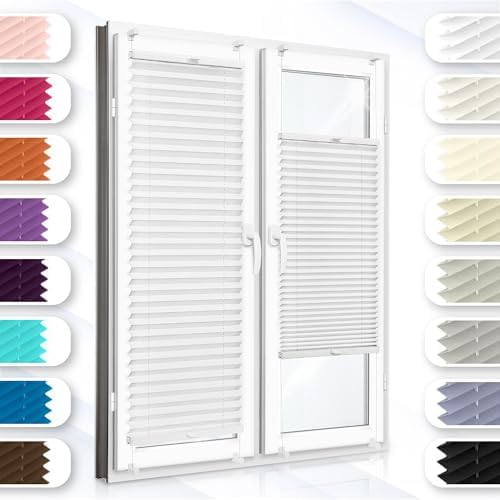
This made-to-measure pleated blind is designed for tilt-and-turn windows and offers a choice of adjustable hooks or adhesive fixtures. You select the mounting method as part of the configuration, so check that the option you choose suits your window before placing an order.
The custom sizing range listed for this model runs from 11.81 to 50.78 inches wide and 19.69 to 90.55 inches high. Its movable upper and lower bars let you position the shade over all or part of the glass. The description characterizes the fabric as opaque with medium light transmission, so it offers privacy while still allowing some daylight; it should not be assumed to provide complete blackout.
Compared with the drill-mounted Concept Crystal blind, this one can avoid standard screw installation. However, a no-drill option still depends on the window and the chosen fixture: adhesive mounting may not suit every surface or installation situation. Take careful measurements and confirm the product’s mounting instructions, particularly if your casement opens outward or has limited frame space.
Pros:
- Custom sizing for a more tailored fit
- Choice of adjustable hooks or adhesive fixtures
- Upper and lower bars can be moved to vary coverage
- Available in multiple fabric and profile colors
Cons:
- Requires careful measuring and configuration before ordering
- Mounting method must be compatible with the window and frame
Verdict: This is the most flexible pick if you want custom pleated coverage and need an alternative to standard screw-mounted installation.
4. CHICOLOGY Cordless Mini Blinds: Best for Kitchens and Bathrooms

CHICOLOGY’s cordless mini blind uses one-inch vinyl slats and a tilt wand to control light. You can raise or lower it by hand, then tilt the slats from light filtering toward more private, room-darkening coverage. The product listing notes that small light gaps are normal, so it is not a fully sealed blackout option.
The vinyl is described as moisture-resistant and suited to humid rooms such as kitchens and bathrooms. The listed size is 35 inches wide by 60 inches high, with other width and height combinations available. For an inside mount, the blind is manufactured half an inch narrower than the ordered width to provide clearance.
Installation uses screws; the package includes inside- and outside-mount brackets and hardware. That makes it less suitable for renters who can’t drill, but gives you standard mounting choices if screw installation is acceptable. As with any slatted blind on a casement, measure the available space and check that the headrail and slats won’t obstruct the handle or opening motion.
Pros:
- Cordless lift and tilt wand for simple light adjustment
- Moisture-resistant vinyl is suited to humid rooms
- Inside- and outside-mount brackets are included
- Multiple size combinations are available
Cons:
- Screw mounting is required
- Small light gaps are normal, so it may not meet blackout needs
Verdict: Choose CHICOLOGY if you want a cordless, moisture-resistant slatted blind and can use screw-mounted hardware in your window area.
5. JILRON Blackout Roller Shade: Best for Blocking Light Without Drilling

The JILRON is an adhesive-mounted roller shade made with light-blocking fabric. The listed size is 35 inches wide by 63 inches high. Its simple purpose is to darken a room and add privacy without screw holes or complex tools.
The adhesive setup may appeal to renters or anyone looking for a temporary installation, but it still needs a suitable mounting surface and careful placement. The product description does not provide a custom sizing range, so verify the listed dimensions against your window rather than assuming the shade can be trimmed or adjusted to fit.
A roller shade has a different feel from a pleated or slatted blind: it provides a single panel of coverage instead of adjustable slats or independently movable top and bottom bars. That makes it a reasonable choice when blocking light matters more than fine control over how much daylight enters. Check that the shade and its adhesive mount will not interfere with the casement handle or sash.
Pros:
- Light-blocking fabric is designed for blackout coverage
- Adhesive installation does not require drilling
- Simple roller-shade style suits bedrooms and offices
- Provides privacy as well as light control
Cons:
- The listed size may not fit every casement window
- Adhesive mounting depends on a suitable surface and correct placement
Verdict: Pick the JILRON shade if your priority is blocking light without drilling and its listed dimensions work for your window.
How to Choose Blinds for Casement Windows
Check how the window opens
Casement windows swing on hinges, and some European-style windows also tilt inward. Before choosing a blind, consider the full path of the sash as it opens and closes. Make sure the blind’s headrail, fabric, slats, and mounting hardware won’t block the handle, catch on the frame, or interfere with the window’s movement.
Measure the frame and glass carefully
For an inside mount, measure the space where the blind will sit and check the product’s stated clearance requirements. Custom products need accurate width and height measurements because they are made to your specifications. Ready-made blinds may have a different actual width from the size shown, so read the manufacturer’s fit notes before ordering.
Choose a mounting method that suits your home
Screw-mounted blinds provide a fixed installation but require drilling into the frame or mounting area. No-drill products may use hooks or adhesive fixtures, and these methods are not interchangeable. Confirm which mounting parts come with the product, whether you must select a configuration, and whether your window frame can support that method.
Decide how much light you want to keep or block
Pleated fabric shades and tilting mini-blind slats can provide adjustable coverage while allowing some daylight. A blackout roller shade is a better fit when reducing incoming light is the main goal. Keep in mind that slatted blinds can have small gaps, and a fabric described as light filtering or semi-opaque is not the same as blackout material.
Consider handles, hinges, and nearby objects
Casement windows often have a handle near the edge of the glass, so measure the depth as well as the width of the mounting area. A slim pleated shade may be easier to position close to the pane, while a mini blind’s headrail and slats need enough room to hang and tilt. Also check for nearby trim, screens, or other features that could affect installation.
Match the blind to the room
Think about privacy, moisture, and the look you want. Vinyl slats are described as moisture-resistant in the CHICOLOGY model, while custom pleated shades offer a fabric-focused appearance and a choice of colors. For a bedroom or office where darkness matters, consider a blackout shade—but confirm its dimensions and mounting surface first.
Frequently Asked Questions
What type of blind works best on a casement window?
A slim blind that fits inside the frame and does not interfere with the handle or sash is often a practical choice. Custom pleated shades are designed for a close fit, but the best option depends on your frame space, mounting preference, and light-control needs.
Can you use regular mini blinds on casement windows?
Yes, if the blind fits the window and leaves enough clearance for the handle and opening motion. Check the actual blind width and mounting depth, and make sure the slats can tilt without hitting the frame or hardware.
Are no-drill blinds suitable for casement windows?
They can be, provided the specific hooks or adhesive fixtures are compatible with your window. The Concept no-drill pleated blind offers a choice of mounting methods, while the JILRON roller shade uses adhesive. Read the installation details and check the condition and shape of the mounting surface.
Do pleated blinds block all light?
Not necessarily. The Concept Crystal model is described as semi-opaque, and the other Concept pleated model is described as allowing medium light transmission. Those descriptions indicate some daylight may pass through. For stronger light blocking, consider a product specifically described as blackout.
How do I measure for an inside-mounted blind?
Measure the width and height of the area where the blind will sit, and follow the product’s instructions for taking those measurements. Check for any required clearance or size deduction. For made-to-measure shades, enter the dimensions exactly as the seller requests rather than adjusting them on your own.
Which option is best if I want to avoid drilling?
The Concept no-drill pleated blind offers adjustable hooks or adhesive fixtures, while the JILRON roller shade uses adhesive mounting. Your choice depends on whether you want adjustable pleated coverage or a blackout-style roller shade, and whether the chosen fixture suits your window.
Final Recommendation
For most casement windows, the Concept Crystal custom pleated blind is the strongest all-around choice if you can drill and want a close-fitting shade with flexible top-and-bottom adjustment. If avoiding standard drilling is more important, consider the Concept no-drill pleated model after confirming its mounting configuration. Choose the JILRON roller shade when blocking light is your main goal, or a cordless mini blind when you prefer adjustable slats and have enough room for them to operate.
