
Choosing the best cavity wall insulation batts starts with knowing what kind of wall you have. The products below are fiberglass batts for open, framed wall cavities—not loose-fill insulation for a sealed masonry cavity. Match the batt’s thickness and width to your framing, then check your local energy code and any vapor-control requirements before you buy.
Table of Contents
Quick Comparison
| Product | R-Value | Size or Coverage | Best For | Availability |
|---|---|---|---|---|
| Owens Corning R-15 Unfaced Fiberglass Batts | R-15 | 15 in. x 105 in.; 87.5 sq. ft. | Deeper framed wall cavities | Marked unavailable in supplied listing data |
| Knauf R-11 Unfaced Fiberglass Batts | R-11 | 24 in. x 96 in.; 2,048 sq. ft. across 8 bags | Large projects with 2×4 framing | Listed as available |
| R-11 Unfaced Fiberglass Batt, 16 x 96 in. | R-11 | 16 in. x 96 in.; 170.67 sq. ft. | Standard 2×4 wall cavities | Listed as available |
| Owens Corning R-8 Unfaced Sound Barrier Batts | R-8 | 16 in. x 96 in.; 213.33 sq. ft. | Interior walls and sound reduction | Listed as available |
| Owens Corning R-21 Kraft-Faced Batts | R-21 | Fits 2×6 framing; bulk set of 10 bags | Deeper wall cavities needing higher R-value | Listed as available |
Our Picks: Best Cavity Wall Insulation Batts reviews
1. Owens Corning R-15 Unfaced Batts for Deeper Wall Cavities

This unfaced fiberglass batt is listed at R-15 and measures 15 inches wide by 105 inches long, with 87.5 square feet of coverage. Its higher R-value makes it a candidate for a deeper framed cavity than a standard 2×4 wall, but confirm the product thickness and framing fit before ordering.
Because it is unfaced, it does not include a paper vapor retarder. That can be useful when your wall assembly calls for unfaced insulation, but the right vapor-control approach depends on your climate, wall layers, and local code. The listing data marks this product unavailable, so it may not be an immediate option.
Compared with the R-11 choices, this batt offers a higher stated R-value and a narrower width. It is not a direct substitute for insulation designed for a different stud spacing or cavity depth.
Pros:
- R-15 value is higher than the listed R-8 and R-11 options.
- Unfaced construction gives you flexibility when a facing is not needed.
- Long batt format can cover a substantial wall section.
Cons:
- The supplied listing data marks it unavailable.
- Confirm thickness and framing compatibility before buying.
Verdict: Consider this batt if you need unfaced R-15 insulation for a compatible deeper cavity, but check availability and dimensions first.
2. Knauf R-11 Unfaced Batts for Large 2×4 Wall Projects

This bulk package contains eight bags of unfaced R-11 fiberglass batts, with 2,048 square feet of total coverage. Each batt is listed as 24 inches wide, 96 inches long, and 3.5 inches thick, so it is intended for 2×4 framing. Measure your stud spacing carefully: a 24-inch-wide batt is not the right fit for every framed wall.
The unfaced design suits projects where a separate facing is not required or where the wall assembly uses another approved vapor-control layer. The product description specifically identifies interior walls and non-living spaces, so it is worth checking whether its stated application fits your project before using it in an exterior wall.
The large package may be practical for a broad renovation, but it can be more insulation than you need for a small room. Compared with the single-pack R-11 option below, this one emphasizes bulk coverage rather than a smaller project size.
Pros:
- Large stated coverage for bigger jobs.
- 3.5-inch thickness is listed for 2×4 walls.
- Unfaced format leaves the wall assembly’s facing choices open.
Cons:
- The 24-inch width only suits compatible framing spacing.
- Bulk quantity may be excessive for a small project.
Verdict: Choose this Knauf package for a large project with matching 2×4 framing, after confirming the intended wall application and facing requirements.
3. R-11 Unfaced Batts in a Standard 16-Inch Width

This R-11 fiberglass batt is listed as 16 inches wide, 96 inches long, and 3.5 inches thick, with 170.67 square feet of coverage. The stated dimensions and 2×4 compatibility make it a straightforward option to consider for framed walls with the matching cavity size.
It is unfaced, so it does not provide a built-in vapor retarder. That gives you a simpler batt format, but it also means you need to account for the rest of the wall assembly. The listing identifies a single pack, which may be easier to plan around than a multi-bag bulk order.
Its R-11 value matches the Knauf option, while the listed 16-inch width differs from that product’s 24-inch batt width. Check the distance between studs and the manufacturer’s fit guidance; insulation should fill the cavity without being forced or compressed.
Pros:
- Listed 3.5-inch thickness is compatible with 2×4 walls.
- 16-inch width may suit common framed-wall layouts.
- Single-pack coverage is more manageable for smaller jobs than a large bulk bundle.
- Unfaced construction avoids adding a facing layer to the batt.
Cons:
- R-11 may not meet the insulation level required for every location or wall.
- No built-in vapor retarder is included.
Verdict: This is a practical R-11 option for a modest 2×4 wall project when its width matches your framing and local requirements.
4. Owens Corning R-8 Batts for Interior Sound Control

This Owens Corning batt is listed at R-8 and is about 2.5 inches thick. The package description says it covers 213.33 square feet and fits standard 2×4 framing. It is unfaced and includes a sound barrier, so its stated focus is adding basic thermal insulation while helping reduce sound transmission between interior spaces.
For an exterior wall where thermal performance is the main goal, R-8 is lower than the R-11, R-15, and R-21 options in this guide. Its thinner profile may be useful where the cavity or project calls for a shallower batt, but do not assume that the sound-barrier description replaces other sound-control measures.
This product stands apart from the other picks because the listing specifically calls out sound attenuation. It may suit partitions between rooms better than a project focused on maximizing exterior-wall insulation.
Pros:
- Designed with sound reduction in mind for interior spaces.
- Listed 2.5-inch thickness fits the described 2×4 framing use.
- Unfaced construction can suit assemblies that do not call for a batt facing.
- Coverage is clearly stated for the bag.
Cons:
- R-8 is the lowest stated R-value among these picks.
- Sound reduction results depend on the full wall assembly.
Verdict: Pick this batt for an interior wall where sound control is a priority, not as the first choice for a high-R-value exterior wall.
5. Owens Corning R-21 Kraft-Faced Batts for 2×6 Walls
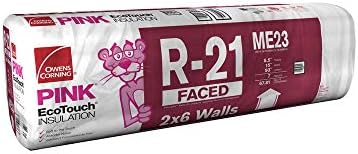
This Owens Corning product is listed as R-21 kraft-faced fiberglass batt insulation for floor or wall use, sized for 2×6 framing. The listing describes a bulk set of 10 bags. Its higher stated R-value makes it the strongest thermal-insulation option in this group, provided your cavity depth and local requirements match.
The kraft facing is an important difference from the unfaced products. A facing can serve as a vapor retarder in some wall assemblies, but it must be installed in the correct orientation and used in line with local code and the rest of the wall design. Do not add another vapor-control layer without checking that the assembly allows it.
The bulk package is best suited to a larger project, and the supplied title does not give a full coverage figure or exact batt dimensions. Check the current listing for those details and make sure the product is compatible with your framing before ordering.
Pros:
- R-21 is the highest stated R-value among these picks.
- Designed for 2×6 framing and listed for floor or wall use.
- Kraft-faced format includes a facing layer.
- Bulk set may suit a larger renovation.
Cons:
- Not suitable for shallower 2×4 cavities.
- Exact coverage and dimensions are not included in the supplied product details.
Verdict: Choose this option for a compatible 2×6 project that calls for R-21 and kraft facing, after confirming coverage and vapor-control requirements.
How to Choose Cavity Wall Insulation Batts
First, identify the type of wall
Fiberglass batts are made to fit open framed cavities, such as spaces between wood studs. They are not designed to be pushed into a sealed masonry cavity through a small drilled hole. If you have a brick or block wall with an enclosed cavity, look for an insulation method made for that wall type and consult a qualified installer.
Match batt thickness to cavity depth
A batt should fit the depth of the space without being crushed or folded. The R-11 options here are listed as 3.5 inches thick for 2×4 framing, while the R-8 batt is about 2.5 inches thick. The R-21 product is listed for 2×6 framing. Confirm the full dimensions and the framing depth before purchasing.
Check the width against stud spacing
Measure the actual space between studs and follow the product’s fit instructions. The listed products include different widths, including 16-inch and 24-inch formats. A batt that is too wide can bunch up, while one that is too narrow can leave gaps. Both conditions can reduce how well the cavity is insulated.
Choose an R-value for your project and location
R-value measures resistance to heat flow, but the right target depends on your climate, wall assembly, and local energy code. A higher number is not automatically the right fit if the batt is too thick for the cavity or the product does not meet the project’s requirements. Check local guidance before choosing between R-8, R-11, R-15, and R-21.
Decide whether you need faced or unfaced batts
Unfaced batts do not include a paper facing. Kraft-faced batts have a facing layer that may act as a vapor retarder in some assemblies. The correct choice depends on the climate and the materials already in your wall. Follow local code and product instructions, and avoid adding layers without understanding how moisture will move through the wall.
Estimate coverage and package size
Compare the product’s coverage with the net area of the cavities you need to fill. Account for framing, openings, and cuts rather than using the wall’s full outside dimensions alone. A large multi-bag package can make sense for a broad project, while a smaller package may be easier to manage for one room. Verify that the package quantity and coverage match your needs.
Install carefully and protect yourself
Fiberglass batts should fill the cavity evenly, with no large gaps or unnecessary compression. Wear protective clothing, gloves, eye protection, and a suitable dust mask while handling and cutting insulation. Keep the material dry and follow the manufacturer’s installation guidance. If the wall has wiring, plumbing, moisture problems, or unusual layers, get professional advice before closing it up.
Frequently Asked Questions
Are these batts suitable for a closed masonry cavity wall?
No. These products are described as fiberglass batts for framed cavities. A sealed masonry cavity generally requires a different insulation approach. Do not try to insert batts through a small access hole.
Which of these products is best for a 2×4 wall?
The R-11 products are listed as 3.5 inches thick and compatible with 2×4 walls. The R-8 product is also described for standard 2×4 framing but is thinner. Check the batt width against your stud spacing and confirm the R-value meets local requirements.
Can I use the R-21 batts in a 2×4 wall?
The supplied listing describes the R-21 product as fitting 2×6 framing. Do not compress a batt into a shallower cavity. Choose insulation sized for the actual cavity instead.
Should I choose faced or unfaced insulation?
That depends on your wall design, climate, and local code. The R-21 product is kraft-faced; the other listed options are unfaced. Check the full wall assembly before choosing a facing, since vapor-control needs vary.
Is a higher R-value always the better choice?
Not by itself. The batt must fit the cavity, and its R-value must suit your climate and project requirements. A batt that is too thick or installed with gaps may not perform as intended.
Can insulation batts reduce sound between rooms?
The Owens Corning R-8 product specifically lists sound reduction as a feature. Actual sound control also depends on the full wall construction, including drywall, sealing, and framing.
How do I know how many bags to buy?
Measure the cavities and calculate the area to be insulated, then compare it with the package coverage. Check the product listing for current package details, especially when the supplied information does not state a full coverage figure.
Conclusion
For a standard 2×4 framed wall, the R-11 unfaced batts are the most direct options in this group, with the Knauf package suited to a larger job and the 16-inch batt better suited to a smaller one. The Owens Corning R-8 batt is the more targeted choice for interior sound control, while the R-21 kraft-faced product is intended for compatible 2×6 cavities. The R-15 option is worth considering if its dimensions fit your wall, but the supplied listing data marks it unavailable. Before buying, confirm that you have a framed cavity, check the fit, and follow local insulation and vapor-control requirements.
