
Choosing the best green spray foam insulation depends on what you mean by “green.” If you want foam with a visible green tint, the Vega Bond injection kit is the clearest match in this lineup. If you mean a more environmentally friendly product, the supplied product details do not provide enough information to compare environmental impacts. These kits also differ in foam type, coverage, and intended use, so match the product to your project before you buy.
Our picks include an injection foam for existing wall cavities, open-cell kits for broader insulating work, and closed-cell options for sealing gaps and adding insulation. Check each kit’s application instructions and safety requirements, and confirm that its intended use suits your wall, attic, crawl space, or other project.
Table of Contents
Quick Comparison
| Product | Foam type | Coverage or stated performance | Best suited for |
|---|---|---|---|
| Vega Bond Open-Cell Injection Foam Insulation Kit | Open-cell injection foam | 100 cu. ft.; R-value 4.4 per inch | Retrofit wall cavities |
| BEEST FullStop Spray Foam Insulation Kit | Hybrid spray foam | Up to 240 board feet; R-value 8.24 at 2 inches | Gap filling and general insulation |
| FROTH-PAK 630 Spray Foam Insulation Kit | Closed-cell, two-part foam | Up to 630 board feet; R-value 6.2 at 1 inch | Air sealing and larger insulation jobs |
| Vega Bond Open Cell Spray Foam Insulation Kit | Open-cell, two-part foam | R-value 8.8 at 2 inches | Walls, roofs, ceilings, and rim joists |
| Kraken Bond Fastcoat Fire Rated Spray Foam Kit | Closed-cell foam in cans | 24 cans; stated coverage of 480 sq. ft. | DIY projects needing multiple cans |
Our Picks: Best Green Spray Foam Insulation reviews
Vega Bond Injection Foam: Best for Green-Tinted Retrofit Work

This open-cell foam kit is designed for injecting insulation into closed wall cavities, which can be useful when you want to improve an existing wall without removing its drywall. Its green tint helps you identify where foam has been placed. That color is a practical visual feature, but it does not by itself establish that the foam is environmentally friendly.
The slow-rise formula expands over a stated two-to-four-minute period. That gradual expansion is intended to fill irregular voids while reducing the chance of pressure damage to the wall. The kit includes a spray gun, hose, nozzles, gloves, goggles, cleaner, and an extended injection tube for reaching behind existing fiberglass. The manufacturer lists an R-value of 4.4 per inch and notes sound absorption as another benefit.
This is a specialized retrofit product, not a general open-spray foam for exposed walls or ceilings. Its injection setup and slow rise make it a better fit for hidden cavities than for surface application. The 100-cubic-foot figure is a volume measure, so compare it carefully with other kits that list board feet or square-foot coverage.
Pros:
- Designed to insulate closed wall cavities without removing drywall
- Green tint helps show where the foam has been injected
- Slow-rise expansion is intended to limit pressure on wall surfaces
- Includes an extended tube and application accessories
Cons:
- Not intended for open spraying on walls or ceilings
- Open-cell foam may not suit projects that call for a different foam type
Verdict: Choose this kit if you need to fill existing wall cavities and want a visible green tint; skip it for exposed-surface spraying or if you are looking specifically for verified environmental credentials.
BEEST FullStop: Best All-in-One Kit for General Gap Sealing

BEEST FullStop is a hybrid spray foam kit intended for insulating and sealing gaps in places such as walls and attics. The package includes 12 cans, an applicator gun, cleaner, gloves, goggles, and a coverall, so it comes with several key application items. The stated yield is up to 240 board feet.
The product lists an R-value of 8.24 at two inches and describes its cured foam as resistant to water absorption. It also reports ASTM E84 test results of a Flame Spread Index of 0 and a Smoke Developed Index of 120, meeting Class A surface-burning criteria. These are product-specific claims; use the product according to its label and confirm that it fits your project’s building and fire requirements.
Its stated application range is 68–77°F, so temperature planning matters. Compared with the Vega Bond injection kit, FullStop is aimed at sprayed gap filling rather than foam delivery into closed wall cavities. Its kit contents may suit a DIY project, though a multi-can system may take more handling than a single two-part tank kit.
Pros:
- Includes 12 cans, applicator gun, cleaner, and protective gear
- Lists Class A surface-burning test results
- Designed to bond to common materials such as wood, metal, drywall, concrete, and brick
- Up to 240 board feet of stated yield
Cons:
- Best application range is relatively specific at 68–77°F
- Board-foot yield may be harder to compare with products listing cubic feet or square feet
Verdict: FullStop is a practical choice if you want an all-in-one kit for general gap sealing and value having application gear included, provided you can work within its recommended temperature range.
FROTH-PAK 630: Best for Larger Closed-Cell Insulation Jobs
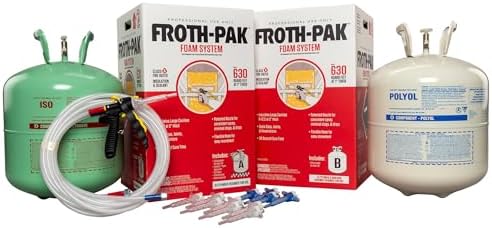
FROTH-PAK 630 is a two-part closed-cell polyurethane foam system supplied with two tanks, a 15-foot hose, a dispensing gun, and cone and fan nozzles. It is intended for insulation and air sealing in areas such as roof and wall junctions, attic or basement penetrations, crawl spaces, and gaps around electrical, mechanical, or plumbing openings. The kit states a yield of up to 630 board feet.
The listed R-value is 6.2 at one inch and 12.2 at two inches. The product also describes the foam as a cost-saving air barrier and gives a fast cure time of 30 seconds. It states that re-entry is possible after one hour with proper ventilation. The foam is described as Class A fire rated up to two inches thick, and the product lists Green Circle Certification, LEED V4 compliance, and ICC listing.
This larger system may be a better match than a small can kit when the job covers multiple gaps or a broader area. However, the product specifies that personal protective equipment is required and not included. That makes it important to plan for appropriate protection before starting, rather than assuming the kit contains everything needed.
Pros:
- Up to 630 board feet of stated yield
- Closed-cell foam is intended for insulation and air sealing
- Includes a 15-foot hose and both cone and fan nozzles
- Lists performance certifications and fire-rating information
Cons:
- Required personal protective equipment is not included
- A two-tank system may be more involved to set up than a can-based kit
Verdict: Consider FROTH-PAK 630 for a larger air-sealing or insulation job if you are prepared to supply the required protective equipment and follow the application instructions carefully.
Vega Bond Open Cell Kit: Best for Sound Absorption and Broad Interior Coverage

This two-part open-cell foam kit is designed for areas including basements, crawl spaces, attics, roofs, ceilings, and rim joists. The manufacturer describes its foam as a higher-density 1-pound-per-cubic-foot formula and gives an R-value of 8.8 at two inches. It also says that two inches provides an effective air barrier and that the foam helps with sound insulation.
The kit includes a spray gun, hose, interchangeable fan and cone nozzles, and protective gear. Those nozzle options give you flexibility for different application areas, while the two-part setup is intended to create a continuous layer of insulation. The product also lists ASTM E84 Class A fire-rating test information for residential and commercial interior use.
Compared with the injection version of Vega Bond foam, this product is intended for direct application across surfaces and building areas rather than hidden wall cavities. Its open-cell construction and stated thickness requirements make it important to plan the job around the intended application. If you need a foam specifically for a closed cavity without drywall removal, the injection kit is the more targeted option.
Pros:
- Designed for several areas, including attics, roofs, crawl spaces, and rim joists
- Lists an R-value of 8.8 at two inches
- Includes fan and cone nozzles plus protective gear
- Describes sound insulation and an air barrier at the recommended thickness
Cons:
- Open-cell foam is not the right choice for every insulation application
- The stated air-barrier performance depends on applying the recommended thickness
Verdict: Choose this Vega Bond kit for planned open-cell application across interior building areas when sound absorption and the stated two-inch performance suit your project.
Kraken Bond Fastcoat: Best Multi-Can Closed-Cell Kit

Kraken Bond Fastcoat is a closed-cell foam kit that includes 24 cans, an application gun, foam cleaner, goggles, a worksuit, and gloves. The listing gives a stated coverage of 480 square feet and an R-value of 5.66 per inch. It is intended for areas such as attics, walls, crawl spaces, and hard-to-reach spots.
The product describes its foam as Class A fire rated and says it adheres to common building materials to create an airtight and watertight seal. Its stated application range is 41–86°F, with a recommended can temperature of 68°F for best performance. The many-can format may be useful when you want to work through smaller sections, though keeping track of application conditions and supplies is part of the job.
Compared with FROTH-PAK 630, Fastcoat uses individual cans rather than a two-tank system. The supplied protective gear is a helpful inclusion, but it does not replace reading the product manual and label. Its environmental description is a manufacturer claim; the supplied information does not provide enough detail to compare its environmental impact with the other products here.
Pros:
- Includes 24 cans, application gun, cleaner, and protective gear
- Lists closed-cell construction and an R-value of 5.66 per inch
- Dual-nozzle system is intended for vertical and ceiling applications
- Stated application range allows some flexibility in working conditions
Cons:
- Best performance depends on bringing the can to the recommended temperature
- Square-foot coverage is listed without a thickness in the supplied product details
Verdict: Fastcoat is a reasonable option if you prefer a multi-can closed-cell kit with protective gear included, but confirm the coverage basis and application instructions for your specific job.
How to Choose Green Spray Foam Insulation
Decide What “Green” Means for Your Project
If you mean green-colored foam, the Vega Bond injection kit is the clearest fit because its product details specifically say that the foam tint helps verify fill locations. If you mean a product with a lower environmental impact, do not use color or general marketing language as proof. Compare clear environmental certifications and product information, and note that the supplied details here do not provide a full environmental comparison.
Match the Foam to the Application
Start with the location you need to insulate. The Vega Bond injection kit is made for closed wall cavities, while the other kits are intended for sprayed application in areas such as walls, attics, crawl spaces, roofs, or around building penetrations. Choosing a product designed for your application can help avoid using injection foam on exposed surfaces or a surface-spray kit in a closed cavity.
Compare Open-Cell and Closed-Cell Options
The products include both open-cell and closed-cell options. The open-cell kits emphasize sound absorption and are designed for particular interior or retrofit uses. The closed-cell kits are positioned for insulation and air sealing, with their own stated R-values and application requirements. Neither type is automatically best for every job; check the product details against your project needs and local building requirements.
Read Coverage Figures Carefully
Coverage is reported in different ways across these products: cubic feet, board feet, and square feet. These measures are not directly interchangeable without knowing application thickness and other conditions. Compare the units and the stated thickness together, and avoid assuming that a square-foot figure represents the same depth or finished result as a board-foot estimate.
Check Application Temperature and Setup
Temperature guidance varies by product. BEEST lists a recommended application range of 68–77°F, while Kraken Bond gives a broader application range and recommends warming the can to 68°F for best performance. Two-part systems also require setup with tanks, hoses, or a dispensing gun. Read the instructions before starting and make sure your work area and supplies are ready.
Plan for Protective Equipment and Safe Use
Protective gear is included with some kits, while the FROTH-PAK listing says that required personal protective equipment is not included. Check exactly what comes in the box, follow the label and instructions, and pay attention to any ventilation and re-entry guidance. For example, FROTH-PAK gives a one-hour re-entry time with proper ventilation; do not apply that instruction to other products.
Consider the Job Size and Kit Format
A multi-can kit may be convenient for working through separate areas, while a two-part tank system may make more sense for a larger project. Injection kits serve a more specific retrofit purpose. Choose based on the amount and type of work you expect to do, and consider whether you are comfortable with the included application method.
Frequently Asked Questions
Does green spray foam mean the product is environmentally friendly?
No. A green tint describes color, not environmental impact. In this lineup, the Vega Bond injection kit uses green tint to help show fill locations. Check for specific environmental information and certifications if that is your priority.
Which product is made for insulating an existing wall without removing drywall?
The Vega Bond Open-Cell Injection Foam Insulation Kit is specifically designed for closed wall cavities and retrofit use without removing drywall. It is not intended for open spraying on walls or ceilings.
What is the difference between board feet and cubic feet?
They are different coverage measures, so compare them carefully. The products list coverage in cubic feet, board feet, or square feet, and the stated thickness can affect how useful a comparison is. Check the product’s own instructions for how its coverage figure applies to your project.
Which kit includes personal protective equipment?
The product details say that BEEST FullStop, the Vega Bond open-cell kit, and Kraken Bond Fastcoat include protective gear. FROTH-PAK says personal protective equipment is required but not included. Always confirm the kit contents and follow its instructions.
Can these foam kits be used in any season or temperature?
No. Application conditions vary. BEEST lists a 68–77°F application range, and Kraken Bond provides a range of 41–86°F while recommending a can temperature of 68°F. Check the individual product instructions before applying foam.
Which option is designed for a larger job?
FROTH-PAK 630 lists up to 630 board feet of yield, while the other kits use different coverage figures or formats. That may make it worth considering for a broader project, but compare coverage units, thickness, application method, and safety requirements before choosing.
Final Recommendation
For closed wall cavities and a visible green tint, the Vega Bond injection kit is the most targeted choice. For larger closed-cell air-sealing work, consider FROTH-PAK 630 if you can supply the required protective equipment. BEEST FullStop offers an all-in-one setup for general gap filling, while the Vega Bond open-cell spray kit suits broader interior applications and Kraken Bond Fastcoat provides a multi-can format. Choose by application, foam type, coverage, and safety needs—not by the word “green” alone.
