
An invisible sliding door system hides most of its hardware behind the door, creating a cleaner look than a standard exposed barn-door track. The best choice depends on your door’s size and weight, how much routing the installation requires, and whether you want a compact kit for a specific opening or a system that can handle a wider door. These five options all use concealed hardware, but their fit requirements and installation details differ.
Table of Contents
Quick Comparison
| Product | Best For | Door Fit and Capacity | Notable Details |
|---|---|---|---|
| JUBEST 38" Concealed Barn Door Hardware Kit | Most standard openings in its size range | 30–34" opening; doors 1-1/4"–1-3/4" thick; up to 176 lb | Dual soft-close mechanisms; tracks can be cut shorter |
| DIYHD 38" Concealed Sliding Barn Door Hardware | A clean floor transition | 30–34" opening; doors 1-1/4"–1-3/4" thick; up to 176 lb | No floor track; dual soft-close mechanisms |
| Milcasa Magic 2 (1800) | Wider doors and adjustable fit needs | Up to 71" wide; 1-1/8"–2-1/2" thick; up to 176 lb | Routing template included; reversible installation |
| Dgavxa 38" Concealed Sliding Barn Door Kit | Soft-close operation in a compact opening | 30–34" opening; doors 1-1/4"–1-3/4" thick; up to 176 lb | Aluminum construction; tracks can be trimmed |
| cvter 34" Concealed Sliding Barn Door Hardware | A listed 26" passage opening | 34" track; doors 1-3/16"–1-3/4" thick; up to 176 lb | Dual soft-close mechanisms; multiple guide components |
Our Picks: Best Invisible Sliding Door System reviews
JUBEST 38-Inch Kit: A Balanced Pick for Standard Openings
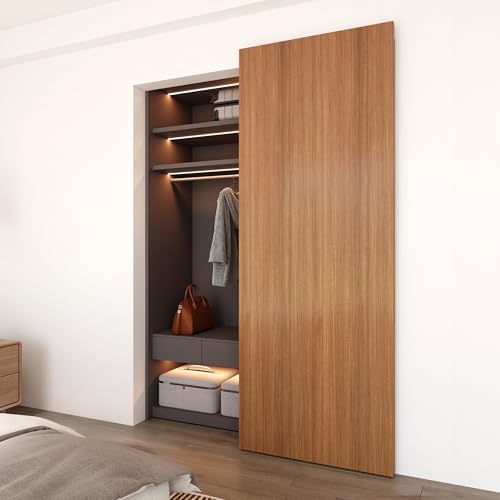
The JUBEST kit is a wall-mounted concealed system designed for openings from 30 to 34 inches. Its track and related hardware sit behind the door, while end caps cover the track ends. That makes it a practical option when you want the sliding-door look without a visible rail above the door.
The aluminum hardware is rated for doors up to 176 pounds and 1-1/4 to 1-3/4 inches thick. Two soft-close mechanisms are included to help control movement at both ends of travel. The top track measures 37.75 inches, and the listing says the tracks can be cut shorter to suit a smaller panel.
Installation takes more preparation than hanging a door on a visible surface-mounted rail. The door needs L- and U-shaped channels for the hardware, and the instructions call for removing the baseboard or door frame. Check those requirements against your door and wall before buying; trimming a track does not remove the need for the correct opening and door preparation.
Pros:
- Fits a stated 30–34-inch opening range.
- Includes two soft-close mechanisms and end caps.
- Aluminum construction supports doors up to 176 pounds.
- Tracks can be cut shorter for smaller panels.
Cons:
- Requires routed channels in the door.
- Baseboard or door-frame removal may be needed.
Verdict: Choose the JUBEST if your opening falls within its stated range and you want a well-specified concealed kit with soft-close hardware, provided you are prepared for the door and wall modifications.
DIYHD 38-Inch Kit: A Minimalist Option Without a Floor Track

The DIYHD system is made for a 30–34-inch opening and hides its top rail behind the door. A key distinction is that it has no floor track. The kit does include bottom components and a floor guide, so it is not a system with no lower door guidance at all; rather, it avoids a track running across the floor.
It is designed for wood doors between 1-1/4 and 1-3/4 inches thick, with a stated maximum door weight of 176 pounds. Dual soft-close mechanisms help slow the door at the ends of its travel. The aluminum rail can be cut shorter, but the door still needs the proper routed slots described in the preparation instructions.
Skipping a floor track can make the doorway easier to sweep and avoids a raised rail across the walking path. The trade-off is that installation still needs careful alignment of the concealed hardware and guide components. The listing also calls for removing the baseboard or door frame, so this is not a drop-in replacement for every existing doorway.
Pros:
- No floor track across the doorway.
- Dual soft-close mechanisms are included.
- Rated for doors up to 176 pounds.
- Rail can be shortened for a smaller door setup.
Cons:
- Requires door routing and careful preparation.
- Still includes lower guide hardware that must be installed correctly.
Verdict: The DIYHD is a strong fit if avoiding a floor track is a priority and your door meets the stated thickness, weight, and opening requirements.
Milcasa Magic 2: More Sizing Flexibility for Wider Doors

Unlike the 38-inch kits in this roundup, the Milcasa Magic 2 is designed for a much wider door: its stated maximum width is 71 inches. The hardware is hidden behind the door and wall to create a floating appearance. The door slab is not included, so you will need to supply a compatible wooden door with wood at both the top and bottom.
This system supports doors up to 176 pounds and from 1-1/8 to 2-1/2 inches thick. Its sizing rules need close attention: the door should be at least 3 inches taller than the opening and 8-1/2 inches wider for full opening coverage. The listing also specifies a door-to-wall distance of 1/2 to 1-1/4 inches and 1-9/16 inches between the ceiling and the top of the door.
A routing template is included to help guide door milling, and the system can be installed for either left- or right-handed doors. These features make it more adaptable than the fixed-size kits, but also make precise planning essential. For carpet, cork, or other soft flooring, the listing says a special running track is needed.
Pros:
- Supports doors up to 71 inches wide.
- Fits a broader stated range of door thicknesses than the 38-inch kits.
- Includes a routing template.
- Can be mounted for left- or right-handed doors.
Cons:
- Door slab is not included.
- Clearance and door-size requirements call for careful measuring and routing.
Verdict: Choose the Milcasa Magic 2 for a wider custom door or broader thickness range, but only if you can meet its detailed door, clearance, and routing requirements.
Dgavxa 38-Inch Kit: Concealed Hardware with Dual Dampers
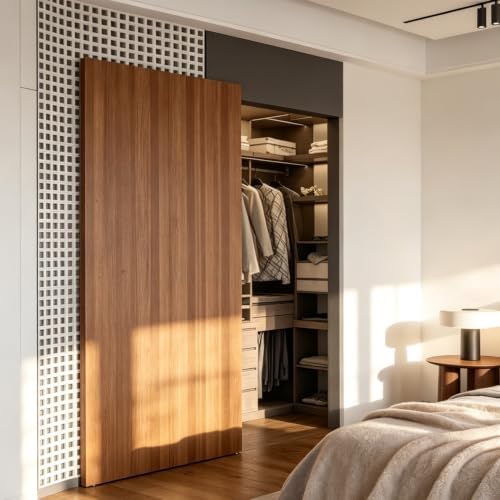
The Dgavxa kit is another concealed wall-mounted system for openings from 30 to 34 inches. Its hardware is intended to sit behind the door, with end caps covering the track ends. The aluminum alloy track and nylon wheels are described as supporting doors up to 176 pounds, while dual dampers provide soft-close control.
The listed door thickness range is 1-1/4 to 1-3/4 inches. The top track is listed at 38-1/4 inches, and the track can be trimmed for a smaller door setup. The system also requires L- and U-shaped grooves in the door, and the instructions call for removing baseboards or door frames. A flat floor is noted as a requirement for proper installation.
Its basic fit and capacity are similar to the JUBEST and DIYHD kits. The main practical difference is that the Dgavxa description specifically calls out nylon wheels and floor flatness. That makes checking the doorway and installation surface especially worthwhile before choosing it. The supplied details do not establish a clear advantage in door capacity over the other compact options.
Pros:
- Dual soft-close dampers are included.
- Rated for doors up to 176 pounds.
- Aluminum alloy track and nylon wheels.
- Track can be trimmed for smaller setups.
Cons:
- Requires routed door grooves and removal of baseboards or door frames.
- Installation calls for a flat floor.
Verdict: Consider this kit if its stated dimensions suit your opening and you want concealed hardware with dual dampers, but verify the floor and door-preparation requirements before ordering.
cvter 34-Inch Kit: Sized for a 26-Inch Passage Opening

The cvter system uses a 34-inch track and is listed for a 26-inch passage opening. It is a more compact choice than the 38-inch kits, which are specified for 30–34-inch openings. Its aluminum alloy rail is rated for doors up to 176 pounds, and the stated door thickness range is 1-3/16 to 1-3/4 inches.
The kit includes upper and lower rails, a top roller, bottom rollers, side rollers, two soft-close mechanisms, end caps, and a floor guide. That is a fairly detailed set of guidance hardware, so confirm that the included components match your planned installation and floor conditions. The listing says the track length should equal the door width and describes wider-door sizing needs for full opening coverage; follow the product’s measuring instructions rather than relying on the track length alone.
The system is described for several rooms, including closets, pantries, offices, and bedrooms. Its narrower stated passage size makes it less interchangeable with the 38-inch options. Measure the clear opening and the door itself, then verify the required overlap and hardware placement before choosing this kit.
Pros:
- 34-inch track is listed for a 26-inch passage opening.
- Includes two soft-close mechanisms.
- Rated for doors up to 176 pounds.
- Door thickness range begins at 1-3/16 inches.
Cons:
- Its stated opening fit is narrower than the 38-inch options.
- Door width and overlap requirements need careful checking.
Verdict: Pick the cvter if your passage opening matches its stated 26-inch fit and you want a compact concealed kit; choose a larger system if your opening falls outside that range.
How to Choose an Invisible Sliding Door System
Measure the Opening and Door Width
Start with the clear width of the opening, then check the door width required to cover it. A track’s length does not automatically tell you how wide an opening it will cover. For example, the 38-inch kits here are specified for openings from 30 to 34 inches, while the cvter kit is listed for a 26-inch passage opening. The Milcasa system has its own wider-door requirement for full opening coverage. Use the exact sizing instructions for the system you are considering.
Check Door Thickness, Weight, and Construction
Compare your door with both the permitted thickness range and maximum weight. Most kits in this roundup are rated for doors up to 176 pounds, but their thickness limits differ. The Milcasa system accepts a wider thickness range, while the 38-inch kits have more specific limits. The Milcasa listing also requires wood at the top and bottom of the door, so a compatible slab is important.
Understand the Door Preparation
Concealed hardware often needs channels routed into the door so the track and guides can fit. The JUBEST, DIYHD, and Dgavxa listings call for L- and U-shaped grooves. The Milcasa includes a routing template, but it still requires door milling. If you do not have the tools or experience for precise routing, plan to get help before purchasing.
Look at Floor and Wall Conditions
These systems need secure installation and accurate alignment. Check the wall mounting requirements, floor flatness, baseboards, and door trim before you start. Some kits call for removing the baseboard or door frame. A system described as having no floor track may still use a floor guide or other lower door components, so check what will be installed near the floor.
Decide Whether You Need Soft Close
Soft-close mechanisms help control the door as it reaches the ends of its travel. The JUBEST, DIYHD, Dgavxa, and cvter kits include two mechanisms. If a quiet, controlled closing action matters in your space, confirm that the kit includes the hardware and that your door meets its weight and fit limits.
Plan for Clearances and Floor Coverings
Measure the space above and beside the door, as well as the distance between the door and wall. The Milcasa system lists specific ceiling and wall clearances, while the cvter description notes that the door needs to be wider than the doorway for full opening coverage. The Milcasa listing also says a special running track is needed for carpet, cork, or other soft floors. Check the instructions for your flooring before installation.
Frequently Asked Questions
What makes a sliding door system “invisible”?
In these systems, the rail and much of the hardware are concealed behind the door rather than left exposed above it. End caps may hide the track ends. The exact appearance depends on the door, wall, and installation, so check each system’s design and preparation requirements.
Do these systems include a door?
The listed kits are hardware systems, not complete door-and-hardware packages. The Milcasa listing explicitly says the door slab is not included. Check the package details for the other kits and plan to supply a compatible door.
Can I install a concealed sliding system on any door?
No. The door must meet the system’s thickness and weight limits, and several kits require routed grooves or specific wood construction. Measure your door and read the preparation instructions before choosing a kit.
Does “no floor track” mean there is no hardware near the floor?
Not necessarily. The DIYHD description says there is no floor track, but its kit still includes bottom components and a floor guide. A floor guide helps control the door without the same type of continuous track across the floor.
Can I cut a track to fit a smaller door?
The JUBEST, DIYHD, and Dgavxa descriptions say their tracks can be cut shorter. Cutting the track does not change the system’s other fit requirements, such as door thickness, opening width, routing, or hardware placement. Measure carefully and follow the manufacturer’s instructions.
Which system is best for a wider door?
The Milcasa Magic 2 has the largest stated maximum door width in this group, at 71 inches. It also has detailed door-size and clearance requirements, so confirm that your door and installation space meet them.
Final Recommendation
For a typical 30–34-inch opening, the JUBEST is a balanced starting point because it combines concealed hardware, dual soft-close mechanisms, and clearly stated door limits. The DIYHD is worth considering when avoiding a floor track is a priority. For a wider door, the Milcasa Magic 2 offers more capacity, but it calls for more careful planning and routing. Before ordering any system, verify your opening, door dimensions, floor conditions, and installation clearances against the specific kit’s instructions.
