Choosing the best electric tankless hot water heater for an RV depends on what you need it to do. A compact 110V point-of-use unit may help with a sink, but it may not supply enough flow for a shower. And some products marketed for RV use are propane-powered or store hot water in a small tank rather than heating it tanklessly. Below, we compare those options and explain the key power, flow, and installation limits to check before you buy.
Table of Contents
Quick Comparison
| Product | Type and power | Best suited for |
|---|---|---|
| xwdzswgs 110V 3000W Tankless Heater | Electric, 110V, 3000W | Point-of-use sink hot water |
| xwdzswgs 110V Tankless Heater with Display | Electric, 110V, 3000W | Compact sink installation |
| ORBEK RV Propane Tankless Water Heater | Propane burner, 12V DC controls | RV showers and multiple hot-water uses |
| CAMPLUX 6kW Electric Point-of-Use Heater | Electric, 240V, hardwired | Suitable 240V installations, not typical RV outlets |
| Fisoceny 2.5-Gallon Mini Tank Heater | Electric storage tank, 120V, 1500W | Small hot-water buffer for a sink |
Our Picks: Best Electric Tankless Hot Water Heaters For Rv reviews
1. xwdzswgs 110V 3000W Heater for Basic Point-of-Use Hot Water

This compact 110V unit is designed to heat water at the point of use, such as beneath a sink. Its 3000W element and digital display are intended to provide hot water without a storage tank. The listing gives a temperature-rise range of 82°F at 0.3 GPM to 131°F at 0.5 GPM, making clear that the water gets less warm as flow increases.
For an RV, that low-flow limit matters. The listing says the heater is not suitable for showers, which generally need at least 1.8 GPM. It may make more sense for handwashing or a small sink than for bathing. It also needs vertical installation, and the product information calls for careful wiring and pipe connections. Confirm the unit’s electrical requirements against your RV’s available power and have a qualified installer check the setup.
The compact design may appeal if you want a small point-of-use heater rather than a tank. However, supplied user experiences are mixed: some describe quick heating and a useful compact size, while another reports breaker trips. That makes a careful check of circuit capacity especially important.
Pros:
- Compact format for a sink or other point-of-use location
- Digital temperature display with Fahrenheit and Celsius options
- Listed safety features include dry-boil and overheating protection
- No storage tank or preheating wait
Cons:
- Not intended for a shower or high-flow use
- Electrical capacity and installation requirements need close attention
Verdict: Consider it for a low-flow sink if its electrical requirements suit your RV, but choose another option for showers.
2. xwdzswgs 110V Tankless Heater with LCD Display
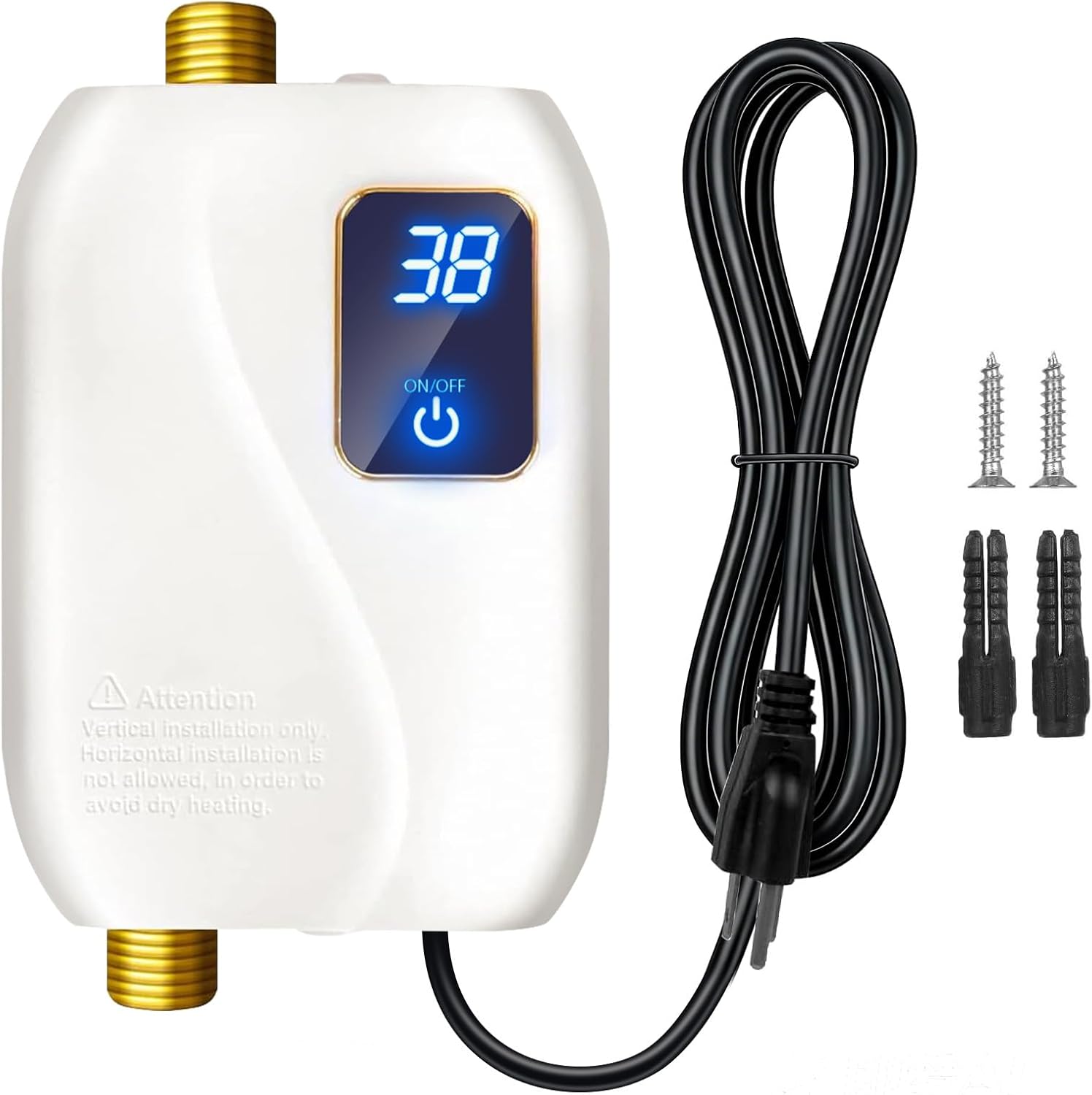
This model has much in common with the first pick: it is a 3000W, 110V electric heater intended for point-of-use installation. It has an LCD display, standard 1/2-inch NPT connections, and listed protections for overheating, dry operation, and leakage. The product information also gives the same low-flow temperature-rise figures: 82°F at 0.3 GPM and 131°F at 0.5 GPM.
That performance profile makes it a possible fit for a low-demand sink, not a whole-RV water heater. The listing specifically says it is not suitable for showers. It must be installed vertically, and the product information recommends checking wiring and making secure plumbing connections. The listing states that the product qualifies for an ETL standard; verify the certification details for the exact model before buying if certification is important to you.
Compared with the first 110V option, this model highlights its stainless steel and ABS construction and an ETL-related claim in its product information. Neither detail changes the basic flow limitation. Treat it as a small sink heater, and check that your power source can handle the load rather than assuming any RV outlet will work.
Pros:
- Small wall-mounted design for tight spaces
- LCD display and selectable Fahrenheit or Celsius units
- Listed dry-boil, leakage, and overheat protections
- Uses standard 1/2-inch NPT water connections
Cons:
- Low stated flow rate is not suitable for a typical shower
- Requires a suitable electrical circuit and vertical installation
Verdict: This is a reasonable point-of-use candidate for a compatible RV sink, but it is not a replacement for a shower-capable RV water heater.
3. ORBEK Propane Tankless Heater for RV Showers

This is the most RV-focused option in the group, but it is not electric-heated: it uses a 60,000 BTU propane burner and a 12V DC supply. The burner heats water on demand, while the 12V supply supports the unit’s operation. The product is designed for RV use, including showers, dishwashing, and handwashing, and it avoids storing a tank of heated water.
Its stated features include a smart remote control with temperature adjustment from 95°F to 123°F, a built-in 150 PSI pressure-reducing valve, and a high-altitude suitability mode. The product description also lists standard RV water connections and compatibility with several common cutout sizes. Check your existing opening carefully, and confirm propane, water, and electrical connections before purchase. Door panels are sold separately according to the listing.
Everyday experiences supplied with the product describe a straightforward fit for some existing openings and steady hot water during showers. That is encouraging, but your RV’s plumbing, cutout, and installation still determine fit. Compared with the 110V electric models, this is the more relevant choice when your priority is sustained shower hot water and your RV is set up for propane.
Pros:
- Designed for RV hot-water needs, including showers
- Propane burner heats water on demand
- 12V DC operation and remote temperature control
- Built-in pressure-reducing valve and stated high-altitude mode
Cons:
- Uses propane, so it does not meet a strictly electric-heater requirement
- Optional door panels are sold separately; confirm cutout size and connections
Verdict: If shower performance is your main goal and propane is acceptable, this RV-specific unit is the strongest match in this comparison.
4. CAMPLUX 6kW 240V Electric Heater for Compatible Setups

The CAMPLUX is a 6kW electric tankless heater rated for 240V. It is a different class of installation from the 110V point-of-use models: the listing calls for hardwiring, a 30A circuit breaker, and 10 AWG wire. It is not a plug-in option for a standard RV outlet. Only consider it if your RV installation and power setup can support those requirements, with a qualified professional confirming compatibility.
The manufacturer lists a 50°F temperature rise at 1.0 GPM, a maximum temperature of 131°F, and a compact wall-mounted body. It also describes self-modulating power use and an auto-shutoff feature for overheat protection. Supplied user experiences include use as a replacement in an RV, but that does not mean it will fit or work with every RV electrical system.
Compared with the 110V heaters, the CAMPLUX has a higher stated heating output and flow figure, but its 240V hardwired requirement is a major tradeoff. It may suit a specialized installation better than a typical RV setup. Confirm the power supply, breaker, wire size, plumbing, and pressure-relief requirements before committing.
Pros:
- Higher output than the 3000W 110V options
- Temperature and inlet-flow display
- Compact wall-mounted design
- Listing describes self-modulating power and overheat shutoff
Cons:
- Requires 240V hardwiring, a 30A breaker, and 10 AWG wire
- Not a straightforward fit for RVs with only standard 120V power
Verdict: Choose this only when a qualified installer confirms that your RV can support its 240V hardwired requirements.
5. Fisoceny 2.5-Gallon Mini Tank for a Small Hot-Water Reserve

This product is not tankless. It stores 2.5 gallons of hot water and uses a 1500W, 120V heating element to warm the tank. Its small size and under-sink design may make it useful when you want a short reserve of hot water close to a sink, but it does not provide endless on-demand hot water.
The listing says the water can heat in about five to eight minutes and that the temperature can be adjusted from 86°F to 149°F. It includes a pressure-relief valve and describes overheat, dry-burn, and high-pressure protections. The product is listed as suitable for RVs and supports wall or floor mounting, but its tank still takes up space and its capacity is limited. A longer use may draw down the stored hot water before the tank reheats.
Supplied user experiences point to the value of having a nearby hot-water reserve for small tasks, such as handwashing or rinsing. Compared with the tankless picks, this model trades continuous heating for stored water and a lower stated power draw. It may be a practical alternative when you need sink hot water, but it does not match the target if tankless operation is essential.
Pros:
- Small 2.5-gallon capacity for an under-sink installation
- Runs on 120V and 1500W, according to the listing
- Adjustable temperature control and included pressure-relief valve
- Can be mounted on a wall or placed on the floor
Cons:
- Stores hot water, so it is not a tankless heater
- Limited capacity may not suit extended use or showers
Verdict: Consider it for a compact sink hot-water reserve if you are comfortable with a small tank rather than true tankless heating.
How to Choose an Electric Tankless Water Heater for an RV
Match the heater to the job
Start by deciding whether you need hot water for a sink, a shower, or several fixtures. A low-flow point-of-use heater may work for handwashing, but the two 3000W models in this guide are specifically described as unsuitable for showers. A shower-capable heater needs enough flow and heating output for your water demand. Do not assume that “tankless” automatically means it can serve every fixture.
Check voltage, circuit, and available power
Compare the heater’s voltage and wiring requirements with the power available in your RV. The 110V models, the 120V mini tank, and the 240V CAMPLUX have different electrical needs. In particular, the CAMPLUX listing calls for hardwiring, a 30A breaker, and 10 AWG wire. Have a qualified professional confirm the circuit and installation; an outlet fitting or voltage label alone does not prove the RV can safely run the heater.
Understand flow rate and temperature rise
Tankless heaters raise the temperature of water as it flows through the unit. Higher flow can mean a smaller temperature rise, and colder incoming water can make it harder to reach a comfortable outlet temperature. Use the product’s stated flow and temperature-rise figures as a guide, then consider your water source, climate, and intended fixture. If a listing does not provide enough information for your needs, ask the manufacturer before buying.
Decide whether propane is an option
The ORBEK is the only shower-focused RV unit in this selection, but it uses propane rather than electric resistance heating. Its controls use 12V DC, while propane supplies the heat. If you want an all-electric setup, it is not the right match. If you are open to propane and need sustained shower hot water, compare the installation requirements with your RV’s existing system.
Measure the space and connections
Measure the available mounting area, service access, and any existing RV cutout before ordering. Check inlet and outlet sizes, mounting direction, and whether the unit requires a pressure-relief arrangement. Some models have strict installation instructions, such as vertical-only mounting. For replacement RV heaters, also confirm whether a door panel is included or sold separately.
Consider a mini tank only when a tank is acceptable
A small storage heater can provide a nearby reserve for a sink, but it is not tankless and has limited capacity. The Fisoceny holds 2.5 gallons, so consider whether that amount suits your use and whether you have room for the tank. It may help with short tasks, but it is not a substitute for continuous hot water during a long shower.
Frequently Asked Questions
Can a 110V, 3000W tankless heater run an RV shower?
The two 110V models in this guide are listed as unsuitable for showers. Their stated temperature-rise figures are given at low flow rates, so they are better considered for a sink or other small point-of-use task.
Which product here is designed for RV showers?
The ORBEK is described as an RV shower heater, but it is propane-powered and uses a 12V DC supply for operation. It is not an electric resistance water heater. Check your RV’s propane, electrical, plumbing, and installation compatibility before purchasing.
Is the CAMPLUX 6kW model a plug-in RV heater?
No. The product information specifies 240V hardwiring, a 30A circuit breaker, and 10 AWG wire. Confirm that your RV can support these requirements with a qualified installer before considering it.
Is the Fisoceny mini tank tankless?
No. It stores 2.5 gallons of hot water. It can serve as a small hot-water reserve, but its capacity is finite and it does not heat water continuously as it flows through the unit.
Can I install a point-of-use heater under an RV sink?
Possibly, if there is enough space and the unit’s mounting, plumbing, and electrical requirements are met. Check the product instructions, available circuit capacity, water connections, and service access. Use a qualified installer if you are unsure about the electrical or plumbing work.
What should I check before replacing an RV water heater?
Confirm the cutout dimensions, water connections, power source, fuel type, mounting requirements, pressure-relief setup, and any door-panel needs. For a tankless model, also check that its flow and heating capacity match the fixtures you plan to use.
Final Recommendation
For an electric-only RV setup, the two 110V heaters are the closest tankless matches here, but their stated low flow makes them better suited to sinks than showers. The CAMPLUX has a higher stated output, yet its 240V hardwired requirements may not suit many RVs. If you need shower-capable RV hot water and are open to propane, the ORBEK is the most directly RV-focused choice. The Fisoceny is a small-tank alternative, not a tankless one. Match your choice to your actual power system, water demand, and installation space before buying.