Accurate rip cuts depend on a table saw fence that stays parallel to the blade and holds the workpiece steady. The products below are a mixed group: one is a fence-extension and safety kit, three are miter gauges for crosscuts and angled cuts, and one is a miniature craft saw. That distinction matters because a miter gauge is not a substitute for a rip fence. If your goal is better rip-cut support, the BOW XTENDER is the closest match here; the other picks serve different workshop tasks.
Table of Contents
Quick Comparison
| Product | Type | Best for | Rip-cut relevance |
|---|---|---|---|
| GOINGMAKE Compact Table Saw Miter Gauge | Miter gauge with 14-inch fence | Compact crosscuts and angled cuts | Not a rip fence |
| GOINGMAKE Miter Gauge with Micro-Adjust Flip Stop | Miter gauge with 18-inch fence | Repeat crosscuts and precise angles | Not a rip fence |
| BOW Products Ultimate Table Saw XTENDER & Safety Kit | Fence extension and support kit | More workpiece support and feed control | Extends an existing fence; not a replacement |
| WolfPawn Miter Gauge with Micro-Adjust Flip Stop | Extendable miter gauge | Repeat crosscuts and longer workpieces | Not a rip fence |
| MIMYTH Mini Table Saw for Crafts | Miniature craft saw | Small craft and model-making cuts | Not a full-size rip-fence upgrade |
Our Picks: Best Table Saw Fences For Accurate Rip Cuts reviews
1. GOINGMAKE Compact Miter Gauge: A Small-Saw Crosscut Upgrade
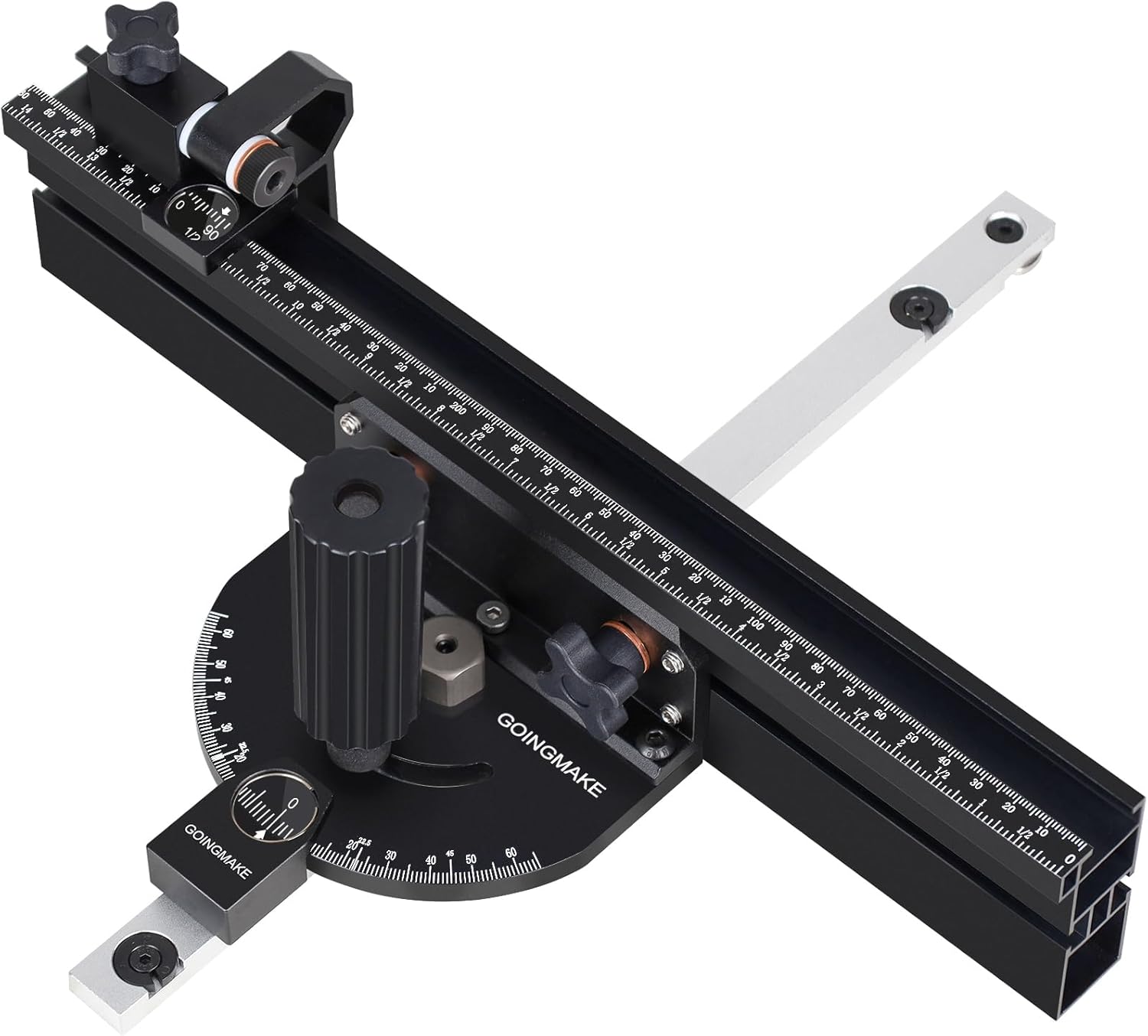
This compact GOINGMAKE gauge is designed to guide work through a table saw slot for crosscuts and miter cuts. Its 14-inch fence has inch and millimeter scales, and the gauge offers 11 positive angle stops, including common settings such as 90, 45, and 22.5 degrees. It also has a flip stop for setting up repeat cuts.
The aluminum-alloy construction and adjustable miter bar are intended to give the gauge a steady fit in compatible 3/8-by-3/4-inch T-slots or U-slots. Owners have found it smooth to slide and straightforward to adjust, including on some portable saws. As with any miter gauge, check the fit and calibrate it to your saw before relying on its scale.
This is useful if your stock miter gauge feels loose or you want repeatable crosscuts in a compact setup. It does not guide long boards parallel to the blade, so it will not replace or improve the function of your rip fence. Compared with the longer gauges below, its shorter fence is easier to store but offers less workpiece support.
Pros:
- Compact fence with inch and millimeter scales
- 11 positive angle stops for common miter settings
- Adjustable bar is designed for standard T-slot and U-slot dimensions
- Flip stop helps set up repeat crosscuts
Cons:
- Designed for crosscuts and angles, not rip cuts
- Shorter fence provides less support than longer miter-gauge options
Verdict: Choose this gauge to improve compact-saw crosscuts and angled cuts, but look for a proper rip-fence solution if parallel ripping is your priority.
2. GOINGMAKE Micro-Adjust Miter Gauge: For Repeatable Crosscuts

This GOINGMAKE model pairs an 18-inch extruded fence with a micro-adjustable flip stop. Its magnifier helps you read the scale, while the micro-adjust feature is designed for fine stop positioning. The product listing states adjustment accuracy up to 0.001 inch; that figure describes the adjustment feature, not a guarantee that every saw setup will cut to that tolerance.
The gauge has positive angle stops and a locating button for setting common angles, plus adjustable miter bars intended to fit standard 3/8-by-3/4-inch T-slots and U-slots. Once the gauge is fitted and zeroed, the fence scale and stop can help you repeat crosscuts without measuring each piece from scratch.
Its longer fence and finer stop adjustment make it a more feature-focused crosscut option than the compact GOINGMAKE model. The trade-off is that it is still a miter gauge, not a fence that locks parallel to the blade for ripping. Verify the bar fit and calibrate the gauge on your saw before making production cuts.
Pros:
- 18-inch fence with inch and millimeter scales
- Micro-adjustable flip stop with magnifier
- Positive angle stops for common miter settings
- Adjustable bars designed for standard T-slot and U-slot dimensions
Cons:
- Does not serve as a rip fence
- Requires setup and calibration to your saw
Verdict: This is a strong option for repeat crosscuts and fine stop adjustments, but it is the wrong tool if you need a fence for ripping boards lengthwise.
3. BOW Products XTENDER Kit: Added Support for an Existing Fence
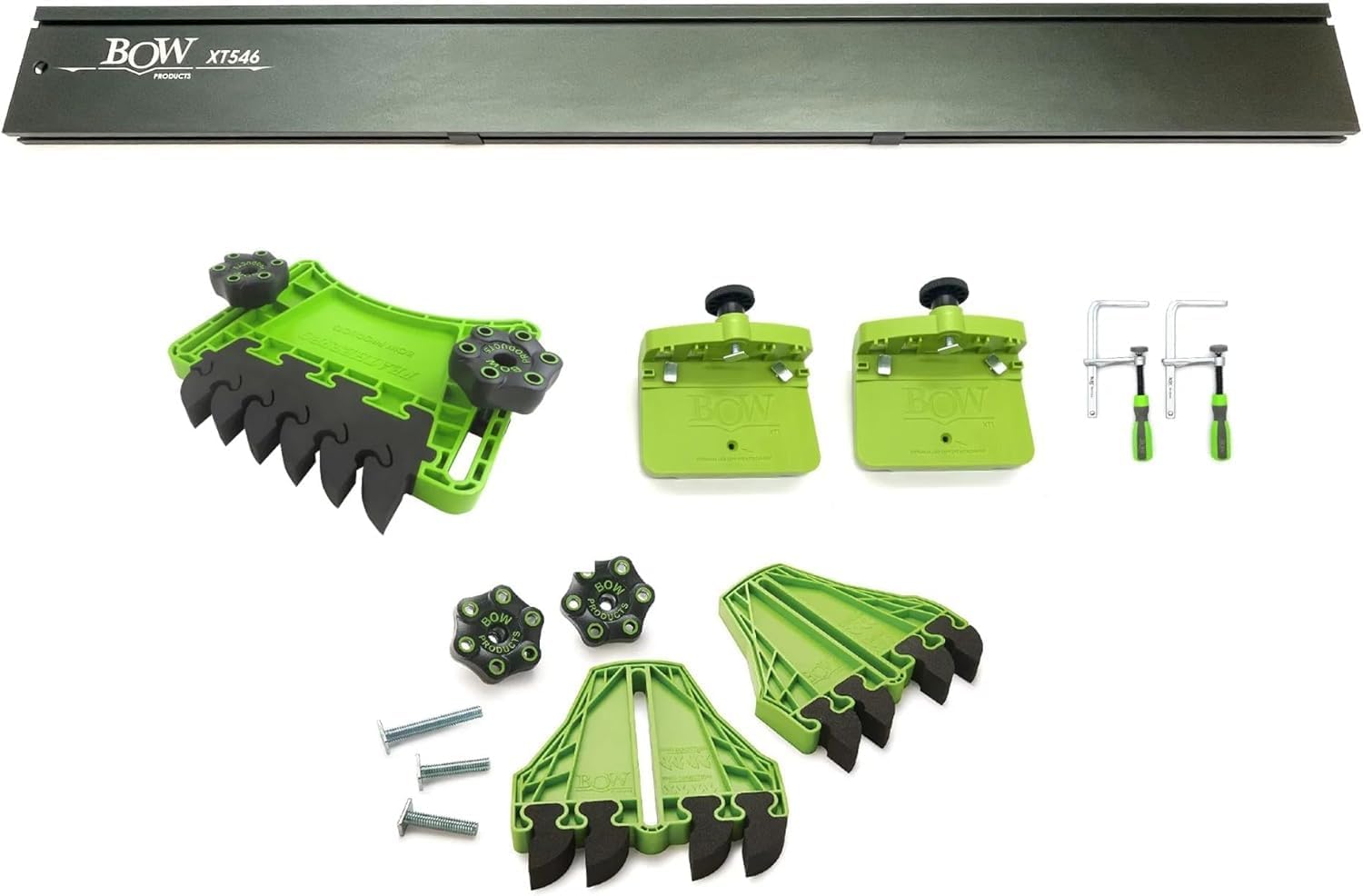
Of the products in this list, the BOW Products XTENDER is the closest match for someone seeking more support during rip cuts. It is a 46-inch fence extension that attaches to an existing table saw fence; it is not a standalone fence or a replacement for a fence that does not lock square and parallel to the blade.
The kit includes two XT1 feed supports, two XT2 T-track clamps, two FencePRO FP4 featherboards, and one FeatherPRO FP1 featherboard. The XTENDER has T-slots along its face, top, and back for mounting included or compatible accessories. Its position can be adjusted for infeed, outfeed, or a centered setup, and the product information says it attaches to or detaches from a fence in under 10 seconds.
Extra support can help when handling longer stock on a small portable or contractor saw, while featherboards can help hold stock against a fence during a cut. Owners have noted that the extension feels substantial and can be useful on compact jobsite setups. Still, you must confirm that the kit fits your saw’s fence and set up any supports so they do not interfere with the blade or workpiece. It can improve the working area around a compatible fence, but it does not correct a misaligned fence.
Pros:
- 46-inch extension adds support to a compatible existing fence
- Includes feed supports, clamps, and featherboards
- T-slots allow multiple accessory positions
- Can be positioned for infeed, outfeed, or centered support
Cons:
- Not a standalone rip fence or a replacement for a faulty fence
- Compatibility and attachment setup should be checked for your saw
Verdict: For a compatible saw with a sound existing fence, this is the most relevant choice here for adding rip-cut support and accessory options.
4. WolfPawn Extendable Miter Gauge: Longer Crosscut Capacity

The WolfPawn miter gauge has a 19.5-inch standard fence that can extend to support crosscuts up to 36 inches, according to the product description. It includes inch and millimeter scales, a hidden flip stop, and a micro-adjust feature with a magnifier. These features are aimed at repeatable crosscuts rather than ripping.
Its angle-setting button and locating holes provide positive stops for several common angles. The aluminum-alloy gauge has adjustable bars for standard 3/8-by-3/4-inch miter slots, and the listing describes a sliding pad intended to help it move smoothly across the table. Some users find the extended fence and stop useful for trim work, though initial setup may take time.
The ability to extend the fence is useful when you need more support for longer crosscut pieces. However, one reported limitation is that the extension may work only on the left side of a saw, which could restrict your preferred setup. Check the intended orientation and available clearance on your saw before choosing it. Like the other gauges, it cannot guide a long rip cut in place of a parallel fence.
Pros:
- Extends to support crosscuts up to 36 inches, as specified
- Micro-adjustable flip stop supports repeat cuts
- Positive angle stops for common settings
- Includes inch and millimeter scales
Cons:
- Not designed to replace a rip fence
- Extension direction may limit setup options on some saws
Verdict: Consider this gauge if you want a longer, extendable crosscut guide and can confirm its orientation works with your saw.
5. MIMYTH Mini Table Saw: For Small Craft Materials, Not Full-Size Ripping

The MIMYTH is a small, multifunctional craft saw rather than a table saw fence accessory. Its product description lists four 2.5-inch blades for different materials, an adjustable blade height up to 0.59 inch, and a cutting angle range from 0 to 90 degrees. It also includes a drill chuck, sanding disc, and soft shaft for other small-scale tasks.
This compact tool is aimed at model-making, hobby work, and small materials such as balsa wood, thin wood, plastic sheets, and some metal pieces. Owners who use it for miniatures and small projects appreciate its small footprint and range of included functions. The scale and stated cutting depth make it unsuitable as an upgrade for full-size rip cuts.
The supplied information also indicates that its fence and crosscut guides may need improvement for some users. That makes careful setup especially important, and it should not be treated as a precision rip-fence solution. Compared with the other products here, it is the only complete saw, but it serves a separate craft-focused purpose.
Pros:
- Compact format for craft and model-making projects
- Includes multiple blades for different small materials
- Adjustable blade height and cutting angle
- Drill chuck and sanding accessories add other functions
Cons:
- Not intended as a full-size table saw or rip-fence upgrade
- Fence and crosscut guides may require careful setup
Verdict: Buy this for small craft tasks if its limited cutting capacity fits your work; skip it if your goal is accurate rip cuts on a full-size table saw.
How to Choose a Table Saw Fence for Accurate Rip Cuts
Make sure you are shopping for a rip fence
A rip fence guides a board along the saw blade at a set distance, helping you cut a consistent width. A miter gauge rides in the table slot and guides work across the blade for crosscuts and angled cuts. Those tools solve different problems. If your goal is ripping, start with a fence that locks securely and can be aligned parallel to the blade.
Check whether you need a replacement or an extension
A fence extension adds length, mounting points, or workpiece support to a compatible fence. It does not automatically replace the locking and alignment functions of the original fence. If your current fence shifts, will not lock securely, or is out of alignment, an extension may not address the main problem. Confirm how an add-on attaches and which fence styles it supports before buying.
Match the accessory to your saw and its slots
For miter gauges, compare the bar dimensions with your saw’s miter slots, including whether the slot is a T-slot or U-slot. For fence extensions, check the mounting method and any stated compatibility notes. A product that fits the table slot may still not fit your fence, so assess both connections when relevant.
Consider the size of the stock you handle
Long or wide workpieces need enough support at the infeed and outfeed sides to stay controlled as you cut. A longer fence extension or feed supports may help with handling, but they do not replace a stable saw setup or careful technique. For small crosscuts, a miter gauge with a stop may be more useful than a long rip-fence extension.
Look for useful adjustment and measurement features
Scales, adjustable stops, and micro-adjust features can save time when you make repeated cuts. Treat built-in scales as setup aids, not a substitute for checking the cut against a reliable measuring tool. Calibrate the gauge or fence to your saw, and verify the first cut before repeating a batch.
Keep the intended cut and safe operation in mind
Use a rip fence for ripping and a miter gauge for crosscuts; do not use both to trap a workpiece during a cut. Featherboards and supports can help manage stock when they are set up correctly, but they do not make an unsafe setup safe. Follow the saw and accessory instructions, keep hands clear of the blade, and use suitable workpiece support.
Frequently Asked Questions
Is a miter gauge the same as a table saw rip fence?
No. A rip fence guides material parallel to the blade for lengthwise cuts. A miter gauge rides in a slot and guides work across the blade for crosscuts and angled cuts.
Which product in this list is most relevant to rip cuts?
The BOW Products XTENDER is the most relevant because it adds length, accessory mounting points, and support to a compatible existing fence. It is an extension, not a standalone rip fence or a fix for a fence that will not align properly.
Will the GOINGMAKE or WolfPawn gauges improve rip-cut accuracy?
They are designed for crosscuts and miter cuts, not for guiding long rip cuts. Their stops and angle adjustments can help with repeatable cuts across the blade, but they do not replace a rip fence.
What should I check before buying a miter gauge?
Check your saw’s miter-slot dimensions and shape, such as whether it uses a 3/8-by-3/4-inch T-slot or U-slot. Also consider fence length, stop design, angle settings, and whether you are comfortable calibrating the gauge to your saw.
Can a fence extension correct a fence that is out of alignment?
Not by itself. An extension adds support or mounting options, but the original fence must still lock securely and align correctly. Check your saw and fence setup before adding an extension.
Is the MIMYTH mini saw suitable for ordinary table saw rip cuts?
No. It is described as a miniature craft saw with a maximum stated blade height of 0.59 inch. It is intended for small craft materials and should not be treated as a full-size table saw or rip-fence upgrade.
Conclusion
For accurate rip cuts, choose a properly aligned rip fence that fits your saw and locks securely. Among these five products, the BOW Products XTENDER is the closest fit for adding support and accessories to a compatible existing fence, but it does not replace that fence. The GOINGMAKE and WolfPawn products are miter gauges for crosscuts, while the MIMYTH is a small craft saw. Match the tool to the cut you need rather than expecting a crosscut guide or miniature saw to improve full-size ripping.