
Choosing the best 100 percent silicone roof coating starts with matching the coating to your roof, its condition, and the amount of material the job needs. Silicone coatings are designed to create a water-resistant layer, and several options here also offer a bright white finish. Compare the listed roof types, application guidance, and coverage carefully—especially if your roof has ponding water, old coatings, or areas that need repair.
Table of Contents
Quick Comparison
| Product | Size | Standout feature | Best suited for |
|---|---|---|---|
| Countryman 100% Silicone Roof Coating | 4.75 gallons | High-solids formula; no primer required for most listed surfaces | RV and flat roofs |
| AWF PRO 100% Silicone Roof Coating | 5 gallons | Coverage and film-build guidance provided | Commercial, low-slope, and RV roof projects |
| Jetcoat Ultra White 100% Silicone Roof Coating | 4.75 gallons | Lists a wide range of roof surfaces | Residential and commercial roofs |
| Gardner Black Jack Eterna-Kote 100% Silicone+ Roof Coating | 1 gallon | Product states it is rain safe in 15 minutes | Smaller coating jobs and repairs |
| Kool Seal 100% Silicone Roof Coating | 5 gallons | White silicone coating in a larger container | Shoppers who can confirm suitability for their roof |
Our Picks: Best 100 Percent Silicone Roof Coating reviews
Countryman: A High-Solids Option for RV and Flat Roofs

Countryman’s white coating comes in a 4.75-gallon container and is aimed at RV and flat-roof use. The brand describes it as a high-solids formula, meaning it is designed to leave a thicker silicone layer after curing than a lower-solids product. It also promotes a single-coat application when used at the recommended coverage rate.
The listed compatible surfaces include metal, EPDM rubber, fiberglass, spray polyurethane foam, modified bitumen, and existing silicone coatings. Countryman says primer is not needed for most applications, but that does not remove the need to clean and prepare the roof correctly. Check the product directions for your exact roof material and condition before applying.
This is a practical option if you want one coating marketed for both RV and flat roofs, and you value a simpler application plan. One limitation is that the supplied product details do not give a coverage figure, so you will need to consult the label or listing to estimate how many containers your roof requires. Its single-coat claim also depends on following the recommended application rate and having a suitable roof surface.
Pros:
- High-solids formula intended to leave a thicker cured layer
- Listed for several common roofing materials
- Primer is not required for most listed applications, according to the manufacturer
- Designed for RV and flat-roof use
Cons:
- Supplied details do not state a coverage rate
- Single-coat performance depends on the recommended application rate and roof condition
Verdict: Choose Countryman if you want a versatile silicone coating for an RV or flat roof and can confirm the required coverage for your project.
AWF PRO: Detailed Coverage and Film-Build Guidance

AWF PRO’s five-gallon coating is designed for flat and low-slope roofs, with RV applications also listed. Its product details provide more application numbers than most options in this group: the formula is listed as 96% solids, with approximate coverage of 333 square feet per pail at 1.5 gallons per 100 square feet. Actual coverage can change with roof texture and application method.
The coating is described as reflective white, with stated solar reflectance of up to 87% and thermal emittance of 89%. AWF PRO also lists 249% elongation and a temperature range of -50°F to 200°F. These are manufacturer-provided specifications, not a promise of performance on every roof. The product can be applied by roller, brush, or high-pressure airless spray equipment.
The detailed guidance makes this a useful choice for shoppers planning a larger project or comparing the coating thickness required for a system. The tradeoff is that this is not presented as a one-size-fits-all, one-coat solution: primers, bleed blockers, reinforcement, or extra coats may be needed depending on the substrate and roof condition. Warranty options are also tied to specified dry-film thickness and system requirements, so read those terms before relying on them.
Pros:
- Provides a stated coverage rate and film-build guidance
- Can be applied by brush, roller, or airless spray equipment
- Lists reflectance, emittance, elongation, and temperature specifications
- Suitable for commercial, low-slope, and RV roof applications according to the product details
Cons:
- Additional system products or coats may be needed for some roofs
- Coverage varies with roof texture and application method
Verdict: AWF PRO is a strong fit if you want clear application and film-build numbers, but plan the full roof system rather than assuming one pail or one coat will be enough.
Jetcoat Ultra White: Broad Listed Surface Compatibility
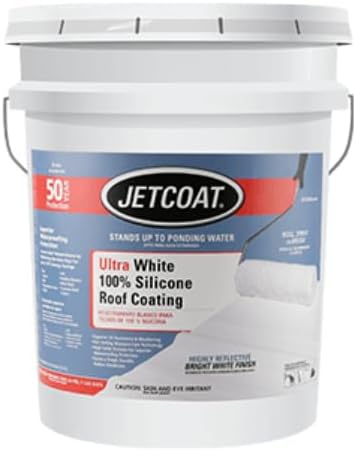
Jetcoat Ultra White is a 4.75-gallon silicone coating listed for residential and commercial roofs. Its stated compatible surfaces include asphalt, wood, built-up roofing, polyurethane foam, modified bitumen, EPDM, APP, metal, and concrete. That wide range may be useful if your roof material is less common, but confirm the specific substrate and preparation steps in the product directions.
The product description says it can be applied with airless spray equipment or a medium-nap roller. It also gives approximate coverage of 250 square feet per container, while noting that surface porosity affects the result. That figure is helpful for early planning, but porous or rough areas may require more material.
The product title includes a “50-Year” claim, but that wording alone should not be treated as a guaranteed service life. Check the product listing and written warranty terms to understand what the claim means and what conditions apply. Availability may also change, so confirm that the item can be ordered before building your project plan around it.
Pros:
- Lists compatibility with a broad range of roofing surfaces
- Gives an approximate coverage figure
- Application options include a medium-nap roller or airless sprayer
- Bright white finish is intended to reflect sunlight
Cons:
- Coverage depends on surface porosity
- Clarify the meaning and conditions of the “50-Year” claim before purchase
Verdict: Consider Jetcoat if your roof material is among its listed substrates and you want coverage guidance, but verify current availability and any warranty terms first.
Black Jack Eterna-Kote: A Smaller Container with Fast Rain-Safe Claim

Black Jack Eterna-Kote is a one-gallon white silicone coating intended for flat roofs and other roofing surfaces. The manufacturer describes it as a moisture-cure product that forms a flexible waterproof seal and can withstand ponding water. Its smaller container may be easier to manage for a limited-area project than the larger pails in this comparison.
A standout claim is that the coating is rain safe in 15 minutes. That can matter when weather is a concern, but follow the label’s temperature, surface-preparation, and application directions rather than treating the timing as universal. The product is also described as low odor and usable across a wide temperature range, though the supplied details do not give exact coverage or a complete list of compatible roof materials.
Compared with the five-gallon choices, this container is a more natural fit for a small job than a full roof restoration. For a larger area, calculate material needs before buying and check whether the application requires multiple containers or additional preparation products.
Pros:
- One-gallon container suits smaller projects
- Manufacturer states it is rain safe in 15 minutes
- Flexible finish is designed to resist cracking
- Product description highlights use on flat roofs and resistance to ponding water
Cons:
- Supplied details do not state coverage per gallon
- Compatible roofing materials are not fully listed in the supplied information
Verdict: Black Jack is worth considering for a smaller roof-coating job where the rain-safe claim is useful, provided the product label confirms compatibility with your roof.
Kool Seal: A Five-Gallon Silicone Coating with Limited Details

Kool Seal’s listed product is a white, five-gallon 100% silicone roof coating. That is the extent of the supplied product information, so there is not enough detail here to compare its coverage, application method, compatible roof materials, or curing instructions with the other options.
The larger container may appeal to shoppers coating a broad area, but container size alone does not show how much roof it will cover. Before ordering, check the current product information and label for the required application rate, roof compatibility, preparation steps, and whether a primer or additional coats are needed.
This product is harder to recommend confidently than the other picks because key project-planning details are missing. If those details are available on the listing or product label and match your roof, it may still be worth considering; otherwise, a coating with clearly stated coverage and substrate guidance is easier to assess.
Pros:
- Listed as a 100% silicone coating
- White finish and five-gallon container
- Could suit a larger project if its verified coverage matches your needs
Cons:
- Supplied information does not state coverage or application method
- Roof compatibility and preparation requirements are not provided
Verdict: Consider Kool Seal only after confirming its coverage, application directions, and compatibility with your roof from the current product information.
How to Choose a 100 Percent Silicone Roof Coating
Confirm the Coating Matches Your Roof Material
Start with the roof surface, not the coating’s broadest marketing claim. Check whether the product specifically lists your material, such as metal, EPDM, fiberglass, modified bitumen, or concrete. Existing coatings, repairs, and roof condition can affect adhesion too. If your exact surface is not named, contact the manufacturer before buying rather than assuming it will work.
Calculate Coverage from the Application Rate
Compare the stated coverage with your roof’s measured area and the recommended application rate. Coverage is often an estimate, and rough, porous, or irregular surfaces can use more material. A coating that advertises a single coat may still require a particular thickness or application rate to reach its intended performance. Use the product’s directions to calculate how many containers you need.
Check Whether Primer or Other System Products Are Needed
Some coatings say primer is unnecessary for most applications, while other roof systems may call for primer, a bleed blocker, reinforcement, or extra coats. The right approach depends on the substrate and existing roof condition. Do not skip a required product based on a general claim; follow the instructions for your roof and the coating you choose.
Match the Application Method to Your Setup
Products may be designed for a roller, brush, or airless sprayer. A roller or brush may suit a smaller area, while spray equipment can be useful on a larger roof if you have the proper setup and experience. Check the directions for the recommended tools and any application limits before starting.
Plan Around Weather and Curing Instructions
Temperature, moisture, and the time before rain can affect application. A quick rain-safe claim is useful only when the roof and weather conditions meet the product’s instructions. Read the label for surface-dryness requirements, temperature limits, and curing guidance, and avoid applying the coating if the forecast or roof conditions do not fit those directions.
Evaluate Warranty and Long-Term Claims Carefully
Terms such as “50-year” or “permanent” should not replace a close look at written warranty conditions. Coverage may depend on installation details, film thickness, preparation, or using a complete system. Review the actual terms and keep the product and installation information for your records.
Frequently Asked Questions
What does 100 percent silicone roof coating do?
It forms a silicone coating over a roof surface. The products in this guide are marketed for waterproofing and protection, with some also designed to resist ponding water or reflect sunlight. Results depend on roof compatibility, preparation, application rate, and following the product directions.
Can silicone roof coating be applied over any roof?
No. Compatibility differs by product and roof material. Check the manufacturer’s list of suitable substrates, including any rules for existing coatings or repairs. If your roof material is not listed, ask the manufacturer before applying the coating.
Does 100 percent silicone roof coating need a primer?
It depends on the product and the roof. Countryman says primer is not required for most of its listed applications, while AWF PRO notes that primers or other system materials may be needed based on the substrate and roof condition. Follow the specific product instructions for your project.
How much silicone roof coating do I need?
Measure the area you plan to coat, then compare it with the product’s coverage and recommended application rate. For example, AWF PRO lists approximate coverage of 333 square feet per five-gallon pail at a stated application rate, while Jetcoat gives an approximate 250-square-foot figure per 4.75-gallon container. Actual coverage can vary, so use the directions for the selected product.
Can silicone coating go over an existing roof coating?
Some products list existing silicone coatings as compatible, but that does not mean every old coating is suitable. The surface may need cleaning, repair, or other preparation. Confirm that the old material is compatible and follow the product’s instructions before coating over it.
Is a white silicone roof coating reflective?
Several products in this guide describe their white finish as reflective. AWF PRO provides stated reflectance and emittance figures, while the other product descriptions make more general reflectivity claims. Actual results depend on the product, installation, and roof conditions.
Final Recommendation
For an RV or flat roof, Countryman offers a high-solids formula and lists compatibility with several common roofing materials. AWF PRO is the more specification-focused pick, with explicit coverage and film-build guidance for planning a system. Jetcoat lists broad substrate compatibility, while Black Jack’s one-gallon size may suit a smaller job. Kool Seal is difficult to assess from the available details, so verify its instructions before choosing it. In every case, confirm roof compatibility, coverage, and preparation requirements before you buy or apply a coating.
