A 110-volt tankless heater can save space and provide hot water at a sink, but shower performance depends on how much water it can heat as it flows. Of these five options, only the CNCEST is specifically presented as a shower heater. Even so, its listing does not provide a flow rate, so you should confirm it can deliver a comfortable shower with your incoming water temperature and plumbing before buying. The other electric models are intended for point-of-use applications, while the two larger-capacity options run on gas rather than 110-volt electric power.
Table of Contents
Quick Comparison
| Product | Power or fuel | Best fit | Shower suitability |
|---|---|---|---|
| CNCEST 4,500W Instant Water Heater | 110V electric, 4,500W | Shower-focused use where the electrical setup is suitable | Most directly marketed for a shower; flow rate is not listed |
| xwdzswgs 3,000W Tankless Water Heater | 110V electric, 3,000W | Small point-of-use applications | Not suitable for showers, according to the listing |
| ThermoMate 4.5kW Under-Sink Heater | 120V electric, 4,500W | Sink and other point-of-use hot water | Not presented as a shower heater |
| GASLAND Gasmart E Propane Heater | Propane gas; listed as 120V | Whole-house hot water where propane installation is appropriate | Not a 110V electric heater |
| Rinnai RX180iN Condensing Tankless Heater | Natural gas or propane; listed as 120V | Whole-home hot water with professional installation | Not a 110V electric heater |
Our Picks: Best 110 Volt Tankless Water Heater For Shower reviews
CNCEST 4,500W: The Most Shower-Focused 110V Option

This is the closest match to the search for a 110-volt tankless heater for a shower. The listing describes it as a bath and shower heater and says a shower head, outlet pipe, and bracket are included. Its 4,500W element is paired with a display and temperature adjustment from 86°F to 131°F.
The compact wall-mounted unit has a stainless steel inner liner and lists several protective features, including over-temperature protection, water-and-electricity isolation, and an IPX4 waterproof rating. Those features are useful around a bathroom, but they do not remove the need to follow the installation instructions and local electrical requirements.
The main limitation is that the listing does not give a flow rate or specify the temperature rise at a particular flow. That makes it hard to predict whether it will keep up with your preferred shower flow, especially with cold incoming water. It also lists a current draw of 40.9A, so have a qualified electrician verify that your wiring and circuit can safely support the unit before installation.
Pros:
- Specifically marketed for bath and shower use
- 4,500W heating power and adjustable temperature display
- Shower head and mounting accessories are listed as included
- Lists multiple protection features and an IPX4 rating
Cons:
- No flow-rate information is provided to confirm shower output
- Listed 40.9A draw calls for careful electrical planning
Verdict: Choose the CNCEST only if you want the most shower-oriented 110V option here and an electrician confirms the electrical setup and expected water flow are suitable.
xwdzswgs 3,000W: Compact Heater for Small Point-of-Use Jobs
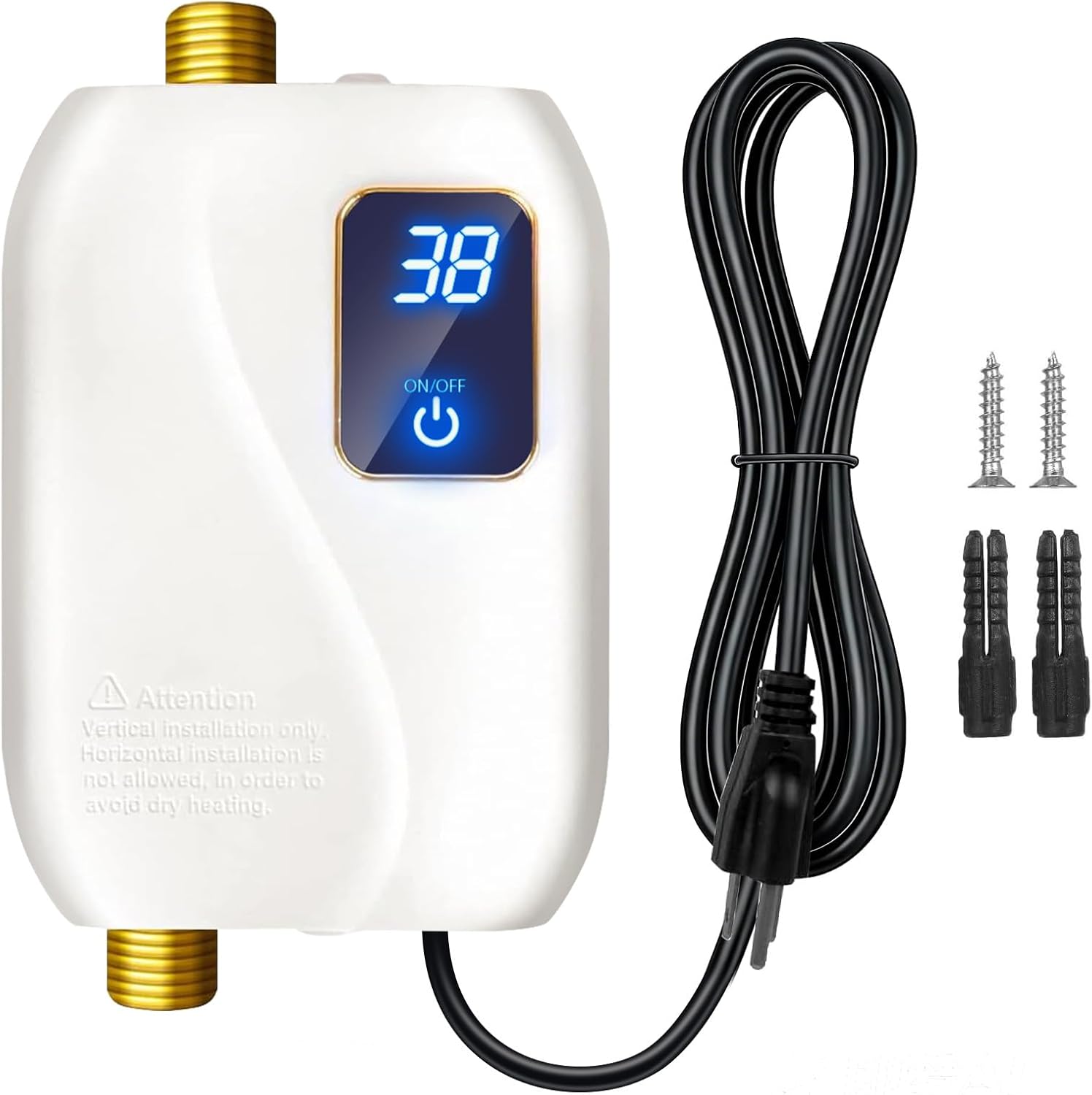
This 3,000W, 110V model is a small wall-mounted heater aimed at sinks and other compact applications. It has an LED display, adjustable temperature settings, and a set of safety features that the listing says include leakage and dry-boil protection, overheating shutoff, and an IPX4 rating. The listing also describes standard 1/2-inch NPT connections.
For shower shoppers, however, the important detail is the manufacturer’s warning: this unit is not suitable for showers, and the listing notes that a shower normally requires at least 1.8 GPM. Its stated temperature-rise figures are tied to very low flows, which helps explain why it is better treated as a small point-of-use heater than a shower solution.
It may make sense for a handwashing sink or another limited-flow use if its installation requirements match your setup. The listing specifies vertical installation only, so plan around that restriction and check the instructions before mounting it.
Pros:
- Compact wall-mounted design for small spaces
- LED temperature display and adjustable settings
- Lists multiple safety protections
- Designed for point-of-use hot water
Cons:
- Listing explicitly says it is not suitable for showers
- Must be installed vertically, according to the listing
Verdict: Skip this model for a shower; consider it only for a small sink or similar low-flow application.
ThermoMate 4.5kW: A More Clearly Specified Under-Sink Choice

The ThermoMate is a compact point-of-use heater intended for under- or over-sink installation. It has a 4,500W heating system, a digital temperature display with one-degree adjustment, and a listed outlet temperature range of 85°F to 131°F. The cast aluminum heating element is separated from the water line, while the water tube is stainless steel.
Its specifications are more detailed than those of several small heaters in this group. The listing gives a 0.26–1.0 GPM range and states that the unit is 120V only, hardwired, and requires a 40A double-pole breaker and minimum 8 AWG wire. Those are specific electrical requirements to verify with a qualified electrician; do not assume this model is a direct fit for a 110V plug-in setup.
The listed flow range and under-sink purpose make this a better match for a faucet than a shower. It can be a useful choice when you need nearby hot water at a sink, but the supplied information does not establish that it can meet typical shower flow needs.
Pros:
- Temperature adjustment in one-degree increments
- Lists a specific flow range and electrical requirements
- Compact format intended for tight spaces near a sink
- ETL approval is stated in the product title
Cons:
- Designed for sink applications, not specifically for showers
- 120V hardwired installation and circuit requirements may not suit every home
Verdict: Pick the ThermoMate for a point-of-use sink installation if its hardwired requirements fit your home; do not choose it as a shower heater without confirmation from the manufacturer and an installer.
GASLAND Gasmart E: A Propane Whole-House Alternative

This GASLAND model is a propane tankless heater, not a 110V electric unit. The product details list 120V power for its electrical components, but the heat source is propane. The listing gives a maximum flow rate of 7.6 GPM and a heat output of 199,000 BTU, positioning it as a whole-house option rather than a small electric heater near a shower.
It lists safety features such as flame-failure, freeze, and overheat protection, and it is described as CSA certified. Because it uses gas and is intended for indoor installation, it requires planning for the fuel supply and correct installation. The listing recommends professional installation for this type of appliance; follow its requirements and applicable local rules.
This model may be worth comparing if your real goal is a stronger whole-home hot-water supply and you already have, or can install, a suitable propane setup. It does not meet the 110V electric brief, and its larger capacity should not be confused with a simple point-of-use shower heater.
Pros:
- Listed maximum flow rate of 7.6 GPM
- Propane-powered whole-house design
- Lists several operating protections
- CSA certification is stated in the product description
Cons:
- Uses propane rather than 110V electricity to heat water
- Requires appropriate gas installation and setup
Verdict: Consider the GASLAND only if you want a propane whole-house heater and can meet its installation requirements; it is not a 110V electric shower-heater choice.
Rinnai RX180iN: A High-Capacity Gas System for Professional Installation

The Rinnai RX180iN is a condensing tankless gas heater that can use natural gas or propane. Its listing gives a maximum flow rate of 10 GPM and 180,000 BTU of heat output. The unit is described as supporting indoor or outdoor installation, with the required outdoor vent cap noted for outdoor use.
This model is far removed from a small 110V electric heater. Its listed 120V power supports the gas appliance; it does not make the unit an electric water heater. The compact design, high stated flow capacity, and Quick Flush feature may appeal to homeowners planning a larger gas system, but the manufacturer recommends professional installation.
It is a possible alternative if you are comparing whole-home gas systems rather than point-of-use electric units. The correct choice depends on fuel availability, installation location, venting needs, and the hot-water demand in your home.
Pros:
- Listed maximum flow rate of 10 GPM
- Supports natural gas or propane, according to the listing
- Indoor or outdoor installation options are described
- Includes a Quick Flush feature and a high stated efficiency factor
Cons:
- Gas-powered, not a 110V electric heater
- Professional installation is recommended
Verdict: The Rinnai is a potential whole-home gas-system option, but it is not the right product if you specifically need a 110V electric shower heater.
How to Choose a 110-Volt Tankless Water Heater for a Shower
Check shower flow and temperature rise
A heater has to raise the temperature of water while it is moving. The faster the flow and the colder the incoming water, the harder a small electric unit must work. Look for a published flow rate at a stated temperature rise, not just a wattage or maximum outlet temperature. If a listing gives no flow information, ask the manufacturer whether it can support your shower’s flow and local incoming-water temperature before you buy.
Match the heater to the electrical supply
Do not assume that a product labeled 110V will work with any nearby outlet or existing wiring. Check its voltage, current draw, breaker and wire requirements, and whether it must be hardwired. For example, the CNCEST listing gives a 40.9A current draw, while the ThermoMate specifies a 40A double-pole breaker and minimum 8 AWG wire. Have a qualified electrician confirm the installation is safe and meets local requirements.
Choose a shower unit, not a sink heater
Many small tankless electric heaters are meant to serve a sink or a low-flow faucet, not a shower. A unit may produce hot water at a small flow but struggle to keep up when more water passes through it. Read the product’s stated use and limitations closely. In this group, the 3,000W model explicitly says it is not suitable for showers, and the ThermoMate is presented as an under-sink heater.
Consider incoming water temperature and your comfort needs
Water entering the heater can be much colder in some locations or seasons, so the same unit may deliver different results from one home to another. Compare the listed temperature range with your preferred shower temperature, but remember that a maximum temperature alone does not show how much water the heater can warm at once. A flow-and-temperature-rise specification is more useful for judging real shower performance.
Review installation location and water protection
Check whether the unit is designed for the location where you plan to mount it, how its water connections are arranged, and what waterproof rating or protective features are listed. Follow the manufacturer’s instructions for clearances, mounting direction, and plumbing. An IP rating or built-in safety feature is not a substitute for correct installation.
Decide whether a gas system is a better fit
If your priority is a full-flow shower or multiple hot-water fixtures, you may need to compare options beyond small 110V electric heaters. The GASLAND and Rinnai models in this guide use gas for heating, even though their listings include electrical voltage for appliance components. They require suitable fuel and professional planning, so treat them as separate alternatives rather than 110V electric replacements.
Frequently Asked Questions
Can a 110V tankless water heater provide a comfortable shower?
It depends on the heater’s wattage, flow rate, incoming water temperature, and electrical setup. A low-power point-of-use heater may work at a sink but fail to provide enough hot water at shower flow. Check for a published flow rate at a stated temperature rise before choosing a model.
Which product in this guide is most directly intended for a shower?
The CNCEST 4,500W model is the only one specifically marketed here for bath and shower use. Its listing does not provide a flow rate, so confirm expected shower performance with the seller or manufacturer and an installer before purchasing.
Is the 3,000W xwdzswgs model suitable for a shower?
No. Its listing explicitly says it is not suitable for showers and describes it as a point-of-use heater for smaller applications.
Is a 120V heater the same as a 110V heater?
Not necessarily for installation purposes. Product labels and household electrical terminology can vary, but you should use the exact voltage, current, and wiring requirements in the product specifications. Have an electrician confirm whether a particular unit is compatible with your home’s supply.
Do the GASLAND and Rinnai models run on 110V electricity?
No. Both use gas to heat water. Their listed electrical voltage is for the appliance’s electrical components, not its main heat source. GASLAND specifies propane, while Rinnai supports natural gas or propane.
What electrical information should I check before buying?
Check the rated voltage, wattage, current draw, breaker size, wire size, and whether the heater must be hardwired. Some listings give specific requirements, and those should be checked against your existing setup by a qualified electrician.
Final Recommendation
The CNCEST 4,500W is the most shower-focused option in this group, but the missing flow-rate specification means its real shower performance is not clear from the supplied details. Confirm that it can meet your flow and temperature needs, and have an electrician verify the listed 40.9A draw and required wiring before you buy. The xwdzswgs and ThermoMate are better treated as point-of-use sink heaters, while the GASLAND and Rinnai are gas-powered whole-home alternatives—not 110V electric shower heaters.