
A 60-gallon air compressor can support longer shop sessions than a small portable model, but tank size is only part of the decision. Match the compressor’s airflow rating to your tools, check its voltage against your shop’s electrical supply, and leave room for the tank and pump. The five options below range from compact-footprint, two-stage designs to models with higher stated airflow, so the best fit depends on the work you do and the utilities you have.
Table of Contents
Quick Comparison
| Compressor | Airflow at 90 PSI | Maximum pressure | Power | Notable detail |
|---|---|---|---|---|
| Campbell Hausfeld 60-Gallon Two-Stage | 7.6 SCFM | 175 PSI | 230V, 3.7 running HP | Oil-lubricated cast-iron pump; 23 x 23-inch footprint |
| VEVOR 60-Gallon Heavy-Duty | 8 SCFM | 155 PSI | 230V, 3.7 HP | Dual air outlets; listing says no plug |
| DEWALT DXCM603.COM 60-Gallon | 14.6 CFM | 175 PSI | 208–230V, 5 HP | High stated airflow; single-stage design |
| JEGS 60-Gallon V-Twin | 6.3 CFM | Not specified | 110V, 3 HP | Single-phase motor; single-stage pump |
| DEWALT 60-Gallon Vertical, 3.7 HP | 11.5 SCFM | 155 PSI | 240V, 3.7 HP | Oil-lubricated pump; vertical tank |
Our Picks: Best 60 Gallon Air Compressors For Shops reviews
Campbell Hausfeld 60-Gallon Two-Stage Compressor for Versatile Shop Work

This stationary Campbell Hausfeld model pairs a 60-gallon ASME tank with an oil-lubricated, two-stage cast-iron pump. It delivers 7.6 SCFM at 90 PSI and reaches a maximum of 175 PSI. That makes it a practical option for a shop using a mix of air tools, though you should compare its airflow with the requirements of any tool that will run continuously.
The vertical tank has a listed footprint of 23 by 23 inches, which may help preserve floor space. Its 3.7 running HP motor requires a dedicated 230/240V supply, so check your shop’s electrical setup before choosing it. The manufacturer describes the pump as engineered for up to 10,000 hours based on a B-10 bearing rating; treat that as a design-life estimate, not a guarantee of service life.
The listing information provided for this guide marks this model unavailable, so confirm its status before planning a purchase. Compared with the DEWALT models here, its stated airflow is lower, but the two-stage pump and 175 PSI maximum pressure may appeal if those features fit your priorities.
Pros:
- Two-stage, oil-lubricated cast-iron pump
- 175 PSI maximum pressure
- Compact listed footprint for a 60-gallon tank
- Suitable for a range of common shop tasks, subject to tool airflow needs
Cons:
- Requires a dedicated 230/240V supply
- Listed as unavailable in the supplied product data; check the listing
Verdict: Choose this Campbell Hausfeld if you want a two-stage cast-iron pump and can accommodate its 230/240V power needs, after confirming that it is available.
VEVOR 60-Gallon Compressor with Dual Air Outlets

The VEVOR combines a 60-gallon tank with a 3.7 HP motor and a belt-driven, oil-lubricated pump. Its stated output is 8 SCFM at 90 PSI, with a maximum pressure of 155 PSI. That airflow is a little higher than the Campbell Hausfeld and JEGS figures in this group, but it is below the two DEWALT models’ stated 90 PSI outputs.
VEVOR lists a 3 mm carbon-steel tank with a powder-coated surface and an oil observation mirror for checking oil level. Dual air outlets are intended to let two tools connect at once; that does not mean the compressor can supply both tools at their full airflow demand continuously. The model is listed as 230V single-phase and does not include a plug, so plan for suitable electrical installation.
This is a reasonable candidate for a shop that values dual outlets and wants a 60-gallon tank without needing the highest airflow in this comparison. The supplied information does not state its dimensions, pump life, or noise level, so check the listing and installation details if those factors matter to your layout.
Pros:
- Stated output of 8 SCFM at 90 PSI
- Dual air outlets for connecting two tools
- Oil observation mirror simplifies oil-level checks
- 60-gallon tank and 155 PSI maximum pressure
Cons:
- 230V setup and no plug are listed, so electrical planning is needed
- Lower stated airflow than either DEWALT option
Verdict: Consider the VEVOR if its dual outlets and 8 SCFM rating suit your tools and you can arrange the required 230V connection.
DEWALT DXCM603.COM for Higher Stated Airflow
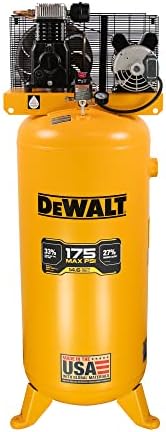
This DEWALT has the highest stated airflow in the comparison: 14.6 CFM at 90 PSI and 17 CFM at 40 PSI. It combines that output with a 5 HP motor, a 60-gallon ASME tank, and a maximum pressure of 175 PSI. Those figures make it the strongest on paper for shop tools with substantial air demands, but check each tool’s required CFM and pressure rather than relying on tank size alone.
The compressor uses a single-stage mechanism, unlike the two-stage Campbell Hausfeld. Its motor is described as suitable for 208–230V applications, while the product information also says it should be connected to a 240V, 60 Hz AC supply. Confirm the exact electrical requirements on the product listing and with a qualified installer before purchase.
The listing information supplied for this guide marks this model unavailable, so verify stock before making plans. Its high airflow is a clear advantage over the other options listed here, but the 5 HP motor and electrical requirements may call for more preparation than a lower-output model.
Pros:
- Highest stated airflow of these five models at 90 PSI
- 5 HP motor and 175 PSI maximum pressure
- 60-gallon ASME tank
- Designed for 208–230V applications, with 240V connection guidance in the listing
Cons:
- Listed as unavailable in the supplied product data; confirm current status
- Electrical connection details should be checked carefully before installation
Verdict: If your tools need more airflow than the other models provide, this DEWALT stands out on specifications, provided it is available and your shop can support its electrical requirements.
JEGS 60-Gallon V-Twin for a Listed 110V Supply

The JEGS stands apart because its listing specifies a 3 HP, 110V, single-phase motor. It has a 60-gallon tank and a V-Twin, single-stage compressor, with stated airflow of 8.6 CFM at 40 PSI and 6.3 CFM at 90 PSI. That makes it the lowest-output option here at 90 PSI, so it is best matched with tools whose airflow needs stay within that range.
A 110V specification may fit shops that do not have a 230/240V supply available, but do not assume the unit will work with any particular outlet. Check the product listing for connection and circuit requirements before installation. The supplied details do not give a maximum pressure, tank dimensions, or pump material, so those are worth confirming if they affect your decision.
Compared with the larger-output DEWALT models, the JEGS is a more limited match for demanding, continuous-use tools. Its stated electrical specification may make it worth considering for a shop with compatible power and moderate air needs, but the lower 90 PSI airflow is a key tradeoff.
Pros:
- 60-gallon tank with a listed 110V, single-phase motor
- 3 HP V-Twin, single-stage design
- Airflow figures are provided at both 40 PSI and 90 PSI
Cons:
- Lowest stated airflow at 90 PSI among these options
- Maximum pressure and several installation details are not provided in the supplied data
Verdict: The JEGS is worth considering if its 110V specification suits your shop and your tools have modest airflow demands; confirm its connection details and maximum pressure first.
DEWALT 60-Gallon Vertical Compressor with 11.5 SCFM at 90 PSI

This vertical DEWALT has a 3.7 HP motor, an oil-lubricated pump, and a 60-gallon tank. Its stated output is 11.5 SCFM at 90 PSI and 13.4 SCFM at 40 PSI, with a maximum pressure of 155 PSI. That places its 90 PSI airflow between the VEVOR and the higher-output DEWALT DXCM603.COM.
The vertical tank can help use floor space efficiently, although the supplied product information does not give its exact footprint. This model is listed as a 240V compressor, so make sure your shop is equipped for the required supply. Its 155 PSI maximum is lower than the 175 PSI figures for the Campbell Hausfeld and DXCM603.COM, but many buyers will find airflow at their tools’ working pressure more useful than the maximum-pressure number alone.
The listing information provided for this guide marks this model unavailable, so confirm its status before buying. If it is available, it may be a middle ground for a shop that wants more stated airflow than the VEVOR or Campbell Hausfeld without choosing the 5 HP DXCM603.COM.
Pros:
- 11.5 SCFM at 90 PSI and 13.4 SCFM at 40 PSI
- Vertical 60-gallon design
- Oil-lubricated pump and 3.7 HP motor
- Airflow sits between the lower- and higher-output models in this comparison
Cons:
- Requires a 240V supply
- Listed as unavailable in the supplied product data; verify stock
Verdict: This DEWALT is a strong middle-ground choice on airflow if it is available and your shop has the required 240V supply.
How to Choose a 60-Gallon Air Compressor for Your Shop
Match Airflow to Your Tools
Check the CFM requirement for each air tool at the pressure where you plan to use it. A large tank stores compressed air, but it does not make up for a pump that cannot keep up with a tool’s ongoing demand. For tools used for long stretches, compare their required airflow with the compressor’s CFM at the same PSI. Of these options, the DEWALT DXCM603.COM has the highest stated output at 90 PSI, while the JEGS has the lowest.
Confirm Voltage and Electrical Requirements
Power needs vary across these models. The JEGS is listed as 110V single phase, while the other options specify 230V, 230/240V, or 240V. Check the product listing and your shop’s electrical supply before choosing a compressor. The VEVOR listing says no plug is included, and the DXCM603.COM information includes more than one voltage reference, so verify the exact connection requirements rather than assuming a particular outlet or circuit will work.
Consider Pressure Alongside CFM
Maximum pressure is not the only number that matters. The models here list maximum pressures from 155 to 175 PSI, but your tools may use a lower working pressure. Look for airflow ratings at a pressure close to your tools’ requirements, then check whether the compressor can supply that airflow. A higher maximum PSI does not automatically mean a compressor is the better fit for every tool.
Think About Pump Design and Maintenance
The Campbell Hausfeld is described as a two-stage, oil-lubricated cast-iron pump. The VEVOR and second DEWALT also list oil-lubricated designs, while the JEGS is described as a V-Twin single-stage model. Oil-lubricated compressors need the maintenance described by the manufacturer, so review the care instructions before buying. The supplied information does not give detailed maintenance schedules for every model.
Plan for the Tank’s Footprint and Installation
A 60-gallon tank is a substantial stationary unit. Measure the space where you intend to place it and allow for access to controls and maintenance points. The Campbell Hausfeld has a listed footprint of 23 by 23 inches, but exact dimensions are not included for the other choices in the supplied information. Also consider how air will be routed to tools and whether the installation meets the manufacturer’s requirements.
Check Availability and Listing Details
Availability can change, and the supplied product data marks the Campbell Hausfeld and both DEWALT models as unavailable. Check the Amazon listing before settling on one of those options. Before ordering any compressor, confirm the exact model, voltage, included connection parts, dimensions, and any specifications that are important for your shop.
Frequently Asked Questions
Is a 60-gallon air compressor enough for a shop?
It can suit many shop tasks, but tank capacity alone does not determine whether a compressor can run a particular tool. Compare the tool’s airflow requirement with the compressor’s CFM rating at the relevant pressure, especially if the tool will run continuously.
Which compressor in this comparison has the highest airflow?
The DEWALT DXCM603.COM has the highest stated airflow at 14.6 CFM at 90 PSI. Its listing information marks it unavailable in the supplied data, so check the product page for current status.
Which option is listed for 110V power?
The JEGS is listed with a 110V, single-phase, 3 HP motor. Confirm the required circuit and connection details with the product listing before installation.
Does a higher maximum PSI mean a compressor is better?
Not necessarily. Maximum PSI describes the highest listed pressure, while CFM at the pressure your tool uses helps show whether the compressor can keep up during operation. Compare both figures with your tools’ requirements.
Can I use two air tools at the same time?
The VEVOR has dual air outlets for connecting two tools. Whether it can supply both tools at once depends on their combined airflow demand and the compressor’s output, so check those requirements before using them together.
Do these compressors include a plug?
The supplied information specifically says the VEVOR is 230V single phase and has no plug. For the other models, check the individual listing for plug and wiring details rather than assuming what is included.
Final Recommendation
For the highest stated airflow, the DEWALT DXCM603.COM leads this group on paper, while the DEWALT 3.7 HP vertical model offers a middle-ground airflow figure. The Campbell Hausfeld stands out for its two-stage cast-iron pump, and the VEVOR includes dual outlets. The JEGS is the only option listed at 110V, but it has the lowest stated airflow at 90 PSI. Match your choice to your tools’ CFM needs and your shop’s electrical supply, then confirm availability and installation details on the product listing.
