
Choosing the best breathable paint for exterior brick starts with the coating, not just the color. Brick needs to release moisture, so a mineral lime finish may be a better fit than a conventional paint when breathability is your main concern. Below, we compare five options by finish, application, stated features, and how clearly each product’s information addresses breathability.
Table of Contents
Quick Comparison
| Product | Finish and format | Breathability stated? | Best suited for |
|---|---|---|---|
| Meoded Lime Wash Paint for Brick | Thin, matte mineral limewash | Yes | A soft, weathered look on raw brick or stone |
| Meoded Lime Slurry | Thicker, textured lime coating | Yes | A more dimensional, old-world finish |
| Rust-Oleum Whitewash Masonry Paint | Dilutable, smooth matte whitewash | Not stated in the supplied details | Adjustable coverage on porous surfaces |
| Romabio Masonry Flat | Flat masonry paint | Not stated in the supplied details | Brick, stone, or Hardie board when a flat paint finish is wanted |
| MOLLOR Brick Paint Kit | Dilutable water-based paint kit | Not stated in the supplied details | Small projects where a kit and adjustable opacity are useful |
Our Picks: Best Breathable Paint For Exterior Brick reviews
1. Meoded Lime Wash Paint for a Soft, Natural Brick Finish

Meoded Lime Wash is the most direct match here if you want a breathable coating for exterior brick. It is made with slaked limestone and is described as a mineral finish that lets brick and stone breathe. Rather than forming a uniform, opaque film, limewash gives the surface a matte, softly varied appearance while leaving some of the underlying texture visible.
The product is intended for unsealed brick, stone, and masonry, and its listed application is two coats by brush using cross-hatch, multidirectional strokes. The maker says no base coat is needed on raw, unsealed masonry; if the surface has a sealer, it should be sanded off first. One gallon is listed as covering about 200–300 square feet, though actual coverage can depend on the surface and application.
This is a strong choice when moisture movement and a traditional whitewashed look matter more than a perfectly even paint color. Its limits are just as important: it is not presented as a simple one-coat application, and sealed brick needs extra preparation. The natural color variation is part of the finish, so it may not suit someone seeking a consistent, solid-color coating.
Pros:
- Breathable mineral coating for exterior brick and stone
- Matte finish that preserves natural surface texture
- Made for unsealed masonry, with no base coat needed on raw brick
- Two-coat brush application and stated coverage of about 200–300 square feet per gallon
Cons:
- Sealed surfaces require sanding before application
- Natural variation may look less uniform than conventional paint
Verdict: Choose Meoded Lime Wash if you want a breathable, matte mineral finish and your brick is raw or can be properly prepared.
2. Meoded Lime Slurry for More Texture and Coverage

Meoded Lime Slurry is a thicker, brush-applied alternative to a traditional limewash. It contains more body and aggregate, creating a more dimensional finish while allowing some of the original brick or stone to show through. Like the Lime Wash above, it is described as a breathable mineral coating for interior and exterior masonry.
The slurry is intended for absorbent, unpainted, unsealed brick, stone, masonry, and porous cement. The maker recommends mixing it with 5–10% clean water, applying two coats with a large brush, and sealing with Meoded Stain Shield after a 48-hour cure. The listed coverage is about 65–75 square feet for the 5 kg size or 260–300 square feet for the 20 kg size for a two-coat application.
This finish suits you if you want more visible texture and depth than a thinner limewash provides. The trade-off is that the thicker material covers less area per smaller container and has a specific mixing and sealing process. Its natural variation also means the finished wall will not look like a smooth, uniform paint job.
Pros:
- Breathable mineral coating for exterior masonry
- Thicker formula creates a more textured, dimensional finish
- Can be applied directly to absorbent, unsealed brick and stone
- Coverage is provided for both listed container sizes
Cons:
- Requires mixing and a recommended sealing step after curing
- Small 5 kg size covers less area than the Lime Wash option
Verdict: Pick Lime Slurry if you want a breathable finish with more texture and are comfortable following its mixing and sealing directions.
3. Rust-Oleum Whitewash for Adjustable Coverage

Rust-Oleum Whitewash is a water-based masonry coating for brick, stone, stucco, and wood. It is described as self-priming and sealing, with a smooth matte finish. You can dilute it with water to change the coverage and let more of the underlying surface show through.
The product information lists interior and exterior use and calls out low odor and low VOC as features. Those may be practical considerations for a project where application comfort matters. However, the supplied details do not say that this coating is breathable. If your main goal is to let exterior brick release moisture, do not assume that a “whitewash” label means it performs like a mineral lime coating.
Compared with the two Meoded products, Rust-Oleum offers a smoother finish and adjustable opacity, but its breathability is not established in the available product information. That makes it a possible option for someone focused on appearance and application, but a less certain choice for a brick wall where vapor permeability is a priority.
Pros:
- Made for brick, stone, stucco, and wood
- Can be diluted to adjust coverage
- Self-priming and sealing formula
- Water-based, low-odor, and low-VOC according to the product details
Cons:
- Breathability is not stated in the supplied product details
- Smoother finish may be less suited to a naturally varied limewash look
Verdict: Consider Rust-Oleum for a smooth, adjustable whitewash, but verify its suitability for your brick and moisture conditions if breathability is essential.
4. Romabio Masonry Flat for a Flat Paint Finish
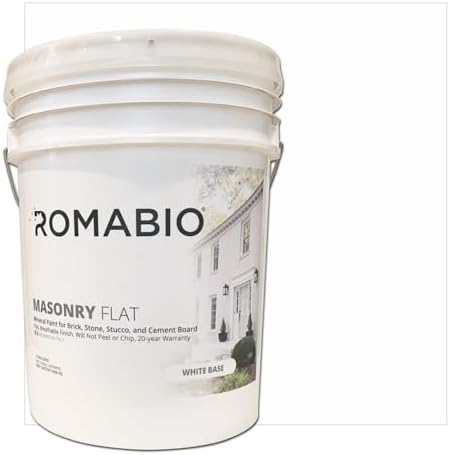
Romabio Masonry Flat is a flat-finish paint listed for brick, stone, and Hardie board. The product information says it can be applied with a brush, roller, or professional sprayer, giving you a few options for handling different project sizes and surface details. It is sold in a five-gallon size in the supplied listing.
For previously painted surfaces, the maker calls for one coat of Romabio MicroGrip Primer first. This is an important distinction if you are repainting an old brick exterior rather than treating bare masonry. The available details do not state that Masonry Flat is breathable, so it is not as clear a match as the Meoded lime products for shoppers specifically seeking a vapor-permeable coating.
Its flat finish may suit a project where a painted, more even appearance is the goal. But if the brick has an existing coating or you are selecting paint based on breathability, check the full product specifications and surface-preparation requirements before buying.
Pros:
- Listed for brick, stone, and Hardie board
- Can be applied by brush, roller, or professional sprayer
- Touch-ups are possible, according to the product details
- Primer direction is provided for pre-painted surfaces
Cons:
- Breathability is not stated in the supplied product details
- Pre-painted surfaces require a separate primer step
Verdict: Choose Romabio Masonry Flat if you want a flat paint finish and its full specifications suit your wall; confirm breathability before using it where moisture release is a key concern.
5. MOLLOR Brick Paint Kit for Small, Customizable Projects

MOLLOR’s 16-ounce brick paint is sold as a makeover kit with painting tools. The water-based formula is described as low odor and suitable for indoor and outdoor use on brick, stone, and concrete. The product details also describe it as a color-restoring coating designed to adhere to rough masonry.
You can dilute it with 10–20% clean water for a lighter, more transparent whitewash effect. The maker recommends testing an inconspicuous area first, which is a sensible step when you want to see how a small amount of paint will look on your specific brick. The listing does not state that the coating is breathable, so it is not the strongest choice if vapor permeability is your deciding factor.
The small container and included tools may be convenient for a limited makeover, such as a small wall or fireplace. For a large exterior, check the coverage information on the listing and calculate the quantity before starting. The product details do not provide a coverage figure here, making it harder to estimate how many containers a full facade would need.
Pros:
- Includes painting tools in the kit
- Listed for indoor and outdoor brick, stone, and concrete
- Water-based and described as low odor
- Dilution allows a lighter whitewash effect
Cons:
- Breathability is not stated in the supplied product details
- No coverage figure is provided in the supplied information
Verdict: MOLLOR may suit a small project where a kit and adjustable opacity are useful, but choose a coating with clearly stated breathability for a moisture-sensitive exterior brick wall.
How to Choose Breathable Paint for Exterior Brick
Look for clear breathability information
Do not rely on words such as “masonry paint,” “whitewash,” or “exterior” alone to confirm that a coating lets moisture move through brick. Look for product information that clearly describes the coating as breathable or vapor-permeable. In this comparison, the two Meoded lime products specifically describe themselves as breathable mineral coatings. For the other options, the supplied details do not establish breathability, so check the full manufacturer specifications before choosing them for a moisture-sensitive wall.
Match the coating to the brick’s current surface
Find out whether your brick is bare, sealed, or already painted before you buy. Meoded Lime Wash and Lime Slurry are described for unsealed, absorbent masonry, and the Lime Wash directions call for sanding off a sealer first. Romabio’s information calls for MicroGrip Primer on pre-painted surfaces. If you are not sure what is on the wall, identify the existing finish before applying a new coating; different surface conditions can call for different preparation.
Choose the finish you actually want
Limewash gives a soft, matte appearance with natural color variation and visible surface texture. Lime Slurry is thicker and more dimensional, while Rust-Oleum Whitewash is described as a smoother matte finish with coverage that can be adjusted by dilution. Romabio is a flat masonry paint. MOLLOR can also be diluted for a lighter whitewash effect. Test a small, inconspicuous patch so you can judge the color and texture on your own brick.
Plan for application and preparation
Application methods differ across these products. The Meoded lime coatings call for brush application, while Romabio allows a brush, roller, or professional sprayer. Rust-Oleum is described as self-priming and sealing, and MOLLOR is packaged as a kit with tools. Read the complete label before starting, especially for directions on dilution, number of coats, primer, curing, and sealing.
Estimate coverage for the whole project
Coverage varies by product and, in the case of Lime Slurry, by container size. Meoded Lime Wash lists about 200–300 square feet per gallon. Lime Slurry lists about 65–75 square feet for a 5 kg container or 260–300 square feet for a 20 kg bucket for two coats. Check the current listing and product label for the other options, then allow for the wall’s texture and the number of coats when estimating how much you need.
Address moisture problems before coating
Paint is not a fix for water getting into a wall. Before coating exterior brick, check for damp areas, damaged mortar, or other signs of moisture and address the cause. Follow the product’s surface-preparation directions and avoid applying a coating to a wall that is not ready for it. If you are unsure about the wall’s condition or the right coating, consult a masonry professional.
Frequently Asked Questions
What makes paint breathable for exterior brick?
A breathable coating allows moisture vapor to move through the coated wall rather than trapping it behind a dense surface film. Check the manufacturer’s specifications for an explicit breathability or vapor-permeability claim. In this group, Meoded describes both its Lime Wash and Lime Slurry as breathable mineral coatings.
Is limewash a good choice for exterior brick?
It can be a suitable choice when you want a breathable mineral finish and the brick is an appropriate surface for the product. Meoded says its Lime Wash is made for unsealed exterior brick and stone. Follow the application directions and prepare sealed or previously coated surfaces as instructed.
Can I apply limewash over painted or sealed brick?
Do not assume that you can apply it directly. Meoded Lime Wash is described for unsealed brick, and its directions say to sand off an existing sealer first. Lime Slurry is also intended for absorbent, unpainted, unsealed masonry. Check the product instructions for your exact surface before proceeding.
What is the difference between limewash and lime slurry?
Limewash is the thinner, softer-looking option in this comparison, with matte color variation and visible brick texture. Lime Slurry is thicker and has more body and aggregate, so it creates a more dimensional finish. Both Meoded products are described as breathable mineral coatings.
Does whitewash always mean a coating is breathable?
No. “Whitewash” describes an appearance or product style, not a guarantee of breathability. Rust-Oleum Whitewash allows adjustable coverage, but the supplied product information does not state that it is breathable. Confirm the full specifications if that feature matters for your project.
Do I need to seal lime slurry after applying it?
Meoded recommends sealing Lime Slurry with its Stain Shield after a 48-hour cure. Follow the current label directions for the product you purchase, including the stated curing time and sealing instructions.
Final Recommendation
For exterior brick where breathability is the priority, Meoded Lime Wash is the clearest all-around pick in this comparison: its product details explicitly describe a breathable mineral coating, give directions for unsealed brick, and list approximate coverage. Choose Meoded Lime Slurry instead if you want a thicker, more textured finish and are comfortable with its mixing and sealing steps. For the other paints, confirm breathability with the manufacturer before applying them to brick where moisture movement is a concern.
