
A bucket water heater with a thermostat can warm water to a chosen temperature and switch off or cycle as it reaches that setting, reducing the need to monitor the water constantly. The picks below are portable immersion heaters, but they differ in wattage, controls, and safety features. Before choosing one, check the heater’s instructions, match it to your water volume, and plan to fully submerge it before plugging it in and unplug it before removing it.
Table of Contents
Quick Comparison
| Product | Power | Standout features | Best fit |
|---|---|---|---|
| Laoaivena 2000W Heater with Delayed Start | 2000W | Thermostat, LCD, delayed start, stainless steel guard | Small buckets and other small water volumes |
| Laoaivena 2000W Heater with Temperature Display | 2000W | Thermostat, LED display, stainless steel guard | Simple temperature-controlled heating |
| Xyloz 1800W Heater with GFCI | 1800W | Adjustable LCD controller, built-in GFCI, ETL-certified plug | Shoppers prioritizing added electrical protection |
| ROKAFU 1800W Heater with Dry-Burn Protection | 1800W | Temperature display, auto shut-off, stated minimum water volume | Small buckets and containers that meet its use limits |
| Fextaoty Portable Heater with GFCI and Thermostat | Listing gives conflicting wattage details | Thermostat, GFCI plug, 304 stainless steel | Shoppers willing to confirm the specifications before buying |
Our Picks: Best Bucket Water Heater With Thermostat reviews
1. Laoaivena 2000W Heater with Delayed Start for Flexible Timing

This 2000W immersion heater is designed for buckets, bathtubs, small pools, and other modest amounts of water. Its built-in thermostat lets you choose a target temperature, while an LCD displays the current water temperature. The listing says it can warm five gallons in about 15 minutes, though starting temperature, container shape, and surrounding conditions can change heating time.
A delayed-start timer is the main feature that sets this model apart. The product description says you can schedule heating up to 999 minutes ahead. That may be useful when you want to plan a heating session, but it does not make the unit suitable for unattended operation. Follow the manual and keep the heater supervised while it is powered.
The heating element is surrounded by a 304 stainless steel guard, which helps keep the element away from hands, container walls, and animals. The listing suggests farm and outdoor uses, but an immersion heater still needs careful supervision around livestock and other animals. The maker also says to limit continuous heating to four hours per session and not to use an extension cord.
Pros:
- Thermostat and live LCD temperature display
- Delayed-start timer for planned heating sessions
- Stainless steel guard around the heating element
- 2000W output for small-volume heating
Cons:
- Its timer and controls may be more than you need for occasional bucket use
- The listing advises limiting continuous heating and avoiding extension cords
Verdict: Choose this Laoaivena if you want a high-powered bucket heater with a thermostat, temperature display, and scheduling option, and can follow its operating limits closely.
2. Laoaivena 2000W Heater for Straightforward Temperature Control

This second Laoaivena model also pairs 2000W heating with a built-in thermostat. Its LED panel displays the water temperature, and the product description says the heater shuts off when the set temperature is reached. It is presented for buckets, bathtubs, camping water, inflatable pools, and farm water containers.
Compared with the first Laoaivena, this model has a simpler scheduling feature: its description mentions setting a delay for 30 or 60 minutes rather than a timer of up to 999 minutes. It also uses a 304 stainless steel guard around the heating element. The listing identifies an UL-listed cord, but does not describe a built-in GFCI plug or a low-water sensor, so do not assume it has either feature.
The maker estimates about 15 minutes to warm five gallons from cold to warm. That is a product claim, not a guaranteed heating time; larger volumes will take longer. For bucket use, the straightforward thermostat and display may matter more than extra scheduling options. Use the heater only as directed, with the element fully submerged before plugging it in, and unplug it before taking it out of the water.
Pros:
- 2000W heating with a built-in thermostat
- LED panel shows the water temperature
- 304 stainless steel guard around the element
- Described for several small-volume and outdoor uses
Cons:
- The delay setting is more limited than the first Laoaivena model’s stated timer
- The product description does not specify a built-in GFCI or low-water shutoff
Verdict: This is a good match if you want 2000W power and basic thermostat control without needing an extended delayed-start timer.
3. Xyloz 1800W Heater with Adjustable Control and GFCI
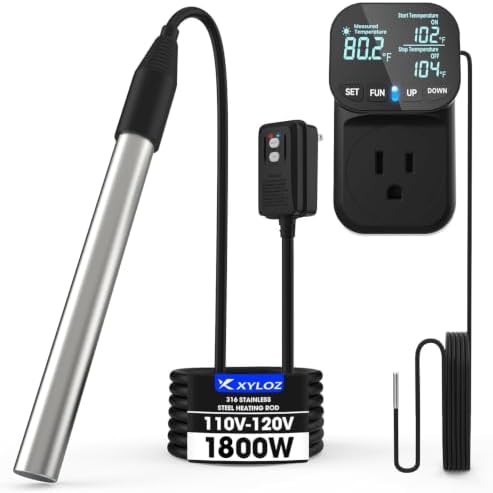
The Xyloz is an 1800W immersion heater with an adjustable LCD temperature controller. The listing says it monitors water temperature and adjusts heating to maintain the selected setting. For a bucket, that gives you more control than a basic immersion rod without a thermostat, although you should still supervise operation and follow the product instructions.
Its listed electrical safety features include an integrated GFCI device and an ETL-certified plug. A GFCI can cut power when it detects a leakage fault, but it is not a substitute for safe setup or proper use. The description also calls out a waterproof wiring design and a 304 stainless steel heating rod. It states that the unit can be heated continuously for three hours; treat that as a limit, not a reason to leave it unattended.
This model is listed for buckets as well as small pools, hot tubs, and water storage tanks. Those broad applications do not mean it can heat any size of container efficiently. For a bucket, check the instructions for minimum water level and placement, and make sure the heater cannot touch the sides or bottom if the manual requires clearance. Its 1800W rating is lower than the 2000W options above, but the GFCI feature makes it a noteworthy alternative for shoppers comparing electrical protection.
Pros:
- Adjustable LCD temperature controller
- Integrated GFCI protection and ETL-certified plug, as stated in the listing
- 304 stainless steel heating rod
- Designed for buckets and other small-volume uses
Cons:
- Lower wattage than the 2000W models in this list
- The stated three-hour continuous-use limit requires planning for longer heating sessions
Verdict: Consider the Xyloz if its stated GFCI protection and adjustable LCD controls are priorities and its 1800W output suits your water volume.
4. ROKAFU 1800W Heater with Temperature and Dry-Burn Protection

ROKAFU’s 1800W heater is described as having a temperature display, thermostat-style cycling, and auto shut-off. The listing says it shuts off if the target temperature is reached or if the water level is too low. That low-water protection is a useful distinction, but it should not replace fully submerging the metal heating tube before plugging in.
The product description recommends at least two gallons of water and gives a maximum safe heating temperature of 194°F (90°C). It also says not to use the heater in iron or glass containers. These restrictions are important: check the container and heater instructions before use, and do not assume that a small bucket is suitable just because it holds water.
At 1800W, this model is less powerful on paper than the 2000W heaters, but it gives more specific operating guidance in its listing. It may suit someone who values a stated low-water shutoff and temperature display for occasional bucket use. The supplied description does not list GFCI protection, so use a GFCI-protected outlet and do not treat the heater’s shutoff feature as electrical protection.
Pros:
- Temperature display and automatic shut-off features
- Listing specifies low-water protection
- Gives a minimum water volume and maximum temperature
- Stainless steel construction
Cons:
- Not intended for iron or glass containers, according to the listing
- Its 1800W output is below the 2000W options
Verdict: The ROKAFU is worth considering if its stated low-water shutoff and clear operating limits fit your setup, but confirm that your bucket material and water volume meet its instructions.
5. Fextaoty Portable Heater with GFCI and Thermostat

Fextaoty combines a thermostat with a GFCI plug and a 304 stainless steel body. The listing describes it as portable and suitable for buckets, bathtubs, camping showers, small spa tubs, and stock tanks. It also advises using the heater in short, controlled sessions and unplugging it when the water reaches the desired temperature.
There is an important specification issue to resolve before choosing this model: the supplied product description calls it a 15.7-inch, 2000W heater in one section, then describes it as a 1500W heater intended for 25–30 gallons in another. Those details do not agree. Confirm the exact wattage, recommended water volume, and included features with the current product information before buying; do not base your decision on either figure alone.
The GFCI plug is a useful feature to compare with models that do not list one, while the thermostat can help control the target temperature. However, the conflicting power and capacity claims make this a less straightforward pick than the other options here. For bucket use, choose it only if the seller’s confirmed specifications match your container and intended heating task.
Pros:
- Listing includes both a thermostat and GFCI plug
- 304 stainless steel construction
- Described for buckets and several portable water-heating uses
- Compact form intended for storage and transport
Cons:
- The product description gives conflicting wattage and capacity information
- The listing advises against long or unattended heating sessions
Verdict: The Fextaoty could suit a shopper seeking a portable heater with a GFCI and thermostat, but verify its actual wattage and water-volume guidance before placing an order.
How to Choose a Bucket Water Heater With a Thermostat
Match the heater to your water volume
Heating time depends on how much water you have, how cold it starts, and the heater’s wattage. The products here range from 1800W to 2000W, but higher wattage alone does not guarantee a particular heating time. Check the maker’s recommended water volume and minimum water level, then compare that guidance with the amount of water you plan to heat. Avoid using a small-volume immersion heater as a substitute for a full-size water or pool heater.
Look at the thermostat and display controls
A thermostat lets you select a target temperature and can cycle or switch off the heater when that temperature is reached. A display can make it easier to see the water temperature, but check whether it shows a live reading and how the controls work. If you want to schedule a heating session, compare the timer details carefully: the two Laoaivena listings describe different delay options.
Check the electrical safety features
Some models list a built-in GFCI, while others describe temperature control or low-water shutoff instead. These features are not interchangeable. A thermostat controls temperature; a low-water shutoff is intended to respond to insufficient water; and a GFCI is designed to cut power when it detects a leakage fault. Use a GFCI-protected outlet, follow the manual, and never touch the water while the heater is plugged in.
Review container and placement limits
Confirm that the heater is suitable for your container and that the heating element can remain fully submerged without touching the bottom or sides, as directed by the instructions. The ROKAFU listing specifically says not to use its heater in iron or glass containers and recommends at least two gallons of water. Other models may have different limits, so do not assume those instructions apply across the whole category.
Consider guards, materials, and handling
A metal guard can help keep hands or the container away from the heating element, and several picks describe stainless steel construction. A guard does not make the heater safe to handle while powered. Keep children and animals away, unplug the unit before removing it, and allow hot surfaces and water to cool as needed before handling or storage.
Check the stated use time and supervision requirements
Use-time limits vary by product. One listing recommends limiting continuous heating to four hours per session, another states a three-hour limit, and the Fextaoty listing advises short, controlled sessions. Follow the instructions for the exact model you buy. Do not leave an immersion heater running unattended, even if it has a thermostat, timer, or automatic shut-off.
Resolve unclear specifications before buying
Specifications matter for matching a heater to a bucket, but product descriptions can be incomplete or inconsistent. The Fextaoty listing, for example, gives both 1500W and 2000W figures. Confirm the actual wattage, water-volume range, plug and safety features, and included controls in the current product details or manual before relying on them.
Frequently Asked Questions
Can I leave a bucket water heater plugged in while I do something else?
No. A thermostat or timer is not a reason to leave an immersion heater unattended. Supervise it while it is powered, keep children and animals away, and follow the specific instructions for your model.
Do I need to fully submerge the heater before plugging it in?
Yes. The product descriptions repeatedly warn that the heating element or metal tube must be fully submerged before power is connected. Unplug the heater before removing it from the water.
Does a built-in thermostat make every immersion heater safe?
No. A thermostat helps control water temperature, but it does not replace safe setup, supervision, or electrical protection. Check whether the specific model also lists features such as GFCI protection or low-water shutoff, and follow its manual.
How long does it take to heat a bucket?
It depends on the water volume, starting temperature, heater wattage, and other conditions. One 2000W listing estimates about 15 minutes for five gallons, but that is not a guarantee. Larger amounts of water generally require more time.
Can I use one of these heaters in a bathtub or small pool?
Some of the products are described for bathtubs or small pools, but each has its own limits. Check the stated capacity and instructions before use. Do not assume a bucket heater is suitable for a full-size pool or any container not listed by the manufacturer.
Is a GFCI plug the same as a thermostat?
No. A thermostat controls the water temperature. A GFCI is an electrical safety device that can cut power when it detects a leakage fault. One feature does not replace the other.
Which model is the best overall choice for a bucket?
The first Laoaivena offers a useful combination of 2000W power, a thermostat, a live display, and a longer delayed-start option. If GFCI protection is your priority, compare the Xyloz and Fextaoty listings, and confirm the features and specifications for the exact model before buying.
Final Recommendation
For most shoppers seeking a thermostat-controlled bucket heater, the Laoaivena 2000W with delayed start offers the broadest mix of listed controls and power. The Xyloz is a strong alternative if its stated GFCI protection is important, while the ROKAFU stands out for its listed low-water shutoff and clear operating limits. Whichever you choose, match it to your water volume, use a GFCI-protected outlet, fully submerge it before plugging in, and never leave it unattended.
