
A condensing gas water heater can provide hot water on demand while recovering heat that would otherwise leave through the exhaust. The right model depends on your home’s hot-water demand, incoming water temperature, fuel supply, venting options, and installation needs. These five picks range from high-capacity whole-home units to a lower-flow option for smaller households.
Table of Contents
Quick Comparison
| Water Heater | Maximum Flow Rate | Efficiency / Capacity | Best For |
|---|---|---|---|
| Rinnai RX199iN Condensing Tankless Water Heater | Up to 11.1 GPM | 199,000 BTU; 0.98 UEF | Large hot-water demand and flexible installation |
| ThermoMate Condensing Tankless Water Heater | Up to 6 GPM | 114,000 BTU; 0.86 UEF | Moderate demand and on-unit diagnostics |
| Rheem RTGH Series Condensing Tankless Water Heater | 8.4 GPM at a 35°F rise | 157,000 BTU; 0.93 UEF | Multi-bathroom homes |
| EZ Ultra HE Condensing Tankless Water Heater | Up to 3.4 GPM at a 45°F rise | Natural gas; indoor installation | Smaller hot-water needs |
| Rheem Prestige Condensing Tankless Water Heater | 11.0 GPM | Natural gas; built-in recirculation | High demand and reduced wait at taps |
Our Picks: Best Condensing Gas Water Heater reviews
1. Rinnai RX199iN: Best for High Demand and Flexible Placement

The Rinnai RX199iN is a high-capacity condensing tankless heater designed for homes with substantial hot-water needs. It is rated for up to 11.1 gallons per minute and 199,000 BTU, and its listed Uniform Energy Factor is 0.98. Actual flow depends on the temperature rise your household needs, so the maximum rating should not be treated as a guarantee of simultaneous use at every fixture.
Its compact size and Versa Vent design give it more placement flexibility than an indoor-only model. The product information says it can be installed indoors or outdoors, with an RX-OVC vent cap required for outdoor installation. Smart Sense gas control supports natural gas and propane, but confirm the configuration and installation requirements with a qualified installer before ordering.
Convenience features include an easy-to-use interface and Quick Flush function. Wi-Fi control requires a separate Controlr module, so it is not built into the purchase as described. Rinnai recommends professional installation. The listed residential warranty includes 15 years on the heat exchanger, five years on parts, and five years on labor when registered within 90 days; otherwise, the labor warranty defaults to one year.
This is the strongest fit in this group for households that need high output and value installation flexibility. Its high capacity may be more than a smaller home needs, and the installation requirements deserve careful review before purchase.
Pros:
- High listed capacity of up to 11.1 GPM and 199,000 BTU
- 0.98 UEF listed efficiency
- Indoor or outdoor installation options, with the required outdoor vent cap
- Supports natural gas and propane through Smart Sense gas control
Cons:
- Wi-Fi control requires a separate module
- Professional installation is recommended, and the outdoor setup requires an additional vent cap
Verdict: Choose the RX199iN if you need high output and want more placement options, provided its fuel, venting, and installation requirements fit your home.
2. ThermoMate: Best for Moderate Demand and Built-In Diagnostics

This natural-gas ThermoMate is a mid-capacity option rated for up to 6 GPM and 114,000 BTU. Its dual heat exchanger combines stainless steel and oxygen-free copper components, and the manufacturer lists a 0.86 UEF. ThermoMate says the unit can supply two showers at 2 GPM each when incoming water is 65°F and the outlet target is 105°F; colder inlet water can reduce the available flow at a given temperature.
A 3.5-inch touchscreen displays the set temperature, water flow, fan operation, and flame status. The listed temperature range is 90°F to 140°F, and the product description includes several built-in safety protections and freeze protection that activates at 41°F. It also requires a 120-volt power connection.
Like other condensing heaters, this model produces condensate that needs a suitable drain. The product information recommends an external condensate neutralizer, which is not included. That means the installation plan should account for drainage and treatment rather than treating this as a simple swap-in appliance.
The ThermoMate is a practical choice for households with moderate demand that want an on-unit display and diagnostic information. Its capacity is below the Rinnai and larger Rheem models, so it is less suited to heavy simultaneous use.
Pros:
- Up to 6 GPM and 114,000 BTU for moderate household demand
- Touchscreen shows operating information and error codes
- Dual heat exchanger design and listed 0.86 UEF
- Includes multiple listed safety protections and freeze protection
Cons:
- Condensate drain and optional neutralizer need to be considered during installation
- Lower maximum flow than the highest-capacity options here
Verdict: Consider the ThermoMate if its 6-GPM rating suits your household and you want a clear display, but plan for condensate drainage and professional installation.
3. Rheem RTGH Series: A Balanced Pick for Multi-Bathroom Homes

The Rheem RTGH Series is an indoor natural-gas model with a listed output of 8.4 GPM at a 35°F temperature rise and 157,000 BTU per hour. Rheem describes it as a whole-home heater intended for homes with several bathrooms. Its listed UEF is 0.93, and the product information notes low-NOx emissions compliance.
For day-to-day operation, the unit has a digital temperature control with stated precision of ±1°F, along with built-in freeze protection and a multi-point safety system. It uses direct venting and comes with mounting hardware and an installation manual. Professional installation is recommended.
Its capacity sits between the 6-GPM ThermoMate and the higher-flow Rinnai and Rheem Prestige models. That middle position may suit a family home, but sizing still depends on the number of fixtures likely to run at once and the difference between incoming and desired water temperatures. The listed warranty is 15 years on the heat exchanger and five years on parts.
This model stands out as a straightforward indoor choice for a home that needs more flow than a compact mid-capacity heater can offer. The product data does not list a built-in recirculation feature, so shoppers focused on reducing wait time at distant taps may prefer the Rheem Prestige.
Pros:
- 8.4 GPM listed at a 35°F rise
- 0.93 UEF and 157,000 BTU per hour
- Digital temperature control and built-in freeze protection
- Direct-vent indoor design with mounting hardware included
Cons:
- Indoor installation only, according to the supplied product details
- Its maximum flow is below the two 11-GPM-class options in this comparison
Verdict: The RTGH Series is a sensible middle-ground option for multi-bathroom homes that need strong flow in an indoor natural-gas unit.
4. EZ Ultra HE: A Lower-Flow Choice for Smaller Hot-Water Needs
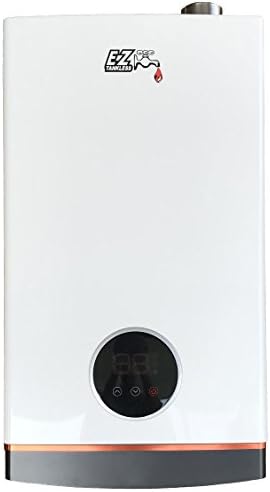
The EZ Ultra HE is an indoor natural-gas condensing tankless heater with a listed output of up to 3.4 GPM at a 45°F rise. Its condensing design uses exhaust gas to preheat incoming water. Compared with the other models in this guide, its stated flow rate is modest, making it a better match for limited demand than a home where several showers and appliances often run together.
The unit can be vented horizontally or vertically using 2-inch solid-core Schedule 40 PVC or CPVC. The product information says a back-draft prevention device and stainless-steel horizontal vent pipe are included. Because venting details affect installation, confirm the planned layout and materials with a qualified installer and local requirements.
This is the simplest, lower-capacity option in the group. It may appeal if your hot-water needs are limited and its venting arrangement suits your home. The available product details do not list a UEF, advanced controls, or a warranty, so check the manufacturer’s current documentation before making a decision.
Compared with the ThermoMate, EZ Ultra HE has a lower listed flow rate and fewer documented operating features. Its main appeal is a straightforward indoor condensing setup with described horizontal and vertical venting options.
Pros:
- Condensing design recovers exhaust heat to preheat incoming water
- Horizontal or vertical venting options are described
- Includes a back-draft prevention device and stainless-steel horizontal vent pipe
Cons:
- Listed flow is only up to 3.4 GPM at a 45°F rise
- Product details provided do not specify UEF or warranty coverage
Verdict: Choose the EZ Ultra HE only if its lower flow rating matches your household’s demand and its venting requirements work for your installation.
5. Rheem Prestige: Best for High Flow with Built-In Recirculation

The Rheem Prestige is an indoor natural-gas condensing tankless heater rated for 11.0 GPM. Its built-in recirculation feature is intended to help reduce the wait for hot water at taps. The product description also lists a water- and gas-leak detection system that can shut the unit down and provide an error code.
Another listed feature is Auto-Learn Programming, which tracks water use over time and programs the unit around peak demand. Rheem also describes a water-saving setting and a compact design intended to save space compared with a tank-style heater. The supplied product information does not specify its BTU rating, UEF, or warranty, so compare those details with the manufacturer’s documentation before purchase.
With its high listed flow and recirculation function, the Prestige is a strong candidate for a busy home where hot water is used at multiple locations. Recirculation features still need to be configured to match the home and its plumbing; ask an installer how the setup will work in your layout. If the higher stated UEF and indoor-or-outdoor flexibility matter more, the Rinnai RX199iN has more complete specifications in the supplied data.
Pros:
- 11.0 GPM listed capacity
- Built-in recirculation aims to reduce hot-water wait time
- Auto-Learn Programming tracks usage and adjusts for peak times
- Water- and gas-leak detection can shut down the unit and provide an error code
Cons:
- Supplied product details do not specify UEF, BTU rating, or warranty
- Indoor natural-gas installation may not fit every home or fuel setup
Verdict: Consider the Rheem Prestige if high flow and built-in recirculation are priorities, but verify its efficiency, warranty, and installation details before committing.
How to Choose a Condensing Gas Water Heater
Size the heater for simultaneous use
Start by listing the hot-water fixtures and appliances you may use at the same time. Then compare that demand with the unit’s flow rate at the temperature rise your home needs. A model’s maximum GPM does not tell the whole story: the listed Rheem RTGH figure, for example, is specified at a 35°F rise, while the EZ Ultra HE figure is specified at a 45°F rise. Colder incoming water generally calls for a larger temperature rise, which can affect available flow. Ask an installer to size the heater for your climate and household habits.
Confirm fuel compatibility
Check whether your home is set up for natural gas or propane and confirm that the selected model supports that fuel in the required configuration. Most models in this guide are described as natural-gas units. The Rinnai RX199iN is listed with Smart Sense gas control that supports natural gas and propane. Do not assume that a unit can switch fuels without the correct setup; verify the details with the manufacturer and installer.
Plan the venting and installation location
Venting options differ by model. The Rinnai RX199iN is described for indoor or outdoor installation, but its outdoor setup requires an RX-OVC vent cap. The Rheem RTGH and Rheem Prestige are described as indoor models, while the EZ Ultra HE lists horizontal or vertical venting with specified pipe materials. Check the installation manual, local code, clearances, and the route for the vent before buying.
Account for condensate drainage
Condensing heaters produce condensate as they recover heat from exhaust. Your installation needs a suitable way to drain it, and some setups may require condensate treatment. ThermoMate specifically recommends an external condensate neutralizer, which is not included. Ask the installer what drainage and neutralization equipment your particular model and local rules require.
Compare efficiency figures carefully
When available, compare Uniform Energy Factor (UEF) figures, but do not treat efficiency as the only measure of value. The supplied data lists a 0.98 UEF for the Rinnai RX199iN, 0.93 for the Rheem RTGH, and 0.86 for the ThermoMate. The supplied descriptions do not state UEF for the EZ Ultra HE or Rheem Prestige. Check the current product documentation for missing figures and compare models using consistent ratings and assumptions.
Think about controls and recirculation
Controls can make routine operation and troubleshooting easier. The ThermoMate has a touchscreen with operating information and error codes; the Rinnai RX199iN includes an interface and Quick Flush feature, while its Wi-Fi control requires a separate module. The Rheem Prestige lists built-in recirculation and usage learning. Consider which features solve a real problem in your home, and ask how they affect installation and operation.
Review warranty terms and service needs
Warranty terms are not identical across these models. The supplied information lists the Rinnai RX199iN with a 15-year heat-exchanger warranty, five years on parts, and five years on labor when registered within 90 days; the Rheem RTGH lists 15 years on the heat exchanger and five years on parts. For models without warranty details here, consult the manufacturer before buying. Also confirm who will install and service the unit, since professional installation is recommended for several of these products.
Frequently Asked Questions
What does a condensing gas water heater do?
A condensing gas water heater captures some heat from exhaust to help preheat incoming water. This heat recovery is the central design feature described for the condensing models in this guide.
How do I know what flow rate I need?
Add up the hot-water fixtures you expect to use at the same time, then compare that demand with each heater’s flow at the temperature rise your home requires. Have an installer account for incoming water temperature, since colder water can affect the output you can use.
Do condensing tankless heaters need electricity?
Some models do. The ThermoMate product information specifies a 120-volt power cord, but the supplied details do not explain the electrical requirements for every model. Check each installation manual and confirm the requirements with an installer.
Does every condensing water heater need a condensate neutralizer?
Condensing units produce condensate, but the required drainage and treatment depend on the unit and installation rules. ThermoMate recommends an external neutralizer for its model, and the product description says it is not included. Ask a qualified installer what your selected heater requires.
Can these water heaters be installed outdoors?
Installation options vary. The Rinnai RX199iN is described for indoor or outdoor use, with an RX-OVC vent cap required outdoors. The other models in this guide are described as indoor units or specify indoor venting. Confirm the approved location and venting plan in the product manual.
Is a tankless heater a simple replacement for a tank heater?
Not always. A tankless model may require different gas, venting, drainage, electrical, or plumbing arrangements. Have a qualified installer check your home and the selected model before treating it as a direct replacement.
Which model is the best overall choice?
The Rinnai RX199iN is the most complete all-around pick in this comparison based on its listed high flow, 0.98 UEF, and indoor-or-outdoor installation options. The best choice for your home still depends on your actual hot-water demand, fuel, installation plan, and budget.
Final Recommendation
For a high-demand household seeking strong listed capacity and flexible placement, the Rinnai RX199iN is the leading choice in this group. The Rheem RTGH offers a balanced indoor option, while the ThermoMate suits moderate demand and adds a detailed touchscreen. The EZ Ultra HE is best considered for smaller hot-water needs, and the Rheem Prestige stands out for its built-in recirculation. Before ordering any model, have a qualified installer confirm the sizing, fuel, venting, condensate, and electrical requirements for your home.
