
A surface-mounted cord cover is a simple way to tidy the cables hanging below a wall-mounted TV without opening the wall. The right choice depends on how many cables you need to hide, how far they run, and whether you want a low-profile strip or a kit with corners and connectors. These five options range from short, simple covers to longer, paintable systems.
| Product | Best for | Capacity and layout | Notable feature |
|---|---|---|---|
| Yecaye TV Cord Hider | A short, straight TV drop | 42 inches; 3–4 wires | Three sections can be used separately or joined |
| Delamu Cord Hider, 157-inch | Longer cable runs | 157 inches; 2–4 wires | Snap-on, click-open design |
| Delamu Large TV Cord Hider | Several TV or network cables | Designed for 3–4 wires; six sections | Cuttable and paintable |
| YCLYC TV Cord Hider | A wider, higher-capacity cover | 39 inches; 3–6 cables | Hinged cover and paintable surface |
| EVZA Paintable Raceway Kit | A longer route with corners | 15.7-inch sections; designed for 3–4 cables | Includes connectors and mounting options |
Table of Contents
Our Picks: Best Cord Covers For Wall Mounted Tv reviews
1. Yecaye TV Cord Hider: A Simple Choice for a Short TV Drop

The Yecaye is a compact surface raceway for tidying the cables that run down from a wall-mounted TV. Its three 14-inch sections add up to 42 inches, and you can use them separately or connect them for a longer straight run. That makes it a practical fit when you only need to cover the space beneath the screen.
The cover uses pre-applied adhesive tape, so installation does not require screws or extra mounting hardware. Its listed internal space is 1.1 inches long by 0.52 inches wide, and the product is intended to hold about three to four wires, depending on cable size. The cover can slide or snap on, which may help when you need to arrange or change cables in a tight spot.
Compared with the longer raceways here, this one is easier to match to a short, simple route but offers less reach. Measure the cable bundle before buying: thicker HDMI or power cables may take up more room than slim network wires. Its adhesive approach is convenient, but the supplied information does not specify compatibility with every wall finish.
Pros:
- Three sections can be used separately or joined.
- Pre-applied adhesive keeps setup simple.
- Slide-on or snap-on cover provides access to cables.
- Compact length suits a short vertical drop.
Cons:
- At 42 inches, it may not cover a longer route.
- The internal width may be limiting for a bulky cable bundle.
Verdict: Choose the Yecaye if you want a straightforward, short cover for a few TV cables and do not need a route with corners.
2. Delamu 157-Inch Cord Hider: A Long Snap-Open Raceway
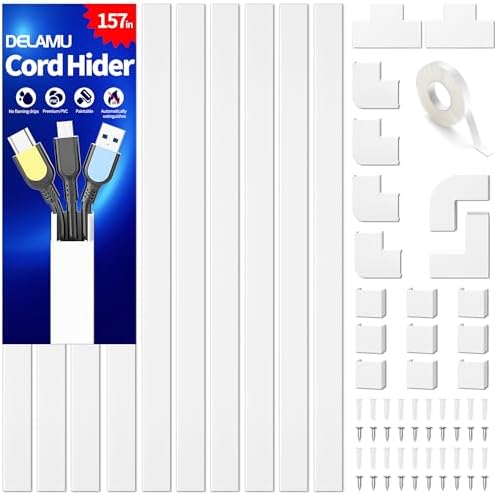
This Delamu kit is designed for a longer wall run than a basic TV drop. Its listed 157-inch length can help cover cables that travel along the wall as well as down from the television. The raceway is intended to organize two to four wires, such as TV, computer, or office cables.
Its attach-and-snap design is the main convenience. The covers click open and closed, so you can place the wires inside and access them again without treating the raceway as a permanently sealed channel. The product description also identifies the material as premium PVC and states that it passed the UL94 V-0 flammability test.
The extra length is useful when the route is not limited to the area directly below the TV, but it can mean more material to measure and align. Plan the path before attaching the adhesive-backed pieces, and check the size of your cable bundle first. This option is a good match for a longer, relatively simple route; the EVZA kit is a better fit if you need a stated assortment of corner connectors.
Pros:
- Long 157-inch run for more extensive cable routing.
- Snap-open covers make cables easier to access.
- Designed to hold two to four wires.
- PVC material is stated to meet the UL94 V-0 rating.
Cons:
- A long route takes more planning to lay out neatly.
- The supplied product details do not list included corner connectors.
Verdict: Pick this Delamu when you need a longer snap-open cover for a modest bundle of cables and want access for future changes.
3. Delamu Large TV Cord Hider: Flexible Sections for a Wider Cable Bundle

This larger Delamu raceway is intended for three to four TV, audio, or network cables. The kit includes six cable-cover sections, giving you flexibility to lay out the route in separate stretches rather than relying on one long piece. It is designed for living rooms, workspaces, and other setups where several cables need to be gathered neatly.
The covers can snap or slide into place, and the product description says they can be cut to the length you need and painted to suit the wall. Adhesive tape is used for mounting. Since the tape is described as very sticky, decide on the route before installation; repositioning may be difficult and could affect the wall surface. The listing says accessories are not included, so check the package details if you need additional connectors or mounting parts.
Compared with the 157-inch Delamu, this model emphasizes larger cable capacity and a set of separate sections rather than a stated total length. It is a useful option when you want to tailor the layout and finish, but you should confirm the number of sections and any connectors you need before starting the job.
Pros:
- Designed to cover three to four TV, audio, or network cables.
- Six sections offer flexible layout options.
- Can be cut to length and painted.
- Snap-on and slide-on cover design allows cable access.
Cons:
- Accessories are not included, according to the product details.
- Strong adhesive makes careful placement important.
Verdict: Choose this Delamu if you need room for several cables and value cut-to-fit sections and a paintable surface.
4. YCLYC 39-Inch TV Cord Hider: More Room for Several Cables

The YCLYC is a short but relatively roomy raceway. It comes as three 13-inch sections for a total of 39 inches, with listed dimensions of 1.5 inches wide by 0.75 inches high. The description says it can hold three to six cables, depending on their size, and gives examples of up to four HDMI cables or six Cat 6 Ethernet cables.
A one-piece hinge design lets you open the cover to add or remove cables. The PVC sections can be cut with a small hacksaw, and the surface can be painted. Adhesive strips are included for installation without screws, but the seller cautions against using the tape on textured, rough, or dusty walls. Removing the strong tape may damage a surface, so think through placement first.
This is a better fit than the slimmer Yecaye if you have a thicker bundle but only need a short run. Its 39-inch length is a clear limitation for a route that extends across the wall. The listing also states that the material meets the UL94 V-0 rating.
Pros:
- Wider channel is designed for three to six cables.
- Hinged cover makes adding or removing wires convenient.
- Three sections can be cut to adjust the layout.
- Paintable surface and stated UL94 V-0 rating.
Cons:
- 39 inches may be too short for longer routes.
- Adhesive is not recommended for textured, rough, or dusty surfaces.
Verdict: The YCLYC is a strong option for a short drop where cable capacity matters more than total length, provided your wall surface is suitable for adhesive.
5. EVZA Paintable Raceway Kit: A Long System with Connectors

The EVZA kit is designed for longer or more involved routes. Its channels are 15.7 inches long, and the listing describes the kit as a 315-inch system. It includes connectors such as couplings, flat pieces, T-junctions, and inside and outside elbows, which can help route cables around corners or change direction.
The raceway is paintable and can be cut with a knife or hacksaw. The product description says it can hold three to four cables, with space for cables up to 1 inch wide and 0.63 inches high. It uses adhesive tape, and the kit also allows drywall anchors and screws as another mounting option. That choice can be useful when adhesive alone is not suitable for your wall.
Compared with the other picks, this one offers the most detailed set of layout parts and mounting options. It may be more than you need for a simple straight drop, and you will need to plan the route to use the connectors well. Check the actual dimensions of your cable bundle against the stated channel capacity before installation.
Pros:
- Long system suited to routes beyond a short TV drop.
- Includes several connector types for corners and junctions.
- Can be painted and cut to fit.
- Offers tape or drywall anchors and screws for mounting.
Cons:
- The kit may be more complex than needed for a simple vertical run.
- Its listed cable capacity still requires checking your bundle’s size.
Verdict: Choose the EVZA if you need a longer, configurable route with connectors and want the option to use screws instead of adhesive tape.
How to Choose a Cord Cover for a Wall-Mounted TV
Measure the route, not just the drop
Measure the full path the cables need to follow, including any horizontal stretch to an outlet or nearby device. Compare that measurement with the total raceway length and the length of each section. A short cover such as the YCLYC or Yecaye may suit a simple drop, while a longer system can be more practical for a route that travels across the wall.
Check the cable bundle’s size
Count the cables and consider their thickness before choosing a channel. Product capacity is a guide, not a guarantee that every mix of cables will fit comfortably. A bundle of thicker HDMI and power cables can take up more room than several slim network cables. Compare your bundle with the listed internal dimensions when they are provided.
Decide whether you need a straight run or connectors
A straight raceway can be enough when the cords only run down from the TV. If you need to turn a corner, branch toward another device, or connect several sections, look for a kit that includes the appropriate connectors. The EVZA kit lists several connector types, while the other products may be better suited to simpler layouts unless you confirm what is included.
Choose a cover you can access
Cables may change when you add a streaming device, console, or other equipment. Snap-on, slide-on, and hinged covers can make it easier to reach the wires later. If you expect the setup to stay fixed, a simpler cover may be enough; if you often rearrange devices, prioritize an easy-to-open design.
Consider the wall surface and mounting method
Adhesive installation is quick, but wall texture and surface condition matter. The YCLYC product details specifically caution against using its tape on textured, rough, or dusty surfaces. Strong tape can also affect paint or the wall when removed. If you need a screw-mounted option, the EVZA kit lists drywall anchors and screws as an alternative.
Plan the finish and fit
Paintable covers can blend into a wall more closely, but make sure the product is designed for painting and choose a color that suits your space. Some sections can be cut to length, which helps create a cleaner fit around a TV or outlet. Measure and plan before cutting or sticking the raceway in place.
Use a surface raceway for the right purpose
A cord cover hides cables along the wall; it does not route them inside the wall. Check the product’s instructions and your local requirements for the specific cords you plan to cover. Keep the raceway within its stated capacity, and do not force cables into a channel that is too small.
Frequently Asked Questions
How many cables can a TV cord cover hold?
It depends on the channel’s internal size and the thickness of your cables. These options are described as holding roughly two to six wires, depending on the model. Check the stated dimensions and allow enough room for the actual cable bundle rather than relying on a wire count alone.
Can I cut a cord cover to fit my wall?
Some can be cut. The Delamu large cord hider and the YCLYC product description say their sections can be cut, and EVZA says its channels can be cut with a knife or hacksaw. Follow the product instructions and measure the route before making a cut.
Can I paint a TV cord cover?
Several picks here are described as paintable, including both Delamu options, the YCLYC, and the EVZA. Check the individual product instructions before painting, and test your paint on a small area if you are unsure how it will look on the surface.
Will adhesive cord covers work on textured walls?
Adhesive performance can depend on the wall surface. The YCLYC listing cautions against using its tape on textured, rough, or dusty walls. If your wall is not smooth, look for a mounting method suited to that surface and check the product’s instructions.
Are these covers installed inside the wall?
No. These products are surface-mounted raceways that cover cables along the outside of the wall. If you want cables routed inside a wall, that requires a different approach and may be subject to electrical and building requirements.
Which option is best for a short TV drop?
The Yecaye is a compact 42-inch option for a simple route with a few wires. If your bundle is larger, the 39-inch YCLYC has a wider channel, though you should confirm that your wall surface is suitable for its adhesive tape.
Which option is best for a route with corners?
The EVZA kit is the clearest match among these choices because its listed parts include couplings, flat pieces, T-junctions, and inside and outside elbows. Plan the route first so you can choose the right connectors and channel lengths.
Conclusion
For a short, simple TV drop, the Yecaye is a practical starting point; for a larger bundle in a short space, consider the wider YCLYC. Choose the Delamu 157-inch option for a longer snap-open run, or the large Delamu for flexible sections and paintability. If your route needs corners or alternate mounting options, the EVZA kit offers the most detailed set of connectors. Before buying, measure your wall route and cable bundle so the cover fits both the length and the wires you need to hide.
