
A good electric roof vent fan can help move hot, stale, or damp air out of an RV, camper, or trailer. The right choice depends on more than airflow: check the roof opening and thickness, power needs, controls, noise details, and whether you want features such as reversible airflow or an automatic rain sensor. These five 12-volt options cover a range of feature sets, from straightforward ventilation to remote-controlled models with added sensors.
Table of Contents
Quick Comparison
| Product | Notable features | Best fit for |
|---|---|---|
| OUTPRIZE Upgraded Remote Control RV Roof Vent Fan | 10 speeds, reversible airflow, rain sensor, remote and panel controls | Shoppers who want detailed speed control and remote operation |
| RVMATE 14×14 RV Roof Vent Fan | Remote, reversible airflow, putty tape and manual handles included | Replacing a standard vent with a remote-controlled model |
| RVLOVENT 10-Speed RV Vent Fan | Rain sensor, remote, up to 1000 CFM, extra screen frame | Those who prioritize airflow and automatic rain protection |
| 2012 RV Roof Vent Fan | Reversible airflow, rain sensor, four speeds, timer modes | Shoppers looking for a quieter fan with timed operation |
| Kohree RV Roof Vent Fan | 12V power, 6-inch blades, standard 14-by-14-inch opening | Those seeking a more straightforward replacement vent fan |
Our Picks: Best Electric Roof Vent Fan reviews
OUTPRIZE: Remote Control and Ten-Speed Flexibility
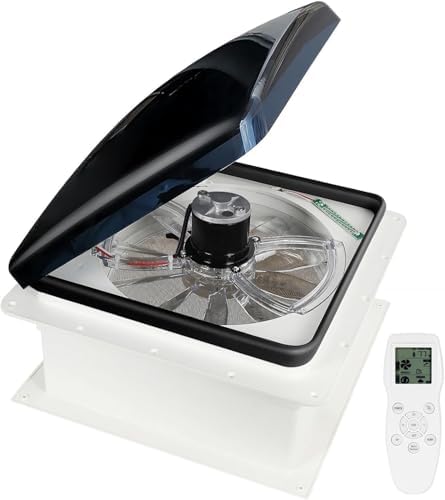
The OUTPRIZE is a 12-volt roof vent fan for a standard 14-by-14-inch opening. Its main draw is a broad set of controls: you can choose from 10 speeds, reverse the airflow to bring air in or push it out, and operate the fan using either the remote or the panel.
The listed airflow range is 400 to 1300 CFM in both directions. The product description also lists power use of 20 watts on high and a maximum noise level of 45 dB. These figures make it easier to compare on paper, though how the fan feels in your RV will depend on your installation and surroundings. A rain sensor and an auto-off feature when the lid closes add convenience, while the included spare fuses and two-year warranty are useful ownership details.
Fit deserves careful attention. The product is designed for a 14-by-14-inch opening and can fit an opening up to 14.5 inches, though the fit may not be as snug. Its stated roof-thickness range is 1.9 to 7 inches; the description notes that you may need to trim the garnish for roofs around 1.9 to 6.1 inches thick. Check those measurements against your roof before ordering.
This is a feature-rich option for someone who wants remote operation, reversible airflow, and fine speed adjustments. Its listed noise level is higher than the 25 dB maximum stated for the 2012 model, and the fit notes are more involved than the RVMATE’s specified roof-thickness range.
Pros:
- Ten speeds and reversible intake or exhaust airflow
- Remote and panel controls, plus a rain sensor
- Listed airflow range of 400 to 1300 CFM
- Includes two spare fuses and a two-year warranty
Cons:
- Roof-thickness and garnish-trimming details require careful checking
- Its listed maximum noise level is 45 dB
Verdict: Choose the OUTPRIZE if you want a highly adjustable fan with remote controls and a rain sensor, and its roof-fit requirements match your RV.
RVMATE: Remote-Controlled Replacement with Installation Supplies

The RVMATE is a 12-volt fan designed for a standard 14-by-14-inch RV roof opening. Its remote lets you switch the fan on or off and choose between drawing fresh air in and exhausting indoor air. That reversible operation is useful when your goal changes from clearing odors to bringing in outside air.
The stated roof-thickness range is 1.25 to 2.25 inches, which is narrower than the OUTPRIZE’s listed range. The product description says it has a one-piece frame and includes putty tape for sealing the frame to the roof. The package also includes two manual handles, which may be useful if you need a way to operate the vent without the remote.
This model is a practical candidate for replacing a damaged or cracked vent, especially if its roof measurements match your RV. The included sealing material and hardware reduce the need to source those items separately, but installation still requires careful alignment and a sound seal. The supplied details do not list an airflow rating, a noise figure, speed settings, or an automatic rain sensor, so shoppers who need those specifications should compare other models.
Compared with the OUTPRIZE and RVLOVENT, the RVMATE offers fewer stated electronic features. Its appeal is a simpler feature set paired with included installation items and remote-controlled reversible airflow.
Pros:
- Remote control with intake and exhaust modes
- Putty tape and two manual handles are included
- Designed for standard 14-by-14-inch openings
- Specified roof-thickness range helps with fit checks
Cons:
- No airflow or noise rating is provided in the supplied details
- No rain sensor or speed settings are listed
Verdict: The RVMATE makes sense for a standard vent replacement when its roof-thickness range fits and you value a remote, reversible fan with basic installation supplies included.
RVLOVENT: Strong Listed Airflow with Rain Protection

This 12-volt RV roof fan is built around two useful features: a listed maximum airflow of 1000 CFM and a rain sensor that automatically closes the cover when rain is detected. It also has 10 speed settings and remote control, giving you several options for adjusting ventilation without reaching the roof opening.
The fan is designed for a 14-by-14-inch opening, and its UV-resistant cover is intended for outdoor use. An extra screen frame is included, which gives you a replacement part if the original screen becomes dirty or damaged. The product description lists power use of 24 watts, but it does not provide a noise measurement or a roof-thickness range.
This model may suit RV owners who want a rain-sensing lid and a stated airflow figure for venting heat, moisture, or odors. However, the supplied details do not say that the fan has reversible airflow, so do not assume it can also draw outside air into the RV. Confirm the opening and installation requirements before choosing it as a replacement.
Compared with the OUTPRIZE, the RVLOVENT lists a lower maximum airflow figure but still includes 10 speeds and rain protection. Compared with the RVMATE, it provides more stated electronic features, but the RVMATE includes putty tape and manual handles in its listed package details.
Pros:
- Rain sensor automatically closes the cover when rain is detected
- Ten speed settings and remote control
- Listed maximum airflow of 1000 CFM
- Includes an extra screen frame
Cons:
- No roof-thickness range or noise figure is provided in the supplied details
- Reversible airflow is not specified
Verdict: Pick the RVLOVENT if a rain-sensing cover and a stated 1000 CFM maximum are priorities, and you do not need a confirmed intake mode.
2012: Quiet Operation, Reversible Airflow, and Timer Modes

The 2012 roof vent fan is a 12-volt model for a standard 14-by-14-inch opening. It combines remote control, reversible intake and exhaust, a rain sensor, and four speed settings. The product description also lists four timer modes, each ranging from 60 to 240 minutes.
Its stated maximum noise level is 25 dB, and the fan uses a brushless motor. Those figures may appeal if you plan to run the fan near a sleeping area, though actual sound in your RV can vary with installation and other conditions. The housing is described as ASA and PC, with a stated operating range from -30°C to 100°C. A three-year warranty and lifetime support are also listed.
Compared with the OUTPRIZE, this model has fewer speed settings, but it lists a lower maximum noise level and includes timer modes. The product description says it has a brushless motor with a longer lifespan, but that is a manufacturer claim rather than a guarantee of how long an individual fan will last. No airflow rating or roof-thickness range is provided in the supplied details.
This is a good fit for shoppers who value quiet operation, reversible airflow, and scheduled run times. Before ordering, confirm that its installation requirements work with your roof, since the listed information only confirms compatibility with a standard 14-inch opening.
Pros:
- Listed maximum noise level of 25 dB
- Reversible airflow with remote control and four speeds
- Four timer modes from 60 to 240 minutes
- Rain sensor and three-year warranty are listed
Cons:
- No airflow rating or roof-thickness range is provided in the supplied details
- Four speeds offer fewer adjustment steps than the 10-speed options
Verdict: Consider the 2012 model if quiet operation, a rain sensor, and timer controls matter more to you than a published airflow rating or a larger number of speed settings.
Kohree: A Straightforward 12-Volt Vent Fan

The Kohree is a 12-volt roof vent fan with 6-inch blades, designed to fit standard 14-by-14-inch RV openings. Its stated purpose is to move air through a camper, trailer, or motorhome and help clear odors from cooking, smoke, waste, or pets.
The supplied details describe it as a replacement for an old or cracked roof vent and say the package includes screws and instructions. They also state that the fan can run with the lid closed while driving or on rainy days. That detail may be useful if you want circulation without opening the vent, but check the product instructions and your RV setup for the correct way to use it.
The Kohree has fewer listed features than the remote-controlled choices above. The supplied information does not specify a remote, reversible airflow, rain sensor, speed settings, airflow rating, or noise level. That makes it harder to compare its performance directly with the models that publish more detailed specifications. Its main appeal is a basic 12-volt fan format for a standard opening.
If you are replacing a vent and do not need remote operation or automatic controls, the Kohree may be worth considering. If you want to choose between intake and exhaust, fine-tune speed, or compare noise and airflow figures, look at a model with those features clearly listed.
Pros:
- 12-volt design for RV and trailer use
- Designed for standard 14-by-14-inch roof openings
- Includes screws and installation instructions
- Six-inch blades are specified
Cons:
- No remote, rain sensor, or reversible airflow is listed
- No airflow or noise rating is provided in the supplied details
Verdict: Choose the Kohree if you want a simple 12-volt replacement fan and do not need the more detailed controls and performance specifications offered by the other picks.
How to Choose an Electric Roof Vent Fan
Measure the Roof Opening and Roof Thickness
Start by measuring the existing opening rather than relying only on the vent’s advertised size. Several picks are made for a standard 14-by-14-inch opening, but the OUTPRIZE notes that an opening up to 14.5 inches may not provide as snug a fit. Roof thickness also matters: the RVMATE lists a range of 1.25 to 2.25 inches, while the OUTPRIZE lists 1.9 to 7 inches and notes that garnish trimming may be needed in some cases. Confirm both measurements before buying.
Choose the Airflow Direction You Need
An exhaust fan pushes indoor air out, which can help clear heat, moisture, and odors. A reversible fan can also draw outside air in. The OUTPRIZE, RVMATE, and 2012 models specifically list reversible airflow. The supplied details for the RVLOVENT and Kohree do not confirm that feature, so check the product information if intake mode is important to you.
Compare Airflow and Speed Controls
A published CFM figure gives you a way to compare stated airflow, but it is not the only factor in how ventilation will work in your RV. The OUTPRIZE lists 400 to 1300 CFM, and the RVLOVENT lists up to 1000 CFM. Both also list 10 speed settings. The 2012 model has four speeds, while airflow figures are not provided for the RVMATE or Kohree. If you want to make a close comparison, prioritize products that publish comparable specifications.
Decide Whether You Want a Remote, Rain Sensor, or Timer
A remote can make it easier to operate a roof fan without reaching the ceiling. Rain sensors are listed for the OUTPRIZE, RVLOVENT, and 2012 models, and the 2012 product also lists timer modes. These features can add convenience, but they are not included in every option. The RVMATE has a remote but no rain sensor listed; the Kohree’s supplied details do not list a remote or sensor.
Consider Noise and Power Details
If you plan to run a fan while resting, a published noise figure can help narrow your choices. The 2012 model lists a maximum of 25 dB, and the OUTPRIZE lists a maximum of 45 dB. The RVLOVENT lists power use of 24 watts, while the OUTPRIZE lists 20 watts on high. The other supplied descriptions do not give comparable figures. Keep in mind that actual sound and power use may depend on operating conditions.
Check What Comes in the Package
Included parts can affect how much you need to source separately. The RVMATE lists putty tape and two manual handles, the RVLOVENT includes an extra screen frame, and the Kohree includes screws and instructions. The OUTPRIZE includes two spare fuses. Check the current product details to confirm what comes with the fan and whether any installation materials or tools are still needed.
Plan the Installation and Seal
Replacing a roof vent involves more than fitting the fan into the opening. The frame needs to align with the roof, and the installation must be sealed to help protect the interior from water. The RVMATE description includes putty tape and outlines an installation process, but your roof condition and existing wiring can affect the work. If you are unsure about the electrical connection or roof seal, consult a qualified RV technician.
Frequently Asked Questions
What size opening do these roof vent fans fit?
Most of the models in this guide are designed for a standard 14-by-14-inch opening. The OUTPRIZE says it can fit an opening up to 14.5 inches, though the fit may not be as snug. Measure your opening and compare it with the exact product fit notes before ordering.
What does reversible airflow mean?
A reversible fan can move air in either direction. In exhaust mode, it pushes indoor air out. In intake mode, it brings outside air in. The OUTPRIZE, RVMATE, and 2012 models list reversible airflow in their supplied product details.
Do these fans work with a standard 12-volt RV system?
Each product in this guide is described as a 12-volt or 12V DC fan. Still, check the product’s wiring and installation instructions, and confirm that the electrical setup in your RV is compatible before installing it.
Which models list a rain sensor?
The OUTPRIZE, RVLOVENT, and 2012 models list rain sensors that close the vent cover when rain is detected. The supplied details for the RVMATE and Kohree do not list this feature.
Which option lists the lowest noise level?
The 2012 model lists a maximum noise level of 25 dB. The OUTPRIZE lists a maximum of 45 dB. The supplied information does not provide a noise figure for the other three models, so there is not enough detail to compare their stated noise levels.
Can I install an electric roof vent fan myself?
Installation depends on the fit of the roof opening, the condition of the roof, and the electrical connections. Some product descriptions provide installation supplies or steps, but that does not ensure that every RV will be a simple replacement. If you are not comfortable working with roof seals or 12-volt wiring, ask an RV service professional for help.
Which fan is the best choice overall?
The OUTPRIZE is a strong all-around choice if you want 10 speeds, reversible airflow, a remote, and a rain sensor, provided its roof-fit requirements work for your RV. For a quieter listed noise level and timer modes, consider the 2012 model. The best fit depends on your measurements and which features you will use.
Final Recommendation
For the widest mix of listed controls, the OUTPRIZE stands out with 10 speeds, reversible airflow, remote and panel operation, and a rain sensor. The 2012 model is a better match if its listed 25 dB maximum noise level and timer modes are your priorities. Whichever fan you choose, verify the opening size, roof thickness, included parts, and installation requirements before placing your order.
