
Choosing the best exterior push button door lock depends on how you want to enter: with a key, a numeric code, or a mechanical button sequence. The options below include a one-touch locking lever, an electronic keypad lock, and battery-free mechanical keypad locks. Check your door’s thickness, backset, and exposure to weather before buying. Also note that a lever or knob lock is not necessarily a substitute for a deadbolt.
Table of Contents
Quick Comparison
| Product | Entry type | Power and keys | Important fit or use note |
|---|---|---|---|
| ANNFUZ One-Touch Keyed Entry Lever | Interior push-button locking; exterior key entry | No batteries; unique keys | Fits doors 1⅜–2 inches thick; 2⅜- or 2¾-inch backset |
| Yamiry Keypad Smart Door Knob Lock | Numeric keypad | Electronic; key backup | IP54 weather resistance; supports up to 20 codes |
| VEVOR Mechanical Keyless Entry Lock | Mechanical code keypad | No batteries; no key listed | Includes multiple spindles and two latch sizes |
| LVOZ Mechanical Keypad Lock with Handle | Mechanical code keypad | No batteries; no key listed | Professional installation may be needed; check latch size |
| ANNFUZ Matte Black Mechanical Keypad Lock | Single-sided mechanical code keypad | No batteries; no key listed | Not suitable for gates or doors with gaps that allow access to the inside lever |
Our Picks: Best Exterior Push Button Door Lock reviews
ANNFUZ One-Touch Keyed Entry Lever for Simple Locking

This ANNFUZ lever is different from a typical exterior keypad lock. You press a button on the inside to engage the lock, while a key unlocks it from outside. That makes it a straightforward choice if you want to lock up without entering a code or relying on batteries.
The product is described as a heavy-duty zinc entry handle with an internal mechanism designed for frequent use. Its lever can be pushed down or lifted, which may be helpful if turning a knob is difficult. The listing says it fits doors from 1⅜ to 2 inches thick and has an adjustable latch for 2⅜- or 2¾-inch backsets. It is reversible for left- or right-hand doors.
One important distinction: this is not a code-entry lock, and the supplied information does not give it an outdoor weather-resistance rating. The locking button is on the inside, so confirm that this arrangement meets your needs for an exterior door. It may suit someone who wants keyed access from outside and a quick one-touch locking action from inside, but it should not be confused with a deadbolt.
Pros:
- One-touch locking without everyday key use
- Unique keys are supplied for each lock
- Lever operation can be easier than turning a knob
- Reversible design and two backset options
Cons:
- No numeric code entry
- No outdoor weather rating is stated in the supplied information
Verdict: Choose this ANNFUZ lever if you want simple inside push-button locking with keyed entry from outside, rather than a keypad code.
Yamiry Keypad Lock for Code Access and Guest Entry

The Yamiry is an electronic keypad lock with a handle, aimed at households that want to share access codes instead of handing out keys. It accepts 4- to 8-digit codes and supports up to 20 codes, plus a one-time code for guests. A physical key is also included as a backup entry method.
Its listed features include a backlit keypad, low-battery indicator, anti-prying user code, and an IP54 weather-resistance rating. You can set the auto-lock delay from 5 to 99 seconds or turn auto-lock off. These controls make it more flexible than a basic mechanical keypad, but they also mean you will need to manage batteries and learn the programming steps.
The listing says installation takes about 15 minutes with a screwdriver, though your door and existing hardware can affect the work involved. The product information does not specify door thickness or backset, so check compatibility before ordering. Compared with the mechanical options below, this is the better fit if you value multiple codes and adjustable auto-locking over battery-free operation.
Pros:
- Supports up to 20 user codes and a one-time guest code
- Backlit keypad and low-battery indicator
- Adjustable auto-lock timing, with an option to disable it
- Physical key provides another way to unlock
Cons:
- Requires batteries and electronic setup
- Door thickness and backset compatibility are not stated in the supplied details
Verdict: Pick the Yamiry if you want electronic code sharing and adjustable auto-locking, and confirm the lock’s fit for your door before buying.
VEVOR Mechanical Keypad Lock for Battery-Free Access

This VEVOR lock uses a mechanical keypad, so it does not need batteries or wiring. Its 4- to 7-character combination can use numbers and the X and Z buttons. The product description says the code can be entered in any order and that the handle can also provide code-free entry, a detail worth understanding before you choose it for a security-sensitive location.
The manufacturer describes a zinc-alloy body with a rust-resistant coating for use at outdoor entry points, including front doors and garden gates. The package is listed with four spindles for doors 1.4 to 2.5 inches thick and two latch sizes: 2⅜ and 2¾ inches. It can be installed on left- or right-hand doors, giving it broader fit options than some alternatives.
There are trade-offs. This is a single-sided keypad lock, and the supplied details do not list a key backup. Its code-setting process is mechanical rather than app-based, so it will not offer electronic features like a low-battery warning or temporary digital codes. Check how the handle’s code-free operation works for your intended setup. Compared with the LVOZ, VEVOR provides more included spindle and latch options in the supplied product details.
Pros:
- Mechanical operation needs no batteries or wiring
- Code can use 4 to 7 characters
- Four spindles and two latch sizes are included
- Designed for left- or right-hand doors and described for outdoor use
Cons:
- No key backup is listed in the supplied details
- Code-free handle operation may not suit every security need
Verdict: Consider the VEVOR if you want a mechanical keypad and broad door-fit options, but confirm the handle’s operation suits your security requirements.
LVOZ Mechanical Keypad Handle for Heavy-Duty Use

The LVOZ combines a handle with a single-sided mechanical keypad. It accepts a 4- to 8-character code, using digits or letters, and does not need batteries or wiring. The listing describes it for homes, offices, garages, storage areas, and commercial entry points.
Its zinc-alloy body has a triple-plating finish, and the manufacturer describes the lock as resistant to water, UV rays, heat, and corrosion. The product also has an auto-locking mechanism. It fits doors from 1.4 to 3.1 inches thick, but the included latch is for a 2⅜-inch backset. The 2¾-inch latch is available upon request, so check that detail before placing an order.
Installation is the main caution. The product is described as suited to new door installations and may require additional drilling; professional installation is recommended. The handle direction needs to be set before the relevant screws are fully tightened, and the listing warns that it cannot be changed afterward. In contrast with the simpler install claims for some other options, this lock is better for shoppers comfortable with careful door preparation or arranging help.
Pros:
- Battery-free mechanical keypad with a 4- to 8-character code
- Weather and corrosion resistance are described by the manufacturer
- Fits a wide range of door thicknesses
- Auto-locking mechanism is included
Cons:
- Professional installation or extra drilling may be needed
- 2¾-inch backset latch must be requested separately
Verdict: The LVOZ is worth considering for a new or prepared door when you want a weather-resistant mechanical keypad and are ready to verify latch size and installation needs.
ANNFUZ Matte Black Keypad Lock for Shared Spaces
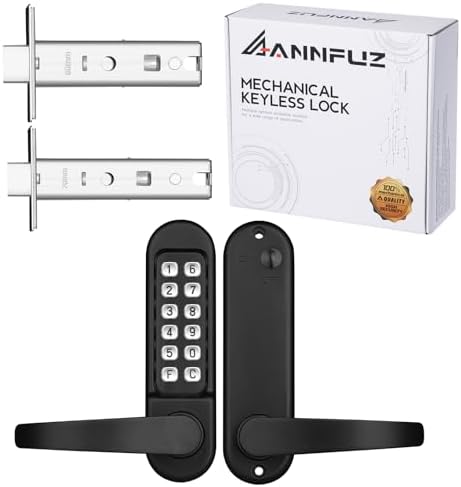
This ANNFUZ model is a single-sided mechanical keypad lock with a matte black finish. It uses a 4- to 6-character code made from numbers or letters, without repeated characters, and does not need batteries, wiring, cards, or electronics. The listing says the code can be entered in any order.
The product includes two non-adjustable latches, one for a 2⅜-inch backset and one for a 2¾-inch backset. Its reversible handle is designed for left- or right-hand doors, and it fits doors from 1.2 to 2.2 inches thick. The listing describes it as auto-locking after the door closes, with inside exit that does not require a code.
Pay close attention to the manufacturer’s warning about gaps. The lock should not be used on fence gates or doors where someone could reach through and operate the inside lever. The listing also says there is no passage mode, so it is intended to engage after each entry rather than stay unlocked. Compared with the Yamiry, it avoids battery management but does not offer electronic code controls or a stated weather-resistance rating.
Pros:
- No batteries or wiring required
- Includes latches for two common backsets
- Reversible handle fits left- or right-hand doors
- Inside exit does not require entering the code
Cons:
- Not suitable for gates or doors with reachable gaps
- No outdoor weather-resistance rating is stated in the supplied information
Verdict: Choose this ANNFUZ keypad for a compatible, gap-free door where you want battery-free code entry and automatic relocking.
How to Choose an Exterior Push Button Door Lock
Choose the entry method that fits your routine
A mechanical keypad lets you enter a code without batteries, while an electronic keypad can offer features such as multiple user codes and adjustable auto-lock timing. A one-touch lever is different: it locks from inside with a button and uses a key for outside entry. Decide whether you need shared codes, key backup, or simple locking before comparing finishes and extra features.
Check door thickness and backset
Door thickness and backset determine whether the lock and latch will fit. Backset is the distance from the edge of the door to the center of the handle or lock hole. The products here vary in supported thickness and included latch sizes, and some latch options may need to be requested. Measure your door and existing hardware, then compare those measurements with the product specifications.
Consider weather exposure
Exterior locks face rain, sun, and temperature changes, but the products do not all provide the same weather details. The Yamiry listing specifies IP54 weather resistance, while the VEVOR and LVOZ descriptions discuss outdoor use and weather-resistant construction. The supplied information does not give an outdoor rating for either ANNFUZ model. For a fully exposed door, look for clear weather guidance and follow the manufacturer’s installation instructions.
Understand how it locks and unlocks
Check which side has the keypad or button, how you exit from indoors, and whether the lock automatically engages when the door closes. Some models have an inside lever that opens without a code; one product description specifically warns against installing it where someone could reach that lever through a gap. Consider the door’s surroundings as well as the lock itself.
Plan for installation
Some locks are described as screwdriver installations, while the LVOZ may need additional drilling and professional help. Existing holes, door thickness, latch size, and handle direction can change the work involved. Read the installation instructions before starting, especially if the product requires you to set the handle direction before tightening the hardware.
Decide whether you need a deadbolt
A keyed lever or keypad handle is not automatically a deadbolt. If your door needs a separate deadbolt, check whether the handle lock is meant to work alongside one and whether the door has room for both. Do not assume that a keypad or push button alone provides the same function as a deadbolt.
Frequently Asked Questions
What is the difference between a mechanical and electronic keypad lock?
A mechanical keypad uses a physical mechanism and does not need batteries or wiring. An electronic keypad needs power but may offer features such as multiple codes, a low-battery indicator, or adjustable auto-lock timing. The exact features vary by model.
Do all of these locks use a code to unlock from outside?
No. The ANNFUZ one-touch entry lever uses a key from outside and a push button on the inside. The other listed keypad models use a code for entry, though their keypad designs and operation differ.
Can I install one of these locks on any exterior door?
No. Door thickness, backset, existing holes, and door handing can affect fit. Check the exact product specifications and measure your door before ordering. Some models may also require extra drilling or professional installation.
Are mechanical keypad locks completely weatherproof?
Not necessarily. The VEVOR and LVOZ descriptions refer to outdoor use or resistance to weather, but that does not mean every installation is suitable for every exposure. Check the manufacturer’s guidance for your location and the specific model.
Do these locks replace a deadbolt?
Not by default. These products are described as lever or handle locks, and their listings do not establish that they replace a separate deadbolt. If you want deadbolt security, confirm your chosen setup includes one.
Which option is best for a rental or shared space?
A keypad can make access easier to share without distributing keys. The Yamiry offers multiple codes and a one-time guest code, while mechanical models avoid batteries. Consider how often you need to change access and whether the door fits the lock.
Final Recommendation
For code sharing and electronic features, the Yamiry is the most flexible option in this group, provided its fit and battery needs work for your door. For battery-free code entry, compare the VEVOR’s included fit options with the LVOZ’s installation demands and the ANNFUZ matte black model’s gap warning. If you prefer a key outside and one-touch locking inside rather than a keypad, the ANNFUZ entry lever is the more direct match. Whatever you choose, verify the door measurements, outdoor suitability, and whether you still need a separate deadbolt.
