For a French drain in clay soil, look for a permeable, non-woven geotextile that can separate fine soil from the gravel while allowing water to pass through. A heavier fabric may offer more strength during installation, but fabric alone cannot prevent every clog: the drain’s gravel, pipe, slope, and outlet all matter. These five options include several weights and roll sizes, so you can match the fabric to your project without buying more than you need.
Table of Contents
Quick Comparison
| Product | Fabric type and weight | Size | Best for |
|---|---|---|---|
| Super Geotextile Non-Woven Fabric, 4 oz | Non-woven geotextile, 4 oz | Check listing for available size | General French drain and landscaping projects |
| Super Geotextile Non-Woven Fabric, 6 oz | Non-woven geotextile, 6 oz | Check listing for available size | Projects where a sturdier fabric is preferred |
| VEVOR Non-Woven Geotextile, 8 oz | Needle-punched non-woven PP, 8 oz | 3 ft × 100 ft | Long runs and heavier-duty applications |
| VEVOR Non-Woven Geotextile, 4 oz | Needle-punched non-woven PP, 4 oz | 15 ft × 20 ft | Wide coverage and smaller projects |
| VEVOR Non-Woven Geotextile, 8 oz | Needle-punched non-woven PP, 8 oz | 6 ft × 50 ft | Wider trenches or projects needing broad fabric |
Our Picks: Best Fabric For French Drain In Clay Soil reviews
1. Super Geotextile 4 oz: A Practical All-Purpose Pick

This 4-ounce non-woven geotextile is made for uses that include French drains, landscaping, erosion control, and underlayment. Its main advantage for a drain project is its non-woven construction, which is intended to let water pass while helping keep surrounding soil separate from drainage stone.
The manufacturer describes it as medium-duty, dimensionally stable, and resistant to rot and UV exposure. Those traits can make it easier to handle while laying out a trench. In a buried drain, though, good installation and suitable filtration matter more than a fabric’s general toughness alone.
This is a reasonable option for a homeowner who wants a versatile fabric and does not need the added material weight of a 6- or 8-ounce choice. Check the listing’s available dimensions before ordering, since the supplied product information does not specify a single roll size.
Pros:
- Non-woven fabric is intended for drainage and soil separation.
- Listed for French drains and several other landscaping uses.
- Medium-duty 4-ounce weight is a manageable general-purpose option.
- Manufacturer describes it as dimensionally stable and rot resistant.
Cons:
- Product information provided here does not identify a specific roll size.
- It may be less robust than the 6- and 8-ounce alternatives during rough handling.
Verdict: Choose this 4-ounce fabric for a straightforward drain or landscaping project when you want non-woven geotextile without stepping up to a heavier option.
2. Super Geotextile 6 oz: A Heavier Fabric for Tougher Handling
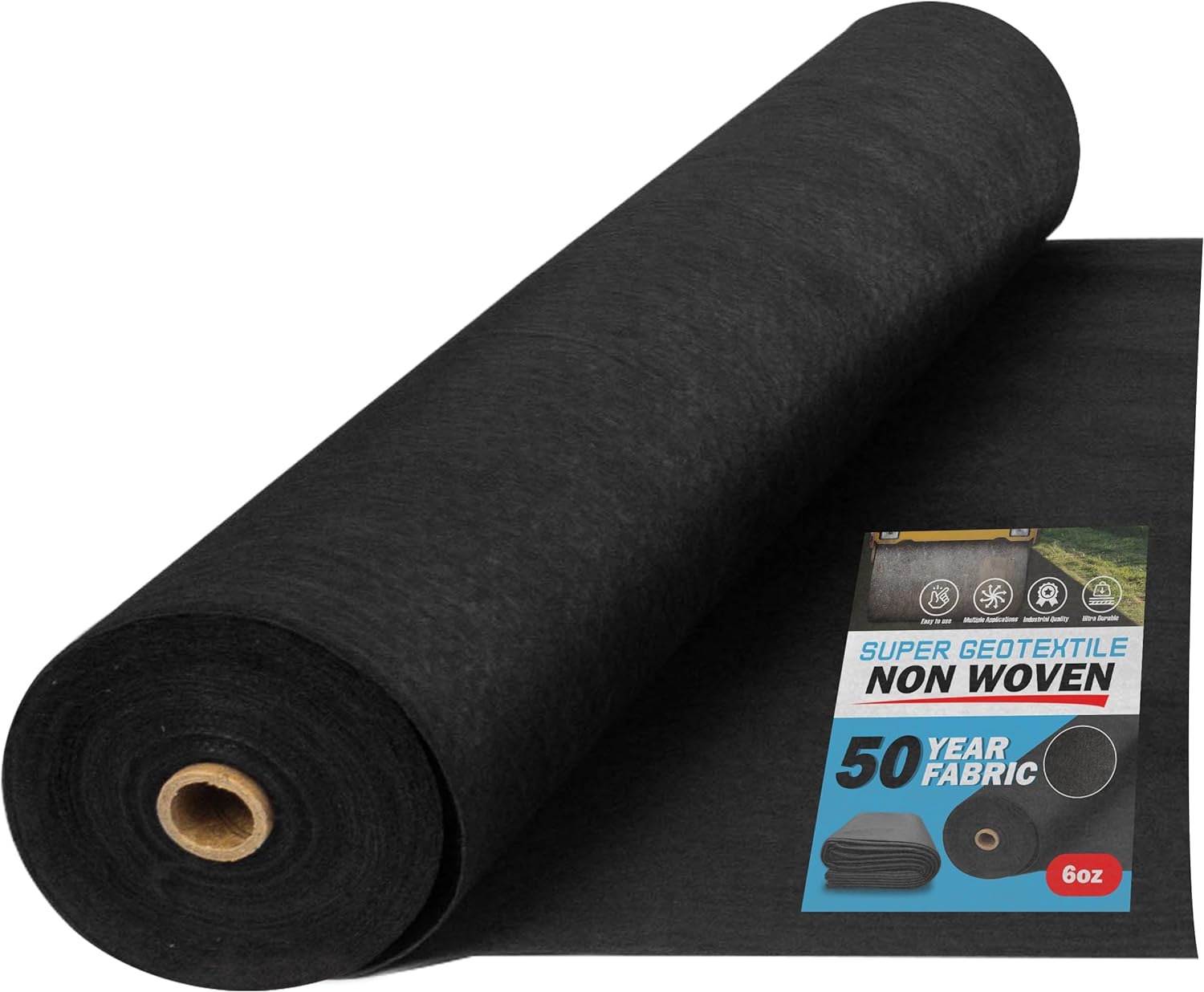
This is the 6-ounce version of Super Geotextile’s non-woven fabric, positioned as a heavy-duty choice for French drains, retaining walls, underlayment, and erosion control. Compared with the 4-ounce option above, its greater stated weight makes it the more substantial choice in this product line.
That extra heft can be useful when you need fabric that feels sturdier to move and position around a gravel trench. It does not guarantee that the fabric is a perfect filter for every clay soil, however. Clay contains fine particles, so match the geotextile to the soil and drainage design when possible, especially for a large or high-stakes project.
The manufacturer describes the fabric as high-strength, dimensionally stable, and resistant to UV exposure and rot. The supplied details do not give a specific roll dimension, so confirm the size and coverage available in the listing before buying.
Pros:
- Heavier 6-ounce option in the Super Geotextile range.
- Non-woven construction is intended for drainage applications.
- Listed for French drains, retaining walls, and erosion control.
- Manufacturer describes it as durable and dimensionally stable.
Cons:
- Specific roll dimensions are not included in the supplied product details.
- The heavier fabric may be more than a small, simple drain project requires.
Verdict: Pick this version if you want a sturdier alternative to 4-ounce fabric and can confirm that the available roll size fits your trench.
3. VEVOR 8 oz, 3 ft × 100 ft: Best for Long Drain Runs

This VEVOR fabric is an 8-ounce, needle-punched non-woven polypropylene geotextile. At 3 feet wide and 100 feet long, it offers a long roll that may suit an extended French drain or several smaller projects. The product listing also gives tensile-strength and load-capacity figures, which indicate the fabric is designed for demanding ground and drainage uses.
Its non-woven structure is intended to allow water through while filtering gravel, and the product is also listed for ground stabilization, paths, and erosion control. Some users describe water passing through readily in landscape applications, and one use case involved a foundation curtain drain. These experiences suggest useful versatility, but they do not establish how well the fabric will filter every type of clay.
The 8-ounce weight is the heaviest listed option in this selection, which may be useful if the fabric will be handled around rough stone or used in a demanding installation. The tradeoff is that a heavier fabric can be unnecessary for a small trench. Also check that the 3-foot width gives you enough material to line and fold over your planned gravel bed.
Pros:
- Long 100-foot roll suits extended drain runs.
- 8-ounce needle-punched non-woven polypropylene construction.
- Listed for French drains, gravel, and ground stabilization.
- Some users report that it drains well and is easy to position.
Cons:
- The 3-foot width may not provide enough coverage for every trench design.
- Its heavier construction may be more than a small residential project needs.
Verdict: Choose this roll when you need a long length of heavier non-woven fabric and its 3-foot width works for your drain layout.
4. VEVOR 4 oz, 15 ft × 20 ft: Best for Broad Coverage
This 4-ounce VEVOR geotextile comes as a 15-foot-by-20-foot sheet of needle-punched non-woven polypropylene. Unlike the narrow rolls, its broad dimensions may be convenient when you need to cover a wide area or want a large piece for a project with fewer seams.
The listing describes the material as permeable and suitable for French drains, paths, gravel, and erosion control. Its lighter 4-ounce weight makes it a less heavy-duty choice than VEVOR’s 8-ounce options, but it may be easier to handle for general landscaping and residential drain work.
Some users report that the fabric lays down easily, stays in place when secured, and lets rain pass through in landscape applications. Those observations are useful for judging handling and water passage, but they are not a substitute for checking whether the fabric’s filtration properties suit your particular clay soil.
Pros:
- Large 15-foot-by-20-foot sheet offers broad coverage.
- Non-woven polypropylene construction is intended for drainage.
- Listed for French drains and several landscaping applications.
- Some users find it easy to lay out and secure.
Cons:
- At 4 ounces, it is lighter than the 8-ounce VEVOR options.
- A large sheet may be awkward to manage in a narrow trench.
Verdict: This is a practical choice when you need a broad piece of 4-ounce non-woven fabric and prefer sheet dimensions over a long, narrow roll.
5. VEVOR 8 oz, 6 ft × 50 ft: Best for a Wider Trench Liner

This is another 8-ounce needle-punched non-woven polypropylene fabric from VEVOR, supplied in a 6-foot-by-50-foot roll. Its extra width compared with the 3-foot version gives you more material across the trench, which can help when your design requires a wider gravel bed or generous fabric folds.
The manufacturer lists it for French drains, gravel, paths, underlayment, and erosion control, and describes it as permeable and tear resistant. The wider format is its clearest advantage over the 3-foot-by-100-foot VEVOR option. The latter provides more total length, while this one may fit a wider layout with less concern about coverage across the trench.
For clay soil, do not choose based on weight and width alone. The right filter needs to let water through while limiting soil movement into the gravel; if your soil is very fine or the drain is critical to protecting a structure, consider getting a geotextile specification matched to the soil and drainage plan.
Pros:
- 6-foot width may suit wider trenches or larger fabric folds.
- 8-ounce needle-punched non-woven polypropylene construction.
- Listed for French drains, gravel, and erosion control.
- 50-foot length is more manageable than a very long roll for some projects.
Cons:
- Provides less total length than the 3-foot-by-100-foot option.
- The wider roll may be more material than a narrow trench needs.
Verdict: Select this option if your drain layout needs a wider, heavier fabric and a 50-foot roll covers the planned run.
How to Choose Fabric for a French Drain in Clay Soil
Choose a permeable, non-woven geotextile
For a gravel-filled French drain, non-woven geotextile is a common choice because it is designed to let water pass while separating soil from the stone. Avoid choosing a fabric only because it is labeled “landscape fabric.” Some fabrics are mainly intended for weed control, so confirm that the product is specifically listed for drainage or geotextile use.
Think about clay’s fine particles
Clay soil can contain very fine particles that may move with water and build up around a drain. A fabric’s weight alone does not tell you whether it will filter your particular soil well. For a small yard project, a drainage-rated non-woven fabric may be a practical starting point. For a foundation drain or a site with persistent water problems, ask a drainage professional to match the filter fabric to the soil and design.
Use weight as a durability clue, not a complete specification
The choices here range from 4 to 8 ounces. Heavier fabric may feel sturdier during handling and around stone, while lighter fabric may be easier to manage for a modest project. Weight does not, by itself, prove that a fabric has the right filtration properties, so consider the listed use and any available technical specifications as well.
Match the roll dimensions to your trench
Measure the trench and the amount of fabric needed to line the bottom and sides, with enough material left to fold over the gravel if your design calls for it. A 3-foot-wide roll can suit a narrower trench, while a 6-foot roll or broad sheet gives more coverage. Compare the total length with your planned drain run, and allow for overlaps or extra fabric where needed.
Plan the full drainage system
Fabric is only one part of a French drain. The trench needs a suitable gravel bed, correctly placed pipe if the design uses one, and a route for water to exit. If the trench has poor slope or the outlet is blocked, a better fabric will not solve the underlying problem.
Install carefully to reduce damage and soil mixing
Keep the fabric intact while placing gravel, and avoid dragging it across sharp debris that could tear it. Use enough fabric to maintain separation between the surrounding soil and the drainage stone. Follow the drain design for overlaps and the final fold, and keep excavated clay from mixing into the clean gravel.
Frequently Asked Questions
What kind of fabric is best for a French drain in clay soil?
A permeable, non-woven geotextile made for drainage is a sensible starting point. Clay can be especially fine, so the ideal filtration properties depend on the soil and drain design. For a foundation or other critical application, get the fabric specification matched to the site.
Is heavier geotextile always better for clay?
No. A heavier fabric may offer more strength during handling, but weight alone does not determine how well it filters clay particles or passes water. Check the stated use and technical details, and consider professional guidance for demanding installations.
Can I use woven landscape fabric in a French drain?
Some woven products are designed for different purposes, such as stabilization or weed control. For a gravel drain, look for fabric specifically described as a drainage geotextile and confirm that its permeability and filtration suit your project.
Should the fabric wrap the gravel or the pipe?
French drain designs commonly use fabric to separate the gravel from surrounding soil, but the exact arrangement depends on the system. Follow the product and drain-design instructions so the fabric does not interfere with the intended flow path.
How wide should the fabric be?
It should be wide enough to line the trench as planned and leave the material needed for overlaps or a top fold. Measure your trench before ordering; a wider roll can make coverage easier, but may be unnecessary for a narrow drain.
Can fabric prevent a French drain from clogging?
It can help limit soil from mixing into the drainage stone, but it cannot guarantee that a drain will never clog. Fine clay, poor installation, sediment, or an outlet problem can still affect performance. Proper design and a clear discharge route are important.
Final Recommendation
For most homeowners comparing these options, start with a drainage-rated non-woven geotextile and choose its weight and dimensions to match your trench. The Super Geotextile 4-ounce fabric is a sensible general-purpose option, while the VEVOR 8-ounce rolls offer a heavier alternative in different widths and lengths. In clay soil, the most important step is making sure the fabric’s filtration properties fit the site—not simply choosing the heaviest material.