
Indoor plants need light, water, and the right nutrients to grow well. The best food for your plants depends on how you like to feed them, how often you want to do it, and whether you prefer a ready-to-use formula or a concentrate you mix with water. These five liquid options are made for indoor plants, but their directions and features differ. Use the comparison and guide below to find a fit for your routine, and always follow the product label for the plant and pot you’re feeding.
Table of Contents
Quick Comparison
| Product | Format | Notable feature | Feeding details |
|---|---|---|---|
| Miracle-Gro Indoor Plant Food, 2-Pack | Liquid food, two 8 fl. oz. bottles | For indoor container plants | Apply to soil or mix with water; reapply every two weeks |
| TPS Nutrients Indoor Plant Food | Liquid fertilizer, 8 oz. | Kelp-enriched formula | Mixes with water; follow the label for dosage |
| Miracle-Gro Indoor Plant Food, Pump Bottles | Liquid food, two 8 oz. bottles | Pump-top application | Use one or two pumps in soil, or mix four pumps with water |
| Easy Peasy Plants Liquid Indoor Plant Food | Concentrated liquid | 4-3-4 nutrient blend; blue formula | Must be mixed with water; check the label for the right amount |
| Espoma Organic Indoor! Plant Food | Concentrated liquid, 8 oz. | Organic plant food | Mix half a capful per quart of water; use every two to four weeks |
Our Picks: Best Food For Indoor Plants reviews
1. Miracle-Gro Indoor Plant Food: A Straightforward Choice for Mixed Collections

This two-bottle set is a practical option if you want one liquid food for a variety of indoor container plants. The product is described for houseplants, flowers, vegetables, herbs, and more, so it can suit a home with a mixed collection rather than a single type of plant.
You can apply it directly to the soil and water afterward, or mix it into a quart of water as part of your watering routine. The stated reapplication interval is every two weeks. That clear schedule makes it easier to plan feeding, but you’ll still want to check the label and account for each plant’s needs.
Compared with the pump-bottle Miracle-Gro option below, this version uses a pour-and-measure approach rather than pump counts. It comes in a two-pack, which may be useful if you feed several plants. It is not described as organic, so choose another option if that is a key requirement for you.
Pros:
- Made for a broad range of indoor container plants
- Can be applied to soil or mixed into water
- Two bottles included
- Provides a stated every-two-weeks feeding interval
Cons:
- Requires measuring or mixing rather than pump dosing
- Not identified as an organic formula
Verdict: Choose this two-pack if you want a versatile liquid plant food and are comfortable measuring or mixing it into your watering routine.
2. TPS Nutrients Indoor Plant Food: A Kelp-Enriched Formula for Houseplants

TPS Nutrients offers an 8-ounce liquid fertilizer formulated for indoor houseplants. Its description highlights a kelp-enriched formula and lists plants such as monstera, pothos, philodendron, snake plants, peace lilies, and fiddle-leaf figs. That range makes it a possible match for a collection of common foliage plants.
The liquid is designed to mix with water, so it can fit into a regular watering routine. The supplied product information does not give a specific dilution amount or feeding schedule. Check the container directions before use rather than guessing at a dose, especially if you are new to concentrated plant food.
Unlike the two Miracle-Gro options here, this product does not list pump-based directions or a stated interval in the supplied details. Its distinguishing feature is the kelp-enriched formula. If you need a clearly specified schedule or dosage, compare the label instructions with the more detailed directions on the other choices before buying.
Pros:
- Kelp-enriched liquid formula
- Made for indoor houseplants
- Lists a wide range of common houseplants as suitable options
- Mixes with water for use during watering
Cons:
- The supplied product details do not state a dosage or feeding interval
- Single 8-ounce bottle rather than a two-pack
Verdict: Consider TPS Nutrients if you want a kelp-enriched liquid for a range of indoor plants and are prepared to follow the directions on its label.
3. Miracle-Gro Pump Bottles: A Handy Option for Measured Doses

This two-bottle set of Miracle-Gro Indoor Plant Food is intended for indoor container plants, including houseplants, snake plants, croton, peace lilies, flowers, and vegetables. Its main practical difference is the pump-style dosing described in the product information.
The directions specify one pump for small pots and two for large pots when applying the food directly to soil. You can also mix four pumps with a quart of water and water as usual. These options may make dosing more convenient than measuring a liquid from a bottle, though you still need to choose the right amount for your pot and follow the label.
Compared with the other Miracle-Gro product in this list, this version gives pump counts rather than a general pour-and-mix method. It is a good match for someone who prefers portioned doses, but not necessarily for a gardener who wants an organic formula or a concentrate with a listed nutrient ratio.
Pros:
- Pump directions offer a simple way to portion the food
- Can be applied directly to soil or mixed with water
- Two 8-ounce bottles included
- Suitable for several types of indoor container plants
Cons:
- Pot-size directions require you to judge whether a pot is small or large
- Not identified as an organic formula
Verdict: Pick the pump-bottle version if portioning is your priority and you want a liquid food with both direct-to-soil and water-mixing directions.
4. Easy Peasy Plants: A Concentrated 4-3-4 Formula

Easy Peasy Plants is a concentrated liquid fertilizer for indoor potted plants. Its product description lists a 4-3-4 nutrient blend and says the formula must be mixed with water. It also describes the liquid as blue, which can help you distinguish prepared feeding water from plain water.
The supplied directions mention both half a teaspoon while watering and one teaspoon with at least two cups of water. Because those amounts are not presented consistently, check the product label for the correct dilution before preparing a batch. Avoid assuming that a concentrated formula can be used straight from the bottle.
This option may suit plant owners who want a concentrate and a listed nutrient blend. It differs from the Miracle-Gro pump products, which provide pump-count directions, and from Espoma, which gives a clear half-capful-per-quart instruction in the supplied information.
Pros:
- Concentrated liquid intended for indoor potted plants
- Lists a 4-3-4 nutrient blend
- Blue color is intended to show when it has been mixed into water
- Can be used as part of a watering routine
Cons:
- Must be diluted with water before use
- The supplied description gives different mixing amounts, so the label needs to be checked
Verdict: Choose Easy Peasy Plants if you want a concentrated formula with a listed nutrient blend, but confirm its label dosage before your first use.
5. Espoma Organic Indoor! Plant Food: A Concentrate with Clear Mixing Directions
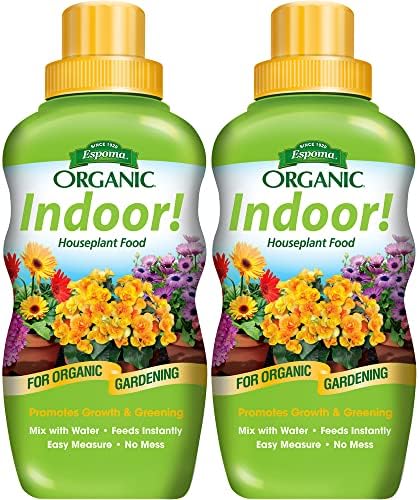
Espoma Organic Indoor! is a concentrated liquid plant food for indoor plants, including fiddle-leaf figs, monstera, snake plants, pothos, and palms. The product is described as organic and intended to provide nutrients for houseplants of different sizes.
Its directions are specific: mix half a capful into a quart of water, then thoroughly drench the soil. The stated use interval is every two to four weeks. The cap measure may be less exact than a marked measuring spoon, so take care to use the amount directed on the label.
Compared with Easy Peasy Plants, Espoma provides a clear mixing amount in the supplied details. It may be the better fit if you are looking for an organic option and are comfortable mixing a concentrate. As with any plant food, it is not a substitute for suitable light, watering, or other basic care.
Pros:
- Described as organic plant food
- Suitable for a range of indoor plants
- Gives a mixing amount and a two-to-four-week use interval
- Concentrated liquid can be mixed with water
Cons:
- Requires mixing before use
- Uses a capful measurement that may be less precise than a marked measure
Verdict: Espoma is a strong choice if you want an organic concentrated plant food and prefer having a stated dilution and feeding interval.
How to Choose Food for Indoor Plants
Match the formula to your plants
Start by checking that the food is intended for indoor container plants and is suitable for the plants you own. Several options here cover a broad range, while some list examples such as pothos, monstera, snake plants, or peace lilies. If your collection includes different kinds of plants, a broadly labeled formula may be more convenient than buying separate foods.
Choose a format that fits your routine
Liquid plant foods can be poured into soil, measured into water, or portioned with a pump, depending on the product. A pump may be convenient if you prefer counting doses, while a concentrate can be a practical fit if you are comfortable measuring and mixing it. Read the directions before choosing, since not every product uses the same method.
Check the dosage and feeding interval
Plant foods differ in how much to use and how often to apply them. The products in this list include directions ranging from every two weeks to every two to four weeks, while some supplied details do not state an interval. Follow the label for your specific product, and do not assume that one brand’s dilution or schedule applies to another.
Consider whether you want an organic product
If organic plant food is important to you, look for that description on the product and read the label for ingredient details. Espoma is described as organic in the supplied information. The other products here are not identified as organic, so compare their packaging and ingredient information if this is a deciding factor.
Look for clear nutrient information
A listed nutrient ratio can help you compare formulas, but it is only one part of choosing plant food. Easy Peasy Plants lists a 4-3-4 blend, while the supplied details for the other options focus more on plant coverage, format, or use directions. Check the full label for the details you need, and avoid choosing based on a ratio alone.
Use fertilizer as part of overall plant care
Plant food supplies nutrients, but it does not replace appropriate light, watering, or a suitable potting mix. If a plant is struggling, first consider its growing conditions rather than assuming that more fertilizer is the answer. Use only the amount directed on the label, especially with concentrated products.
Frequently Asked Questions
What is the best food for indoor plants?
The best choice depends on your plants and feeding routine. For a broad range of indoor container plants, the Miracle-Gro options offer several application methods. Espoma may suit shoppers seeking a product described as organic, while Easy Peasy Plants lists a 4-3-4 blend.
How often should I feed indoor plants?
Follow the schedule on the product label. The options here include directions to reapply every two weeks or every two to four weeks, but the interval varies by product. Do not use one product’s schedule for another fertilizer.
Can I apply liquid plant food directly to the soil?
Some products allow direct-to-soil application, while others are described as concentrates that must be mixed with water. Check the directions for your specific food. For example, the Miracle-Gro pump-bottle directions include direct-to-soil use, while Easy Peasy Plants says it must be mixed with water.
Can I use the same plant food for different houseplants?
Some products are described for a wide range of indoor plants, including foliage plants, flowers, vegetables, or herbs. Check the label to confirm that your plants are included and follow the appropriate dosage directions.
Is organic plant food better for houseplants?
Organic may be an important preference, but it does not automatically make a product the right fit for every plant or routine. Compare the product label, ingredients, feeding directions, and the needs of your plants. Espoma is the option in this list described as organic.
Should I use more plant food if my plant is not growing well?
No. More fertilizer is not always the answer. Check the plant’s light, watering, and growing conditions, and follow the product label rather than increasing the dose on your own.
Final Recommendation
For a versatile, easy-to-find liquid option with a stated feeding schedule, the Miracle-Gro two-pack is a practical starting point. Choose the pump-bottle version if measured doses appeal to you, Espoma if an organic formula is your priority, or Easy Peasy Plants if you want a concentrate with a listed 4-3-4 blend. Whichever you pick, use the label directions as your guide and match the feeding routine to your plants.
