
A freestanding wood slat wall can help define a room, screen a desk, or add privacy without closing off all the light. The options below vary a lot: some are freestanding office panels, while others use floor-to-ceiling posts that rely on pressure or adhesive. One listed option uses iron rather than wood, so check the construction details before you buy.
For a flexible office divider, the VIVO panel is the clearest match. For a more open home partition, consider an adjustable post system—but measure your ceiling and floor carefully, and confirm that the installation method suits your space.
Table of Contents
Quick Comparison
| Product | Design | Best suited for | Key detail |
|---|---|---|---|
| VIVO Freestanding 76" x 66" Privacy Panel | Two connected PET panels with wood-slat styling | Office workstations and desk privacy | About 75.6 inches long by 65.8 inches high |
| MOIUBYW Floor-to-Ceiling Wooden Slat Divider | Adjustable solid-wood posts | Room partitions with a floor-to-ceiling look | Post height adjusts from about 3.9 to 7.9 feet |
| Adjustable Floor-to-Ceiling Wooden Slat Room Divider | Solid-wood posts with adjustable fit | Custom-height indoor partitions | Listed as adjustable from 70 to 230 cm; availability may vary |
| Zotopwetir 5-Pack No-Drill Wooden Room Divider | Wood slats with telescoping supports | Reconfigurable partitions and rental spaces | Listed for ceiling heights from 2.3 to 9.8 feet |
| Freestanding Screen Column Room Divider | Slatted-style iron columns | People open to a metal alternative | Not described as a wood product; availability may vary |
Our Picks: Best Freestanding Wood Slat Wall reviews
1. VIVO Freestanding Privacy Panel: Best for Office Separation

The VIVO is a two-panel office divider, not a row of individual floor-to-ceiling wood posts. Its PET panels have a wood-slat appearance against black fabric, and the frame uses aluminum with steel feet. Together, the panels measure about 75.6 inches long and 65.8 inches high. The feet add about 7.5 inches to the overall length or depth, depending on how you assemble it.
This is the most straightforward choice for creating a separate desk zone or screening a workstation. The connected panels can also be arranged with additional compatible panels, according to the product description. The fabric contains recycled material, and the slats are described as helping absorb sound. That may soften some office noise, but this is a privacy screen—not a soundproof wall.
Compared with the floor-to-ceiling options, VIVO does not need a ceiling fit or adhesive installation. In return, it has a fixed panel format and a fabric-backed look rather than the open, airy effect of spaced wooden posts. Check the full footprint, including the feet, before planning where it will stand.
Pros:
- Freestanding frame avoids a floor-to-ceiling installation
- Two connected panels provide a broad office screen
- Modular design allows connection to other panels
- PET slat styling and recycled-content fabric suit a modern workspace
Cons:
- Not a solid-wood slat wall
- Its feet take up extra floor space, and the panel dimensions are fixed
Verdict: Choose the VIVO if you want a freestanding office privacy panel with wood-slat styling and do not need a true floor-to-ceiling partition.
2. MOIUBYW Adjustable Solid-Wood Posts: Best for a Custom Partition

MOIUBYW uses separate solid-wood posts rather than one large panel. The posts are listed as 2 by 2 inches, with adjustable heights from about 3.9 to 7.9 feet. You can place multiple posts in a line to make a partial screen between areas such as a living room and dining space, or to add some separation around a home office.
The open spacing between posts can preserve more light and airflow than a fabric-backed screen. Each post has a screw-adjustable base and a rubber pad at the top. Installation calls for marking the floor and ceiling, applying wood glue to the top pad, and tightening the base. The glue is not included, and the ceiling surface needs to be flat and smooth for the adhesive approach described.
Unlike the VIVO, this design can create a more architectural slat-wall effect. It also takes more care to install: measure each position, check the ceiling material, and plan the spacing before fixing the posts in place. The product description presents these as room dividers, but they should not be treated as structural supports or safety railings.
Pros:
- Solid-wood posts offer a more traditional wood-slat appearance
- Adjustable post height suits a range of room dimensions
- Spaced posts can separate areas while allowing light through
- Individual posts let you choose the width and spacing of the divider
Cons:
- Installation requires careful measuring and wood glue, which is not included
- It depends on suitable floor and ceiling surfaces rather than standing independently like a screen
Verdict: Pick MOIUBYW if you want a customizable solid-wood partition and are comfortable with a measured, floor-to-ceiling setup.
3. Adjustable Wooden Slat Room Divider: Best for Tailoring Post Height

This listing describes a floor-to-ceiling partition made from 2-by-2-inch solid-wood posts. The listed adjustable range is 70 to 230 centimeters, and the posts can be cut with a saw for further customization. That may appeal if you need to fit an unusual space or want to create a slatted screen with a specific height.
The product description says installation uses rubber pads and screw bases with supplied wood glue, without drilling. It also describes the finish as water-based paint and says the posts are intended for indoor spaces such as living rooms, offices, studios, and dressing areas. Because the listing is marked unavailable in the supplied product information, check whether it can be ordered before choosing it over the available alternatives.
This option is similar in concept to the MOIUBYW posts, but its stated range starts lower and it specifically mentions cutting the posts to length. Cutting is a one-way change, so measure carefully and confirm the product’s instructions before altering any pieces. The listing does not provide a complete assembled width, so you will need to confirm the pack size and layout details on the product page.
Pros:
- Solid-wood construction and a customizable post layout
- Listed height range covers a range of room sizes
- Posts can be cut to a desired length, according to the description
- Designed to create a partial-privacy screen while retaining airflow
Cons:
- Listed as unavailable in the supplied product information
- Cutting posts is irreversible and requires careful planning
Verdict: Consider this divider if its adjustable, cut-to-fit design matches your project, but confirm availability and product details before making plans around it.
4. Zotopwetir No-Drill Slat Divider: Best for a Reusable Setup

This five-pack uses individual slat posts with telescoping top and bottom supports. The listing gives a broad ceiling-height range of 2.3 to 9.8 feet and describes the posts as stackable side by side to create a custom-width partition. It is designed to be taken apart and reused, which may suit renters or anyone who expects to move or rearrange the room.
The slats leave gaps, so the divider is intended to soften sightlines while allowing light to pass through. The product description refers to wood veneer and also describes thick, solid natural-wood slats; because those material claims differ, check the listing details for the exact finish and construction you will receive. The supports use anti-slip pads, but a no-drill design still needs a suitable floor and ceiling and a secure fit.
Compared with the MOIUBYW posts, this option emphasizes tool-free assembly and disassembly. Its stated height range is also unusually wide, so do not assume every ceiling height or surface is a good fit. Measure the installation area and confirm the package configuration and instructions before relying on the stated range.
Pros:
- Five posts can be arranged to set a custom partition width
- Telescoping supports are designed for no-drill installation
- Components are described as reusable and easy to disassemble
- Open slats allow more light and airflow than a solid panel
Cons:
- Material descriptions are not fully consistent, so confirm the construction before buying
- Fit and stability depend on the room dimensions and contact surfaces
Verdict: Choose the Zotopwetir if a reusable, adjustable post system matters most and its listed dimensions and construction suit your room.
5. Freestanding Screen Column: A Metal Alternative to Wood
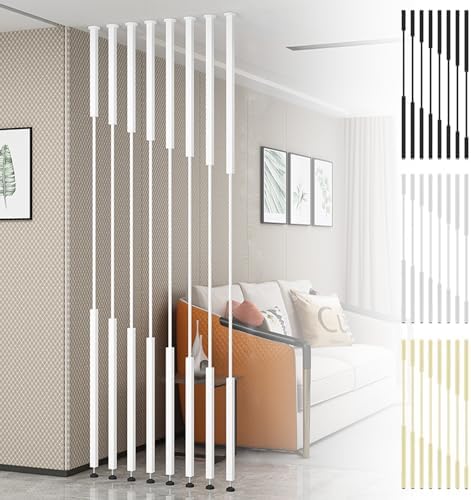
This listing is included as a design alternative, but its description says the screen columns are made from iron—not wood. It uses an open, slatted-style layout intended to divide areas while allowing some light and airflow through. Adjustable feet and rubber pads are described as helping with fit and protecting the floor.
Installation involves marking positions on the floor and ceiling, attaching rubber pads and screw seats, using adhesive at the top, and tightening the lower screws. That makes it closer to a floor-to-ceiling post system than a freestanding folding screen. The listing does not specify the overall height range or pack size in the supplied details, so check those points before deciding whether it can cover your intended space.
This option may suit you if you want a metal partition and are less concerned with matching a wood interior. It is a poor fit if a natural wood finish or wood construction is essential. The product is also marked unavailable in the supplied product information, so verify its order status.
Pros:
- Iron construction offers a non-wood alternative
- Open slatted design is intended to preserve light and airflow
- Adjustable feet and rubber pads are included in the described design
- Suitable for considering as a room-separation concept in several indoor spaces
Cons:
- Not made from wood, despite the wood-slat search category
- Listed as unavailable, and key dimensions are not provided in the supplied details
Verdict: Skip this option if you specifically want a wood slat wall; consider it only if an iron screen column is acceptable and the listing confirms fit and availability.
How to Choose a Freestanding Wood Slat Wall
Decide Between a Standing Panel and Floor-to-Ceiling Posts
A standing panel, such as the VIVO, has its own frame and feet. It is easier to move than a tension-style post system, but it has a fixed footprint and does not reach the ceiling. Individual posts can create a more built-in look and let you choose the spacing, but they require a suitable ceiling and floor and more careful installation. Check which type you need before comparing finishes.
Measure the Room and the Divider Footprint
Measure the height from floor to ceiling at the exact installation point, since room surfaces may not be perfectly level. For a standing panel, include the feet or base in your floor-space plan. For post systems, confirm the height range, post count, and expected width of the finished arrangement. Do not rely on a product’s maximum adjustment range without checking the instructions and the fit in your room.
Choose the Privacy Level You Want
Closely spaced or fabric-backed panels block more of the view than widely spaced slats. Open posts preserve more light and airflow but offer less visual privacy. Think about what you want to screen—such as a desk, entryway, or dressing area—and choose a layout that balances privacy with an open feel.
Check Materials and Finish Claims
Product titles and descriptions can use similar terms for different materials. Confirm whether the main structure is solid wood, wood veneer, PET with a wood-style finish, or metal. Also check the listed finish and care guidance if the divider will sit in a busy area. If natural wood is important to you, do not assume that slat styling means the posts themselves are wood.
Understand the Installation Method
“No drill” does not mean every setup is suitable for every room. Some post systems use pressure, rubber pads, or adhesive at the ceiling, and one listing calls for glue that is not included. Check whether the ceiling and floor surfaces are compatible, whether the installation can leave marks, and whether you are comfortable with any required cutting or adhesive. Follow the manufacturer’s instructions and do not use a room divider as a structural barrier.
Consider Stability, Safety, and Intended Use
Use a divider for visual separation, not as a railing, childproof barrier, or support for leaning or climbing. Follow any stated installation limits, and make sure posts or panels cannot tip or shift in normal use. If you need a barrier for safety or sound control, look for a product designed and rated for that purpose rather than relying on an open slat screen.
Frequently Asked Questions
Is a freestanding wood slat wall the same as a room divider screen?
Not always. A traditional screen stands on its own feet, while many slat-wall products use separate posts that press between the floor and ceiling. Check the installation method and dimensions to understand which type you are buying.
Which option is easiest to set up without attaching anything to the ceiling?
The VIVO is the clearest freestanding panel option in this group. The other slat-style choices describe floor-to-ceiling post installations that use pressure, pads, or adhesive, so they are not the same kind of stand-alone screen.
Do wood slat dividers block all light?
Open slats are designed to leave gaps that let light pass through. A fabric-backed panel like the VIVO provides more visual coverage, although it is not a solid wall. The amount of light and privacy depends on the slat spacing and panel design.
Can I use a slat divider for soundproofing?
No option here is described as soundproof. The VIVO product description says its slats help with sound absorption, but a divider should not be treated as a substitute for a sound-isolating wall or acoustic treatment.
Are no-drill floor-to-ceiling dividers safe for every room?
No. Their fit depends on the height and condition of the floor and ceiling, along with the installation instructions. Check the product’s requirements and avoid using any divider as a railing or other safety barrier.
Which option is best if I need real wood?
The MOIUBYW and adjustable wooden-post listings describe solid-wood construction. The VIVO uses PET panels with a wood-slat appearance, the Zotopwetir listing has mixed material descriptions, and the iron-column option is not wood. Confirm the exact material on the product page before ordering.
Final Recommendation
The VIVO Freestanding Privacy Panel is the most practical pick if you need a ready-to-place office divider and can work with its panel format and footprint. If your priority is a more open, architectural wood-slat partition, the MOIUBYW adjustable posts are a closer match, provided your room and installation surfaces suit a floor-to-ceiling setup. Check dimensions, materials, and availability carefully—especially for listings marked unavailable or with unclear construction details.
