
If you’re searching for the best front door awning with posts, there’s one important detail to know: none of the options below includes ground-support posts. They are wall-mounted awnings, so they need a suitable exterior wall for installation. If that works for your entryway, compare the canopy size, materials, drainage, and mounting style to find the right fit.
Our top choice is the Kozyard for its adjustable tilt and metal construction. For a fixed canopy, the VEVOR aluminum model offers a metal-panel alternative, while the polycarbonate options provide a lighter-looking cover with built-in drainage designs.
Table of Contents
Quick Comparison
| Product | Size | Standout feature | Best suited for |
|---|---|---|---|
| Kozyard Adjustable Door Window Awning | 82 × 43.5 in | Four adjustable tilt levels; metal panels | Shoppers who want control over shade angle |
| GGNEBAI Polycarbonate Door Awning | 40 × 120 in | Wide canopy with drainage grooves | Wide entrances or other long coverage areas |
| VEVOR Polycarbonate Window and Door Awning | 38 × 40 in | UPF 50+ panel and directional drainage | Compact door or window coverage |
| VEVOR Aluminum Door Awning | 40 × 42 in | Aluminum panels and curved drainage edges | Those who prefer a fixed metal canopy |
| VINGLI Door Entrance Awning | 40 × 60 in | UPF 50+ panels and drainage sink design | Entrances needing a wider-than-compact cover |
Note: These products are wall-mounted rather than post-supported. Confirm that the chosen model and its mounting method suit your wall before ordering, and follow the product’s installation instructions.
Our Picks: Best Front Door Awning With Posts reviews
1. Kozyard Adjustable Awning: Best for Flexible Shade

The Kozyard is a large wall-mounted awning with an 82-inch width and a 43.5-inch sloped panel. Its defining feature is four adjustable tilt positions, letting you change the angle to manage sun and airflow. That makes it more adaptable than the fixed-angle canopies in this group.
The metal panels have a powder-coated finish, and the design includes a front gutter to direct rainwater away from the doorway. The product description also lists snow and wind performance limits, but says those apply only when the awning is firmly installed according to its guidelines. It is described as compatible with siding, wood, brick, and concrete walls, including some uneven or stepped surfaces.
Its rail-mount design allows the canopy to be assembled at ground level and slid into place, which may reduce the amount of work done overhead. Still, the wide canopy and wall mounting call for careful planning. It does not have ground-support posts, and the installation surface must be suitable for the mounting system.
Pros:
- Four tilt settings offer more shade-angle control than fixed models.
- Metal construction and a powder-coated finish.
- Built-in gutter directs rainwater away from the entry.
- Rail-mount design offers more than one way to position the assembled panel.
Cons:
- It is wall-mounted and does not include posts.
- The large width requires accurate measuring and a suitable mounting surface.
Verdict: Choose the Kozyard if you want a wide metal awning with adjustable tilt and your wall can support its installation; skip it if you specifically need a freestanding canopy with posts.
2. GGNEBAI 40 × 120-Inch Awning: Best for a Long Coverage Area

This GGNEBAI model is a wall-mounted polycarbonate canopy measuring 40 by 120 inches. Its long width may suit an entrance that needs more coverage than a compact door awning provides, or another broad area such as a patio or window. Measure the wall and the space you want sheltered before choosing a canopy this wide.
The product description highlights drainage grooves intended to send water away from the covered area, along with UPF 50+ protection. Its clear polycarbonate panels are paired with ABS brackets. The description also states a 220-pound load capacity, but that figure should not be treated as a promise for every installation or weather condition; use the supplied instructions and hardware for the intended setup.
Assembly instructions and several types of screws are included for different wall materials, and a two-person setup is recommended for wider models. The listing is marked unavailable in the supplied product information, so check the Amazon listing before planning a purchase. Like the other picks, this canopy attaches to a wall rather than standing on posts.
Pros:
- Wide 120-inch format can cover a longer stretch than compact models.
- Polycarbonate panels are described as impact-resistant.
- Drainage grooves guide rainwater away from the entrance.
- Product information lists UPF 50+ protection.
Cons:
- Its long width may not fit smaller entry walls.
- The supplied listing information marks it unavailable.
Verdict: Consider this model if you need a long polycarbonate cover and can confirm it is available, but it is not the right choice for a post-supported or freestanding entry cover.
3. VEVOR 38 × 40-Inch Polycarbonate Awning: Best Compact Option

At 38 by 40 inches, this VEVOR canopy is one of the more compact choices here. Its polycarbonate cover is paired with ABS brackets, making it a straightforward option to compare if you want a smaller wall-mounted shield over a door, window, balcony, or porch.
The panel is described as offering UPF 50+ protection, while a directional drainage sink is intended to guide water away from the entry. The product description also calls the construction shock-resistant, flame-retardant, and noise-reducing. Those are manufacturer-provided feature claims; installation quality and conditions can affect how a canopy performs in use.
The kit includes instructions and mounting screws for brick, concrete, or wood walls. Its modest size may be easier to fit than the 82-inch Kozyard or 120-inch GGNEBAI, but it also provides less width. It has no ground posts, so it needs a suitable wall for support.
Pros:
- Compact size can suit smaller doors or windows.
- Product information lists UPF 50+ protection.
- Directional drainage is designed to move water away from the entry.
- Includes mounting hardware for several wall types.
Cons:
- Its 38-inch width offers less coverage than the wider picks.
- It is wall-mounted and does not include posts.
Verdict: Pick this VEVOR if you want a compact polycarbonate canopy with drainage features and have a compatible wall; choose a wider model when you need more coverage.
4. VEVOR 40 × 42-Inch Aluminum Awning: Best Fixed Metal Canopy

This fixed VEVOR awning measures 40 by 42 inches and uses aluminum panels instead of polycarbonate. Its product description specifies 0.6-millimeter panels and 22-millimeter support rods. The fixed design has no adjustable tilt, so it may suit shoppers who prefer a set canopy angle over the Kozyard’s four-position setup.
Curved edges and a drainage system are designed to guide water away, while the connected ripple panels are described as helping prevent leaks. The manufacturer positions this model for year-round use over doors, windows, garages, patios, and other areas. As with any wall-mounted canopy, the installation surface and correct assembly matter.
The fixed metal build gives this model a different look and feel from the clear polycarbonate options. Its 40-inch width is also more modest than the Kozyard and GGNEBAI. It does not include ground-support posts, so it won’t meet the needs of someone looking for a freestanding porch roof.
Pros:
- Aluminum panels offer a metal alternative to polycarbonate.
- Curved edges and drainage are designed to move water off the canopy.
- 40 × 42-inch size fits more compact spaces than the widest models.
- Product description provides panel and support-rod dimensions.
Cons:
- Fixed angle cannot be adjusted for changing sun or airflow needs.
- Does not include posts for freestanding support.
Verdict: Choose this VEVOR if you prefer a fixed aluminum canopy in a compact size, but consider the Kozyard if adjustable shade is more important to you.
5. VINGLI 40 × 60-Inch Awning: Best Mid-Width Polycarbonate Pick
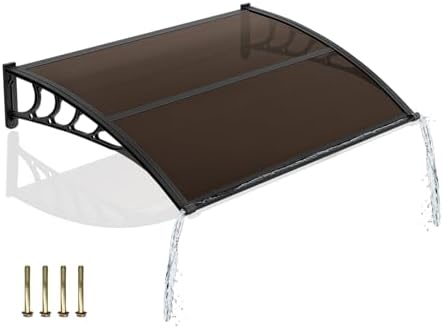
The VINGLI is a 40-by-60-inch wall-mounted canopy with polycarbonate panels, ABS brackets, and aluminum alloy rods. Its dimensions put it between the compact VEVOR models and the extra-wide Kozyard and GGNEBAI, which may make it a useful size to consider for a broader doorway.
The product description lists UPF 50+ protection and a drainage-sink design intended to move rainwater toward the sides. It also describes tight panel seals to help prevent leaks. The included assembly components and illustrated instructions are intended to support DIY installation, but you should still confirm that the wall and supplied mounting approach suit your home.
This model’s combination of a 60-inch width and drainage features makes it a middle-ground option among the polycarbonate canopies here. The description says it can be used over doors, windows, patios, porches, and balconies. It does not include posts, so it requires wall mounting rather than a freestanding setup.
Pros:
- 60-inch width offers more coverage than the compact options.
- Product information lists UPF 50+ protection.
- Drainage design is intended to direct water to the sides.
- Includes assembly components and illustrated instructions.
Cons:
- It is wall-mounted, not post-supported.
- Check the dimensions carefully if your entry has limited wall space.
Verdict: The VINGLI is a reasonable middle-size choice if you want a polycarbonate canopy wider than a compact door awning and can mount it securely to your wall.
How to Choose a Front Door Awning
Decide Whether You Need Posts or Wall Mounting
Start by confirming the type of support your entrance needs. Every product in this guide is described as a wall-mounted awning; none includes ground-support posts. If you need a freestanding cover, look for a product specifically designed with posts and a support frame rather than assuming a wall awning can be adapted. For a wall-mounted model, make sure the wall material and shape match the manufacturer’s installation guidance.
Measure the Door and the Available Wall Space
Compare the canopy’s width and projection with the area you want to cover. A small model such as the 38 × 40-inch VEVOR takes up less wall space, while the 82-inch Kozyard and 120-inch GGNEBAI cover a much wider stretch. Measure the doorway, trim, nearby windows, and any obstacles before choosing. Leave room for the mounting hardware and follow the product’s placement instructions.
Choose the Canopy Material
Polycarbonate models in this list are described as clear or high-transparency panels and include stated UV-protection features. The VEVOR aluminum model and Kozyard metal-panel model offer a metal alternative. Material can affect the look of your entry and the style of coverage you prefer, but the supplied descriptions do not provide a direct comparison of long-term performance across all models.
Look at Drainage and Canopy Shape
Rainwater needs a clear path away from the doorway. The products use different approaches, including grooves, a drainage sink, curved edges, and a built-in gutter. Consider where the water will go after it leaves the canopy, especially if a walkway, step, or neighboring window is nearby. A listed drainage feature does not remove the need to install the awning at the angle and position described by its manufacturer.
Consider Adjustable Versus Fixed Coverage
The Kozyard is the only adjustable option in this group, with four tilt levels. That can be useful if you want to change the angle for shade or airflow. The other listed models are fixed designs, so their canopy angle does not offer the same adjustment. If you prefer a set installation and do not need tilt control, a fixed model may be simpler to compare.
Check Installation Requirements and Weather Claims
Review the included hardware, compatible wall materials, and assembly method before buying. Some products list screws for wood, brick, or concrete, while the Kozyard description also mentions siding and uneven surfaces. Do not assume one kit fits every wall. Treat load, wind, and weather figures as product-specific claims and follow the installation instructions; the Kozyard’s stated wind and snow performance, for example, is conditional on firm installation according to its guidelines.
Frequently Asked Questions
Do any of these awnings include support posts?
No. The supplied product information describes all five as wall-mounted awnings. If you need a freestanding canopy supported by posts, look for a model designed and sold with that structure.
Which option has an adjustable angle?
The Kozyard has four tilt levels. The other products in this guide are described as fixed awnings.
Which awning is the widest?
The GGNEBAI model is listed at 40 × 120 inches, making it the widest option in this comparison. Its listing is marked unavailable in the supplied information, so check its Amazon listing before making plans to buy it.
Which models have polycarbonate panels?
The GGNEBAI, compact VEVOR, and VINGLI models are described as having polycarbonate panels. The Kozyard and the 40 × 42-inch VEVOR are metal-panel options.
Can these awnings be installed on brick or concrete?
Several product descriptions list brick or concrete among compatible wall types, but installation details vary. Check the instructions for the specific model and make sure the supplied hardware matches your wall and installation plan.
How should I choose the right awning width?
Measure the opening and the wall area you want to cover, then compare those measurements with the awning’s listed dimensions. Also account for trim, nearby fixtures, and the mounting area. A wider canopy needs more wall space and may require extra help during installation.
Final Recommendation
For a wall-mounted front door awning, the Kozyard is the most versatile pick in this group because it combines a wide metal canopy, four tilt settings, and a built-in gutter. The VINGLI offers a mid-width polycarbonate alternative, while the compact VEVOR is easier to consider when wall space is limited. If posts are essential, none of these products is a match—choose a purpose-built post-supported canopy instead.
