
A hidden door pivot hinge can let a bookcase, panel, or cabinet swing open without visible side hinges. The right choice depends on more than the advertised weight capacity: check how the hinge mounts, what kind of swing it allows, and whether the kit includes the hardware your project needs. Here are five options, compared by their stated features and practical trade-offs.
Table of Contents
Quick Comparison
| Product | Advertised capacity | Rotation and mounting | Notable details |
|---|---|---|---|
| Millsten Hidden Door Pivot Hinge | 570 lbs | 180° side mount or 360° center mount | 304 stainless steel; ball-bearing lower hinge |
| KIMSOFUNNY Hidden Door Pivot Hinge | 570 lbs | Central-axis or side installation; 360° rotation described | 304 stainless steel; telescopic pin |
| HFCENXIE Heavy-Duty Hidden Door Hinge | 700 lbs | 360° and 180° swing options described | Solid alloy steel; drill bits included |
| EaseLife Hidden Door Pivot Hinge | 580 lbs | 360° rotation | Stainless steel; top-and-bottom installation |
| YLINTBENG Hidden Door Pivot Hinge | 600 lbs | 360° central-axis rotation; side mounting also described | Alloy steel; drill bits and screwdriver included |
Capacity figures above are the manufacturers’ stated ratings. Confirm the product specifications and installation requirements for your door before buying.
Our Picks: Best Hidden Door Pivot Hinge reviews
1. Millsten Hidden Door Pivot Hinge: Best for Flexible Mounting

The Millsten kit is designed for hidden doors and bookcase doors, with a stated capacity of 570 pounds. Its main advantage is the choice of mounting approach: the product description specifies side mounting for a 180-degree swing or center mounting for a full 360-degree rotation. That makes it a useful option if you are still deciding how your door should move.
The hinge is made from solid 304 stainless steel and uses a ball-bearing design in the lower hinge set. The upper pin retracts for adjustment during setup. The package also includes a door catch, screws, a screwdriver, gloves, and installation instructions, so it provides more setup items than some basic pivot kits.
For a bookcase door or other heavy custom panel, the mounting choice and included catch are practical advantages. However, the large capacity figure should not replace careful planning: the door, frame, floor, and fasteners all need to suit the installation. The kit’s 180- and 360-degree options also depend on how you install it, so choose the layout before cutting or drilling.
Pros:
- Two stated mounting options offer different swing ranges.
- 304 stainless steel construction.
- Ball-bearing lower hinge and adjustable upper pin.
- Includes a door catch, screwdriver, gloves, and installation instructions.
Cons:
- Correct operation depends on choosing and executing the intended mounting method.
- The advertised capacity does not by itself confirm suitability for every door or frame.
Verdict: Choose the Millsten if you want a well-equipped kit with clearly stated side-mount and center-mount swing options.
2. KIMSOFUNNY Pivot Hinge: Best for a Simple Stainless-Steel Kit

This KIMSOFUNNY set is a straightforward top-and-bottom pivot hinge kit for concealed doors, bookcases, cabinets, and panels. It has a stated 570-pound capacity and is made from 304 stainless steel. The description highlights a telescopic pin for adjusting the hinge’s up-and-down reach during installation.
The listing describes 360-degree rotation with the hinge on the door’s central axis, and also says it can be installed at the side. It includes the top and bottom hinge, a ball catch, 30 screws, and a screwdriver. That is a useful core package, though it is less extensive than kits that also list gloves, drill bits, or a more detailed set of installation materials.
This option may suit a project where you already have the tools and need a basic pivot assembly with a catch. One detail to sort out before ordering is the mounting plan: the description discusses both central and side installation, but the full-rotation claim is specifically tied to a central-axis setup. Check the product instructions and your door layout rather than assuming both installations produce the same swing.
Pros:
- 304 stainless steel construction and a stated 570-pound capacity.
- Includes a ball catch and mounting screws.
- Telescopic pin allows vertical adjustment during setup.
- Designed for bookcase doors, cabinets, and other concealed panels.
Cons:
- Fewer installation extras are listed than with some competing kits.
- The stated swing depends on the mounting arrangement.
Verdict: Consider this kit if you want a basic stainless-steel pivot set and are comfortable confirming the mounting details for your project.
3. HFCENXIE Heavy-Duty Pivot Hinge: Best for a High Stated Capacity

HFCENXIE advertises the highest load capacity in this group at 700 pounds. The hinge is described as thick, solid alloy steel, with a treated surface intended to resist corrosion. Its feature list includes both 360-degree rotation and a 180-degree swing option, making it relevant to projects where the door’s movement is a key design choice.
The package description lists a telescopic pin, 30 mounting screws, ball-catch hardware, a screwdriver, and two woodworking drill bits. It also states that the hinge can fit doors from 1.5 to 12 inches thick and up to 50 inches wide. Treat those dimensions as product claims to verify against the current listing and installation instructions before designing around them.
This could be a fit for a substantial bookcase or custom hidden entry when its mounting pattern and dimensions match your build. Compared with the stainless-steel options here, its stated material is alloy steel, so check the finish and intended environment if moisture or corrosion is a concern. A large capacity rating is not a substitute for a sound frame, floor, and fastening plan.
Pros:
- Highest stated capacity among the five products in this comparison.
- Describes both 180-degree and 360-degree swing options.
- Includes drill bits, a screwdriver, screws, and ball-catch hardware.
- Lists door thickness and width limits for planning.
Cons:
- Its alloy-steel construction differs from the stainless-steel choices in this list.
- Confirm the stated door-size range and mounting requirements before building.
Verdict: This is the option to investigate first if you need the highest advertised capacity, provided its dimensions, material, and mounting instructions suit your build.
4. EaseLife Hidden Door Pivot Hinge: Best for a Clean, Concealed Look
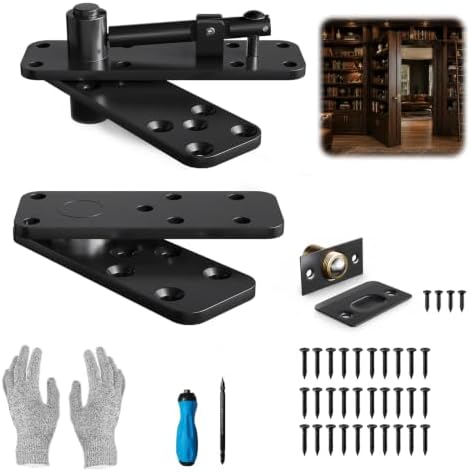
EaseLife focuses on the concealed appearance of a pivot-mounted door. The hinge installs at the top and bottom rather than along the sides, helping keep the hardware out of view when the door is closed. The listing gives it a 580-pound capacity and describes 360-degree rotation.
The product is described as stainless steel and is intended for bookcases, cabinets, and thick panels. Its feature list emphasizes smooth rotation and a complete kit with mounting screws. However, it provides less detail about included tools and adjustment features than several other products in this comparison, so check the package contents and installation instructions before starting.
This is a reasonable choice when the hidden look is your main goal and a 360-degree swing fits your room layout. The product description does not specify the same range of mounting alternatives as the Millsten kit, so it may be less suitable if you need to choose between a side-mounted swing and a central-axis pivot.
Pros:
- Top-and-bottom installation keeps side hardware concealed when closed.
- Stainless-steel construction.
- Designed for bookcase, cabinet, and panel doors.
- Describes 360-degree rotation.
Cons:
- The listing provides fewer details about included tools and adjustments.
- Does not describe as many mounting choices as some competing kits.
Verdict: Pick the EaseLife if a concealed top-and-bottom installation and stated 360-degree rotation match your door design.
5. YLINTBENG Pivot Hinge: Best for a Tool-Rich Installation Kit

YLINTBENG lists a 600-pound capacity for this pivot hinge and describes a reinforced mechanism with a treated alloy-steel finish. The design is intended to transfer door weight through the lower arm toward the floor, rather than relying only on the door frame. As with any pivot system, the supporting structure and installation still need to be appropriate for the door.
The kit includes the top and bottom hinge assembly, 30 mounting screws, ball-catch hardware, a screwdriver, and two wood drill bits. Its description calls for central-axis mounting for 360-degree rotation and also mentions side installation. It includes a telescopic pin for vertical adjustment, which can help when aligning the door during setup.
Compared with the KIMSOFUNNY kit, this one lists more tools in the box and a higher stated capacity. It does not offer the same clearly described 180-degree side-mount option as the Millsten, though, so confirm the desired swing path before buying. Its alloy-steel construction is also worth considering if your project needs a particular material or finish.
Pros:
- Stated 600-pound capacity and adjustable telescopic pin.
- Includes drill bits, a screwdriver, mounting screws, and catch hardware.
- Describes a central-axis layout for 360-degree rotation.
- Designed for bookcase, cabinet, panel, and other hidden doors.
Cons:
- The listing’s 360-degree rotation is tied to central-axis installation.
- Made from alloy steel rather than the 304 stainless steel specified for some alternatives.
Verdict: Choose the YLINTBENG if you value the included setup tools and its stated capacity, and your project suits its mounting approach.
How to Choose a Hidden Door Pivot Hinge
Match the hinge to your door’s weight and support
Start with the finished door’s weight, including shelves and anything stored on a bookcase door. Compare that total with the hinge’s stated capacity, but do not treat the number as a guarantee for every installation. The door frame, floor, fasteners, and mounting surface also have to support the load. If the door is especially heavy, plan the structure and hardware together.
Choose the swing path before you cut
A center-mounted pivot can allow a door to rotate around an axis, while a side-mounted arrangement may create a more familiar inward or outward swing. The products in this guide do not all describe the same options. Millsten clearly lists 180-degree side mounting and 360-degree center mounting; other listings tie their full rotation claims to central-axis installation. Check the instructions and make sure the door will clear walls, shelves, and nearby furniture.
Check the door’s dimensions and mounting space
Measure the door thickness, width, and available clearance at the top and bottom. Confirm that the hinge’s mounting plates, pin, and any required grooves fit your design. One product listing gives a specific door-size range, but dimensions should be verified against the product instructions before you build around them. A hinge that fits the weight may still be unsuitable if its dimensions or mounting pattern do not fit the door.
Compare materials and the intended environment
Some options specify 304 stainless steel, while others describe solid alloy steel with a treated surface. Material and finish can matter if the door will be used in a space exposed to moisture or frequent handling. Read the product details carefully and consider whether the stated material and finish suit the room. Do not assume all steel hinges have the same corrosion resistance.
Look at adjustment features and included hardware
A telescopic pin can help with vertical adjustment during installation. A ball catch can help keep the door in place, while screws, drill bits, and a screwdriver may reduce the number of separate items you need to gather. Compare each package list with your project and tools. Included hardware is useful, but it does not replace accurate layout, suitable fasteners, or careful installation.
Plan for installation accuracy
Pivot hinges rely on the upper and lower hardware lining up correctly. Review the installation manual before drilling, mark the pivot location carefully, and check that the door can move through its intended path. If you are building a heavy bookcase door or are unsure how to support the load, consider getting help from a qualified installer or carpenter.
Frequently Asked Questions
What is a hidden door pivot hinge?
It is hardware that supports a door at pivot points near the top and bottom, rather than using visible hinges along the side. This can help a bookcase, panel, or cabinet door appear seamless when closed.
Do all hidden door pivot hinges rotate 360 degrees?
No. Some products describe 360-degree rotation only for a central-axis installation, while others also describe side mounting or a 180-degree swing. Check the specific product’s mounting instructions and make sure the swing path works in your room.
How much weight can these hinges support?
The five products listed here advertise capacities from 570 to 700 pounds. Those are manufacturer-stated figures, not a substitute for checking the door’s actual weight and the strength of the floor, frame, and fasteners.
Can I use a pivot hinge for a bookcase door?
Yes, the products in this guide are described for bookcase or bookshelf doors. Before choosing one, account for the weight of the bookcase itself and any items that will remain on it when it swings open.
Does a hidden pivot hinge work with any door thickness?
No. Door thickness, width, and mounting space vary by hinge and installation. Check the product’s stated limits and instructions before buying or cutting a groove in the door.
Do these kits include everything needed to install the hinge?
Package contents vary. Some include screws, a catch, a screwdriver, or drill bits, while others list fewer extras. Check the included-items list and gather any tools or materials your installation requires.
Final Recommendation
The Millsten is the most flexible pick in this group because its description clearly separates 180-degree side mounting from 360-degree center mounting and includes several useful installation items. If your main priority is the highest stated capacity, look closely at the HFCENXIE—but verify its dimensions, material, and installation requirements before planning your door around it. For every option, prioritize a suitable mounting layout and sound structural support over the capacity number alone.
