
A propane heater can provide useful backup warmth when electricity is out or help take the chill off a well-ventilated work area. But “indoor safe” does not mean risk-free: propane heaters burn fuel, and safety features such as an oxygen depletion sensor (ODS) are not a substitute for proper ventilation or a carbon monoxide alarm. Always check the heater’s manual and label for approved locations, clearances, fuel connections, and operating instructions.
Our top pick is the OKF for its three heat settings, rolling cabinet design, and stated compatibility with a standard 20-pound propane tank. The WELLUCK offers similar output with a foldable design, while the DECOKTOOL is a smaller option that uses 1-pound cylinders. Below, we compare all five models and explain what to consider before choosing one.
Table of Contents
Quick Comparison
| Heater | Heat settings | Fuel and key safety features | Best suited for |
|---|---|---|---|
| OKF Propane Heater | 6,000 / 12,000 / 18,000 BTU | 20-pound tank; ODS and tip-over shutoff | Flexible heat and easy movement around a work area |
| DECOKTOOL Portable Propane Heater | 4,000 / 9,000 / 18,000 BTU | 1-pound cylinder; ODS, tip-over, and flame-out protection | Portable use where a compact fuel setup matters |
| WELLUCK Propane Heater | 6,000 / 12,000 / 18,000 BTU | 20-pound tank; ODS and tip-over shutoff | Movable heat with a fold-flat storage design |
| Hotdevil Propane Heater | Three settings; up to 18,000 BTU | 20-pound tank; ODS, tip-over, and flame-out protection | A wheeled cabinet heater for garages and work areas |
| SANAUVULCAN Propane Cabinet Heater | 6,000 / 12,000 / 18,000 BTU | 20-pound tank; ODS and tip-over shutoff | Extended low-setting use and compact cabinet storage |
Our Picks: Best Indoor Safe Propane Heater reviews
1. OKF Propane Heater: Best Overall for Adjustable Heat

The OKF is a cabinet-style radiant heater with three output levels: 6,000, 12,000, and 18,000 BTU. That range gives you more control than a heater with only a high setting. Its product description says it can heat areas up to 450 square feet, though actual comfort depends on room conditions, insulation, ventilation, and placement.
It connects to a standard 20-pound propane tank using the supplied regulator and hose. Four casters, two with brakes, and a carry handle make it easier to reposition than a stationary heater. The tank stores inside the cabinet, which keeps the setup more contained. The listed safeguards include an ODS and automatic tip-over shutoff. Pulse ignition is also designed to make startup simpler.
This is a practical choice if you want adjustable heat for a garage or another location where the manufacturer permits indoor use. Its tank size and cabinet format make it less compact than a small cylinder-powered heater, and a full tank adds weight. The stated runtime of up to 69 hours applies to the low setting, not every heat level.
Pros:
- Three heat settings from 6,000 to 18,000 BTU
- Uses a standard 20-pound tank with the supplied regulator and hose
- ODS and tip-over protection are listed
- Casters and a handle help with moving the heater
Cons:
- Less compact than a heater designed for 1-pound cylinders
- The long stated runtime is for the low setting
Verdict: Choose the OKF if you want a movable cabinet heater with three heat levels and a standard 20-pound tank connection.
2. DECOKTOOL Portable Propane Heater: Best for a Small Fuel Cylinder
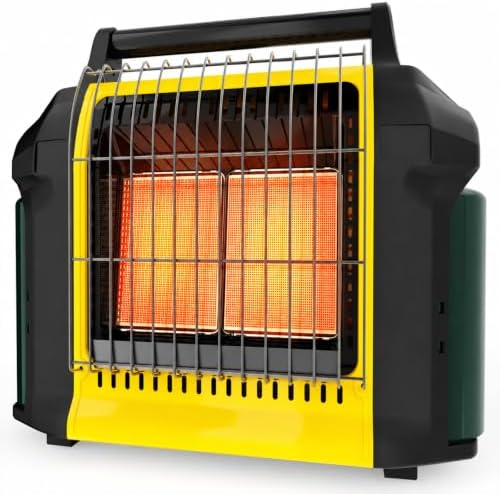
The DECOKTOOL has a compact format and uses standard 1-pound propane cylinders, which may be simpler to carry than a full-size tank. Its listed heat settings are 4,000, 9,000, and 18,000 BTU, with claimed coverage up to 450 square feet. It also has a carry handle and a protective front grille.
Its safety features include ODS, tip-over protection, and flame-out protection. The flame-out feature is intended to stop fuel flow if the flame goes out. The product description also claims quick radiant heat, but the listed runtime is approximately five to seven hours and depends on the setting. The cylinder is not included, so account for getting compatible fuel separately.
Compared with the cabinet-style picks, this model is easier to carry and does not call for a 20-pound tank in the supplied description. The tradeoff is that smaller cylinders may need more frequent replacement during extended use. The supplied product information marks this model as unavailable, so check its listing before planning a purchase.
Pros:
- Compact design with a carry handle
- Three listed heat settings, including a lower 4,000 BTU option
- ODS, tip-over, and flame-out protection are listed
- Uses standard 1-pound propane cylinders
Cons:
- Propane cylinder is not included
- Listed runtime is shorter than the low-setting estimates for some 20-pound-tank models
Verdict: Consider the DECOKTOOL if portability and 1-pound cylinders suit your plans, but confirm availability and follow the manual’s location and ventilation rules.
3. WELLUCK Propane Heater: Best for Fold-Flat Storage

The WELLUCK delivers three heat levels—6,000, 12,000, and 18,000 BTU—and connects to a standard 20-pound tank with the supplied hose and regulator. Its stated maximum coverage is 450 square feet. The foldable body is its key design feature: when the heater is cool and disconnected from the gas hose, it folds down for slimmer storage.
Four swivel casters, two with locking brakes, help with movement, while side handles give you another way to carry it. The product description lists ODS and tip-over protection, as well as a front mesh guard. It also describes a flare-free ignition sequence with a dedicated ignition setting; follow the included instructions rather than improvising the startup process.
This model suits someone who needs a full-size-tank heater but wants to save storage space between uses. As with the OKF, the quoted runtime of up to 69 hours is for the 6,000 BTU setting. The product description limits operation to below 4,500 feet in altitude, so check that restriction if you live or work at a higher elevation.
Pros:
- Three heat settings up to 18,000 BTU
- Fold-flat design for storage after disconnecting the hose
- Four swivel casters, including two with brakes
- ODS, tip-over protection, and a front mesh guard are listed
Cons:
- Requires a standard 20-pound tank and hose connection
- Product information specifies operation below 4,500 feet
Verdict: The WELLUCK is a strong fit if you want cabinet-heater output and easier storage, provided its altitude limit and setup requirements work for you.
4. Hotdevil Propane Heater: Best for a Wheeled Cabinet Design

The Hotdevil is a cabinet-style heater that uses a standard 20-pound propane cylinder. It offers three heat settings and a maximum output of 18,000 BTU, with claimed coverage up to 450 square feet. Its five rolling wheels and hidden tank cabinet give it a different layout from the smaller, carry-style DECOKTOOL.
The listed safety features include an ODS, tip-over protection, and flame-out protection. The heater uses piezoelectric ignition, according to the product description. These safeguards can help reduce specific risks, but they do not remove the need to use the heater only in approved, properly ventilated locations and to follow the manufacturer’s instructions.
The cabinet and wheels may suit a garage or workshop where you want to move the heater around without carrying it. The supplied description mentions use in a living room, basement, and tent, but those locations should not be treated as automatically approved: confirm the manual’s exact rules before use, especially in enclosed or sleeping spaces. The description does not give a precise runtime figure.
Pros:
- Three heat settings with output up to 18,000 BTU
- Cabinet design stores the 20-pound tank inside
- Five wheels make it easier to reposition
- ODS, tip-over, and flame-out protection are listed
Cons:
- Requires space for a cabinet heater and full-size tank
- No specific runtime estimate is provided in the supplied information
Verdict: Pick the Hotdevil if you prefer a wheeled cabinet and need a heater with several listed shutoff protections, while checking its manual for approved use locations.
5. SANAUVULCAN Propane Cabinet Heater: Best for a Compact Cabinet Footprint

This SANAUVULCAN cabinet heater has three output levels—6,000, 12,000, and 18,000 BTU—and is described for spaces from 150 to 450 square feet. It connects to a standard 20-pound tank. The listed dimensions are 15 by 10 by 22 inches, and the cabinet has five casters, two of which lock.
The product information lists an ODS that shuts the heater off if oxygen drops below 18%, along with tip-over protection. It also says the model is CSA approved and uses piezoelectric ignition without batteries or electricity. Its claimed runtime of up to 69 hours applies to the lowest heat setting, so higher output will use fuel faster.
The compact dimensions may be useful when floor space is limited, though you still need to allow all clearances required by the manual. The supplied information marks this model as unavailable, so check its listing before choosing it. Among the cabinet models, its listed dimensions and CSA approval are notable, but that does not make ventilation or careful operation optional.
Pros:
- Three heat settings and stated coverage from 150 to 450 square feet
- Compact listed dimensions with five casters
- ODS and tip-over protection are listed
- Product information states CSA approval
Cons:
- Supplied product information marks it unavailable
- The up-to-69-hour runtime is limited to the low setting
Verdict: The SANAUVULCAN is worth considering if you want a compact cabinet heater with stated CSA approval, but confirm availability and the exact operating instructions first.
How to Choose an Indoor Propane Heater
Confirm Where the Heater Is Approved for Use
Start with the heater’s label and manual, not only its product title. Some models are described for both indoor and outdoor use, but that does not mean they are suitable for every room, tent, RV, or sleeping area. Follow the manufacturer’s location limits and any local rules. If the manual does not clearly approve your intended space, do not use the heater there.
Understand Ventilation and Carbon Monoxide Risk
Propane combustion can produce carbon monoxide, an odorless gas that can be deadly. An ODS is designed to shut the heater off when oxygen levels become too low; it is not a carbon monoxide detector. Use the ventilation required by the manufacturer, keep a working carbon monoxide alarm in the area, and never treat a safety shutoff as a reason to operate the heater in a sealed space. Do not leave a fuel-burning heater on while you sleep.
Match Heat Output to Your Space
BTU ratings describe heat output, not a guarantee that a heater will warm every room of a given size. Drafts, ceiling height, insulation, outdoor temperature, and airflow all affect comfort. A lower setting can be useful for taking the chill off, while higher output may be needed in a larger or colder area. Check the manufacturer’s coverage guidance and use the heater only in a space it approves.
Choose a Fuel Setup That Fits Your Needs
The cabinet models in this group connect to a standard 20-pound tank, while the DECOKTOOL is described for 1-pound cylinders. A larger tank can reduce how often you need to change fuel, but the tank and heater take up more space. Smaller cylinders are easier to carry, but the DECOKTOOL’s listed runtime is approximately five to seven hours, depending on the setting. Use only the fuel type and connection specified by the manufacturer.
Compare Safety Features Carefully
Look at the listed protections, such as ODS, tip-over shutoff, and flame-out protection. These features address different problems, and not every model lists all three. Check how the manual says each feature works and whether it must be inspected or reset. Keep the heater upright and stable, maintain the required clearances, and keep people and objects away from hot surfaces.
Consider Moving, Storage, and Setup
Casters can help you move a cabinet heater across a suitable floor, while a carry handle may be more useful for a compact unit. A foldable design can reduce storage space, but the WELLUCK instructions say to disconnect the gas hose before folding. Allow a heater to cool as directed before moving or storing it, and do not move it while connected or operating unless the manual explicitly permits that.
Check Runtime Claims in Context
Runtime depends on the heat setting and fuel supply. The OKF, WELLUCK, and SANAUVULCAN list up to 69 hours on low with a 20-pound tank; that figure does not apply at maximum output. The DECOKTOOL gives an approximate five-to-seven-hour range, depending on its setting. Treat these as manufacturer-provided estimates rather than guarantees, and plan to monitor fuel use.
Frequently Asked Questions
Are indoor propane heaters completely safe to use inside a home?
No fuel-burning heater is risk-free. Use a model indoors only if its label and manual approve that location, provide the required ventilation, and follow all clearance and operating instructions. Keep a working carbon monoxide alarm in the area. An ODS is not a substitute for an alarm or proper ventilation.
Can an ODS detect carbon monoxide?
No. An ODS responds to low oxygen levels; it is not designed to detect carbon monoxide. Use a separate carbon monoxide alarm and follow the heater’s ventilation instructions.
Can I use one of these heaters in a tent or while sleeping?
Do not assume a heater is suitable for a tent or sleeping area because a product description mentions camping. Check the manual for approved locations, and never leave a fuel-burning heater operating while you sleep. If the instructions do not clearly approve the intended use, choose another heating method.
What does an 18,000 BTU rating mean?
BTU measures heat output. An 18,000 BTU setting produces more heat than a lower setting, but it also uses fuel faster. It does not guarantee that a heater will warm a particular room; drafts, insulation, and other conditions matter.
Which heater uses a 1-pound propane cylinder?
The DECOKTOOL description specifies standard 1-pound propane cylinders and says the cylinder is not included. The OKF, WELLUCK, Hotdevil, and SANAUVULCAN descriptions specify a standard 20-pound tank.
How long will a 20-pound tank last?
It depends on the heater and setting. The OKF, WELLUCK, and SANAUVULCAN list up to 69 hours on low, while higher settings consume fuel more quickly. Treat the stated runtime as an estimate, not a promise.
Which model is the best overall choice?
The OKF is the most balanced choice in this group if you want three heat settings, a 20-pound tank connection, and casters for moving it. If compact storage matters more, consider the foldable WELLUCK. In either case, verify that the heater is approved for your intended location and follow its safety instructions.
Final Recommendation
For a movable propane cabinet heater with adjustable output, the OKF is our leading pick based on its three heat settings, 20-pound tank connection, and listed ODS and tip-over protection. The WELLUCK is a good alternative if fold-flat storage is important, while the DECOKTOOL stands out for its smaller cylinder setup. No model should be considered safe for every indoor space: check the manual, provide the required ventilation, use a carbon monoxide alarm, and never operate a fuel-burning heater while you sleep.
