
A keyless interior door lock can give family members, guests, or staff access without passing around a key. The right choice depends on whether you want a code-entry keypad, a traditional knob for a bedroom, or a simple privacy lock—and whether the lock fits your door. These picks range from feature-rich keypad handles to basic interior privacy hardware, with fit, code capacity, and locking options compared below.
Table of Contents
Quick Comparison
| Product | Lock type | Notable features | Best suited for |
|---|---|---|---|
| TEEHO TE004 Keyless Entry Door Lock Handle | Keypad handle | 20 user codes, one-time codes, passage mode | Homes needing flexible access codes |
| Veise KS04 Keypad Door Lock with Handle | Keypad handle | 21 user codes, away mode, silent mode | Households wanting added access controls |
| MiLocks TKK-02SN Digital Door Knob | Keypad knob | Six codes, optional auto-lock, glow-in-the-dark keypad | Interior doors such as bedrooms and closets |
| RAFECIEE Privacy Door Knob | Privacy knob | Inside locking, reversible design, adjustable latch | Basic privacy without keypad entry |
| Buoan Keyless Electronic Entry Door Knob | Keypad knob | Up to eight codes, automatic locking, emergency power option | Users who want a simple coded bedroom lock |
Our Picks: Best Keyless Interior Door Lock reviews
TEEHO TE004: A Flexible Keypad Handle for Shared Access

The TEEHO TE004 is a keypad handle for people who want to manage access with codes instead of handing out keys. It supports up to 20 user PINs, one-time codes that delete after use, and two physical backup keys. That mix makes it a practical fit for a bedroom, home office, rental space, or other door used by several people.
Its automatic locking can be set from 10 to 99 seconds, and you can also hold a keypad button for two seconds to lock it right away. Passage Mode disables auto-lock when you want the door to stay open for frequent traffic. A backlit keypad helps in low light, while mute mode lets you silence keypad sounds.
The zinc-alloy body has an ANSI Grade 3 rating and an IP54 weather-resistance rating. It takes four AA batteries, which are not included, and the lock provides a low-battery alert. Check your door before ordering: it is designed for doors 1-3/8 to 2 inches thick, standard 2-1/8-inch bore holes, and 2-3/8- or 2-3/4-inch backsets.
Pros:
- Stores up to 20 user codes and supports one-time codes.
- Offers adjustable auto-lock, one-touch locking, and Passage Mode.
- Includes two physical backup keys and a low-battery warning.
- Fits a stated range of common door thicknesses and backsets.
Cons:
- Four AA batteries are required and are not included.
- It may be more features than you need for a low-traffic interior door.
Verdict: Choose the TEEHO TE004 if you want a flexible keypad handle with temporary codes and passage control, and your door matches its fit requirements.
Veise KS04: Extra Access Controls in a Keypad Handle

The Veise KS04 combines a keypad with a handle and supports 21 user codes, unlimited one-time codes, an interior thumbturn, and two backup keys. Its temporary-code option can be useful when someone needs short-term access, while the thumbturn gives you a manual way to operate the lock from inside.
Auto-lock is adjustable from 10 to 99 seconds, and holding a keypad key for two seconds locks the door immediately. Passage Mode turns off auto-lock when you need continuous access. Away Mode disables user codes except for the master code, and an alarm sounds after 10 incorrect entry attempts. Silent mode and a softly lit keypad are helpful features for bedrooms or shared spaces where keypad noise and visibility matter.
The lock uses four AA alkaline batteries, not included, and is rated for a year of battery life according to the product information. It has an ANSI Grade 3 rating and an IP55 rating. The listed fit is for doors 1-3/8 to 2 inches thick with a 2-1/8-inch bore hole; confirm the other door measurements and hardware requirements before buying.
Pros:
- Supports 21 user codes and unlimited one-time codes.
- Away Mode restricts codes while you are gone.
- Includes adjustable auto-lock, Passage Mode, and silent mode.
- Has an IP55 rating and an alarm after repeated incorrect attempts.
Cons:
- Requires four AA batteries, which are not included.
- The product information does not specify a backset range, so check compatibility before purchase.
Verdict: The Veise KS04 is a strong option if you want a keypad handle with more access-control modes, especially Away Mode and multiple temporary codes.
MiLocks TKK-02SN: A Straightforward Keypad Knob for Interior Doors

The MiLocks TKK-02SN is a digital door knob designed for interior spaces such as bedrooms, closets, and storage rooms. It stores up to six individual codes, which can be added or removed without an app or Bluetooth connection. That smaller code capacity may be enough for a household, but it is less suited to a door shared by many users.
Its physical keypad buttons glow in the dark, and audible tones signal locking, unlocking, and low-battery status. Auto-lock is optional, so you can turn it on or off using a switch inside the battery compartment. The knob is made of solid brass and uses concealed screws for a more finished appearance.
Fit is a key point with this model. It is listed for doors 1-1/4 to 1-7/8 inches thick, with an adjustable latch for 2-3/8- or 2-3/4-inch backsets. It uses four AA batteries, which are not included. Unlike the TEEHO and Veise picks, the supplied product details do not list temporary codes or passage mode.
Pros:
- Designed specifically for interior doors and stores up to six codes.
- Glow-in-the-dark physical buttons are visible in dim spaces.
- Auto-lock can be switched on or off.
- Solid-brass construction and concealed fasteners give it a traditional knob look.
Cons:
- Six codes may be limiting for larger households or frequent visitors.
- Four AA batteries are not included.
Verdict: Pick the MiLocks TKK-02SN for a keypad knob with simple code management and optional auto-lock, provided your door falls within its narrower thickness range.
RAFECIEE Privacy Knob: A Basic Choice for Private Rooms
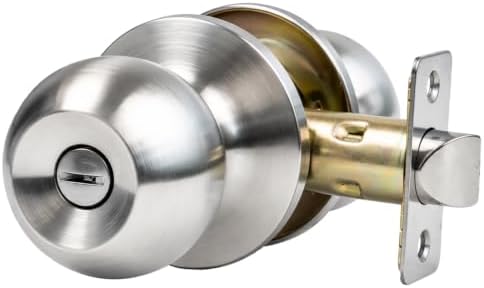
The RAFECIEE is a conventional privacy door knob, not a keypad lock. It is intended for rooms such as bedrooms, bathrooms, and offices where you want to lock the door from inside without entering a code. That makes it the simplest option here, but it does not provide individual PINs or keyless entry from the outside.
The knob is made from stainless steel and has an ANSI Grade 3 certification. Its adjustable latch fits listed backsets of 2-3/8 or 2-3/4 inches and doors 1-3/8 to 2 inches thick. The reversible design is intended to fit common door configurations, and installation requires a Phillips screwdriver.
This pick makes sense when privacy is the goal and a keypad would add unnecessary complexity. If you need to let a visitor in with a code, or want to manage access for several people, choose one of the keypad models instead.
Pros:
- Provides a straightforward inside privacy lock without keypad setup.
- Listed for common door thicknesses and two standard backsets.
- ANSI Grade 3 certified and made from stainless steel.
- Reversible design suits different door orientations.
Cons:
- It does not offer keypad or code-based entry.
- It is less suitable when multiple people need access without a key.
Verdict: Choose the RAFECIEE if you want basic interior privacy, but skip it if your priority is a true keyless lock with PIN codes.
Buoan Keyless Knob: A Compact Coded Lock with Fixed Auto-Lock

The Buoan is a keypad door knob for spaces such as a bedroom, study, garage, or office. It supports up to eight changeable codes and has a backlit keypad. The feature set is more basic than the TEEHO and Veise handles, but it may suit a single interior door where a small number of codes is enough.
One important distinction is that its automatic locking cannot be turned off. The door locks three seconds after opening, according to the product information. That can be helpful if you want the door to relock consistently, but it is less convenient for a room that needs to remain open during moving, gatherings, or frequent trips in and out.
The lock includes a low-power alert and an emergency power charger. Its listed backup battery port can be recharged if the battery runs out. The product information does not specify a battery type or detailed door-fit measurements, so confirm compatibility with the seller before ordering.
Pros:
- Supports up to eight changeable codes.
- Has a backlit keypad for use in dim conditions.
- Includes a low-power alert and emergency power option.
- Automatic locking relocks the door after three seconds.
Cons:
- Auto-lock cannot be turned off.
- Detailed door-fit measurements and battery type are not provided in the supplied product information.
Verdict: The Buoan is worth considering if you want a simple coded knob and are comfortable with automatic relocking that cannot be disabled.
How to Choose a Keyless Interior Door Lock
Decide Whether You Need a Keypad or Just Privacy
A keypad lock lets you open the door with a code, which is useful when several people need access or you do not want to share a physical key. A privacy knob, like the RAFECIEE, serves a different purpose: it locks from inside but does not offer code-based entry. Choose based on how you expect people to enter the room, not just the look of the hardware.
Check Door Thickness, Bore Hole, and Backset
Before buying, measure your door and compare it with the lock’s listed requirements. Door thickness, the size of the bore hole, and the backset—the distance from the door edge to the center of the knob or handle—can affect fit. The MiLocks, TEEHO, and RAFECIEE list specific dimensions; the Buoan information provided here does not. If a measurement is missing, confirm it before ordering.
Match Code Capacity to Your Household
Think about how many people need their own code. The MiLocks stores up to six codes, the Buoan up to eight, the TEEHO up to 20, and the Veise up to 21. If access is temporary, check whether the lock offers one-time codes. TEEHO supports one-time codes that delete after use, while Veise lists unlimited one-time codes.
Choose the Locking Behavior You Want
Automatic locking can help if you often forget to lock a door, but it is not ideal for every room. TEEHO and Veise offer adjustable auto-lock timers and Passage Mode, while the MiLocks allows auto-lock to be switched on or off. Buoan locks after three seconds and its auto-lock cannot be disabled. Consider how often the door needs to stay open before choosing.
Consider Battery Alerts and Backup Access
Keypad locks rely on batteries, so check the battery type, whether batteries are included, and how the lock alerts you when power is low. TEEHO, Veise, and MiLocks use four AA batteries, which are not included. TEEHO and Veise also include physical backup keys; Buoan lists an emergency power option. Review the lock’s backup method so you know what to do if the batteries run low.
Look at Materials and Intended Use
For an interior bedroom or closet, simple operation and door fit may matter more than weather resistance. If the door is exposed to the elements, check the lock’s stated rating: TEEHO lists IP54 and Veise lists IP55. The product information also lists ANSI Grade 3 certification for TEEHO, Veise, and RAFECIEE. Match these details to where the lock will be installed rather than assuming every keypad lock is suited to an exterior door.
Frequently Asked Questions
What is the difference between a keypad lock and a privacy knob?
A keypad lock opens with a PIN code and may also include a physical key or an interior thumbturn. A privacy knob locks from inside for personal space, but it does not provide keypad entry. The RAFECIEE in this list is a privacy knob, not a code lock.
Can I install a keypad door lock myself?
Several of these products are described as DIY installations using a screwdriver. TEEHO and MiLocks also list door measurements for checking fit. Read the instructions and confirm your door dimensions before starting; installation ease does not guarantee that every lock fits every door.
Do these locks need batteries?
The TEEHO, Veise, and MiLocks models use four AA batteries, which are not included. Buoan lists a low-power alert and an emergency power option, but the supplied product information does not specify its battery type. The RAFECIEE is a conventional privacy knob and does not use keypad electronics.
Which option is best for a bedroom?
For code-based access, the MiLocks is designed for interior doors such as bedrooms and stores up to six codes. TEEHO, Veise, and Buoan are also listed for bedroom use. If you only need a simple inside privacy lock, the RAFECIEE may be a more direct fit.
Can these locks stay unlocked while a room is in use?
TEEHO and Veise offer Passage Mode to disable auto-lock. The MiLocks has an auto-lock switch that can turn that feature off. Buoan’s automatic locking cannot be disabled, so it may be less suitable if you want a door to remain unlocked during frequent traffic.
Do all the listed products provide keyless entry?
No. TEEHO, Veise, MiLocks, and Buoan have keypads and code-based entry. The RAFECIEE is a privacy knob without a keypad, so it offers inside locking rather than keyless code access.
Final Recommendation
For most shoppers seeking a true keyless interior door lock, the TEEHO TE004 offers a useful balance of code capacity, one-time access, backup keys, and adjustable locking modes. Choose the Veise KS04 if Away Mode and silent operation matter most, or the MiLocks TKK-02SN if you prefer a keypad knob made specifically for interior doors. The RAFECIEE is best treated as a basic privacy option, while Buoan suits buyers who are comfortable with fixed, fast auto-locking. Before ordering, verify your door measurements and the access features you actually need.
