
A patio door that sticks, squeaks, or takes too much effort to open may need a clean track and the right lubricant. For most sliding doors, a silicone product is a practical place to start: it can reduce friction without leaving the heavy, oily feel some products do. The right choice depends on how you want to apply it, which materials are in your door system, and whether you prefer a spray, grease, oil, or wipe.
Below are five options with different formulas and application styles. Our leading pick is Rocket TT Slide & Glide for its quick-drying silicone formula and stated compatibility with several common door materials. If you prefer a jar, precise oil application, or a dry wipe, the other picks offer useful alternatives.
Table of Contents
Quick Comparison
| Product | Type | Best For | Notable Feature |
|---|---|---|---|
| Impresa Heavy Duty Sliding Door Lubricant | Silicone grease | People who prefer a jar formula | Multipurpose use on doors, hinges, and tracks |
| Rocket TT Slide & Glide Silicone Door Lubricant | Silicone spray | Low-residue application across several materials | Fast-drying, 100% silicone formula |
| UniSport Door, Lock, and Hinge Lubricant | Mineral-based oil | Doors, locks, and hinges in one household product | Includes rust inhibitors |
| Slice Engineering Dry Lube Wipes | Dry-film wipes | Small, controlled applications | Pre-moistened wipes with no spray or drips |
| Liquid Rescue Synthetic Oil for Patio Doors | Synthetic oil | Targeting rollers and other small moving parts | Three different-length application needles |
Our Picks: Best Lubricant For Sliding Patio Doors reviews
Impresa Heavy Duty Lubricant: A Jar Formula for Tracks and Hardware

Impresa is a silicone grease supplied in a 6-ounce jar. It is designed for more than patio doors, with the product description also naming hinges, garage doors, hatches, windows, and glass doors. That broad use may make it handy if you want one lubricant for several moving parts around the home.
Because it comes in a jar rather than a spray can, you can apply it directly where needed, but you will need to manage the amount yourself. Use a small amount on the appropriate moving surfaces and wipe away excess to keep the track tidy. As with any product, check your door’s care instructions and material compatibility before applying it.
Compared with the Rocket TT spray, Impresa may suit someone who prefers grease and wants a product described as heavy duty. The trade-off is that a jar may take more care to apply neatly than a quick-drying spray.
Pros:
- Silicone grease formula for sliding doors and other hardware
- Useful across several door and hinge applications
- Jar format allows direct, controlled placement
Cons:
- Applying grease neatly may take more care than using a spray
- The product description does not specify an applicator tool
Verdict: Choose Impresa if you want a silicone grease in a jar for patio-door tracks and other household hardware, and you are comfortable applying it sparingly by hand.
Rocket TT Slide & Glide: Fast-Drying Silicone Spray

Rocket TT is a 100% silicone spray made for sliding doors and tracks, as well as rollers, hinges, springs, and other moving parts. The product description says it dries quickly and is intended to leave no oily or sticky residue. That makes it a strong option if you want a spray rather than a grease or oil.
The formula is described as suitable for metal, plastic, rubber, vinyl, wood, and glass. That range may help when a door system has more than one material, but it is still wise to check the door manufacturer’s care guidance and test carefully before applying lubricant to a visible surface. The spray is also described as low-odor and suitable for indoor and outdoor use.
Compared with the Impresa jar, this is easier to apply across a track, though spraying calls for care to avoid unwanted overspray. Its fast-drying silicone formula and stated material range make it our best overall pick among these options.
Pros:
- 100% silicone formula designed to dry quickly
- Described as leaving no oily or sticky residue
- Listed for use on metal, plastic, rubber, vinyl, wood, and glass
- Designed for tracks, rollers, hinges, and other moving parts
Cons:
- Spray application can be less precise than a wipe or needle applicator
- Care is needed to limit overspray around the door and nearby surfaces
Verdict: Rocket TT is the best fit if you want a silicone spray for a range of door materials and prefer a formula described as quick-drying and low-residue.
UniSport Door, Lock, and Hinge Lubricant: A Multi-Use Oil
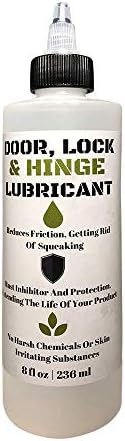
UniSport is an 8-ounce mineral-based lubricant intended for sliding doors, garage doors, hinges, and locks. Its description says it contains rust inhibitors and works across a stated temperature range of -35°F to 180°F. This makes it a flexible household option if you also want to address stiff locks or squeaky hinges.
Unlike the silicone spray picks, UniSport is an oil. That may appeal if you want one product for both moving door parts and locks, but it is worth applying only where the product and door maker allow. Take care around the track and nearby finishes, and wipe away any excess rather than leaving a visible film.
The product description calls the formula non-toxic and made with food-grade mineral-based products. Those claims do not replace the need to follow the label’s instructions, especially around children, pets, or food surfaces. Compared with the dedicated silicone options, UniSport has broader lock-focused use but less emphasis on a dry, non-sticky finish.
Pros:
- Designed for sliding doors, hinges, garage doors, and locks
- Contains rust inhibitors, according to the product description
- Stated to work across a wide temperature range
- May suit households seeking one lubricant for several hardware needs
Cons:
- Oil may require more care to keep nearby surfaces clean
- The description does not specify a precision applicator
Verdict: Choose UniSport if you want an oil for a mix of doors, hinges, and locks, rather than a product focused mainly on a clean-feeling sliding track.
Slice Engineering Dry Lube Wipes: Controlled, No-Spray Application

Slice Engineering takes a different approach: each sealed packet contains a pre-moistened wipe that applies a dry lubricant. The product description says the wipes avoid drips, overspray, and greasy residue, which may be useful when you need to treat a narrow area or want to avoid spraying near glass, flooring, or furnishings.
The dry film is described as water-based and as resisting detergents and water. The wipes are also marketed for sliding door tracks and windows, along with hinges, locks, and zippers. Since the formula is described as a PDMS-free alternative to silicone spray, it may be worth considering if you specifically want to avoid that type of silicone product.
The main limitation is the format: wipes may be less convenient for a long track or repeated maintenance than a larger spray or jar. The product information supplied for this guide marks it unavailable, so check the listing before making it your first choice.
Pros:
- Wipe-on application avoids spray and drips
- Described as leaving an invisible, non-greasy dry film
- PDMS-free and PFAS-free, according to the product description
- Can be used for several small household applications
Cons:
- Wipes may be less convenient for covering a long track
- The supplied product information marks it unavailable
Verdict: Slice Engineering is a useful format to consider if you prefer precise, no-spray application, but its listed availability may make another pick more practical.
Liquid Rescue Synthetic Oil: Precise Application to Rollers

Liquid Rescue is a 100%-synthetic oil described for patio doors and other sliders. It is intended for rails, rollers, latches, locks, and other moving parts, and the package includes three stainless-steel needles in different lengths for more precise application.
Those needles are the key difference from a spray or jar. They can help direct oil toward a small target, such as a roller or latch, when you want to limit the amount applied. This can be useful for troubleshooting a particular moving part, though it may be less convenient if your goal is to treat an entire track quickly.
The product description says it works with metal and plastic parts and helps quiet squeaks. Since it is an oil, use care near the track and surrounding surfaces, and follow the product instructions about where and how much to apply. Compared with Rocket TT, it offers more precise delivery but does not make the same quick-drying, no-residue claims.
Pros:
- Made for patio doors, sliders, rails, rollers, latches, and locks
- Includes three needle lengths for targeted application
- Described for use on metal and plastic moving parts
Cons:
- Oil application calls for care to avoid excess on nearby surfaces
- Targeted needles may be slower than spray for a long track
Verdict: Choose Liquid Rescue if you want to reach a specific roller or small moving part with a needle applicator, rather than coat a track with a spray.
How to Choose a Lubricant for Sliding Patio Doors
Start with the Door’s Care Instructions
Check the door maker’s guidance before applying anything. Some door systems may have specific instructions about which parts to lubricate and what products to use. If you cannot find the manual, look for guidance from the manufacturer or installer. A lubricant that works for one part of a door may not be suitable for every surface or mechanism.
Match the Formula to Your Application Style
Sprays are convenient for reaching a track or several moving parts, but they can be harder to direct exactly. Grease in a jar allows hand application, though it takes care to avoid applying too much. Wipes provide a controlled, no-spray option for small areas. Oil with a needle applicator is useful when you need to target a roller, latch, or other narrow spot.
Consider the Materials in Your Door System
Sliding doors can include several materials, such as metal, plastic, rubber, vinyl, wood, or glass. Compare the product’s stated compatibility with the materials in your door, and follow the label. Rocket TT lists several of these surfaces in its product description, while Liquid Rescue is described for metal and plastic moving parts. When in doubt, test cautiously in an inconspicuous area if the manufacturer permits it.
Look for the Finish You Want
If you want to avoid an oily or sticky feel, consider products specifically described as quick-drying or non-greasy, such as Rocket TT or the Slice Engineering dry-film wipes. Grease and oil can still be useful for appropriate parts, but they need careful placement and cleanup. No matter which type you choose, a light application is usually easier to manage than a heavy coating.
Clean the Track Before Lubricating
Dust, grit, and debris can make a door feel rough even when its moving parts are lubricated. Clear loose debris from the track and wipe away dirt before applying product. Lubricant is not a substitute for cleaning, and adding it over a dirty track can leave a mess. If the door still sticks after cleaning and careful lubrication, the rollers or alignment may need attention.
Choose Based on the Problem You Need to Solve
For a general-purpose silicone spray, Rocket TT is the most balanced option in this group. Impresa is a jar-based alternative for those who prefer grease, while UniSport covers locks and hinges as well as doors. Slice Engineering offers a wipe-on dry film, and Liquid Rescue’s needles are suited to precise oil application. Pick the format that matches the part you need to treat, not just the one with the broadest list of uses.
Frequently Asked Questions
What type of lubricant is best for sliding patio doors?
A silicone lubricant is a common choice for sliding-door tracks and moving parts. The best option depends on your door’s materials and manufacturer instructions. From this list, Rocket TT is a silicone spray, while Impresa is silicone grease.
Should I lubricate the entire patio-door track?
Not necessarily. First clean the track and check the door’s care instructions. Apply lubricant only where recommended and use a small amount. A heavy coating can collect dirt or make cleanup harder.
Can I use oil on patio-door rollers?
Some products, including Liquid Rescue, are described for patio-door rollers. Check the door manufacturer’s guidance before applying oil, target the intended part, and wipe away excess. If you are unsure whether a roller should be lubricated, ask the door maker or an installer.
Is silicone spray safe for every patio-door material?
No single product should be assumed to suit every door. Rocket TT lists compatibility with several materials, but you should still check the product label and your door’s instructions. Avoid spraying directly onto surfaces unless the product directions say that use is appropriate.
Will lubricant fix a patio door that still sticks after cleaning?
Not always. A sticking door can have other causes, such as a problem with its rollers or alignment. If cleaning and a careful, approved application do not help, inspect the hardware and consider getting assistance rather than adding more lubricant.
Which option is best if I want to avoid spray?
Slice Engineering’s pre-moistened wipes avoid spray and are designed for controlled application, though the supplied product information marks them unavailable. Impresa’s jar and Liquid Rescue’s needle applicators are other options if you want to apply lubricant directly rather than spray it across the track.
Final Recommendation
For most shoppers looking for a versatile lubricant for sliding patio doors, Rocket TT Slide & Glide is the strongest overall choice in this group. Its 100% silicone formula is described as quick-drying, low-residue, and compatible with several common materials. Choose Impresa if you prefer silicone grease in a jar, or Liquid Rescue if you want needle applicators for precise work on rollers and other small parts. Whatever you select, clean the track first, check your door’s care instructions, and apply the lubricant sparingly.
