
A microchip cat flap can give your cat a way in while helping keep unfamiliar animals out. The right choice depends on more than chip scanning: consider whether you need to control exits, how large an opening your cat needs, and whether you want app-based features. These five SureFlap options range from a straightforward entry-only flap to larger and connected pet doors.
Table of Contents
Quick Comparison
| Product | Best for | Flap opening | Notable feature |
|---|---|---|---|
| SureFlap Microchip Cat Flap | Simple selective entry | 4 3/4" H × 5 5/8" W | Learns up to 32 identities |
| SureFlap DualScan Microchip Cat Door | Managing entry and exit | 4 3/4" H × 5 5/8" W | Individual exit permissions |
| SureFlap Microchip Cat Flap, Alternate Listing | A basic microchip-controlled flap | 4 3/4" H × 5 5/8" W | One-button programming |
| SureFlap Microchip Pet Door | Larger cats or small dogs | 6 11/16" H × 7" W | Programmable curfew |
| SureFlap Microchip Pet Door Connect | Remote app control | 6 11/16" W × 7" H | Hub-based app features |
Our Picks: Best Microchip Cat Flap Door reviews
Best Simple Entry Control: SureFlap Microchip Cat Flap

This entry-only flap reads a cat’s implanted microchip and unlocks for recognized pets. It can learn up to 32 identities, making it a practical option for a home with several cats. Cats without a compatible chip can use a separately sold programmable collar tag.
The opening measures 4 3/4 inches high by 5 5/8 inches wide. Check those dimensions against your cat before buying, especially if your cat is broad or still growing. The flap runs on four AA alkaline batteries, which are not included; the stated battery life is up to 12 months depending on use. A flashing red light indicates low batteries.
This model focuses on selective entry rather than managing which pets can leave. Any animal can exit, so it is less suitable if you need to keep a particular cat indoors. It can be installed in doors, windows, or walls, though the required installation accessories may vary by location.
Pros:
- Recognizes implanted microchips and can store up to 32 identities
- Simple one-button programming
- Can be installed in a door, window, or wall with appropriate accessories
- Low-battery indicator helps flag when batteries need replacing
Cons:
- Controls entry only, not which pets may exit
- Small opening may not suit larger cats
Verdict: Choose this flap if you want straightforward microchip-based entry for one or more cats and do not need exit restrictions.
Best for Managing Each Cat’s Access: SureFlap DualScan Microchip Cat Door

The DualScan adds a useful layer of control to the standard microchip flap: you can set exit permissions for each pet. That makes it a stronger fit for homes where one cat should stay indoors while other cats are allowed outside. It stores up to 32 pets and is designed to recognize common microchips.
The opening is the same compact size as the basic cat flap—4 3/4 inches high by 5 5/8 inches wide—so measure your cat before settling on this model. It uses four AA batteries, not included, with a stated life of up to a year under normal use. The door can be fitted in a door, window, or wall, with accessories available for different installations.
DualScan’s extra permissions are its main advantage, but they may be unnecessary if every cat in your home has the same indoor and outdoor routine. It also does not have the larger opening or app controls offered by some other options here.
Pros:
- Lets you set exit permissions for individual pets
- Stores up to 32 pets
- Uses existing pet microchips
- Supports installation in doors, windows, or walls
Cons:
- Small flap opening may not suit larger cats
- More access control than some households need
Verdict: Pick the DualScan if you need to decide which cats can leave, not just which animals can enter.
Best Straightforward Alternative Listing: SureFlap Microchip Cat Flap

This listing describes a basic SureFlap microchip cat flap with selective entry, one-button programming, and capacity for up to 32 identities. Its stated microchip compatibility includes 9-digit Avid Secure, 10-digit FDXA, and 15-digit FDXB numbers. If you are unsure which chip your cat has, the product information suggests checking with your veterinarian, shelter, or rescue organization.
The opening is 4 3/4 inches high by 5 5/8 inches wide. The flap uses four AA non-rechargeable alkaline batteries, which are not included, and its stated battery life is up to 12 months depending on use. A flashing red light indicates low batteries. As with the other basic model, collar tags are sold separately for pets without microchips.
The product details closely match those of the other standard SureFlap cat flap in this guide. The supplied information does not describe a major feature difference, so compare the listings and installation requirements rather than assuming this version has added controls. It remains an entry-only option: pets can leave freely, but the flap does not provide individual exit permissions.
Pros:
- Lists compatibility with several common chip formats
- One-button programming and storage for up to 32 identities
- Low-battery warning light
- Suitable for door, window, or wall installation with the right accessories
Cons:
- Does not set exit permissions for individual cats
- Collar tags for pets without microchips are sold separately
Verdict: Consider this listing if you want the standard SureFlap entry-control feature set; check the listing details carefully because it appears similar to the other basic cat flap.
Best Larger Opening with a Curfew: SureFlap Microchip Pet Door

This larger SureFlap door scans a pet’s microchip on entry and can learn up to 32 identities. Its opening measures 6 11/16 inches high by 7 inches wide, which offers more room than the two smaller cat flaps in this guide. The product is described as suitable for cats and small dogs.
A programmable curfew lets you set times for the door to lock and unlock. However, this is still restricted-entry-only: any animal can exit, even if it is not recognized on entry. That distinction matters if your goal is to keep a specific pet inside. The door uses four C alkaline batteries, not included, with a stated battery life of up to 12 months depending on use.
It can be installed in a door, window, or wall with the appropriate accessories. The larger flap may be more comfortable for pets that do not fit the smaller opening, but measure the available space and your pet before installation. This model is a better match for households that value a timed lock and extra clearance over individual exit permissions or app control.
Pros:
- Larger opening than the standard cat flap models
- Can learn up to 32 identities
- Programmable curfew for locking and unlocking
- Designed for cats and small dogs
Cons:
- Any animal can exit, regardless of recognition
- Uses four C batteries, which are not included
Verdict: Choose this pet door if your cat needs a larger opening and you want scheduled locking, but not individual exit control.
Best for App-Based Access: SureFlap Microchip Pet Door Connect
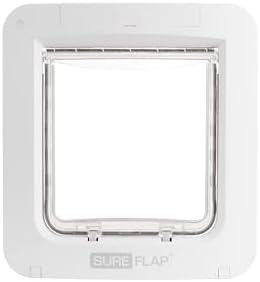
The Connect model is designed for app-based control. Its listed features include remote locking and unlocking, changing curfew times, and viewing long-term pet activity. The opening is listed as 6 11/16 inches wide by 7 inches high, making it larger than the standard cat flap opening.
This version requires a SureFlap Hub, which is sold separately. The supplied product information does not specify battery type, battery life, microchip formats, or the number of identities it can store, so check those details before choosing it. The title also describes the item as “without Hub,” so make sure you understand what is included in the listing and budget for the required hub if you want its connected features.
Remote control can be useful if you want to change access settings without operating the door itself. But the added app features may be unnecessary if you only need a basic microchip-activated flap. Compared with the larger pet door above, the Connect’s key distinction is remote app control rather than a stated curfew feature alone.
Pros:
- Offers remote locking and unlocking through an app
- Allows curfew times to be changed remotely
- Tracks long-term pet activity
- Has a larger opening than the basic cat flap models
Cons:
- SureFlap Hub is required and sold separately
- Supplied details do not specify battery or chip compatibility information
Verdict: Choose the Connect if remote access settings and activity tracking matter to you, and you are prepared to get the required hub separately.
How to Choose a Microchip Cat Flap
Match the access controls to your household
Start with what you need the flap to control. A standard entry-only model recognizes permitted pets coming in, but allows any animal to leave. If one cat must stay indoors while another can go out, look for individual exit permissions, such as those on the DualScan model. If you mainly want to stop unknown animals from entering, a simpler entry-only flap may be enough.
Measure your cat and the flap opening
Compare your cat’s size with the listed opening dimensions, not just the product name. The smaller cat flaps in this guide measure 4 3/4 inches high by 5 5/8 inches wide. The larger pet-door options have openings around 6 11/16 to 7 inches in each direction, depending on the listed measurement. Make sure your pet can pass through comfortably and consider whether the opening will still suit them as they grow.
Check your pet’s microchip or tag needs
Confirm that the door supports your cat’s microchip before buying. The standard models list compatibility with specific chip formats, while the DualScan description says it works with common microchips without listing formats. For a cat without a microchip, the basic flap descriptions say a programmable collar tag is sold separately. Ask your veterinarian or adoption organization for your cat’s chip details if you are unsure.
Plan the installation location
These products are described as installable in doors, windows, or walls, but the accessories needed can depend on the location. Check the installation requirements for your chosen surface before cutting an opening. If you are unsure about fitting a flap in glass, a thick door, or a wall, confirm the required accessories and installation method first.
Consider batteries and connected features
The standard cat flaps use four AA batteries, while the larger SureFlap Pet Door uses four C batteries. The listed battery life for those models is up to 12 months or up to a year under normal use, but actual life depends on use. Batteries are not included. The Connect model adds remote controls and activity tracking, but it requires a separately sold Hub; consider whether those app features are worth the extra setup for your home.
Decide whether a curfew is enough
A timed lock can restrict when pets use a door, but it is different from controlling each pet’s exit. The larger SureFlap Pet Door offers a programmable curfew, yet any animal can exit. If your priority is keeping one specific cat indoors while others go out, choose a model with individual exit permissions rather than relying only on a schedule.
Frequently Asked Questions
How does a microchip cat flap work?
A compatible flap reads a pet’s implanted microchip and grants entry to recognized animals. Some models can store multiple identities. Check the product’s listed chip compatibility and your cat’s chip number before purchase.
Can a cat use one of these doors without a microchip?
The standard SureFlap cat flap descriptions say programmable collar tags are available separately for pets without microchips. Check the specific listing to confirm which tags are compatible and whether they are included.
Can I stop one cat from leaving while allowing another to go out?
The DualScan model is described as allowing exit permissions to be set for each pet. The standard entry-only flaps do not control which animals can leave, and the larger curfew model allows any animal to exit.
Are batteries included?
The product details say the standard cat flaps use four AA batteries and the larger SureFlap Pet Door uses four C batteries; these are not included. The supplied information does not state battery details for the Connect model, so check its listing.
Can I install a microchip cat flap in a wall or window?
The standard cat flap and larger pet-door descriptions say they can be installed in doors, windows, or walls. Additional accessories may be needed depending on the installation. Confirm the requirements for your specific surface before starting the job.
Does the SureFlap Connect include the Hub?
The supplied details say the SureFlap Hub is required and sold separately, even though the product title says “Without Hub.” Check the listing contents before ordering and plan to get the Hub if you want to use the app-based features.
Final Recommendation
For most homes that need selective entry without extra controls, the standard SureFlap Microchip Cat Flap is the simplest place to start—provided its opening fits your cat. Choose the DualScan if different cats need different exit permissions, the larger Pet Door if your pet needs more clearance or you want a curfew, and the Connect if remote app control is worth the separate Hub. Before buying, verify your cat’s chip compatibility, measure the opening, and check the installation requirements for your chosen location.
