
A mini wood lathe can help you turn small projects like pens, bowls, and ornaments without taking up the space of a full-size machine. The right choice depends on what you plan to make: compact hobby pieces call for different capacity and power than longer spindle work. Below, we compare five beginner-friendly options by their listed size, speed range, motor, and included features, then explain what to look for before you buy.
Table of Contents
Quick Comparison: Best Mini Wood Lathes for Beginners
| Mini wood lathe | Working capacity | Motor and speed | Best fit |
|---|---|---|---|
| ARTYMASTER WM101A-Plus | 3-inch diameter × 8-inch length | 96W; variable speed | Small, detailed DIY projects |
| VEVOR 8 × 13-Inch Mini Lathe | 8-inch swing × 13-inch distance between centers | 1/3 HP; 150–3,200 RPM | Versatile beginner projects |
| CXRCY 8 × 12-Inch Mini Lathe | 8-inch swing × 12-inch distance between centers | 1/3 HP; 750–3,200 RPM | Small bowls and spindle projects |
| BACHIN Multi-Purpose Mini Lathe | Not specified | 96W; listed maximum speed of 11,000 RPM | Compact DIY and specialty tasks |
| WEN LA3421 Mini Lathe | 8-inch swing × 13-inch distance between centers | 3.2-amp motor; 750–3,200 RPM | Small projects with soft-start operation |
Our Picks: Best Mini Wood Lathes For Beginners reviews
ARTYMASTER WM101A-Plus: A Compact Pick for Small, Detailed Work

The ARTYMASTER WM101A-Plus is a notably compact benchtop lathe designed for small DIY pieces. Its listed work range is 3 inches in diameter and 8 inches long, which is much smaller than the capacity of the VEVOR, CXRCY, and WEN machines. That makes it a better match for miniature projects than for turning larger bowls or longer spindles.
It has a 96W, 24V motor, an MT1 spindle interface, and variable speed control. The steel base and headstock are intended to reduce vibration, while the tool rest can be adjusted for position, height, and angle. The package also lists interchangeable cutter-head tools, a 2-inch chuck set, drive and live centers, and adjustment wrenches, giving beginners several accessories to start with.
The small footprint and bundled tooling are appealing if your projects are limited in size. The trade-off is capacity: the 3-inch diameter limit is a major constraint compared with the 8-inch swing on the other conventional lathes here. Its 96W motor is also much less powerful on paper than the 1/3 HP models, so it is not the best choice for demanding or larger work.
Pros:
- Compact size suits small-detail projects.
- Variable speed control and adjustable tool rest.
- Includes a chuck set, centers, and turning tools.
- Steel base and headstock are designed to limit vibration.
Cons:
- Smaller listed capacity than the other conventional lathes in this guide.
- Lower motor power makes it a less suitable choice for larger or demanding work.
Verdict: Choose the ARTYMASTER if your priority is a compact machine for small projects and you do not need the larger capacity of a standard 8-inch mini lathe.
VEVOR 8 × 13-Inch Lathe: A Versatile Beginner Machine

This VEVOR benchtop lathe offers an 8-inch swing and 13 inches between centers, giving it room for a wider range of small projects than the ARTYMASTER. Its 1/3 HP, 250W motor and variable speed range of 150 to 3,200 RPM are listed for both roughing and finishing tasks.
The metal frame is designed to help reduce vibration, and the machine includes circuit-board overcurrent protection. VEVOR describes the lathe as a ready-to-use kit with essential accessories, but the supplied product details do not name each item. If you need a particular tool or center, confirm that it is included before ordering.
The broad speed range and standard 8-by-13-inch capacity make this a flexible starting point for a beginner who wants to try several kinds of small turning. Compared with the WEN, it has a lower stated minimum speed, while the WEN specifies a soft-start motor and two-year warranty. The VEVOR’s supplied description does not list those features.
Pros:
- 8-inch swing and 13-inch distance between centers.
- 1/3 HP motor with a wide 150–3,200 RPM range.
- Metal frame is designed to reduce vibration.
- Includes a starter set of accessories, according to the product description.
Cons:
- The included accessories are not itemized in the supplied specifications.
- Soft-start operation and warranty details are not specified in the product information provided.
Verdict: The VEVOR is a sensible option if you want a conventional 8-by-13-inch lathe with a broad speed range and a 1/3 HP motor.
CXRCY 8 × 12-Inch Lathe: A Tool-Rich Choice for Small Turning

The CXRCY has an 8-inch swing over the bed and 12 inches between centers. That is close to the capacity of the VEVOR and WEN, though its stated center-to-center length is an inch shorter. Its 1/3 HP motor has variable speed from 750 to 3,200 RPM, controlled continuously within that range.
This package stands out for its listed accessories: an HSS lathe chisel, two tool rests, a 6-inch faceplate, a spur center, a live center, a knockout rod, and basic adjustment tools. It also includes goggles. Its product description names projects such as small bowls, plates, vases, and pens, so the stated capacity is aimed at hobby-scale work rather than large pieces.
Compared with the VEVOR, the CXRCY includes a more detailed accessory list but has a higher minimum speed. A lower starting speed can be useful for some workpieces and setups, so consider that difference when comparing the two. The package is appealing if you want several accessories supplied, though you should still check that the included tools suit the projects you plan to make.
Pros:
- 8-inch swing and 12-inch distance between centers.
- 1/3 HP motor with variable speed from 750 to 3,200 RPM.
- Includes two tool rests, a faceplate, centers, and an HSS chisel.
- Goggles are listed among the included items.
Cons:
- Its 12-inch center distance is shorter than the 13-inch VEVOR and WEN models.
- The minimum listed speed is higher than the VEVOR’s.
Verdict: Consider the CXRCY if you want a conventional mini lathe with a detailed accessory bundle and do not need the extra inch of turning length offered by some competitors.
BACHIN Multi-Purpose Mini Lathe: A Specialty Option for Compact DIY

The BACHIN is a compact, multi-purpose machine with a 96W motor and a listed maximum speed of 11,000 RPM. Its product description highlights wood turning as well as tasks such as cutting, engraving, grinding, polishing, and drilling. It also comes with four HSS tools and a multi-functional chuck, among other accessories.
This is not an apples-to-apples alternative to the VEVOR, CXRCY, or WEN. The BACHIN description does not provide a swing or distance between centers, and its stated maximum speed is far above the conventional variable-speed ranges listed for those machines. It specifically advises that the device is suitable for cork turning and should not exceed its rated power. Those limits make it important to check the manual and intended work before using it for regular woodturning.
The broad range of listed tasks may appeal to a DIY hobbyist who wants a compact, multi-purpose setup. But a beginner looking for a standard wood lathe with clearly stated work capacity and a conventional speed range may find one of the other models easier to compare and choose.
Pros:
- Compact design aimed at home DIY projects.
- Includes four HSS tools and a multi-functional chuck.
- Product description lists several possible tasks beyond turning.
Cons:
- Swing and distance between centers are not specified.
- Product details describe it as suitable for cork turning and caution against exceeding its rated power.
Verdict: Choose the BACHIN only if its specialty use and compact accessory set match your plans; for general beginner woodturning, the conventional lathes with stated capacity are easier to assess.
WEN LA3421: A Familiar 8 × 13-Inch Lathe with Soft Start
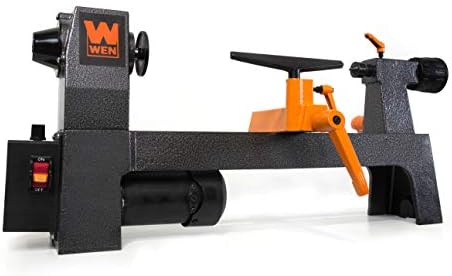
The WEN LA3421 is built for small workpieces, with an 8-inch swing and 13 inches between centers. Its 3.2-amp motor has variable speed from 750 to 3,200 RPM, and the soft-start feature brings the motor up gradually. The product description says this is intended to help prevent motor damage and improve safety.
Included items are a 2.3-inch faceplate, MT1 spindle and tailstock tapers, and two interchangeable tool rests. WEN also lists a two-year warranty. These clear specifications make it easy to compare with the VEVOR: both offer 8-by-13-inch capacity, while the VEVOR has a lower stated minimum speed and specifies a 1/3 HP, 250W motor.
The WEN is a strong fit for a beginner who values a soft start, familiar capacity, and a clearly named set of included parts. The supplied details do not state the motor’s horsepower, so shoppers comparing power ratings should avoid treating its 3.2-amp figure as directly interchangeable with horsepower listings.
Pros:
- 8-inch swing and 13-inch distance between centers.
- Variable speed from 750 to 3,200 RPM.
- Soft-start motor and two interchangeable tool rests.
- Product description includes a two-year warranty.
Cons:
- Its listed minimum speed is higher than the VEVOR’s 150 RPM starting point.
- Horsepower is not provided in the supplied product details.
Verdict: The WEN is a well-specified choice for small projects if you want soft-start operation, standard mini-lathe capacity, and a stated warranty.
How to Choose a Mini Wood Lathe for Beginners
Match the capacity to your projects
Swing over the bed describes the largest workpiece diameter that can fit over the lathe bed, while distance between centers describes the maximum length that fits between the headstock and tailstock. The VEVOR and WEN list an 8-inch swing and 13-inch distance between centers; the CXRCY lists an 8-inch swing and 12 inches between centers. The ARTYMASTER has a smaller stated work range of 3 inches in diameter by 8 inches long. Choose based on the pieces you actually expect to turn, and leave room for the workholding setup.
Compare motor information carefully
Motor ratings are not always given in the same units. The VEVOR and CXRCY list 1/3 HP motors, the VEVOR also gives a 250W figure, the ARTYMASTER and BACHIN list 96W, and the WEN specifies a 3.2-amp motor. These numbers do not provide a complete picture of how a lathe will perform in every situation. For a beginner, it is useful to compare the full specifications and choose a machine intended for the size and type of work you plan to do.
Look at the full speed range
Variable speed lets you adjust the spindle speed to the task and workpiece. The VEVOR lists 150–3,200 RPM, the CXRCY and WEN list 750–3,200 RPM, and the ARTYMASTER describes its speed as infinitely variable without giving a range. BACHIN lists a maximum of 11,000 RPM, but does not provide the same conventional capacity details. Do not compare maximum speeds alone; the low end and the manufacturer’s operating guidance matter too.
Check what comes in the box
Included tools can help you get started, but packages differ. The CXRCY lists a faceplate, centers, two tool rests, and a chisel; the WEN lists a faceplate, tapers, and two tool rests; and the ARTYMASTER lists a chuck set, centers, and turning tools. The VEVOR description says it includes essential accessories but does not itemize them. If you already own tools or need a specific accessory, confirm compatibility and package contents before buying.
Consider stability and workspace
A mini lathe still needs a secure, level place to operate. Some product descriptions specifically mention a metal frame, steel construction, or vibration-reducing design, but the supplied details do not give comparable machine weights or mounting instructions. Check the manual for setup guidance, and consider how you will secure and position the machine in your workspace.
Keep safety in the buying decision
Turning creates chips and dust, and the CXRCY product description specifically advises wearing goggles. Use suitable eye protection, follow the manufacturer’s instructions, and make sure the workpiece and accessories are correctly secured before starting. For a machine with an unusually high listed maximum speed or limited capacity details, read the operating information closely and confirm that it fits your intended use.
Frequently Asked Questions
What is a good size mini lathe for a beginner?
An 8-inch swing with about 12 or 13 inches between centers is a useful size for a range of small projects, including pieces such as pens, small bowls, and vases. A smaller machine can work if you only plan to make miniature items. Check the dimensions of your intended workpieces before choosing.
Is variable speed important on a mini wood lathe?
Variable speed gives you more control over the spindle speed for different tasks. Compare the full range, especially the minimum speed, rather than focusing only on the top speed. Always follow the machine’s instructions for the workpiece and setup.
Can a mini wood lathe turn bowls?
Some of the listed machines are described for small bowls and similar projects. The bowl’s size must fit the lathe’s swing, and the machine and workholding setup must be appropriate for the job. These are mini lathes, so they are not intended to handle large bowl blanks.
Does a beginner need to buy turning tools separately?
Not always. Several models in this guide list tools or accessories in the package, but what is included varies. The VEVOR description does not name each accessory, so check the package details if a certain tool is important to you.
What is the difference between swing and distance between centers?
Swing over the bed is the maximum diameter that can fit over the bed. Distance between centers is the maximum length that fits between the headstock and tailstock. Both measurements limit the size of work you can turn.
Is the BACHIN a standard mini wood lathe?
Its description presents it as a multi-purpose mini lathe and lists a maximum speed of 11,000 RPM, but it does not provide a swing or distance between centers. It also says the unit is suitable for cork turning and advises users not to exceed rated power. If you want a conventional wood lathe with clearly stated capacity, compare it with the VEVOR, CXRCY, or WEN.
Final Recommendation
For most beginners looking for a conventional mini wood lathe, the WEN LA3421 and VEVOR are the easiest to compare: both list an 8-inch swing and 13 inches between centers. The WEN adds soft-start operation and a stated two-year warranty, while the VEVOR lists a lower minimum speed and a 1/3 HP motor. The CXRCY is a good alternative if its accessory bundle appeals to you and 12 inches between centers is enough. Choose the ARTYMASTER for smaller work, and consider the BACHIN only when its specialty use and less clearly stated capacity fit your plans.
