
Outdoor cameras advertised for 24/7 recording vary widely in how they stay powered and what “continuous” means in practice. Some use solar power and record at a lower frame rate when nothing is happening, while a wired NVR system can keep recording without relying on a battery. The right choice depends on whether you have nearby power, reliable Wi-Fi or cellular coverage, and a plan for storing footage.
Below, we compare five options by their recording approach, power needs, storage, and useful features—so you can find a camera that fits your property and how you want to review footage.
Table of Contents
Quick Comparison
| Camera | Power and connection | Recording and storage | Best suited for |
|---|---|---|---|
| MUBVIEW 24/7 Continuous Recording Camera | Solar and battery; 2.4GHz Wi-Fi | Included 32GB card; supports up to 256GB | Solar-powered coverage with pan, tilt, and tracking |
| SEHMUA 2K Solar Security Camera | Solar and battery; 2.4GHz or 5GHz Wi-Fi | Supports up to 512GB card; card not included | Flexible Wi-Fi and adjustable recording settings |
| TKENPRO 2K Solar Camera | Solar and battery; 2.4GHz Wi-Fi | Supports up to 512GB card; card not included | Solar recording with activity-based frame-rate changes |
| Hiseeu 24/7 Recording Camera System | Plug-in cameras and NVR; Wi-Fi for remote access | Included 1TB hard drive | Steady recording and local storage for multiple cameras |
| ZEEPORTE SECURITY 4G LTE Solar Camera | Solar and battery; 4G LTE, no Wi-Fi | Supports up to 256GB card; card not included | Remote sites without Wi-Fi or nearby power |
Our Picks: Best Outdoor Cameras For 24 7 Recording reviews
1. MUBVIEW 24/7 Camera: Best Solar Features and Included Storage
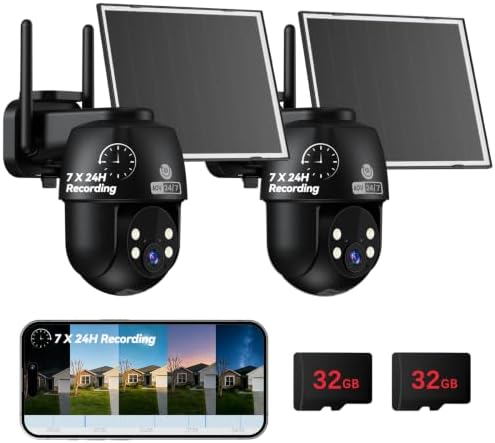
The MUBVIEW combines a solar panel, rechargeable battery, and local card storage in a wireless outdoor camera. It records continuously, but the description says quiet hours use silent, low-frame-rate video. If battery power runs low, it switches to motion clips rather than continuing its normal recording mode. That makes the recording behavior worth considering if you need uninterrupted, full-detail footage at all times.
Its included 32GB microSD card means you can start with local recording without buying a card separately. The camera supports cards up to 256GB, and basic cloud storage keeps short motion clips for seven days. Longer clips, a longer history, and off-site backup require an optional paid plan.
The camera offers 360-degree pan, 100-degree tilt, auto tracking, and 4MP video with 8X digital zoom. It uses 2.4GHz Wi-Fi, not 5GHz, and has an IP65 weather rating. Its solar panel and battery heating are useful features for outdoor placement, though solar performance still depends on sunlight and use. The description also notes that the camera can use a two-camera setup in one app with family sharing.
This is a good fit if you want a wire-free camera with included local storage and active tracking. Compared with the Hiseeu system, it is easier to place without running power cables, but it depends more on solar conditions and battery management.
Pros:
- Includes a 32GB microSD card and supports up to 256GB.
- Solar panel, rechargeable battery, and battery heating are designed for outdoor use.
- Pan, tilt, auto tracking, and human, vehicle, and animal detection.
- Offers 4MP video, spotlight, siren, and two-way audio.
Cons:
- Requires 2.4GHz Wi-Fi; 5GHz is not supported by the camera.
- Low battery can trigger a switch from continuous recording to motion clips.
Verdict: Choose the MUBVIEW if you want a solar-powered camera with included local storage and broad pan-and-tilt coverage, and can accept changes to recording mode when power is low.
2. SEHMUA 2K Solar Camera: Best for Dual-Band Wi-Fi Flexibility

The SEHMUA is a solar-powered, 2K camera system described as supporting both continuous and event recording. You can choose a recording mode based on the area you are watching and your needs. It also supports custom detection zones, alert schedules, and sensitivity settings, which can help focus notifications on more relevant activity.
Its dual-band Wi-Fi support is a useful difference from the MUBVIEW and TKENPRO. The description suggests using 2.4GHz for broader coverage farther from the router or 5GHz when the camera is closer and you want faster video transmission. Actual connection quality will still depend on the camera’s location and your network.
The camera offers 360-degree viewing, 2K video, color night vision, and detection of people and vehicles up to a stated 98 feet. Local continuous recording requires a microSD card, which is not included; the camera supports up to 512GB. Cloud storage is also offered, with a one-month trial described for event clips.
This choice suits households that want options for Wi-Fi band and recording schedule. It does not include local storage, so factor in a compatible memory card if you want to save continuous footage locally. Unlike the Hiseeu kit, it is solar and wireless, but does not include a large hard drive.
Pros:
- Supports both 2.4GHz and 5GHz Wi-Fi.
- Allows a choice between continuous and event recording.
- Offers custom detection zones, schedules, and sensitivity settings.
- Supports local storage on a card up to 512GB.
Cons:
- Memory card is not included.
- Cloud storage options for event clips may involve a paid plan after the trial.
Verdict: The SEHMUA is a strong match if you want a solar camera with dual-band Wi-Fi and adjustable recording options, and you are comfortable supplying your own memory card.
3. TKENPRO 2K Solar Camera: Best for Activity-Based Recording

The TKENPRO uses low-frame-rate recording when there is no activity and switches to a higher frame rate when motion is detected. This approach is intended to balance continuous coverage with storage and power use. It is still different from recording at the same frame rate all day, so it may not be the right fit if your priority is uniform, detailed footage throughout quiet periods.
The camera is solar-powered, with an 8W solar panel and rechargeable battery. It offers 2K color night vision, 360-degree viewing, two-way talk, and human auto tracking. The listed detection range is up to 98 feet. These features make it suitable for a driveway or yard where you want the camera to follow activity, rather than keep a fixed view of just one small area.
Local recording requires a memory card, sold separately, with support for cards up to 512GB. The product description says H.265 video compression can reduce storage use, but the amount of footage you can keep will depend on recording settings and activity. Wi-Fi support is listed for 2.4GHz.
Compared with the SEHMUA, the TKENPRO describes its idle and motion recording behavior in more detail, but does not offer the listed dual-band Wi-Fi support. It is a practical option for a solar installation where activity detection and tracking matter more than a steady frame rate during quiet periods.
Pros:
- Uses lower-frame-rate recording at rest and higher-frame-rate recording when motion is detected.
- Solar panel and rechargeable battery avoid a direct power connection at the camera.
- Offers 2K color night vision, 360-degree view, and human auto tracking.
- Supports local recording on a card up to 512GB.
Cons:
- Memory card is not included.
- Supports 2.4GHz Wi-Fi rather than the dual-band option listed for SEHMUA.
Verdict: Pick the TKENPRO if you want solar-powered coverage with activity-based frame-rate changes, tracking, and large-card support, and do not need full-rate recording during quiet periods.
4. Hiseeu Camera System: Best for Wired, Continuous Local Recording
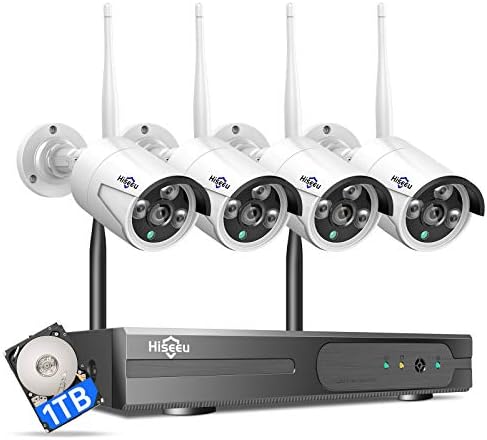
The Hiseeu is a four-camera system built around an NVR, or network video recorder. Its cameras and recorder use wired power, which avoids the battery and sunlight limits of the solar options. It supports continuous, motion-triggered, and customized recording modes, and comes with a 1TB hard drive for local storage.
The system can be viewed and controlled locally without Wi-Fi, according to the product description. For remote access, it supports 2.4GHz and 5GHz Wi-Fi. The listed package includes four 3MP cameras and a 4K NVR; the cameras are described as 3MP, so do not confuse the recorder’s 4K label with the resolution of each included camera. The system can also be expanded to support up to 10 channels.
Hiseeu is the most suitable pick here if consistent recording and local storage are the priority and you can run power to the cameras. Its IP66 weather rating and stated operating range are aimed at outdoor use. The tradeoff is installation: a wired multi-camera setup takes more planning than placing a single solar camera, and remote viewing depends on network access.
Compared with the solar models, this system is less flexible to mount but avoids reliance on solar charging. The included hard drive also gives it a storage advantage over products that require you to purchase a memory card separately.
Pros:
- Wired power supports continuous recording without relying on a camera battery.
- Includes a 1TB hard drive and offers local storage without a required cloud plan.
- Supports continuous, motion-triggered, and customized recording modes.
- Includes four cameras and can expand to up to 10 channels.
Cons:
- Power wiring makes installation less flexible than a solar camera.
- The included cameras are 3MP; the 4K specification applies to the NVR.
Verdict: Choose Hiseeu if you can install wired cameras and want a multi-camera system with a hard drive for local, continuous recording.
5. ZEEPORTE SECURITY 4G LTE Camera: Best for Locations Without Wi-Fi

This camera is designed for places where a standard home network is not available. It connects through 4G LTE rather than Wi-Fi and pairs a solar panel with a rechargeable battery. The product description lists farms, barns, construction sites, RVs, and vacation properties as possible uses, provided the location has 4G coverage.
It offers 24/7 recording when a memory card is installed, but the card is not included; the camera supports up to 256GB. Unlike the other solar picks in this guide, this model requires a cellular data plan. That ongoing connection cost is an important part of ownership, even though you do not need a Wi-Fi router at the site.
The camera provides 2K video, 360-degree pan and tilt, 4X digital zoom, color night vision, two-way audio, and motion detection. Its 9000mAh battery and solar panel are intended to reduce manual charging, but the product description does not remove the need for adequate sunlight and cellular coverage.
This is the clear choice for a remote property without Wi-Fi, but it is less attractive for a typical home with a working network. The MUBVIEW, SEHMUA, TKENPRO, and Hiseeu avoid the cellular-plan requirement.
Pros:
- Uses 4G LTE, so it does not require Wi-Fi or a router at the camera location.
- Solar panel and rechargeable battery support a wire-free installation.
- Offers 2K video, 360-degree pan and tilt, and color night vision.
- Supports continuous recording to a memory card up to 256GB.
Cons:
- Requires a paid cellular data plan and 4G coverage.
- Memory card is not included.
Verdict: Choose this camera for a remote site without Wi-Fi, but consider another pick if you want to avoid ongoing cellular service costs.
How to Choose an Outdoor Camera for 24/7 Recording
Decide What Continuous Recording Means for You
Check whether the camera records at a steady frame rate or changes its recording when the area is quiet. The MUBVIEW describes low-frame-rate recording during quiet hours and a switch to motion clips when battery power is low. TKENPRO also uses a lower frame rate when there is no activity. These approaches can conserve power or storage, but they are not the same as uninterrupted, full-detail footage. If that distinction matters, look closely at each camera’s recording modes before choosing.
Match the Power Source to the Installation
Solar cameras are easier to place where running a power cable is difficult, but their operation depends on sunlight, battery condition, and camera use. The MUBVIEW description specifically notes that runtime varies with sunlight and use. A plug-in system such as Hiseeu is a better fit when you can run power and want to avoid relying on solar charging. Think about the camera’s location and access to power before focusing on extra features.
Check Wi-Fi or Cellular Coverage
Most cameras in this comparison use Wi-Fi, but they do not all support the same bands. MUBVIEW and TKENPRO list 2.4GHz Wi-Fi, while SEHMUA supports both 2.4GHz and 5GHz. Hiseeu can be used locally without Wi-Fi, while remote access uses Wi-Fi. ZEEPORTE SECURITY uses 4G LTE instead of Wi-Fi, so it needs cellular coverage and a data plan. Confirm your signal at the planned mounting point.
Plan for Storage and Playback
Local storage can help you keep recordings without relying on a cloud plan, but the card or drive may not be included. MUBVIEW includes a 32GB card, and Hiseeu includes a 1TB hard drive. SEHMUA, TKENPRO, and ZEEPORTE SECURITY require you to supply a compatible memory card for local recording. Check the supported capacity and consider how long you want to keep footage before it is overwritten. Cloud storage is separate from local recording and may have its own limits or fees.
Choose Coverage and Detection Features for the Area
A wide pan-and-tilt view can help cover a yard or driveway, while a fixed camera can be more suitable for a single doorway or gate. Auto tracking is available on MUBVIEW and TKENPRO, and the products list detection options for people, vehicles, or animals. Detection range figures are product specifications, not a guarantee of alerts at that distance in every setting. Mounting angle, obstacles, lighting, and network conditions can affect what the camera sees and how alerts work.
Consider Weather Resistance and Mounting
Look for the listed weather rating and think about exposure to rain, wind, heat, and cold at your installation point. MUBVIEW and Hiseeu list IP65 and IP66 ratings, respectively, while the other solar models are also described as outdoor cameras. These ratings do not replace careful placement: follow the installation instructions and position the camera and solar panel where they can perform as intended.
Calculate the Ongoing Costs
A camera advertised without a monthly fee may still offer optional paid cloud services, while a cellular model can require a data plan to connect. Include the cost of a memory card if one is not supplied, and consider whether you need cloud backup in addition to local footage. For a multi-camera wired system, also account for the effort of running power cables. The lowest upfront setup is not always the least costly option over time.
Frequently Asked Questions
Can a battery-powered outdoor camera really record 24/7?
Some battery and solar models offer continuous recording, but their recording behavior may change to manage power. In this comparison, MUBVIEW describes low-frame-rate video during quiet hours and a switch to motion clips if battery power is low. TKENPRO describes low-frame-rate recording when there is no activity and a higher frame rate when motion is detected. Read the recording details carefully if you need consistent footage.
Which camera includes storage for recordings?
MUBVIEW includes a 32GB microSD card, and Hiseeu includes a 1TB hard drive in its NVR system. SEHMUA, TKENPRO, and ZEEPORTE SECURITY support local memory cards, but their descriptions say the cards are not included.
Do these cameras require a subscription?
Not all of them require a subscription for local recording. Hiseeu includes a hard drive and describes local recording without a monthly fee. MUBVIEW offers local recording and free short motion clips, with some longer cloud features requiring an optional paid plan. ZEEPORTE SECURITY requires a cellular data plan for its 4G connection. Check the storage and connectivity requirements for the model you choose.
Which option is best for a property without Wi-Fi?
ZEEPORTE SECURITY is the only camera here described as using 4G LTE instead of Wi-Fi. It still requires 4G coverage and a cellular data plan. Hiseeu can be used for local view and control without Wi-Fi, but remote access uses a Wi-Fi connection.
Which camera is best for steady, wired recording?
Hiseeu is the best fit in this group if you can run power to the cameras. Its system supports continuous recording and includes a 1TB hard drive. Its included cameras are listed as 3MP, while the NVR is described as 4K.
Do solar cameras need direct sunlight all day?
The product information does not specify a required number of sunlight hours. Solar performance and runtime can vary with placement, sunlight, and use. Position the panel where it can receive good exposure, and check the maker’s setup guidance for your location.
Final Recommendation
For a wired setup with included local storage and continuous recording modes, the Hiseeu system is the most straightforward choice in this group. If you prefer a solar camera, MUBVIEW stands out for including a memory card and offering pan, tilt, and auto tracking, while SEHMUA offers dual-band Wi-Fi and flexible recording settings. For a remote property without Wi-Fi, ZEEPORTE SECURITY fills a different need, but its cellular plan is an ongoing requirement. Choose based on the recording behavior, power source, and storage plan that fit your site—not just the 24/7 label.
