Choosing the best paint for basement walls to prevent mold starts with finding the source of moisture. Paint can help treat existing surface growth or resist mildew on its own film, but it cannot fix leaks, condensation, or damp building materials. For a sound, dry wall, Zinsser Mold Killing Primer is the strongest choice for treating existing surface mold before a topcoat. For ongoing moisture resistance on masonry, consider a waterproofing paint made for that surface.
Below, you’ll find options for treating mold, protecting a paint film, and waterproofing concrete or masonry. Match the product to your wall material and moisture problem, and follow its label for preparation and application.
Table of Contents
Quick Comparison
| Product | Best For | Key Detail | Coverage Information |
|---|---|---|---|
| Zinsser Mold Killing Primer, Quart | Priming areas with existing surface mold | EPA-registered, water-based primer | Listed as 160 sq. ft. |
| Zinsser PERMA-WHITE Interior Paint | Resisting mold and mildew on the paint film | Self-priming, washable eggshell finish | Listed as 300–400 sq. ft. per gallon |
| Zinsser WaterTite Mold & Mildew White Waterproofing Paint | Waterproofing suitable masonry walls | Waterproofing paint with mold- and mildew-proof film claims | Listed as up to 100 sq. ft. |
| Zinsser Mold Killing Primer, Pack of 3 | Larger projects needing mold-killing primer | Three-quart pack of the water-based primer | Listed as up to 160 sq. ft. per quart |
| KILZ Basement and Masonry Waterproofing Paint | Waterproofing concrete, brick, and cinder block | For interior or exterior masonry; not for active leaks | 75–100 sq. ft. on rough surfaces; 100–125 sq. ft. on smooth surfaces |
Our Picks: Best Paint For Basement Walls To Prevent Mold reviews
Best for Treating Existing Surface Mold: Zinsser Mold Killing Primer

This water-based primer is designed for painting over existing mold and mildew on suitable surfaces. Its EPA-registered fungicidal coating is intended to kill mold, mildew, and odor-causing bacteria, and it can go under a compatible topcoat. That makes it a treatment primer, not a decorative finish paint.
The quart size can suit a smaller affected area or a targeted basement project. The supplied product information lists coverage at 160 square feet, but actual coverage can vary with surface condition and application. Although the product description says extensive pre-cleaning is not required, that does not mean you should ignore the label or paint over a wet, damaged, or structurally unsound wall. Fix moisture problems first and follow the product’s remediation guidance.
Some users describe it as useful for covering old water-related stains, and practical reports suggest it can be convenient for spot treatment. Its main limitation is that it is not waterproof. Pair it with a suitable finish coat when the label calls for one, and do not expect primer alone to stop water from entering the basement.
Pros:
- Designed to kill existing mold and mildew on appropriate surfaces
- Water-based formula cleans up with soap and water
- Can be used under a compatible topcoat
- Quart size is practical for smaller areas or spot treatment
Cons:
- Does not fix leaks or make the wall waterproof
- Not a substitute for proper remediation on damaged or unsafe surfaces
Verdict: Choose this primer when you need a mold-killing treatment for a limited, properly prepared area before applying a finish coat.
Best Finish Paint for Mildew Resistance: Zinsser PERMA-WHITE

PERMA-WHITE is an interior finish paint formulated to resist mold and mildew on the paint film. The product information describes it as self-priming, so it does not require sanding as part of its stated application approach. Its eggshell finish is washable and scrubbable with soap and water, which can be helpful in a finished basement where walls need occasional cleaning.
The key distinction is that its mildewcide is intended to prevent growth on the paint film only. It does not kill mold hidden behind the coating or address moisture coming through a wall. For that reason, it makes more sense as a protective finish on a clean, sound, dry surface than as a fix for active mold or water intrusion.
The listed coverage is 300–400 square feet per gallon, so check the container size and project area before planning how much to buy. Compared with a mold-killing primer, this is the more direct choice when the wall is already in good condition and your goal is a washable finish with mildew resistance.
Pros:
- Self-priming formula
- Paint film is formulated to resist mold and mildew
- Washable and scrubbable with soap and water
- Eggshell finish suits many finished interior spaces
Cons:
- Its mildew protection applies to the paint film, not hidden growth or the wall itself
- Does not waterproof a basement wall or solve a moisture source
Verdict: Pick PERMA-WHITE for a clean, dry interior wall when you want a washable finish designed to resist mildew on its surface.
Best Waterproofing Paint for Masonry: Zinsser WaterTite

Zinsser WaterTite is a latex-based waterproofing paint made for suitable wall surfaces, including masonry. The product description says it resists water pressure and has a smooth, bright white finish that can be applied by brush or roller. It also lists a tintable feature, which may offer more color flexibility than a standard white coating.
This option is aimed at reducing water penetration through an appropriate wall—not simply covering a stain or adding a mildew-resistant finish. The supplied listing states coverage of up to 100 square feet for the gallon container. Check the label for surface requirements, preparation, and application details, since masonry condition can affect results.
WaterTite’s product information includes stated waterproofing and mold- and mildew-proof paint-film guarantees. Those claims should not be read as a cure for structural water problems or a promise that any basement will stay dry. Like the other coatings here, it cannot replace fixing the source of moisture. It is also a less natural fit for drywall or other surfaces outside its intended use.
Pros:
- Designed as a waterproofing coating for suitable surfaces
- Made for interior and exterior applications
- Smooth white finish applies with a brush or roller
- Product information includes stated waterproofing and mildew-resistance guarantees
Cons:
- Best matched to suitable masonry, not every basement wall material
- Requires careful surface preparation and will not correct the cause of water intrusion
Verdict: Consider WaterTite for a suitable masonry wall where waterproofing is the main goal, after you have addressed the source of moisture.
Best Value for Larger Treatment Areas: Zinsser Mold Killing Primer, Pack of 3
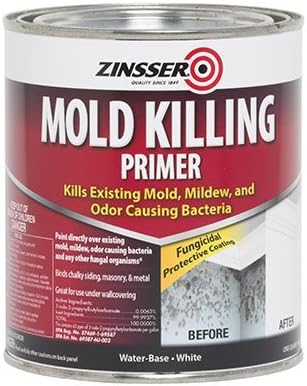
This listing offers three quarts of Zinsser’s water-based Mold Killing Primer. The formula is described as a protective primer for existing mold, mildew, moss, fungi, and odor-causing bacteria on suitable non-porous surfaces. It can be used under a compatible topcoat, including the brand’s PERMA-WHITE paint.
The product information lists coverage of up to 160 square feet per quart, touch-dry time of 30 minutes, and recoat time of one hour. Treat those figures as label-based guidance rather than a guarantee for every wall; roughness, absorption, and application can change coverage. The larger pack is most useful if you have several affected areas or expect to use the same primer across a larger project.
Compared with the single-quart option, the formula is not meaningfully different; the main difference is quantity. That makes the three-pack less convenient for a small spot, and buying more primer does not make it a waterproofing product. It is still important to correct moisture and follow the manufacturer’s preparation and remediation instructions.
Pros:
- Three-quart pack can suit a broader project
- Designed to kill existing mold and mildew on appropriate surfaces
- Water-based coating cleans up with soap and water
- Works under compatible topcoats
Cons:
- May be more product than needed for a small affected patch
- Does not stop active leaks or waterproof the wall
Verdict: Choose the pack of three if you have multiple areas to treat and want the same mold-killing primer in a larger quantity.
Best for Concrete, Brick, and Cinder Block: KILZ Basement and Masonry Waterproofing Paint

KILZ Basement and Masonry Waterproofing Paint is intended for concrete, brick, cinder block, and other listed masonry surfaces, indoors or outdoors. Its product description says its coating blocks up to 12 PSI of water pressure and resists alkali buildup. It is a waterproofing choice for masonry rather than a general-purpose paint for every basement wall.
Coverage depends on the wall texture: the listing gives 75–100 square feet for rough surfaces and 100–125 square feet for smooth surfaces. It is described as low odor and water-based, with a touch-dry time of one hour and a four-hour recoat time. The product information also says to fill holes and cracks with hydraulic cement before below-grade application.
A critical limitation is that the paint is not for walls with active water leaks. It also should not be used on floors. Some users find the white finish brightens a basement, while others may need extra care to get an even look on a rough wall. Stir the product well and follow the label, especially where cracks or signs of ongoing water entry are present.
Pros:
- Made for concrete, brick, cinder block, and other masonry applications
- Can be used indoors or outdoors
- Coverage guidance distinguishes rough and smooth surfaces
- Product information describes resistance to water pressure and alkali buildup
Cons:
- Not for active water leaks or floors
- Rough masonry can require more paint and careful application
Verdict: Choose KILZ when you need a waterproofing coating for concrete or masonry and the wall is properly prepared with no active leak.
How to Choose Paint for Basement Walls to Prevent Mold
Find and fix the moisture source first
Before you choose a coating, determine why the wall is damp. Possible causes include leaks, water moving through masonry, or condensation. Paint can provide a surface treatment or protective film, but it cannot repair a plumbing leak, drainage issue, or persistent moisture problem. If water is entering or the wall is damaged, address that before painting.
Match the product to the wall material
Check whether your wall is drywall, concrete, brick, cinder block, or another material, then confirm that the product label lists it as suitable. Waterproofing paints such as KILZ Basement and Masonry are intended for masonry surfaces. A primer or interior finish paint may be better suited to other properly prepared surfaces, but suitability still depends on the label.
Know the difference between primer and finish paint
A mold-killing primer is designed to treat existing surface mold and prepare a wall for a compatible topcoat. A mildew-resistant finish paint helps resist growth on its own paint film. A waterproofing coating is intended to reduce water penetration through a suitable surface. These functions are different, so choose the coating that fits the problem rather than expecting one paint to do everything.
Check whether the wall has active mold or damage
Do not assume that painting over visible growth is enough. Follow the product’s mold-remediation and surface-preparation instructions, and take damaged or structurally unsound materials seriously. The Zinsser primer is described as not requiring extensive pre-cleaning, but its product information still calls for moisture problems to be fixed and directs users to label guidance for unsound surfaces.
Estimate coverage realistically
Compare the listed coverage with the size and texture of your walls. Rough masonry generally needs more product than a smooth wall, and porous or uneven surfaces can affect how far a coating goes. Treat coverage numbers as estimates and check the container for application instructions and coat requirements before you buy.
Plan for preparation and drying time
Painting a basement may require crack repair, cleaning, drying, and more than one coat. Some products list short touch-dry or recoat times, but those are not a reason to skip label instructions or paint onto a damp surface. Allow the coating to dry and cure as directed before washing or putting the space back into regular use.
Consider the finish and how the room will be used
For a finished basement, a washable finish such as PERMA-WHITE may be useful for routine cleaning. For unfinished concrete or block, a masonry waterproofing product may be the more relevant category. Color and sheen affect the look of the room, but neither replaces moisture control.
Frequently Asked Questions
Can paint stop mold from growing in a basement?
Some coatings are formulated to resist mold or mildew on the paint film, and some primers are designed to kill existing surface growth. No paint can guarantee a mold-free basement if moisture remains. Find and fix the moisture source, and follow the coating label for preparation and use.
What is the difference between mold-killing primer and mildew-resistant paint?
A mold-killing primer is intended to treat existing mold or mildew on suitable surfaces. A mildew-resistant paint is intended to resist growth on the paint film after it dries. They are not interchangeable, and neither should be treated as a fix for water intrusion.
Can I paint over mold on basement walls?
Only use a product specifically labeled for that purpose, and follow its directions. Zinsser Mold Killing Primer is described as suitable for painting over existing mold and mildew without extensive pre-cleaning, but the product information also says to fix moisture issues and consult the label for unsound surfaces. For extensive growth or damaged materials, seek appropriate remediation rather than relying on paint.
Is waterproofing paint right for drywall?
Waterproofing paints in this guide are aimed at suitable masonry surfaces such as concrete, brick, and block. Do not assume they are appropriate for drywall. Check the product label and select a coating intended for your specific wall material.
Can I use waterproofing paint if water is actively leaking?
No. KILZ Basement and Masonry Waterproofing Paint is specifically described as not for walls with active water leaks. A coating should not be used in place of repairing a leak or addressing the source of water entry.
Should I use primer under PERMA-WHITE?
PERMA-WHITE is described as self-priming, but the right preparation depends on the wall’s condition and the product directions. If the surface has existing mold, damage, stains, or another coating, check the label to see whether separate treatment or primer is needed.
Final Recommendation
For a localized area with existing surface mold, Zinsser Mold Killing Primer is the most direct pick, provided you first address moisture and follow its label. For a clean, dry interior wall where you want a washable finish that resists mildew on the paint film, choose PERMA-WHITE. If your basement walls are concrete, brick, or block and waterproofing is the main concern, compare WaterTite and KILZ based on the wall and application instructions. In every case, lasting protection starts with controlling moisture—not just covering the wall.