
A portable evaporative cooler can make a patio, garage, or outdoor work area more comfortable by moving air through water-cooled media. It works differently from an air conditioner: it adds moisture to the air, so it generally performs best in dry conditions and needs good airflow. For open-air use, focus on airflow, tank size, refill options, and how easily you can move the unit. These five picks range from compact models to high-airflow coolers for larger spaces.
Table of Contents
Quick Comparison
| Cooler | Airflow or coverage | Water capacity | Standout feature |
|---|---|---|---|
| Hessaire MC18M | 1,300 CFM; up to 500 sq. ft. | 4.8 gallons | Lightweight body and two-speed fan |
| Hessaire MC37M | Up to 950 sq. ft. | 10.3 gallons | Oscillation and garden-hose adapter |
| Big Ass Fans Cool-Space 350 | Airflow and coverage not specified | 16 gallons | Continuous or manual-fill water options |
| Arctic Air Outdoor Pro | 3,100 CFM | 10 gallons | Oscillation and hose hookup |
| OEMTOOLS 23969 | 5,300 CFM; up to 1,600 sq. ft. | Not specified | Three fan speeds and tool tray |
Our Picks: Best Portable Evaporative Coolers For Outdoor Use reviews
Hessaire MC18M: A Lightweight Choice for Smaller Outdoor Areas
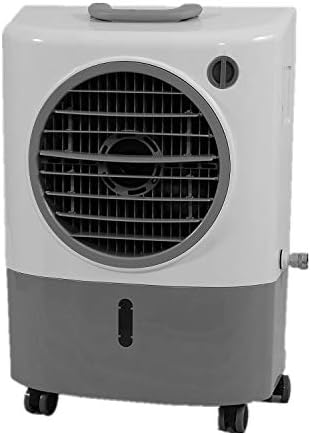
The Hessaire MC18M is a straightforward cooler for patios, porches, and other modest outdoor spaces. It provides 1,300 CFM of airflow and is listed for areas up to 500 square feet. Its two-speed fan keeps the controls simple, while the 4.8-gallon tank gives you a smaller water supply than the larger models here.
The molded ABS resin body is designed to be lightweight and less fragile than traditional cooler construction. Hessaire also describes its axial fan as a way to push air farther, which can be useful when you want a breeze across a seating area rather than cooling a whole large workspace. The single cooling pad and compact tank make this a less involved option to set up and move than a high-capacity unit.
Keep expectations in line with its size: this is not the strongest pick for a large gathering or a broad work area. The tank will also need more frequent attention than the 10- and 16-gallon options. Like other evaporative coolers, it needs air movement and works best where the air is dry.
Pros:
- Lightweight ABS resin construction
- 1,300 CFM airflow and listed coverage up to 500 square feet
- Simple two-speed operation
- Compact 4.8-gallon tank for smaller spaces
Cons:
- Lower airflow and smaller tank than the larger choices
- Not the best fit for expansive outdoor areas
Verdict: Choose the MC18M if you want a simpler, lighter cooler for a smaller patio or outdoor work spot, not maximum coverage.
Hessaire MC37M: Flexible Cooling with Oscillation and Hose Support

The Hessaire MC37M is an indoor-or-outdoor portable cooler listed for spaces up to 950 square feet. Its 10.3-gallon reservoir offers more capacity than the MC18M, and an adapter lets you connect a garden hose for continuous water supply. That hose option can be convenient if the cooler will stay in one place during a long stretch of use.
Oscillating vents help spread airflow across a wider area, and the controls offer four fan-only settings and two evaporation settings. An eight-hour timer adds another way to manage operation. The fan-only settings are useful when you want air movement without running the evaporation function, though they should not be mistaken for refrigerated cooling.
This model sits between the smaller Hessaire and the higher-airflow units in this list. Its stated coverage is useful for comparing it with the MC18M, but the product information does not give a CFM figure. If you need a specific airflow rating to plan for an open worksite, consider a model that lists one.
Pros:
- Listed for areas up to 950 square feet
- 10.3-gallon reservoir with garden-hose adapter
- Oscillating vents help distribute airflow
- Multiple fan and evaporation settings plus an eight-hour timer
Cons:
- CFM rating is not specified in the provided product information
- A larger unit and water tank may be more than needed for a small patio
Verdict: The MC37M is a good middle-ground choice if you want oscillation, a larger reservoir, and the option of a hose connection.
Big Ass Fans Cool-Space 350: High-Capacity Water Supply for Tougher Settings

The Cool-Space 350 is positioned for commercial and industrial environments such as workshops and garages, as well as outdoor events. Its 16-gallon capacity is the largest stated tank size in this lineup. The product also offers two water-supply approaches: fill the tank manually or use continuous water supply.
Variable fan speeds let you adjust airflow, and the unit is described as having a sturdy build with a resin coating intended to protect against buildup and damage. Those features make it a more industrial-minded option than the compact Hessaire MC18M. However, the supplied product details do not state a CFM rating, coverage area, or specific mobility features, so check those details if they are key to your setup.
A large tank can mean fewer manual refills, but it also means more water to manage when filling or moving the cooler. Consider where it will sit, how you will supply water, and whether the space has enough open airflow for evaporative cooling to work well.
Pros:
- Large 16-gallon capacity
- Manual-fill and continuous-water options
- Variable speed settings
- Designed for workshop, garage, and outdoor-event use
Cons:
- CFM and coverage figures are not specified in the supplied details
- The large water capacity may be unnecessary for smaller spaces
Verdict: Consider the Cool-Space 350 for demanding settings where water capacity and a continuous supply option matter more than a published coverage figure.
Arctic Air Outdoor Pro: A Mobile Cooler with 3,100 CFM Airflow

The Arctic Air Outdoor Pro is designed for patios, garages, backyards, and outdoor work areas. It delivers up to 3,100 CFM and has a 10-gallon tank. A garden-hose hookup is offered for continuous refill, while the built-in wheels make it easier to move between locations.
Oscillation and adjustable airflow direction are intended to spread the breeze across a wider area. That combination makes the Outdoor Pro a flexible option if you need to shift cooling between a garage and patio or direct airflow toward different parts of a gathering space. Its product information does not provide a square-foot coverage figure, so use the CFM rating as a comparison point rather than treating it as a guaranteed area size.
As with any evaporative cooler, this is not a sealed-room air conditioner. It is intended for open or semi-open spaces, and its cooling effect depends on the surrounding conditions. The hose connection can reduce the need for manual refills, but you will need a suitable water source nearby to use it.
Pros:
- Up to 3,100 CFM airflow
- 10-gallon tank with hose hookup option
- Oscillating airflow and adjustable direction
- Wheels support moving it between spaces
Cons:
- No square-foot coverage figure is provided
- Continuous refill depends on access to a garden hose
Verdict: Pick the Outdoor Pro if you want a wheeled cooler with a stated airflow rating, oscillation, and a hose-fed option for longer use.
OEMTOOLS 23969: The Highest Listed Airflow for Broad Work Areas
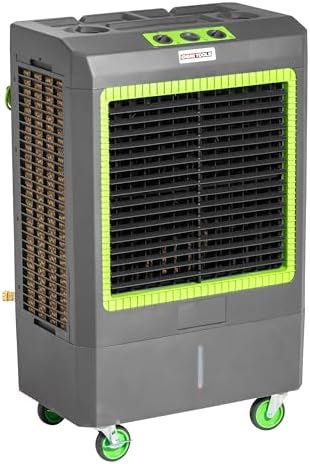
The OEMTOOLS 23969 is built for larger areas such as garages, workshops, and outdoor workspaces. It has a stated airflow of 5,300 CFM and listed coverage of up to 1,600 square feet—the largest stated coverage and airflow in this group. Its three fan speeds let you choose a lower or stronger airflow setting for the task at hand.
Large casters support moving the cooler, and a built-in tool tray adds a practical touch for job sites and workshops. The product description says it should be positioned in front of an open window or door to operate effectively. That makes placement an important part of the setup, especially in a garage or semi-open work area.
The supplied information does not state the water-tank capacity, so you cannot compare its refill interval directly with the other models. It also describes potential temperature reductions of 15 to 30 degrees depending on humidity; treat that as a conditional product claim, not a guaranteed result for every outdoor setup.
Pros:
- 5,300 CFM airflow and listed coverage up to 1,600 square feet
- Three fan speeds
- Large casters support movement around a workspace
- Built-in tray keeps tools close at hand
Cons:
- Water-tank capacity is not specified in the supplied details
- Effective operation depends on placement near an open window or door
Verdict: The OEMTOOLS 23969 is the strongest match for a large, well-ventilated work area when high listed airflow is your priority.
How to Choose a Portable Evaporative Cooler for Outdoor Use
Match Airflow and Coverage to Your Space
Start with the area you want to make more comfortable. A small patio or work nook may not need the same airflow as a large garage or event space. Compare the stated CFM and coverage figures when available, but remember that coverage claims do not guarantee the same cooling in every layout. Open sides, wind, and the distance between the cooler and people all affect how the airflow feels.
Consider Your Climate and Ventilation
Evaporative coolers use water evaporation, so they add moisture to the air. They are generally a better fit for dry conditions than humid ones. They also need fresh air to move through the space; they are not designed to cool a tightly sealed room like a conventional air conditioner. For outdoor use, aim the airflow where people are gathered and avoid blocking the unit’s air intake or outlet.
Choose a Tank Size and Refill Method
A larger reservoir can reduce how often you need to refill by hand, but it also means handling more water. If the cooler will stay near a hose, a continuous-fill connection can be useful. Check the product details for both tank capacity and refill options: some models list one but not the other. Think about access to water before choosing a cooler for a remote area or event site.
Look at Air Direction and Controls
Oscillation can help spread airflow across a wider area, while adjustable direction can help you aim it toward a seating or work zone. Fan speeds and separate fan-only settings give you more control over air movement. A timer may be helpful if you want the unit to run for a set period, but it does not replace checking the water supply and operating conditions.
Check Portability and Placement
Consider whether you will keep the cooler in one spot or move it between a patio, garage, and workshop. Wheels and a lighter body can make relocation easier, while a large tank can make moving a filled unit less convenient. Also check the recommended placement: some models need space near an open door or window, and every cooler needs room for air to enter and exit.
Set Realistic Cooling Expectations
An evaporative cooler moves cooler, moist air; it does not work like refrigerated air conditioning. Its results depend on humidity, airflow, and where you place it. For open-air settings, it may be most useful as a directed breeze for people nearby rather than a way to lower the temperature across an entire yard.
Frequently Asked Questions
Do portable evaporative coolers work outdoors?
Yes. Several models are designed for patios, garages, workshops, or outdoor events. They work best where air can circulate, rather than in a sealed space, and their cooling effect depends on conditions such as humidity and airflow.
Are evaporative coolers a good choice in humid weather?
They are generally more effective in dry conditions. Because the cooling process adds moisture to the air, performance may be less appealing in already humid weather.
What is the difference between CFM and square-foot coverage?
CFM describes airflow volume, while square-foot coverage is a maker’s estimate of the area a unit may serve. They are related but not interchangeable. The listed coverage is not a guarantee of uniform cooling in every outdoor layout.
Can I connect a portable evaporative cooler to a garden hose?
Some models in this list offer a hose adapter or hookup for continuous water supply, including the Hessaire MC37M and Arctic Air Outdoor Pro. Check the individual product details to confirm the connection and setup requirements.
How often will I need to refill the water tank?
It depends on the tank capacity, operating conditions, and whether you use a continuous water connection. The listed capacities range from 4.8 gallons to 16 gallons, but the supplied details do not give a refill interval for these models.
Which cooler is best for a large workspace?
The OEMTOOLS 23969 has the largest stated coverage in this group, up to 1,600 square feet, and lists 5,300 CFM. The actual result will depend on ventilation and layout, so check that the space suits evaporative cooling before choosing by coverage alone.
Can an evaporative cooler replace an air conditioner?
Not in the same way. An evaporative cooler uses water and airflow and is intended for open or well-ventilated areas. It does not provide the same type of cooling as a conventional air conditioner in a closed room.
Final Recommendation
For a large, ventilated work area, the OEMTOOLS 23969 stands out for its stated 5,300 CFM airflow and coverage up to 1,600 square feet. The Hessaire MC37M is a versatile middle choice with oscillation, a 10.3-gallon reservoir, and a hose adapter. For a smaller patio, the lighter Hessaire MC18M may be easier to manage. Before choosing any of them, make sure your climate, water access, and space layout are a good match for evaporative cooling.
