
A portable heater can take the chill off while you get ready, but bathroom use calls for extra care: a heater’s tip-over and overheat protection do not make it safe for wet locations. The products below are indoor space heaters, and the supplied details do not establish that they are rated for use near a tub, shower, or other wet area. Check the manufacturer’s instructions and your local electrical requirements before using any portable heater in a bathroom. If a heater is not expressly approved for that setting, keep it out of the bathroom.
Among these options, the DREO offers the most precise temperature control and a quiet operating design for indoor spaces. The Amazon Basics model specifically says not to use it in bathrooms or other high-moisture areas, so it is included only as an indoor alternative—not as a bathroom pick.
Table of Contents
Quick Comparison
| Product | Key features | Bathroom-use note |
|---|---|---|
| DREO Portable Space Heater | 1500W, thermostat, remote, 12-hour timer, quiet operation | No wet-location rating stated in the supplied details |
| Amazon Basics Ceramic Space Heater | 1500W or 900W heat, fan-only mode, tip-over and overheat protection | Manufacturer says not to use it in bathrooms or other high-moisture areas |
| GiveBest Portable Space Heater | 1500W or 750W heat, thermostat, fan-only mode, tip-over protection | Bathroom use is mentioned, but no wet-location rating is stated |
| WINHL Portable Space Heater | 1500W ceramic heat, oscillation, thermostat, remote, 12-hour timer | No wet-location rating stated; follow the manual and bathroom electrical rules |
| TMHEI Portable Ceramic Space Heater | 750W, 1000W, and 1500W settings, thermostat, remote | No wet-location rating stated in the supplied details |
Our Picks: Best Portable Heater For Bathroom reviews
1. DREO Space Heater: Quiet Heat with Fine Temperature Control

The DREO combines a 1500W PTC heating system with a heat-funnel design intended to spread warm air farther than a basic heater. Its thermostat adjusts from 41°F to 95°F in one-degree steps, giving you more control than a simple high-or-low switch.
It also includes an ECO mode, fan-only mode, remote, 12-hour timer, child lock, and memory function. The brushless DC motor and fan design are specified to operate at 34 dB, which may be useful if you want supplemental heat in a bedroom or other quiet space.
For safety, the supplied details list tip-over detection, overheat protection, a safety plug, V0 flame-retardant materials, and ETL certification. Those features are useful, but they do not mean the heater is designed for a wet bathroom. The product information does not state a wet-location rating, so don’t place it near a tub, shower, sink, or wet floor.
Compared with the simpler Amazon Basics model, the DREO offers more temperature settings and convenience features. It is a stronger fit for someone seeking controlled indoor warmth outside a moisture-prone area, rather than a heater specifically proven for bathroom use.
Pros:
- Fine thermostat adjustment from 41°F to 95°F
- Remote, timer, ECO mode, and fan-only mode
- Quiet operation is specified at 34 dB
- ETL certification and several listed safety features
Cons:
- No wet-location rating is stated in the supplied details
- More features than you may need for occasional, basic supplemental heat
Verdict: Choose the DREO for quiet, adjustable indoor heating, but use it in a bathroom only if the manufacturer’s instructions expressly permit that setting.
2. Amazon Basics Ceramic Heater: Simple Heat for Dry Indoor Rooms
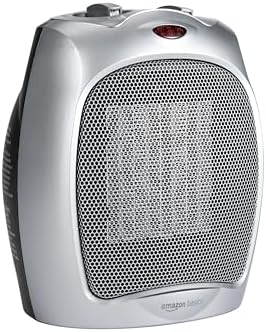
This compact ceramic heater offers three settings: 1500W high heat, 900W low heat, and fan-only operation. At about 7.5 inches long, 6.3 inches wide, and 9.5 inches high, it is a small option for a desk or another dry indoor spot. The listed weight is 3 pounds, so moving it between rooms should be straightforward.
The heater includes tip-over and overheat protection, plus a power indicator light. Its ceramic element is described as producing heat in minutes, and its listed noise level is 43 dB. The controls are simpler than the DREO’s: there is no remote, timer, or thermostat listed in the supplied details.
There is an important limitation for this topic: the manufacturer explicitly says not to use this model in bathrooms, laundry rooms, or other high-moisture areas. That warning makes it unsuitable for bathroom heating. It may still be worth considering if you want a basic portable heater for a dry office or other room.
Among these five options, this is the clearest choice to rule out for bathroom use. Its compact size and basic settings may suit someone who wants straightforward supplemental heat elsewhere, but the bathroom warning should take priority over its portability.
Pros:
- Compact, lightweight design
- Two heat settings and a fan-only setting
- Tip-over and overheat protection are included
- Simple controls for basic indoor use
Cons:
- Manufacturer says not to use it in bathrooms or other high-moisture areas
- No thermostat, remote, or timer is listed in the supplied details
Verdict: Do not choose this model for a bathroom; consider it only for a dry indoor space where its basic controls meet your needs.
3. GiveBest Space Heater: Adjustable Output in a Portable Design

The GiveBest is a small ceramic heater with 1500W and 750W heat settings, a cool-air fan, and an automatic thermostat. A built-in handle makes it easier to carry between rooms. The product description says it is intended for small to medium spaces and lists a six-foot power cord.
Its safety features include overheat shutoff, tip-over protection, and V0 flame-retardant material. The supplied information says the unit shuts off if knocked over and can turn back on once upright. Automatic restart is convenient, but it means you should still place the heater somewhere stable and keep it clear of towels, clothing, and other items.
The product description mentions bathrooms among possible small-room uses, but it does not provide a wet-location rating or other details showing that the heater is suitable for humid or splash-prone areas. A bathroom mention alone is not enough to establish safe placement. Check the manual and keep the heater well away from water; if bathroom use is not expressly allowed, use it in a dry room instead.
Compared with the WINHL, this model has no oscillation or remote listed. Its two heat levels and thermostat are more basic, which may appeal if you want fewer controls. Its bathroom suitability remains uncertain from the supplied product information.
Pros:
- Two heat settings and a fan-only mode
- Automatic thermostat control
- Carry handle and listed six-foot cord
- Tip-over and overheat shutoff features
Cons:
- No wet-location rating is stated in the supplied details
- No remote or timer is listed
Verdict: The GiveBest is a practical basic heater for a dry indoor space; consider it for bathroom use only if its instructions clearly permit it.
4. WINHL Portable Heater: Oscillation and Remote Control

The WINHL is a compact 1500W PTC ceramic heater with 70-degree oscillation. Instead of directing warm air in just one direction, the unit can sweep from side to side. It is designed as supplemental heat for personal spaces and small rooms, rather than a replacement for a home’s main heating system.
A remote, thermostat, ECO mode, and 12-hour timer add convenience. The remote needs two AAA batteries, which are not included. The product details also list overheat and tip-over shutoff and say the heater is ETL listed.
The description mentions a bathroom counter as a possible placement, but it does not state that the heater is rated for wet locations. A small footprint does not make an appliance safe around water. Follow the manual’s placement instructions, avoid splash and steam exposure, and do not set it on a wet or unstable surface.
Compared with the GiveBest, the WINHL adds oscillation, a remote, and a timer. It also gives a specific electrical-use warning: plug it directly into a wall outlet rated for 15A, not an extension cord or power strip, and avoid sharing the circuit with other high-wattage appliances.
Pros:
- 70-degree oscillation to move warm air side to side
- Remote, thermostat, ECO mode, and 12-hour timer
- ETL listing and tip-over and overheat shutoff are specified
- Compact design for personal spaces
Cons:
- No wet-location rating is stated in the supplied details
- Remote requires two AAA batteries, which are not included
Verdict: The WINHL is a feature-rich option for a small dry room, but its bathroom-counter mention is not a substitute for explicit approval for humid or wet use.
5. TMHEI Ceramic Heater: Three Heat Levels and a Digital Display
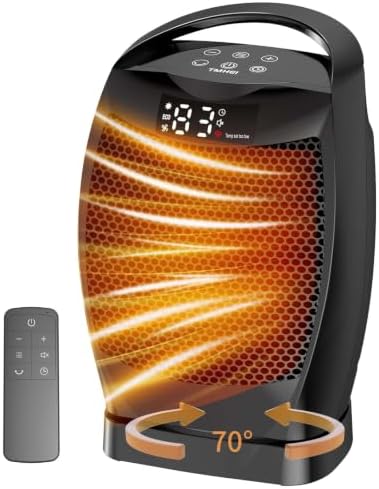
The TMHEI uses PTC ceramic heating and offers three power levels: 750W, 1000W, and 1500W. It also has a cool-air mode and a thermostat that cycles the heater to maintain the selected temperature. A digital display shows the temperature and operating mode, while touch controls and a remote offer two ways to adjust settings.
The product description lists flame-retardant materials, overheat protection, tip-over protection, ETL certification, and a built-in handle. It also specifies operation below 40 dB and describes the heater as suitable for indoor spaces such as homes and offices. These are useful details for supplemental heat, but no wet-location rating is stated.
Unlike the WINHL, the TMHEI has three heat levels rather than one 1500W setting described in the supplied details. That range may help you choose a lower setting when full output is unnecessary. Still, a remote, thermostat, and safety shutoffs do not establish that it is safe to use in a bathroom.
Use this model in a bathroom only if the manufacturer’s instructions explicitly allow it and its placement meets local electrical requirements. Otherwise, it is best treated as an indoor heater for a dry room.
Pros:
- Three heat levels: 750W, 1000W, and 1500W
- Thermostat, remote, and digital display
- Cool-air function and built-in carry handle
- ETL certification and tip-over and overheat protection are specified
Cons:
- No wet-location rating is stated in the supplied details
- Bathroom suitability is not established by its indoor-use description
Verdict: Choose the TMHEI if you want several heat levels and remote control for a dry indoor room; don’t assume it is bathroom-safe without explicit manufacturer approval.
How to Choose a Portable Heater for Bathroom Use
Confirm the heater is approved for the location
Start with the manual, product label, and manufacturer’s guidance. Look for explicit instructions that allow use in a bathroom or other humid location. A general indoor-use label, a small size, or tip-over protection does not show that a heater can handle steam, splashes, or wet conditions. If the instructions do not clearly allow bathroom use, choose another heating approach or keep the portable heater in a dry room.
Think about water, steam, and placement
Bathrooms can expose electrical equipment to water and humidity. Keep any permitted heater away from tubs, showers, sinks, wet towels, and places where water could splash. Place it only on a stable, dry surface and follow the clearance instructions in its manual. Do not handle a heater with wet hands or move it while it is plugged in.
Check the outlet and electrical instructions
Follow the heater’s plug and circuit requirements, and use an outlet that meets local bathroom electrical rules. Do not use an extension cord or power strip unless the manufacturer specifically allows it; the WINHL’s supplied information, for example, says to plug it directly into a wall outlet and not use an extension cord or power strip. If you are unsure whether an outlet is appropriate, ask a qualified electrician.
Match the heat settings to your space
These models list maximum outputs of 1500W, with some offering lower settings. Lower power can be useful when you need less heat, while a thermostat can help manage the temperature. A portable space heater is supplemental heat for a nearby area, not a substitute for whole-home heating. Room size, layout, drafts, and heater placement all affect how warm the space feels.
Choose features you will actually use
A timer can help set a defined run time, while a thermostat can reduce the need to adjust the heater manually. A remote may be convenient when the heater is in a safe, approved location, and oscillation can move warm air across a wider area. These conveniences should come after safety and location approval—not instead of them.
Understand what safety features do and do not do
Tip-over and overheat protection can help shut a heater off in certain situations. Flame-retardant materials and safety certifications are also useful product details. None of these features makes a heater waterproof or safe to place near a shower or sink. Keep the unit clear of fabrics and other combustible items, and do not leave it running unattended.
Frequently Asked Questions
Can I use any portable space heater in a bathroom?
No. Use a portable heater in a bathroom only when the manufacturer expressly permits that setting and the placement meets local electrical requirements. The Amazon Basics model in this guide specifically says not to use it in bathrooms or other high-moisture areas.
Does tip-over protection make a heater safe near a shower?
No. Tip-over protection is designed to address a heater being knocked over. It does not show that the unit is protected from water, steam, or splashes. Check the product’s instructions for approved locations and keep electrical appliances away from water.
Which heater in this list is specifically approved for bathroom use?
The supplied product information does not establish a wet-location rating for any of these five heaters. The GiveBest and WINHL descriptions mention bathroom-related use or placement, but neither detail alone confirms approval for humid or wet conditions. Check the manufacturer’s instructions before considering either for a bathroom.
Is a 1500W heater enough to warm a bathroom?
Wattage alone cannot guarantee that a heater will warm a particular bathroom. Room size, insulation, drafts, layout, and placement affect the result. Also confirm that the heater is approved for bathroom use before considering its output.
Should I use an extension cord with a portable heater?
Follow the manufacturer’s instructions. The WINHL’s supplied information says to plug it directly into a wall outlet and not use an extension cord, power strip, or relocatable tap. Never assume an extension cord is suitable for a high-wattage heater.
Can I leave a portable heater running while I shower or sleep?
Do not leave a portable heater running unattended. A bathroom is especially unsuitable if the heater has not been expressly approved for humid or wet locations. Use the timer only as directed, and follow all safety instructions in the manual.
Final Recommendation
For adjustable indoor warmth, the DREO stands out for its fine thermostat control, quiet-operation specification, remote, and timer. The WINHL and TMHEI offer useful convenience features, while the GiveBest keeps its controls simpler. However, the supplied details do not confirm that these models are rated for wet bathroom conditions, and the Amazon Basics model expressly warns against bathroom use. For a true bathroom heater, prioritize a product whose manufacturer clearly approves it for that location and follow the local electrical requirements.
