
Solar landscape lighting can make a yard easier to enjoy after dark, whether you want to highlight trees, brighten a fence, or add light near a walkway. The right choice depends on the look you want, how much sun the panels receive, and whether you need a few focused beams or a larger set of lights. These five solar spotlights offer different combinations of brightness, color temperature, lighting modes, and mounting options.
Table of Contents
Quick Comparison
| Product | Pack Size | Light and Modes | Notable Feature |
|---|---|---|---|
| AUDERWIN Solar Spot Lights | 4 lights | Cool white; 3 modes | Ground stake or wall mount |
| ESUNYD Solar Spotlights | 10 lights | Cool white; 3 modes | IP67 waterproof rating |
| LETMY Solar Spot Lights | 6 lights | White; 2 modes | 135-degree adjustable head |
| SOLPEX Warm White Solar Spotlights | 10 lights | Warm white; brightness details not specified as modes | Compact design with adjustable beam angle |
| LANSOW Solar Spot Lights | 12 lights | 4 modes; color temperature not specified | Listing states up to 800 lumens |
Our Picks: Best Solar Landscape Lighting For Yard reviews
1. AUDERWIN Solar Spot Lights: A Flexible Four-Light Set
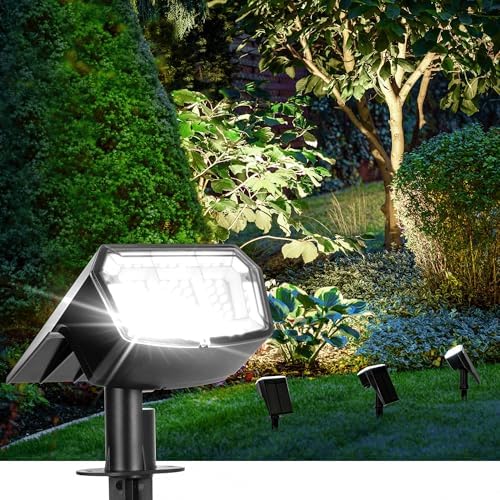
The AUDERWIN set includes four cool-white spotlights, each with 63 LEDs and three brightness modes. They are designed to cast a focused beam on features such as trees, fences, or the front of a house. The set is a practical size if you want to highlight a few spots without buying a large bundle.
Each light can be placed in the ground or mounted on a wall, so you can choose a position based on the feature you want to illuminate. The listing describes an IP65 waterproof rating and an operating temperature range from -4°F to 140°F. For charging, the polycrystalline solar panels need a sunny location; cloudy or rainy weather can reduce the amount of charge they collect.
The three modes give you a choice between longer, lower-brightness operation and brighter light for part of the night. The listing says the high mode starts at full brightness, then dims over time, so it is not a constant full-output setting all night. That trade-off makes this set useful for accent lighting, but less suited to anyone expecting consistent high brightness from dusk until morning.
Pros:
- Four lights suit small and medium-sized accent-lighting plans.
- Three brightness modes let you balance output and run time.
- Can be staked into the ground or mounted on a wall.
- IP65 weather protection is specified for outdoor use.
Cons:
- Cool-white light may feel stark if you prefer a warm garden glow.
- Cloudy or rainy conditions can affect solar charging.
Verdict: Choose the AUDERWIN set if you want four versatile cool-white spotlights and are comfortable with brightness that changes in the high mode.
2. ESUNYD Solar Spotlights: Ten Lights for Wider Coverage

This ten-light set is aimed at yards where several features need their own beam, such as a row of shrubs, a long fence, or a wide driveway edge. Each spotlight has 63 LEDs and three modes. Like the AUDERWIN option, the listed high mode starts at full brightness and then steps down, while lower settings are intended to last longer.
The main distinction in the supplied specifications is the IP67 waterproof rating. That rating is a step above the IP65 ratings listed for several other picks here, though it does not remove the need to position the solar panels where they can collect daylight. The listing also notes that cloudy or rainy weather can affect a full charge.
These lights can be used as landscape spotlights or mounted on a wall. A ten-pack can make it easier to cover more ground, but it may be more than you need for a small patio or a couple of focal points. The listing does not provide a lumen figure, so compare the stated LED count and modes rather than assuming a specific brightness level.
Pros:
- Ten lights can cover a larger yard or multiple features.
- Three modes offer different brightness and run-time choices.
- IP67 waterproof rating is specified in the product details.
- Ground and wall installation options add placement flexibility.
Cons:
- No lumen output is provided in the supplied description.
- The large pack may not be necessary for a small lighting plan.
Verdict: The ESUNYD set is worth considering when you need many cool-white spotlights and prioritize the listed IP67 rating over a stated lumen figure.
3. LETMY Solar Spot Lights: Adjustable Beams in a Six-Pack

LETMY’s six-light set uses 14 LED beads per spotlight and convex optical lenses, which the listing says create a concentrated beam. It is designed for highlighting individual yard features such as trees, flags, statues, fences, and walls. The 135-degree adjustable head gives you more control over where each beam lands than a fixed-head design.
The lights offer two brightness settings. The listed run times are 18 to 20 hours on low and 10 to 12 hours on high, while the solar panel and battery specifications are provided as stated product details rather than a guarantee of performance in every yard. Shady placement, short winter days, and cloudy weather can all limit charging time.
Each light can be staked into the ground or attached to a wall or fence. The IP65 rating and ABS construction make them intended for outdoor use, while the smaller pack size is a middle ground between the four-light and ten- or twelve-light options. If your main priority is broad, even pathway illumination, these focused spotlights may not be the right beam style.
Pros:
- Adjustable heads help direct light toward specific features.
- Two modes give you a choice between brightness and longer operation.
- Includes both ground-stake and wall-mount installation options.
- Six lights offer a moderate amount of coverage.
Cons:
- The focused spotlight design is not the same as wide-area path lighting.
- Two modes provide fewer choices than the three- and four-mode sets.
Verdict: Pick LETMY if aiming each beam precisely matters more to you than having the largest number of lighting modes.
4. SOLPEX Warm White Solar Spotlights: Compact Lights for Subtle Accents

SOLPEX takes a different approach from the cool-white picks: these ten spotlights use warm-white light and a compact design. The listing specifies 38 LEDs and 400 lumens per spotlight, describing the output as suited to comfortable accent lighting around walkways, gardens, and outdoor features. That stated output offers a useful point of comparison with products that list LED counts but no lumen figure.
The lamp head adjusts up to 120 degrees, and each light can be installed as a ground stake or wall-mounted fixture. This flexibility helps when you need to aim a beam at a low garden feature or an elevated wall. The product is listed with an IP65 rating, but the supplied details do not specify multiple lighting modes or a run-time estimate.
The warm tone may be a better fit for a relaxed garden look than bright cool-white light, especially around shared spaces where a softer appearance is preferred. The trade-off is that this set provides less mode information than the other options, so shoppers who want precise control over brightness or overnight duration should compare those details before choosing.
Pros:
- Warm-white light can create a softer landscape effect.
- Ten compact lights suit broader accent-lighting layouts.
- Listing specifies 400 lumens per light.
- 120-degree adjustment and two installation options aid placement.
Cons:
- The supplied details do not list selectable lighting modes or run times.
- Warm-white output may not suit shoppers seeking a crisp, cool beam.
Verdict: Choose SOLPEX if you want a larger set of compact warm-white spotlights and value the stated lumen output over multiple mode settings.
5. LANSOW Solar Spot Lights: A 12-Pack with Four Lighting Modes

LANSOW offers the largest pack in this group, with 12 spotlights and 90 LED beads per light. The listing states up to 800 lumens, along with four modes: low, medium, high, and breathing. The dusk-to-dawn sensor is designed to turn the lights on at night and charge them during the day.
Each light can be staked into a lawn or mounted on a wall, and its head adjusts up to 120 degrees. Those features make it easier to use the set for several kinds of yard accents, from trees and statues to fences and driveways. The listing specifies IP65 protection and an operating range from -4°F to 140°F.
The four modes make this the most adjustable option in the group, and the twelve-light count can help cover a broad area. However, the listing describes the highest mode as lasting up to eight hours, with shorter expected operation as brightness increases. As with any solar fixture, actual run time depends on how much sunlight the panels receive, so a heavily shaded yard may not get the listed performance.
Pros:
- Twelve lights offer extensive coverage for a large yard.
- Four modes include a breathing setting as well as brightness levels.
- Listing states up to 800 lumens per light.
- Adjustable heads and ground or wall mounting support flexible placement.
Cons:
- The full set may be excessive for a small yard or a few focal points.
- Higher brightness settings are listed with shorter run times.
Verdict: LANSOW is the strongest fit if you want many lights, several operating modes, and a stated lumen figure for planning a larger landscape layout.
How to Choose Solar Landscape Lighting for Your Yard
Match the Beam to the Job
Spotlights are best for directing attention to a specific feature, such as a tree trunk, sculpture, fence section, or house wall. They are not automatically a replacement for broad walkway lighting. For paths, consider how many lights you will need and whether their beam direction can cover the area where you walk.
Choose the Right Light Color
Warm-white light tends to create a softer, more relaxed look, while cool-white light gives landscaping a crisper appearance. Think about how the light will look beside your home, plants, and other outdoor fixtures. If you are lighting several areas, using a consistent color temperature can help the yard feel more unified.
Compare Brightness Claims Carefully
LED count alone does not tell you exactly how bright a light will appear. A stated lumen figure, such as the figures provided for SOLPEX and LANSOW, gives another way to compare listed output. Also consider whether the light is intended to create a focused accent or illuminate a broader area. A bright beam aimed at a small feature can look quite different from even path lighting.
Consider Modes and Expected Run Time
More lighting modes give you additional ways to balance brightness and operating time. Check whether a high setting stays at full output or dims during the night, and pay attention to the run-time information for each mode. Product estimates depend on charging conditions, so do not assume the longest listed duration will apply in every yard.
Plan for Sunlight and Panel Placement
Solar lights need daylight to recharge. Place the panel where it can receive as much direct sun as possible, rather than leaving it under dense branches or in a deeply shaded corner. Cloudy and rainy conditions can reduce charging, which may shorten the time the light stays on after dark.
Check Installation and Aim
Ground stakes are convenient for lawns and garden beds, while wall-mount options can work on fences or exterior walls. An adjustable head makes it easier to aim the beam without moving the whole fixture. Before installing the full set, test a light in its intended position and make sure it points toward the feature you want to highlight.
Review Weather Protection and Yard Conditions
Compare the listed waterproof ratings and operating temperature ranges with the conditions where you plan to use the lights. The products here include IP65 or IP67 ratings, but these specifications do not remove the need to follow the manufacturer’s setup instructions. Also consider whether the fixtures will sit in an exposed spot or an area that stays wet or shaded.
Frequently Asked Questions
Do solar landscape spotlights need direct sunlight?
They need daylight to charge, and direct sun generally gives the panel more opportunity to collect energy. Shaded placement, cloudy weather, and rainy days can affect charging and nighttime operation.
Are solar spotlights good for lighting a walkway?
They can add light along a walkway, but spotlights usually create a directed beam rather than broad, even illumination. Check the beam direction and plan enough fixtures to cover the path you want to see.
What is the difference between warm-white and cool-white light?
Warm-white light has a softer appearance, while cool-white light looks crisper. The best choice depends on the mood you want and how the lights will look alongside your home and landscaping.
Can these solar lights be mounted on a wall?
All five product descriptions include a wall-mount option as well as ground installation. Check the package instructions for the specific mounting steps and hardware.
Will the lights stay at full brightness all night?
Not necessarily. Some listed modes are designed to dim over time, and higher brightness settings may have shorter run times. Solar charging conditions also affect how long a light operates after dark.
How many spotlights do I need for my yard?
That depends on the number of features you want to highlight and how far apart they are. A smaller set may be enough for a few focal points, while a ten- or twelve-light set may suit a larger yard or several separate areas.
Which option is best if I want the most lighting modes?
LANSOW lists four modes, including low, medium, high, and breathing. AUDERWIN and ESUNYD list three modes, while LETMY lists two. SOLPEX does not specify selectable modes in the supplied product details.
Final Recommendation
For a large yard, the LANSOW set stands out for its twelve lights, four modes, and listed lumen output. If you prefer warm-white accents, SOLPEX offers a compact ten-light set with a stated lumen figure. For a smaller, flexible setup, AUDERWIN provides four cool-white spotlights with both ground and wall installation options. Whichever set you choose, place the panels where they can collect sunlight and select a brightness mode that fits your yard and expected charging conditions.
