
A step stool with a safety bar can make it easier to reach a high bed, get into a vehicle, or access items around the home—but the right choice depends on where you’ll use it and how much support you need. Below, we compare five options by their stated weight limits, step design, handrail features, and intended uses. Check the fit and setup details carefully, and use any stool on a firm, level surface.
Table of Contents
Quick Comparison
| Product | Stated weight capacity | Notable features | Availability in supplied listing data |
|---|---|---|---|
| Leekpai Step Stool with Handle | 350 lb | Steel frame, non-slip step, handle | Marked available |
| NEAUDE Adjustable Medical Step Stool | 400 lb | Adjustable design, rubber base, detachable platform pad | Marked unavailable |
| Josmimic Bed Step Stool with Motion Light | 400 lb | Bedside straps, adjustable foot pads, motion-sensor LED | Marked available |
| Support Way Medical Step Stool | 800 lb | 19.5-inch-wide platform, adjustable padded handrail | Marked available |
| FAYITING Heavy-Duty Two-Step Bed Stool | 800 lb | Two wide steps, adjustable handrail, bed-frame straps | Marked unavailable |
Availability can change. Check the product listing for current stock and details before buying.
Our Picks: Best Step Stool With Safety Bar reviews
Leekpai Step Stool: A Straightforward Choice for General Home Use

The Leekpai is a single-step stool with a handrail, steel construction, and a stated weight capacity of 350 pounds. Its relatively simple design may suit everyday tasks such as reaching a shelf or stepping up to a slightly elevated surface. The grooved, rubber-like step surface is intended to provide grip, while the handle gives you an extra point to hold as you step.
Assembly tools and instructions are included, according to the product details. That’s useful if you don’t have a tool kit ready, though you should still follow the instructions closely and check that all fasteners are secure before use. The supplied information describes the handle as adjustable but does not give a height range or adjustment method, so confirm the fit if handle position is important to you.
Compared with the bed-focused options below, this is a less specialized choice. It does not list bed-frame straps, a second step, or a night light. That simpler setup may be appealing if you want a stool for general indoor tasks, but it may not be the best match for a high bed or a user who needs a broad platform.
Pros:
- Steel construction with a stated 350-pound capacity
- Handle and grooved non-slip step surface
- Assembly tools are included
- Designed for home or workplace use
Cons:
- Step dimensions and handle adjustment range are not provided
- Does not include listed bed-frame straps or a second step
Verdict: Choose the Leekpai if you want a basic handled step stool for general home tasks and its stated capacity and step size suit your needs.
NEAUDE Adjustable Medical Step Stool: A Versatile Bedside Option

The NEAUDE is described as an adjustable metal step stool for bedside access and other tasks around the home. Its handle and feet have adjustment holes, with a listed height range of 33 to 37.5 inches. The product details also give a 400-pound weight capacity and describe a rubber base and detachable anti-skid platform pad.
The platform measures 21.6 by 11.8 inches, making its listed dimensions useful to compare with the space beside your bed or in a bathroom. Its intended uses include getting in and out of bed, reaching higher items, and use as a garden or bathroom stool. Before choosing it, check whether the height range and platform layout suit the exact task and the user’s movement needs.
The main caveat is availability: the supplied listing data marks this product unavailable. That can change, but it’s worth checking the listing before making it your first choice. Compared with the Josmimic, it has a listed platform size and adjustment range, while the Josmimic adds a motion-sensor light and bedside straps.
Pros:
- Listed 400-pound capacity
- Height adjustment range is specified as 33 to 37.5 inches
- Platform dimensions are provided
- Described for bedside, bathroom, and outdoor tasks
Cons:
- Marked unavailable in the supplied listing data
- Check the specific adjustment and assembly details before purchase
Verdict: Consider the NEAUDE if its adjustable height and platform dimensions fit your needs, but verify that it is available before planning around it.
Josmimic Bed Step Stool: Bedside Support with a Motion Light

The Josmimic is designed specifically to help with access to a high bed. Its metal frame has a stated capacity of 400 pounds, and the padded handle is intended to provide a comfortable grip. Adjustable foot pads help the stool sit level on uneven floors, while two nylon straps are included to secure it to a bedside rail.
A notable extra is the motion-sensor LED light, which is described as turning on when it detects movement. That feature may be useful for nighttime trips, though it does not replace a clear path or careful footing. The product also includes a storage bag for small items and the accessories and tools needed for installation.
This is a more specialized pick than the Leekpai: the straps and light are aimed at bedside use, rather than general reaching. The supplied information does not list the step’s dimensions or a bed-height range, so measure your available space and confirm compatibility with your bed before ordering.
Pros:
- Designed for getting in and out of bed
- Listed 400-pound capacity
- Includes bedside straps and adjustable foot pads
- Motion-sensor light and storage bag are included
Cons:
- Step dimensions and bed-height compatibility range are not specified
- Its bedside-focused features may be unnecessary for general step-stool use
Verdict: The Josmimic is a strong fit to consider for bedside use if its dimensions work with your setup and you value an included motion-sensor light.
Support Way Medical Step Stool: Wide Platform and Adjustable Rail
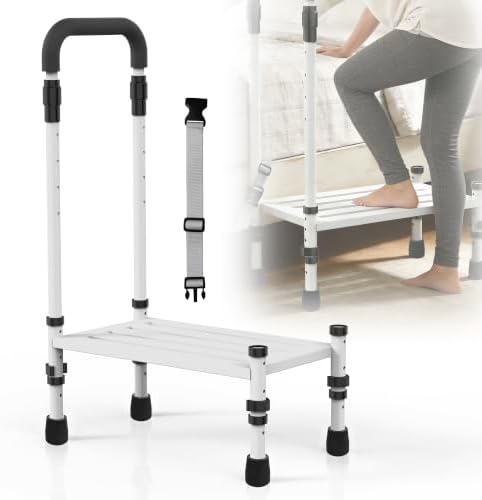
The Support Way has an extra-wide platform listed at 19.5 inches and a padded handrail that adjusts from 32.5 to 40.4 inches. Its reinforced steel frame has a stated capacity of 800 pounds. Those specifications make it a candidate for shoppers who prioritize a wider standing surface and want to set the rail height to suit their reach.
The product is described for several tasks, including getting into high beds, entering SUVs or trucks, and bathroom use. That range can be convenient, but a stool that works in one location may not suit another: check the surface, available floor space, and height of the step relative to the bed, vehicle, or tub. The supplied details say it assembles without tools and is designed to be moved, but do not provide the stool’s full dimensions or weight.
Compared with the Leekpai, the Support Way lists a wider platform, a higher capacity, and a specified rail adjustment range. It does not list a motion light or bedside straps, so it may be less tailored to nighttime bed access than the Josmimic. A high stated weight capacity alone does not confirm that the stool will fit your space or provide the support you personally need.
Pros:
- 19.5-inch-wide non-slip platform
- Listed 800-pound capacity
- Handrail adjusts from 32.5 to 40.4 inches
- Described for bedside, vehicle, and bathroom tasks
Cons:
- Full stool dimensions and weight are not provided
- Bedside straps and a night light are not listed
Verdict: Pick the Support Way if a wide platform and adjustable handrail are priorities, after confirming that its footprint suits your intended location.
FAYITING Heavy-Duty Two-Step Stool: Bed-Frame Attachment for High Beds

The FAYITING is a metal two-step stool intended for high beds. Its product details list a capacity of 800 pounds, a weight of 30 pounds, and an adjustable handrail height of 41 to 44 inches. Two wide, non-slip steps give it a different approach from the single-step options in this roundup.
For added bedside stability, it includes a U-tube and straps designed to secure the stool to a bed frame. The listed fit is for bed heights of 14.5 to 19.5 inches, and the setup can use the U-tube and long straps or short straps attached directly to the bed frame. Confirm that your bed frame and the space below it can accommodate this arrangement before buying.
The two-step design and attachment hardware may make this a better match for a particular bed setup than for moving between general household tasks. Its 30-pound listed weight is also worth considering if you expect to reposition the stool often. The supplied listing data marks it unavailable, so check the product page for current stock and details.
Pros:
- Two wide, non-slip steps
- Listed 800-pound capacity
- Adjustable handrail and bed-frame attachment options
- Specified bed-height fit range of 14.5 to 19.5 inches
Cons:
- Marked unavailable in the supplied listing data
- Listed weight of 30 pounds may make frequent moving less convenient
Verdict: Consider the FAYITING for a high bed that matches its fit range, but verify both availability and bed-frame compatibility first.
How to Choose a Step Stool With a Safety Bar
Start with the task and location
Decide where you will use the stool most often. A basic handled stool may work for reaching shelves, while a bedside model may include straps, an adjustable rail, or a light. If you want one stool for several locations, check whether the product is suitable for each surface and task. A feature that helps beside a bed does not automatically make a stool suitable for a tub or vehicle.
Check the step height and overall fit
Measure the height you need to bridge and the space where the stool will sit. For bedside models, compare the stated fit range with your bed and check for clearance around the frame. Also consider whether you can place your feet squarely on the platform and hold the rail comfortably. If a product does not provide its dimensions or height range, seek that information before buying.
Look at platform size and step count
A wider platform may give you more room to position your feet, while a two-step design may help with a taller bed. More steps also mean a different stepping sequence, so consider what the user can manage steadily. Compare the listed platform measurements with your available floor space rather than assuming that all “wide” or “heavy-duty” stools are the same size.
Use weight capacity as one factor, not the only factor
Compare the stated capacity with the intended user and follow the product instructions. Capacity does not tell you whether the stool will fit the room, stay steady on your floor, or provide the right kind of support. A correctly assembled stool on a firm, level surface is important. Do not use a stool that rocks, shifts, or has loose parts.
Assess the handle and any attachment system
Consider whether the rail height and shape let the user grip it naturally while stepping. Some models list an adjustable rail; others do not specify an adjustment range. Bedside straps or a frame attachment may help secure a stool in its intended position, but compatibility depends on the bed design. Follow the manufacturer’s setup instructions and check the connection before each use.
Consider the surface, feet, and lighting
Look for details about non-slip step surfaces and the stool’s contact with the floor. Rubber feet or adjustable foot pads are useful features to compare, especially if the floor is not perfectly even. For nighttime use, a motion-sensor light may add convenience, but keep the route clear and do not rely on a light alone for safe footing.
Think about assembly and moving the stool
Check whether tools are included, whether the product requires attachment to a bed, and how much it weighs if that information is provided. A heavier model may be less convenient to move, while a stool designed to attach to a frame may be less suited to frequent relocation. Assemble it exactly as directed and recheck fasteners or straps after setup.
Frequently Asked Questions
What is a safety bar on a step stool for?
A safety bar or handrail gives you something to grip while stepping up or down. It can offer added support, but it does not eliminate the risk of a fall or replace a mobility aid recommended by a health professional.
Is a higher weight capacity enough to identify the safest stool?
No. Capacity is only one specification. Platform size, step height, grip surfaces, floor stability, rail fit, and correct assembly also matter. Choose a model that fits the user and the specific location.
Which option is designed specifically for bedside use?
The Josmimic and FAYITING are explicitly described for bedside access, and the NEAUDE is also described for getting in and out of bed. The Josmimic includes bedside straps and a motion-sensor light. The FAYITING lists a bed-height range and bed-frame attachment options.
Can I use these stools in a bathroom or outdoors?
Some product descriptions include bathroom or outdoor uses, but suitability depends on the exact model and conditions. Check the manufacturer’s instructions for permitted locations and surfaces. Do not assume that a step stool is safe inside a wet tub or on a slippery floor.
How do I know if a bedside stool will fit my bed?
Measure the bed height and the available space around and beneath the frame. Compare your measurements with the product’s stated fit range and attachment method. The FAYITING lists a bed-height fit range; the other product details do not provide the same kind of range, so confirm fit directly before ordering.
Should I choose a one-step or two-step stool?
That depends on the height you need to reach and what the user can step onto steadily. A two-step model may suit a higher bed, while a single-step stool can be simpler for lower tasks. Consider the step spacing and available room, and choose a design the user can manage safely.
Final Recommendation
For a general-purpose handled step stool, the Leekpai offers a straightforward steel design with a non-slip step and a stated 350-pound capacity. For bedside use with added nighttime convenience, consider the Josmimic, which includes bed straps and a motion-sensor light. If a wide platform and adjustable rail matter most, the Support Way lists both along with an 800-pound capacity. Whichever you choose, confirm dimensions and fit, assemble it as directed, and use it on a firm, level surface.
