
A manual stone mill can be a useful choice if you want to grind small batches of grains, herbs, or other ingredients without electricity. The five options below use granite grinding surfaces and hand-powered mechanisms, but they differ in their handles, bases, cleaning features, and stated wet-grinding uses. Since manual grinding takes effort, choose based on the ingredients you plan to prepare and how much hands-on work you’re comfortable with.
Table of Contents
Quick Comparison
| Product | Grinding uses | Notable features | Listing status in supplied data |
|---|---|---|---|
| Groviia Natural Granite Stone Grain Mill | Dry and wet | Wooden handle, stainless steel grinding core, detachable design | Not marked available |
| wait wit Natural Stone Grain Mill | Grains and other ingredients; wet use not specified | Deep grinding grooves, wooden base, hand-operated | Not marked available |
| Wpokke Stone Grain Mill Hand Grinder | Dry and wet | Granite grinding core, stainless steel crank, detachable parts | Marked available |
| Gtouse Manual Stone Grain Mill | Dry and wet | Non-slip base ring, discharge port, adjustable coarseness | Not marked available |
| pofluany Manual Granite Stone Grain Mill | Dry and wet | Wood stand, widened discharge channel, granite stones | Marked available |
Availability can change, so check the Amazon listing for current stock and product details before ordering.
Our Picks: Best Stone Mill Grinder For Grains reviews
1. Groviia Natural Granite Mill: A Traditional Wet-and-Dry Option

The Groviia is a hand-powered granite grinder intended for both dry and wet ingredients. Its traditional stone-and-wood look may appeal if you want a countertop tool with a more old-fashioned feel than an electric mill.
The product description lists a wooden handle and a 304 stainless steel grinding core. It also has an enlarged feed inlet and detachable construction, which may make filling and rinsing more manageable. The description names grains, herbs, and spices as possible ingredients, but it does not give a grinding capacity or a stated output rate.
This could suit someone who wants to make small amounts of flour or seasoning by hand and also values a decorative, traditional design. The trade-off is the effort and time involved in manual grinding. Also, the supplied product data does not mark this listing as available, so confirm its current status before choosing it.
Pros:
- Described for both wet and dry grinding.
- Granite construction with a wooden handle and stainless steel core.
- Detachable design and a larger feed inlet.
- Traditional appearance that can serve as a display piece.
Cons:
- Manual operation takes time and effort.
- The supplied data does not mark the listing as available.
Verdict: Consider the Groviia if its traditional style and wet-and-dry versatility fit your needs, but verify availability before planning to buy it.
2. wait wit Granite Mill: Deep Grooves and a Wooden Base

This manual granite mill uses deep grooves in its grinding surface to crush ingredients as you turn the handle. Its description focuses on grains and controlled, slow grinding, with a solid wooden base intended to keep the mill steady on the counter.
The stone-and-wood construction gives it a simple traditional design. The product information says the surface can be rinsed after use, but it does not describe a detachable assembly or specifically list wet grinding. If you plan to grind soaked beans or make pastes, check the listing details before assuming this model is suitable for that job.
Compared with the other options here, this one has fewer stated features: there is no listed stainless steel core, discharge system, or adjustable coarseness. Its straightforward design may still work for shoppers who mainly want a manual grain grinder with a wooden base. The supplied data does not mark the listing as available.
Pros:
- Natural granite grinding surface with deep grooves.
- Wooden base and handle for a traditional setup.
- Hand-operated control over the grinding pace.
Cons:
- Wet-grinding use and coarseness adjustment are not specified.
- The supplied data does not mark the listing as available.
Verdict: This is a basic option to consider for dry grinding if the listing becomes available and its simpler feature set meets your needs.
3. Wpokke Stone Mill: Versatile Wet-and-Dry Grinding
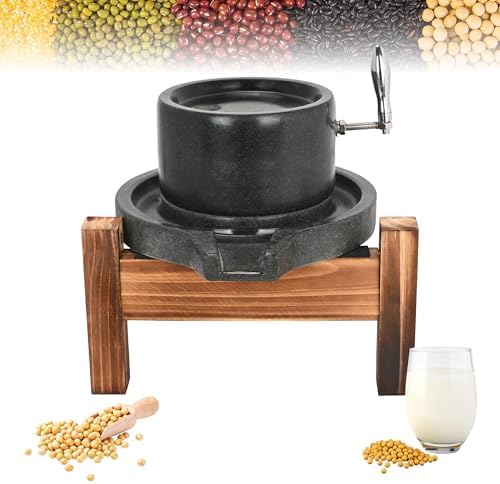
The Wpokke is a manual granite grinder designed for dry ingredients as well as selected wet preparations. Its description lists wheat, corn, soybeans, sesame, almonds, spices, and other small grains among the possible uses. It also notes that pre-soaking or repeated grinding may be needed for finer powder or smoother liquids.
The grinding core is described as natural granite, with a solid wooden frame and food-grade 304 stainless steel parts in the handle and core assembly. The listing gives dimensions of about 7.9 by 11.8 inches and describes a detachable turntable and base that can be rinsed. Those details may help if you want one manual tool for varied ingredients, though the need for repeated passes is worth keeping in mind.
Among these five choices, Wpokke has one of the clearest descriptions of wet-and-dry use and specific ingredient examples. It may suit someone who expects to experiment with flour, spices, and soaked ingredients, rather than someone seeking a fast, high-volume flour mill. The supplied product data marks it as available.
Pros:
- Described for both wet and dry grinding.
- Lists a broad range of ingredients, including grains, nuts, and spices.
- Detachable parts and a rinse-clean surface.
- Stainless steel handle components and granite grinding core.
Cons:
- Finer results or smoother liquids may require soaking or repeated grinding.
- Manual grinding may be tiring for larger batches.
Verdict: The Wpokke is a strong fit if you want a currently marked-available manual mill with clearly described wet-and-dry uses and are comfortable grinding in stages.
4. Gtouse Manual Mill: A Stable Base and Adjustable Grind

The Gtouse pairs a natural granite grinding body with a solid wood base and a stainless steel handle. Its description also specifies a silicone ring under the base to help limit movement on the counter, a practical feature when you need one hand to turn the grinder and the other to manage ingredients.
This model is described for both wet and dry use, with adjustable coarseness. It also has a one-way discharge port intended to help ground material exit without flowing back into the grinding chamber. The listing says the parts can be disassembled for cleaning, which may be useful when changing between ingredients or preparing pastes.
Its feature list is more detailed than those of the Groviia and wait wit mills, but it also mentions a particular installation step: tapping the base tenon into place during assembly. Check the complete instructions and listing before setup. The supplied product data does not mark this listing as available.
Pros:
- Described for wet and dry grinding with adjustable coarseness.
- Silicone ring under the base is intended to help keep it in place.
- Discharge port and detachable design are described as aids to use and cleaning.
- Granite body, wood base, and stainless steel handle.
Cons:
- Base assembly may require extra care.
- The supplied data does not mark the listing as available.
Verdict: If you want features such as an adjustable grind and a discharge port, the Gtouse is worth considering once you confirm the listing is available and review its assembly instructions.
5. pofluany Granite Mill: A Wood-Stand Setup for Countertop Use

The pofluany is a hand-powered stone mill with a supplied wooden stand. Its description gives an upper stone diameter of about 7.87 inches and a lower stone of about 11.81 inches, creating a broad countertop-style setup rather than a compact handheld grinder.
The product is described for wet and dry ingredients, including grains, beans, herbs, and spices. Dense grinding teeth and a widened discharge channel are intended to guide ground material out of the mill, while a backflow-prevention structure is built into the outlet. The listing says the smooth stone surfaces can be rinsed after use.
This option may suit you if you want a traditional manual mill with a stand and a clear set of stated dimensions. The broad lower stone may require more counter space than a small grinder, and turning a hand crank still takes effort. The supplied product data marks it as available.
Pros:
- Includes a wooden stand for countertop use.
- Described for wet and dry grinding.
- Widened discharge channel and backflow-prevention structure.
- Provides dimensions for the upper and lower stones.
Cons:
- Requires countertop space and manual effort.
- Does not state an adjustable coarseness feature.
Verdict: Choose the pofluany if you want a stand-mounted manual mill with wet-and-dry capability and are comfortable with its larger countertop footprint.
How to Choose a Stone Mill Grinder for Grains
Match the mill to what you plan to grind
Start with your usual ingredients. If you mainly want to grind dry grains, a straightforward manual design may be enough. If you also want to work with soaked beans, herbs, or pastes, choose a model whose product description clearly states that it supports wet grinding. Ingredient lists vary, so check that the manufacturer names the foods you expect to use.
Think about effort and batch size
All five options are hand-powered, so you provide the turning force. That makes them independent of electricity, but it also means they may take longer than an electric appliance, especially when grinding repeatedly for a finer result. The product descriptions do not provide comparable batch capacities or grinding speeds. If you need to prepare large amounts often, look for capacity details on the listing before you buy.
Consider the grinding adjustment you need
Some product descriptions mention grooves or dense grinding teeth, while the Gtouse specifically describes adjustable coarseness. If you need different textures, confirm how the adjustment works and what range it offers. Do not assume that every stone mill can produce the same fine flour or smooth paste.
Check stability and countertop space
Manual turning can shift a mill if its base is not steady. Look for a broad wooden base or a feature intended to reduce slipping, such as the Gtouse’s silicone ring. Compare the listed dimensions with your available counter space; the pofluany, for example, specifies a lower stone of about 11.81 inches across.
Review cleaning and assembly details
Stone surfaces may rinse clean, but detachable parts and discharge areas can affect how easily you remove ingredient residue. If you plan to switch between grains and wet preparations, check the cleaning instructions and whether the mill comes apart. Also look for any assembly steps, since some designs may need setup before use.
Verify availability and listing details
Availability in the supplied product data differs among these options, and marketplace listings can change. Before ordering, confirm that the item is available and that the listing matches the model you want. Review the current description for dimensions, included parts, use instructions, and any limits on suitable ingredients.
Frequently Asked Questions
Can a manual stone mill grind wheat into flour?
The product descriptions for these mills include grain grinding, and some specifically name wheat or flour. However, the provided information does not give a guaranteed flour fineness or grinding rate. Check the product details and expect manual grinding to take effort.
Can these stone mills grind wet ingredients?
Several models are described for wet and dry use, including the Groviia, Wpokke, Gtouse, and pofluany. The wait wit description does not clearly specify wet grinding. Follow the individual product instructions and confirm that your intended ingredient is suitable.
Do I need to soak beans before grinding?
The Wpokke description recommends pre-soaking for some smoother wet preparations and notes that repeated grinding may be needed. Instructions can vary by mill and ingredient, so follow the guidance for the model you choose.
Are these mills electric?
No. The products described here are hand-operated, so you turn a handle to grind. This avoids relying on electricity but requires more time and physical effort than an electric mill.
Which option has adjustable coarseness?
The Gtouse description specifically mentions adjustable coarseness. The other supplied descriptions do not clearly state that feature, so check their listings if grind adjustment is important to you.
Which mill is easiest to clean?
Several descriptions mention rinse-clean stone surfaces or detachable parts. The Groviia, Wpokke, and Gtouse listings specifically describe detachable designs, while the pofluany notes that its smooth stone surfaces can be rinsed. Check each model’s cleaning instructions, especially if you plan to use it for wet ingredients.
Final Recommendation
For the clearest combination of stated wet-and-dry uses, ingredient examples, and detachable parts, the Wpokke is the most balanced choice among these options, provided its manual pace suits your needs. The pofluany is another practical pick if you prefer a stand-mounted design with listed dimensions. If adjustable coarseness is your priority, consider the Gtouse, but confirm its availability first. For any of these mills, check the current listing and instructions before ordering.
