
A natural-gas tankless water heater can save space and provide hot water on demand, but the right model depends on how much water your household uses at once—and how cold your incoming water gets. The units below range from compact, lower-capacity options to models advertised for several fixtures, with differences in controls, installation flexibility, and safety features. Treat each listed flow rate as a starting point: actual output depends on the temperature rise required, your gas supply, and your home’s plumbing.
Table of Contents
Quick Comparison
| Product | Listed flow rate | Notable features | Best suited for |
|---|---|---|---|
| QERPRE 100,000 BTU Tankless Water Heater | Up to 4.3 GPM | Three smart modes; stated ±1°F temperature control | Homes that want simple preset controls |
| SNDOAS Natural Gas Tankless Water Heater | Up to 4.23 GPM | LED monitoring; anti-freeze protection; exhaust pipe included | Indoor installations with a licensed installer |
| VELPAX Natural Gas Tankless Water Heater | Up to 4.74 GPM | Stainless steel body; digital temperature display | Small homes or cabins with modest simultaneous demand |
| Orbek 120,000 BTU Tankless Water Heater | Up to 5.1 GPM | Wi-Fi and voice control; indoor or outdoor setup | Households seeking more flow and flexible placement |
| Amzgachfktch 102,000 BTU Tankless Water Heater | Up to 4.75 GPM | Stated ±1°F stability; LED display and safety protections | Homes needing several fixtures supplied at once |
Our Picks: Best Tankless Water Heater Natural Gas reviews
1. QERPRE: A Compact Unit With Helpful Preset Modes

The QERPRE is an indoor natural-gas tankless heater rated at up to 4.3 GPM and 100,000 BTU. Its compact listed dimensions—22 inches high, 14 inches long, and 6.5 inches wide—may help when wall space is limited. It is designed to serve two or three outlets, though the number you can use comfortably at once depends on their flow rates and the required temperature rise.
Its three modes are a distinguishing feature. The 4-Season Mode adjusts temperature based on the season, Kitchen Mode sets water to 100°F, and Bathtub Mode alerts you when a selected amount of water has been reached. The manufacturer also states that its temperature-control system maintains water within ±1°F. These presets may be useful if you prefer quick adjustments instead of changing settings each time.
The unit is listed as starting at water pressure as low as 3.6 PSI and includes several protections, such as flame-out, overheating, and anti-freeze protection. However, the manufacturer says it is not recommended for locations above 2,000 feet. Check that limitation, your local installation rules, and the unit’s venting and gas requirements before choosing it.
Compared with the higher-flow Orbek, the QERPRE has a lower listed capacity and fewer connected controls. It may be a better fit if its preset modes appeal to you and your household’s hot-water demand is moderate.
Pros:
- Three modes for kitchen, seasonal, and bath use
- Compact listed dimensions for wall mounting
- Listed low-pressure startup and multiple safety protections
- Manufacturer-stated ±1°F temperature control
Cons:
- Not recommended above 2,000 feet, according to the manufacturer
- Lower listed flow rate than the Orbek and some other options here
Verdict: Choose the QERPRE if you want compact sizing and task-specific modes, and its altitude and capacity limits suit your home.
2. SNDOAS: An Indoor Model With Clear Digital Monitoring
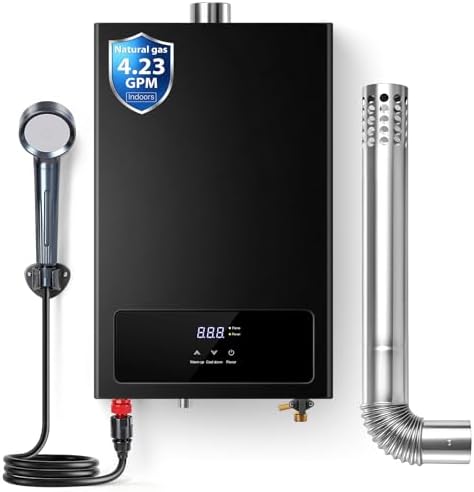
The SNDOAS is an indoor natural-gas model with a listed maximum flow rate of 4.23 GPM. Its LED panel displays temperature, settings, error codes, and gas and water consumption. That information can make it easier to check the unit’s status and spot an error message without guessing what is happening.
The manufacturer lists a temperature range of 95°F to 149°F and states that the heater can hold the selected temperature within ±1°F. Its oxygen-free copper heat exchanger is intended to support heat transfer, while built-in protections cover issues such as overheating, dry burning, and exhaust blockage. The unit also has an anti-freeze feature rated for temperatures down to 23°F.
This model is intended for indoor installation in a well-ventilated area. The product information says an exhaust pipe is included and calls for installation by a licensed technician using 1/2-inch NPT fittings. It also requires a standard 120V/60Hz outlet. Don’t treat the included vent component as proof that the complete installation will meet your home’s venting needs; have a qualified professional confirm the configuration.
With a lower listed maximum flow rate than the VELPAX, Orbek, and Amzgachfktch, the SNDOAS is most compelling for buyers who value its monitoring display and indoor-focused design over a higher stated capacity. The supplied product details also mention two-year free service and US customer support, but confirm the terms directly before purchase.
Pros:
- Display shows settings, temperature, consumption, and error codes
- Includes an exhaust pipe, according to the product description
- Anti-freeze and several operating protections
- Manufacturer-stated ±1°F temperature control
Cons:
- Requires professional installation and a 120V outlet
- Lowest listed maximum flow rate among these five options
Verdict: The SNDOAS is worth considering for an indoor setup if its flow capacity is enough and you want an informative control panel.
3. VELPAX: A Space-Saving Option for Smaller Homes

The VELPAX is a natural-gas tankless water heater listed at up to 4.74 GPM, with a 68,000 BTU-per-hour output stated in the product description. The manufacturer describes it as suitable for two or three points of use and positions it for homes, small cabins, and apartments. The listed flow rate is relatively high, but the lower stated BTU output makes it especially important to check performance at your home’s required temperature rise rather than choosing by GPM alone.
The unit has a stainless steel body, an oxygen-free copper water tank, and an LED display with an adjustable temperature range of 95°F to 149°F. Its listed protections include flame-failure, anti-freeze, and overheating protection. The manufacturer says it can start at 3.6 PSI of water pressure, which may matter if your home has low incoming pressure.
The product description lists 1/2-inch NPT water fittings, a gas pipe, inlet and outlet water pipes, and a 2.5-inch horizontal vent pipe. That parts list does not replace a professional check of gas connections, venting, clearances, permits, or local code. The manufacturer also recommends draining residual water if the heater will sit unused for an extended period in cold weather.
Compared with the SNDOAS, the VELPAX has a higher listed maximum flow rate and a stainless steel exterior. But the product information provides less detail about temperature stability and support. It is a practical candidate for a smaller property when a licensed installer confirms the output fits the expected demand.
Pros:
- Listed maximum flow rate of up to 4.74 GPM
- Stainless steel body and copper water tank
- Digital temperature adjustment and listed low-pressure startup
- Product description lists several connection and vent components
Cons:
- Its stated BTU output makes temperature-rise sizing especially important
- Cold-weather storage requires attention to residual water, according to the manufacturer
Verdict: Consider the VELPAX for a small home or cabin if its output checks out for your climate and the included installation components match your setup.
4. Orbek: The Highest Listed Flow Rate and Flexible Placement

The Orbek is the highest-capacity option in this comparison by its listed figures: 120,000 BTU and up to 5.1 GPM. The manufacturer says it can supply two to four outlets and lists a low-flow start of 0.53 GPM. Those figures may appeal to a household that regularly runs more than one hot-water fixture, but actual performance still depends on the temperature rise and how much water each fixture draws.
Its main convenience features are Wi-Fi, an app, and Alexa voice control. The product information says you can adjust temperature, monitor energy use, and receive maintenance alerts through the app. It also lists a compact body measuring about 22.83 by 14.57 by 7 inches.
The Orbek is described for indoor or outdoor installation. For indoor use, a direct-vent pipe kit is included; for outdoor mounting, the weatherproof exhaust hood is sold separately. This difference can affect the final setup, so confirm which parts are required for your chosen location. The listing states that the unit is CSA certified; still, have an installer verify that the model and installation plan meet local rules.
Compared with the other picks, the Orbek offers the most listed flow and the broadest controls, but its outdoor setup may require an additional part. Its higher capacity makes it the strongest candidate here for heavier household demand, provided your gas line and venting can support it.
Pros:
- Highest listed maximum flow rate and BTU output in this group
- Wi-Fi app and Alexa voice-control features
- Designed for indoor or outdoor placement
- Manufacturer lists CSA certification and several safety protections
Cons:
- Outdoor installation requires a hood sold separately
- More features and higher capacity do not remove the need for professional sizing and installation
Verdict: The Orbek is the most versatile pick for a household that needs higher listed flow and wants smart controls, as long as its installation requirements fit your home.
5. Amzgachfktch: A Higher-Flow Choice With Temperature Monitoring

This natural-gas model is listed at 102,000 BTU and up to 4.75 GPM. The manufacturer says it can supply three or four fixtures, such as a shower, kitchen faucet, and bathroom sink. That is a useful target for a busy household, but it is not a guarantee that every combination will receive adequate hot water in every climate.
The product description highlights water-servo controls and temperature sensors, with a stated temperature range of 95°F to 149°F and claimed stability within ±1°F. An LED display shows temperature, operating status, and fault codes. Its listed safety features include anti-freeze, overheating, dry-burn, and exhaust-blockage protection, plus a fan exhaust system.
An oxygen-free copper heat exchanger and wall-mounted design are intended to support efficient heating while taking up less space than a storage tank. However, the supplied product details do not give a complete installation specification in the available description. Before buying, confirm venting, electrical needs, gas connection size, clearances, and whether any required accessories are included.
Compared with the Orbek, the Amzgachfktch has a lower listed flow rate and fewer described connected features, but it still has a substantial stated output and detailed temperature monitoring. It may suit you if you want a higher-flow model without placing much value on app or voice control.
Pros:
- Listed output of 102,000 BTU and flow rate up to 4.75 GPM
- Manufacturer-stated ±1°F temperature stability
- LED display includes operating status and fault codes
- Includes several listed safety protections
Cons:
- Available product details do not fully specify installation requirements or included parts
- Its listed maximum flow is below the Orbek’s
Verdict: Choose the Amzgachfktch if its rated capacity fits your needs and you value temperature monitoring, but verify all installation details before ordering.
How to Choose a Natural-Gas Tankless Water Heater
Size the Heater for Your Peak Hot-Water Use
Start by listing the fixtures you may use at the same time, such as a shower, kitchen faucet, and laundry appliance. Add their expected flow rates to estimate your household’s peak demand. Then compare that figure with the heater’s output at the temperature rise your home needs. A unit’s advertised maximum GPM alone does not tell you how much hot water it can provide when the incoming water is very cold.
Account for Incoming Water Temperature
The heater must raise cold water to your chosen temperature. Homes in colder regions often need a larger temperature rise than homes with warmer incoming water. Ask an installer to estimate your local winter inlet temperature and compare it with each unit’s output data. This step can help prevent a heater from feeling underpowered even when its headline flow rate looks adequate.
Check BTU Output Along With Flow Rate
GPM describes water flow, while BTU output helps indicate how much heat the unit can add. Consider both figures together rather than comparing GPM by itself. The VELPAX, for example, lists a 4.74 GPM maximum but states 68,000 BTU per hour, so its performance at a particular temperature rise deserves careful confirmation. Ask for the manufacturer’s performance chart if it is not clear from the listing.
Confirm Natural-Gas Supply and Connections
Make sure the model is designed for the fuel available in your home. Do not assume a natural-gas unit can use another fuel or be converted unless the manufacturer confirms it. A licensed professional should check the gas line, supply pressure, connection size, and whether your existing system can support the heater’s required input.
Plan Venting and Installation Location
Tankless gas heaters need a safe way to exhaust combustion gases. Check whether a model is indoor-only, suitable for outdoor use, or supports both configurations, and find out which vent parts are included or sold separately. Also consider wall space, clearances, access for maintenance, and local permit or code requirements. Installation details vary, so have a qualified professional confirm the plan before purchase.
Consider Freezing Conditions and Maintenance
Anti-freeze protection can help, but it is not a substitute for checking the manufacturer’s cold-weather instructions. If the heater is in a location that may freeze or will sit unused, find out whether it needs added protection or draining. Ask about routine maintenance and access to service parts as well, especially if the unit will be difficult to reach.
Choose Controls That Match Your Household
A clear display can help you adjust temperature and understand error codes. Preset modes may simplify common tasks, while Wi-Fi and voice controls may be useful if you want to adjust settings remotely. These features are conveniences rather than substitutes for correct sizing and safe installation. Prioritize the features you will use, and confirm that any app or smart-home function works with your setup.
Frequently Asked Questions
How many fixtures can a natural-gas tankless water heater run at once?
It depends on the heater’s output, the fixtures’ flow rates, and the temperature rise needed. Some models here are advertised for two or three outlets, while the Orbek and Amzgachfktch are described for higher simultaneous use. Have an installer size the unit around your household’s actual peak demand.
Is a higher GPM rating always better?
No. The maximum listed flow rate does not show how much hot water the unit can deliver at every temperature rise. Check the BTU output and the manufacturer’s performance information for your expected incoming-water temperature.
Can I install a gas tankless water heater myself?
Gas connections and combustion venting affect safety, and installation rules vary by location. The SNDOAS description specifically calls for a licensed technician. For any model, check local requirements and use a qualified professional to confirm the gas, venting, electrical, and permit needs.
Do these heaters need electricity?
At least one listed model, the SNDOAS, specifies a standard 120V/60Hz outlet. The supplied information does not give complete electrical requirements for every option, so check the exact model’s manual and product details before installation.
Can I install one of these units outdoors?
The Orbek is described for indoor or outdoor installation, but its outdoor setup requires a weatherproof exhaust hood sold separately. The other product descriptions focus on indoor or wall-mounted installation. Confirm the approved location and required accessories with the manufacturer and your installer.
Will a tankless heater provide hot water instantly at every faucet?
It heats water on demand, but hot water still has to travel through your home’s pipes. The wait at a distant faucet depends on the plumbing layout and distance from the heater.
Which model is the best fit for a larger household?
Of these five, the Orbek has the highest listed flow rate and BTU output, making it the strongest starting point for higher demand. That does not guarantee it will serve every home; confirm the required temperature rise, gas supply, and simultaneous fixture use before choosing.
Final Recommendation
The Orbek stands out for its highest listed flow rate, higher stated BTU output, and indoor-or-outdoor flexibility, making it the leading option to investigate for households with greater hot-water demand. For a more compact choice with useful presets, consider the QERPRE; for digital monitoring in an indoor setup, look at the SNDOAS. Whichever model you choose, base the decision on a temperature-rise sizing check and professional confirmation of gas supply, venting, and local installation requirements.
