
Choosing the best tongue and groove flooring nailer starts with matching the tool to your flooring’s thickness, material, and recommended fastener. The options below are pneumatic models with different ranges of compatible flooring and fasteners, from versatile nailer-staplers to tools designed for thinner or denser flooring. Check your flooring manufacturer’s installation instructions before choosing a nailer or fastener.
Table of Contents
Quick Comparison
| Product | Fastener options | Floor thickness | Best suited for |
|---|---|---|---|
| Freeman P50LSLW 2-in-1 Flooring Nailer/Stapler | 16-gauge L-cleats or 15.5-gauge staples | 5/8–3/4 in. | Standard-thickness tongue and groove flooring |
| Freeman PFL618BR 3-in-1 Flooring Nailer | 16-gauge T-cleats, L-cleats, or 15.5-gauge staples | 1/2–3/4 in. | Projects that benefit from three fastener choices |
| Freeman PF1618GLCN 3-in-1 Flooring Nailer | 16-gauge T-cleats or L-cleats, or 18-gauge L-cleats | 3/8–3/4 in. | A wider range of flooring thicknesses |
| Freeman PF18GLCN 18-Gauge Flooring Nailer | 18-gauge L-cleats | 3/8–3/4 in. | Dense or exotic flooring materials |
| Estwing EF18GLCN 18-Gauge Flooring Nailer | 18-gauge L-cleats | 3/8–3/4 in. | Solid or engineered flooring, including dense woods |
Our Picks: Best Tongue And Groove Flooring Nailer reviews
1. Freeman P50LSLW: A Lightweight 2-in-1 for Standard Flooring
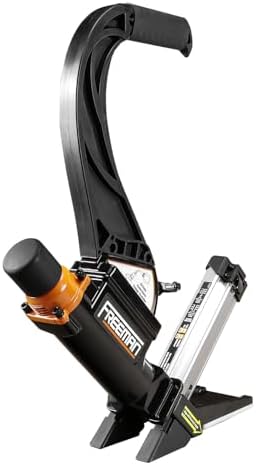
The Freeman P50LSLW combines a flooring nailer and stapler in one pneumatic tool. It accepts 16-gauge L-cleats or 15.5-gauge, half-inch crown staples, both in lengths from 1½ to 2 inches. Its listed flooring range is 5/8 to 3/4 inch, making it a focused choice for common solid hardwood thicknesses rather than thinner flooring.
The aluminum body and magazine are designed to keep the tool light, while heat-treated steel parts add durability. Freeman says this model is two pounds lighter than comparable flooring nailers. Two interchangeable no-mar base plates are included to suit the stated flooring thicknesses, along with a fiberglass mallet. A semi-quick jam release gives access to the drive blade if a fastener jams.
This model makes the most sense if your flooring is within its thickness range and you want the option to use either cleats or staples. Its narrower fastener and flooring range is a trade-off compared with the other Freeman multi-purpose models, which accommodate thinner flooring or additional fastener types.
Pros:
- Switches between 16-gauge L-cleats and 15.5-gauge staples
- Designed for 5/8- to 3/4-inch flooring
- Lightweight aluminum construction and light-strike bumper
- Includes interchangeable no-mar plates and a fiberglass mallet
Cons:
- Does not list compatibility with flooring thinner than 5/8 inch
- Jam release is semi-quick rather than tool-free
Verdict: Choose the P50LSLW if you need a lighter 2-in-1 tool for 5/8- to 3/4-inch flooring and want both cleat and staple options.
2. Freeman PFL618BR: Three Fastener Choices for 1/2-Inch Flooring

The PFL618BR is a 3-in-1 pneumatic flooring nailer and stapler for tongue and groove hardwood. It accepts 16-gauge T-cleats and L-cleats, as well as 15.5-gauge half-inch crown staples. Each fastener type is listed in lengths from 1½ to 2 inches. Its flooring range starts at 1/2 inch and goes up to 3/4 inch.
The tool has an aluminum body, an anodized aluminum magazine, and heat-treated steel parts. Its extended-reach handle and light-strike bumper are designed to make operation more comfortable during longer work periods. Interchangeable no-mar plates help protect finished flooring, and the package includes a fiberglass mallet and a molded carrying case.
Compared with the P50LSLW, this model accepts T-cleats and works with flooring as thin as 1/2 inch. It does not list the 3/8-inch lower limit found on the PF1618GLCN and the two 18-gauge models. Confirm the recommended fastener type and length for your specific flooring before selecting among its three options.
Pros:
- Accepts T-cleats, L-cleats, and staples
- Fits listed flooring thicknesses from 1/2 to 3/4 inch
- Includes no-mar plates, a mallet, and a molded case
- Extended-reach handle and light-strike bumper
Cons:
- Does not list compatibility with flooring thinner than 1/2 inch
- Fastener compatibility requires checking your flooring instructions
Verdict: The PFL618BR is a good match if your flooring is 1/2 to 3/4 inch thick and you want three listed fastener options in one tool.
3. Freeman PF1618GLCN: A Versatile Choice for Thinner Flooring

The PF1618GLCN is a three-fastener flooring nailer built for a broad listed thickness range: 3/8 to 3/4 inch. It accepts 16-gauge T-cleats and L-cleats from 1½ to 2 inches, along with 18-gauge L-cleats from 1¼ to 1¾ inches. Unlike the other Freeman multi-purpose models here, this one lists 18-gauge L-cleats rather than staples.
Its aluminum body and magazine are paired with heat-treated steel parts. Three interchangeable no-mar base plates are included to match the tool to different flooring thicknesses, along with an extended-reach handle, a light-strike bumper, and a fiberglass mallet. This combination gives you more flexibility when your project includes flooring that is thinner than 1/2 inch.
The extra fastener choices are useful only if they match the flooring manufacturer’s requirements, so check those before buying. Compared with the PFL618BR, this model trades staple compatibility for an 18-gauge L-cleat option and a lower minimum flooring thickness.
Pros:
- Listed for flooring from 3/8 to 3/4 inch
- Accepts 16-gauge T-cleats and L-cleats plus 18-gauge L-cleats
- Includes three no-mar base plates
- Extended-reach handle and light-strike bumper
Cons:
- Does not list staple compatibility
- Offers more fastener choices to verify against your flooring specifications
Verdict: Pick the PF1618GLCN if you need a versatile nailer for flooring as thin as 3/8 inch and your installation calls for one of its listed cleat types.
4. Freeman PF18GLCN: A Dedicated 18-Gauge Tool for Dense Flooring

The PF18GLCN is a single-fastener flooring nailer designed for 18-gauge glue-collated L-cleats from 1¼ to 1¾ inches. Freeman identifies it for tongue and groove flooring, including dense or exotic woods such as strand-woven bamboo, teak, and cherry, as well as engineered flooring. Its stated range covers flooring from 3/8 to 3/4 inch.
This pneumatic model uses an aluminum body and magazine, with heat-treated steel parts. It comes with three interchangeable no-mar plates for its flooring range, an extended-reach handle, a light-strike bumper, and a fiberglass mallet. Because it is designed around 18-gauge L-cleats, it is less flexible than the multi-fastener models, but its stated material applications make it a focused option for denser flooring.
Compare its fastener requirements with your flooring instructions before buying; a lower gauge number or a different fastener type is not automatically interchangeable. The Estwing EF18GLCN is a close alternative with a similar thickness range and 18-gauge cleats, while the Freeman model specifically lists three no-mar plates and a mallet in its included features.
Pros:
- Designed for dense and exotic flooring, including strand-woven bamboo
- Works with listed 18-gauge L-cleats from 1¼ to 1¾ inches
- Fits flooring from 3/8 to 3/4 inch
- Includes three no-mar plates and a fiberglass mallet
Cons:
- Accepts only the listed 18-gauge L-cleats
- Does not offer the staple or T-cleat options found on multi-purpose models
Verdict: Consider the PF18GLCN when your flooring is dense or exotic and its installation instructions specify compatible 18-gauge L-cleats.
5. Estwing EF18GLCN: An 18-Gauge Option with Tool-Free Jam Release
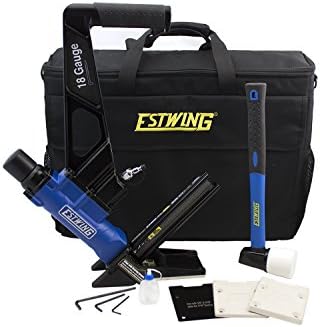
The Estwing EF18GLCN is a pneumatic flooring nailer for 18-gauge L-cleats. It is listed for solid or engineered tongue and groove flooring from 3/8 to 3/4 inch, including bamboo and other dense flooring types. Its no-mar base is intended for use on prefinished or unfinished floors.
The tool has a lightweight aluminum construction, a light-strike bumper, interchangeable base plates, and a tool-free quick release for clearing jams. Those features make it a close match to the Freeman PF18GLCN, although the supplied product details do not list the Estwing model’s cleat length range. Check the tool’s current specifications and your flooring requirements to confirm exact fastener compatibility.
This is a focused choice for flooring that calls for 18-gauge L-cleats, not a general-purpose replacement for models that accept staples or multiple cleat types. Its tool-free jam release is a useful distinction if access to the drive blade is a priority.
Pros:
- Listed for solid and engineered flooring from 3/8 to 3/4 inch
- Designed for bamboo and other dense flooring types
- Tool-free quick release for clearing jams
- Includes interchangeable base plates and a no-mar base
Cons:
- Designed for 18-gauge L-cleats rather than multiple fastener types
- The supplied details do not state a cleat length range
Verdict: Choose the Estwing EF18GLCN if your flooring calls for an 18-gauge L-cleat nailer and you value its tool-free jam release.
How to Choose a Tongue and Groove Flooring Nailer
Match the tool to your flooring thickness
Start with the thickness range listed for the nailer and compare it with the flooring you plan to install. The P50LSLW covers 5/8 to 3/4 inch, the PFL618BR covers 1/2 to 3/4 inch, and the PF1618GLCN and both 18-gauge models cover 3/8 to 3/4 inch. A tool that does not list your flooring thickness may not position its fastener correctly.
Follow the flooring manufacturer’s fastener instructions
Flooring nailers can accept different fastener types, but those options are not automatically interchangeable. These models are compatible with various combinations of T-cleats, L-cleats, and staples. Check the flooring manufacturer’s instructions for the required fastener type, gauge, and length, then choose a tool that lists that exact option.
Consider the flooring material
For common tongue and groove hardwood, several models in this guide may be suitable if their fastener specifications match your floor. For dense or exotic materials, the Freeman PF18GLCN and Estwing EF18GLCN are specifically described for dense flooring; the Freeman also names strand-woven bamboo, teak, and cherry. Use the flooring maker’s guidance to confirm the right tool and fastener for your material.
Decide how much fastener flexibility you need
A multi-purpose model gives you more listed fastener choices in one tool. The PFL618BR accepts T-cleats, L-cleats, and staples, while the PF1618GLCN accepts two types of 16-gauge cleats and 18-gauge L-cleats. The two 18-gauge models focus on L-cleats. More options can be useful, but only when they are compatible with your flooring.
Look at base plates and floor protection
No-mar base plates help protect the floor surface during installation, and interchangeable plates let you adjust the tool for different flooring thicknesses. Check how many plates are included and whether the tool’s stated range covers your floor. Even with a protective base, follow the tool instructions and take care around finished surfaces.
Think about handling and maintenance
An extended-reach handle and a light-strike bumper can make repeated operation more manageable. If you expect to use the tool for long stretches, weight and grip design may matter. Also compare jam-release designs: the Freeman P50LSLW and PFL618BR list semi-quick releases, while the Estwing EF18GLCN lists a tool-free quick release.
Plan for the pneumatic setup
All five models in this guide are pneumatic, so you will need a compatible air-compressor setup. Check the tool’s manufacturer instructions for its operating requirements and confirm that your air hose and compressor are suitable before starting the project.
Frequently Asked Questions
What is a tongue and groove flooring nailer used for?
It drives a compatible fastener through the tongue of flooring boards to secure them to the subfloor. The exact fastener and tool setup depend on the flooring material, thickness, and manufacturer’s installation instructions.
Can I use any cleat or staple that fits in the tool?
No. A fastener can fit the tool but still be wrong for your flooring. Match the fastener type, gauge, and length to both the nailer’s specifications and the flooring manufacturer’s requirements.
Which model works with the thinnest flooring listed here?
The Freeman PF1618GLCN, Freeman PF18GLCN, and Estwing EF18GLCN list compatibility with flooring as thin as 3/8 inch. Verify that the flooring’s required fastener is also compatible with the model you choose.
Which nailers can use staples?
The Freeman P50LSLW lists compatibility with 15.5-gauge half-inch crown staples. The Freeman PFL618BR also accepts those staples, along with T-cleats and L-cleats.
What is the difference between the two 18-gauge models?
Both the Freeman PF18GLCN and Estwing EF18GLCN are listed for 18-gauge L-cleats and flooring from 3/8 to 3/4 inch. The Freeman details include its cleat length range and a fiberglass mallet; the Estwing lists a tool-free quick jam release. Compare the full product specifications before deciding.
Do these pneumatic nailers include an air compressor?
The supplied product details do not list an air compressor as included. Plan for a compatible compressor and check the manufacturer’s operating instructions for setup requirements.
Final Recommendation
For a versatile tool that covers 3/8- to 3/4-inch flooring and accepts several cleat types, the Freeman PF1618GLCN is a strong choice to compare first. If you want staple compatibility, consider the Freeman PFL618BR or P50LSLW, choosing between them based on your flooring thickness. For dense flooring that calls for 18-gauge L-cleats, compare the Freeman PF18GLCN with the Estwing EF18GLCN. In every case, let your flooring manufacturer’s fastener instructions guide the final choice.
