
A WiFi weather station with an outdoor sensor can show you more than a general forecast: it can track conditions around your own home, garden, or property. The right choice depends on which readings you need, how you want to view them, and whether your WiFi setup is compatible. These five options range from straightforward 7-in-1 systems to a dual-band model with longer-term data storage.
Table of Contents
Quick Comparison
| Weather Station | Outdoor Sensor | Display | App and WiFi | Standout Feature |
|---|---|---|---|---|
| LFF 7-in-1 WiFi Weather Station | 7-in-1, solar-assisted | 7.5-inch color | Smart Life; 2.4 GHz | Simple, broad set of local readings |
| cedeil WiFi Weather Station | Wind, rain, UV, light, temperature, and humidity | 7.5-inch HD color | Tuya; 2.4 GHz | PM2.5, AQI, and historical graphs |
| Sainlogic 12-in-1 WiFi Weather Station | Multi-reading outdoor sensor | Not specified | Inercom; 2.4 or 5 GHz | Two-year local storage and data export |
| Raddy VP7 7-in-1 Weather Station | 7-in-1, up to 330-foot stated open range | Not specified | Tuya; 2.4 GHz | Comfort and astronomical metrics |
| Raddy WF-120P WiFi Weather Station | 7-in-1, 100-meter stated range | 10-inch color | Tuya app | Large screen and one-year data history |
Our Picks: Best Wifi Weather Stations With Outdoor Sensors reviews
1. LFF 7-in-1 WiFi Weather Station: A Straightforward All-Rounder
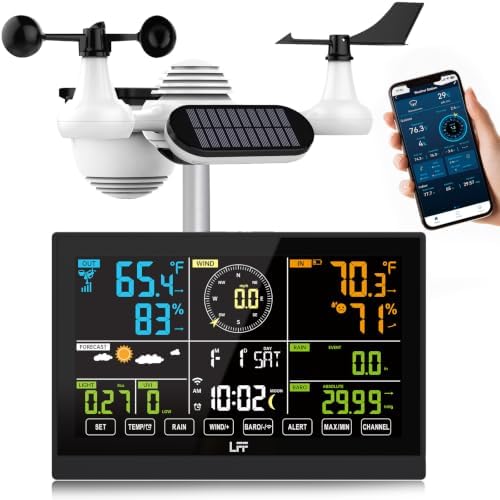
The LFF pairs a 7-in-1 outdoor sensor with a 7.5-inch color display and Smart Life app access. The listed measurements include wind speed and direction, temperature, humidity, air pressure, rainfall, and UV data, giving you a useful local picture without requiring a collection of separate sensors.
The outdoor unit includes a solar panel, with three AA batteries serving as backup. Its stated wireless range is up to 100 meters in open terrain, so placement and obstacles between the sensor and display can affect how well that range suits your property. The indoor console can run from its included power adapter or use three AAA batteries as backup.
A key setup detail is that the adapter must stay connected for WiFi and data synchronization. The station supports 2.4 GHz WiFi, not 5 GHz, so check your network before buying. Its four-level backlight and touch-button controls make it a practical fit for a living room, office, or other spot where you want a dedicated display.
Pros:
- Measures wind, rain, UV, temperature, humidity, and more.
- Large color display with adjustable backlight levels.
- Solar-assisted outdoor sensor with battery backup.
- Works with the Smart Life app for remote access.
Cons:
- WiFi requires 2.4 GHz, and the adapter must remain connected for synchronization.
- Outdoor sensor batteries are not included.
Verdict: Choose the LFF if you want a broad set of backyard readings on a clear display and your network supports 2.4 GHz WiFi.
2. cedeil WiFi Weather Station: Extra Air-Quality Readings and Data History

This station combines a 7.5-inch HD VA color display with an outdoor array for wind, rainfall, UV, light, temperature, and humidity. The console also lists barometric pressure trends and feels-like temperature, plus PM2.5 and AQI readings. Those added measures may appeal if you want indoor and outdoor conditions in one place, though the product description does not detail the air-quality sensor hardware.
The Tuya app provides live readings, historical graphs, and remote adjustments for settings such as brightness and temperature units. The display offers four manual backlight levels and an auto-dimming light sensor. The outdoor sensor is solar-powered with three AA batteries as backup, and its stated transmission range is up to 328 feet.
The station connects to 2.4 GHz WiFi and is described as providing a five-day graphical forecast. Its combination of local sensor data and app history makes it a strong option for tracking changes over time. As with any wireless setup, the stated range is not a guarantee for every home; walls and the sensor’s location can matter.
Pros:
- Includes PM2.5 and AQI readings alongside standard weather data.
- Tuya app offers live data and historical graphs.
- Solar-powered outdoor array has battery backup.
- Auto-dimming sensor can adjust the screen for different lighting.
Cons:
- Requires 2.4 GHz WiFi.
- The product description gives limited detail about the air-quality measurement method.
Verdict: Consider the cedeil if air-quality readings and app-based history matter as much to you as wind and rainfall data.
3. Sainlogic 12-in-1 WiFi Weather Station: Best for Network Flexibility and Data Tracking

The Sainlogic is the most data-focused choice in this group. Its listed readings include indoor and outdoor temperature and humidity, wind direction, real-time and average wind speed, rainfall, barometric pressure, date, moon phase, and a weather forecast. The product description also highlights a sensor chip and gives claimed temperature and humidity precision figures; treat these as manufacturer specifications rather than a guarantee for every installation.
Its standout practical feature is dual-band WiFi support, with connections listed for both 2.4 GHz and 5 GHz networks. The Inercom app is described as offering live monitoring and alerts for conditions such as temperature, humidity, and pressure. For people who like to study seasonal patterns, the station can store up to two years of local data and export it to Excel, according to the product details.
The outdoor sensor is designed to mount on a rooftop, fence, or pole using the included bracket. The listed setup instructions stress correct mounting for wind direction and temperature readings, so placement deserves care. The product description does not specify the display size, making it harder to compare screen readability with the large-screen options in this roundup.
Pros:
- Supports both 2.4 GHz and 5 GHz WiFi.
- Stores up to two years of local weather data and supports Excel export.
- Offers app alerts for selected weather changes.
- Tracks a wide mix of indoor, outdoor, wind, rain, and pressure readings.
Cons:
- Display size is not specified in the supplied product details.
- Correct outdoor mounting is important for useful readings.
Verdict: The Sainlogic is a compelling pick if you want flexible WiFi compatibility and long-term records more than a clearly specified large display.
4. Raddy VP7: A 7-in-1 Station with Comfort and Sky-Planning Metrics

The Raddy VP7’s 7-in-1 outdoor sensor measures wind speed and direction, rainfall, UV, light, temperature, and humidity. The station also lists comfort and astronomical information, including dew point, heat index, wind chill, sunrise, sunset, and moon phases. That extra context can help you plan outdoor time beyond simply checking the temperature.
The system connects to the Tuya Smart app over 2.4 GHz WiFi. Its app features include historical trends, real-time alerts, and a five-day forecast. The outdoor sensor uses 433 MHz radio communication and has a stated open-range transmission distance of up to 330 feet. That figure is for open conditions, so it should not be treated as the expected range through multiple walls.
The console runs from a 5V power cable and has AA battery backup. The product description says the unit is built for a broad temperature range and uses UV-resistant ABS material, but it does not give a display size. If the screen is a major part of your buying decision, compare its current product details with the LFF or Raddy WF-120P, which specify display dimensions.
Pros:
- Combines seven outdoor measurements with comfort and astronomical data.
- Tuya app includes alerts, trends, and a five-day forecast.
- Stated open-range transmission distance reaches 330 feet.
- Console includes a power cable and battery backup option.
Cons:
- Only 2.4 GHz WiFi is specified.
- Display size is not stated in the supplied details.
Verdict: Pick the Raddy VP7 if you value detailed outdoor and comfort metrics, and do not need a specified large screen or dual-band WiFi.
5. Raddy WF-120P: A Large 10-Inch Display for At-a-Glance Reading

The WF-120P stands out for its 10-inch color display, the largest screen specified among these five options. It shows indoor and outdoor temperature and humidity, pressure, wind, rainfall, UV, air quality, moon phase, and a five-day forecast. A larger screen can be useful if you plan to check conditions from across a room or want multiple readings visible at once.
Its 7-in-1 outdoor sensor measures temperature, humidity, wind, rainfall, UV, and sunlight, with a stated transmission range of up to 100 meters. The Tuya Smart app provides live data, historical trends, and access to up to one year of data. Five backlight levels and an automatic night mode offer more control over screen brightness.
The product details mention low-battery alerts, which can help you keep track of power needs. They do not specify the WiFi band, so check the current listing or setup instructions if your network requirements are strict. The product data supplied for this article also marks this model as unavailable, so check its current listing before choosing it.
Pros:
- Large 10-inch color display.
- Shows a broad range of weather readings and a five-day forecast.
- Tuya app offers live monitoring and up to one year of historical data.
- Multiple backlight settings and automatic night mode.
Cons:
- WiFi band compatibility is not specified in the supplied details.
- The supplied product data marks it unavailable, so confirm current availability.
Verdict: If you want the biggest stated screen and app-based history, the WF-120P is worth considering once you confirm it is available and suits your WiFi setup.
How to Choose a WiFi Weather Station with Outdoor Sensors
Decide Which Measurements You Need
Start with the information you will actually use. Temperature and humidity may be enough for checking garden conditions or indoor comfort. Wind speed and direction, rainfall, and UV readings add value if you plan outdoor work, manage irrigation, or want to monitor exposure around your property. Some models also list air quality, pressure trends, or comfort measures such as dew point and heat index.
Check WiFi and App Requirements
WiFi details vary between stations. The LFF, cedeil, and Raddy VP7 specify 2.4 GHz connections, while the Sainlogic lists both 2.4 GHz and 5 GHz. The WF-120P’s supplied details do not name a WiFi band. Check compatibility before buying, and consider whether you want phone alerts, remote viewing, historical charts, or simply a display at home.
Compare the Display for Your Space
A large, clear screen can make a station easier to use as a household dashboard. The LFF and cedeil have 7.5-inch displays, and the Raddy WF-120P has a 10-inch display. Look for adjustable brightness or automatic dimming if the console will sit in a bedroom or a room with changing light. For models without a stated screen size, check the product listing carefully before deciding.
Plan Outdoor Sensor Placement
Consider where you can mount the outdoor sensor and how far it will be from the console. Product descriptions give open-range figures, but real-world range can be affected by walls, buildings, and placement. Follow the installation guidance, especially for wind direction and temperature readings. A clear, suitable mounting spot can matter as much as the advertised transmission distance.
Understand Power Needs
Outdoor arrays in this group include solar power or solar assistance, often with batteries as backup. Check whether batteries are included and what type each component takes. Also note whether the indoor display needs to stay plugged in for WiFi functions. For example, the LFF description says its adapter must remain connected for WiFi and data synchronization.
Choose the Right Amount of Data History
If you only need current conditions, app history may be a bonus rather than a deciding factor. If you want to compare rainfall or temperature patterns over time, look at the storage and export features. The Sainlogic lists up to two years of local storage and Excel export, while the Raddy WF-120P lists up to one year of history. Check whether the features you want are stored on the device, in the app, or both.
Frequently Asked Questions
Do WiFi weather stations still work if the internet goes down?
The local sensor-to-display connection may still show readings, but app access and online features can depend on an internet connection. Check the product instructions for details about offline use and data storage. The Sainlogic, for example, lists local data storage.
Do these stations work with 5 GHz WiFi?
Not all of them. The Sainlogic lists both 2.4 GHz and 5 GHz support. The LFF, cedeil, and Raddy VP7 specify 2.4 GHz, while the supplied WF-120P details do not identify a WiFi band.
Are outdoor sensors completely maintenance-free?
No. Solar power can reduce battery changes, but some systems still use batteries as backup. You may also need to check the sensor and its mounting from time to time. Follow the manufacturer’s instructions for care and battery replacement.
Can I rely on the advertised wireless range?
Use it as a reference, not a guarantee. Range figures are generally stated for open conditions, and walls or other obstacles can reduce the effective distance. Place the sensor and display where they have a clear communication path when possible.
Which option is best for tracking long-term weather patterns?
The Sainlogic is the clearest fit for longer-term records in this group because its product details list up to two years of local storage and Excel export. The Raddy WF-120P lists up to one year of app history.
Which weather station has the largest specified display?
The Raddy WF-120P lists a 10-inch color display. The LFF and cedeil each specify a 7.5-inch screen, while the supplied details for the Sainlogic and Raddy VP7 do not state a display size.
Final Recommendation
For a broad set of everyday outdoor readings and a clear display, the LFF is a practical all-round choice if 2.4 GHz WiFi and a constantly connected adapter fit your setup. Choose the cedeil for added air-quality readings and app history, or the Sainlogic if dual-band WiFi and long-term data storage are your priorities. If screen size matters most, consider the Raddy WF-120P after checking its current availability and WiFi details.
