
A composting toilet is one of the smartest choices for a tiny house. It needs no septic or sewer connection, uses no water and, when set up correctly, does not smell. The trick is picking one that fits your space, your power setup and how many people live with you. We compared 5 composting toilets available now that work well in tiny homes.
Home Throne is reader-supported. As an Amazon Associate, we earn from qualifying purchases. This guide is based on researching and comparing manufacturer specifications, product listings and general owner feedback — we did not physically test these products.
Quick picks
- Best Overall for Tiny Houses: Nature’s Head
- Best for Plumbed-In Urine Drain: Separett Tiny
- Smallest Footprint: OGO Origin
- Highest Capacity: Separett Villa
- Best Budget-Friendly: Cuddy Composting
Table of Contents
Comparison Table
| Product | Type | Power | Urine handling | |
|---|---|---|---|---|
| Nature’s Head | Composting, manual crank | 12V fan | Bottle | View on Amazon |
| Separett Tiny | Urine-separating, no mixing | Fan | Tube to greywater | View on Amazon |
| OGO Origin | Composting, electric agitator | 12V | Bottle | View on Amazon |
| Separett Villa | Urine-separating, no mixing | Fan (per model) | Drain or container | View on Amazon |
| Cuddy Composting | Composting, manual mixer | 12V fan | Container | View on Amazon |
The 5 Best Composting Toilets for Tiny Houses
1. Nature’s Head Self-Contained Composting Toilet

Nature’s Head is the composting toilet many tiny-house builders reach for first. It diverts urine into a front bottle and mixes solids with a bulking material such as coco coir using a hand-crank spider handle, keeping waste dry and largely odor-free with its small vent fan.
The brand says two people using it full-time will typically empty the solids bin every 4–6 weeks, and it comes with a 5-year warranty. Its close-quarters spider handle design suits tight bathrooms.
Key features:
- Urine-diverting composting design
- Close-quarters spider handle agitator
- 12V vent fan
- 2 people full-time: empty solids about every 4–6 weeks (per brand)
- 5-year warranty
Pros
- Proven, widely used design
- Low running costs
- Good capacity for two people
Cons
- Liquids bottle needs frequent emptying
- Requires venting and bulking material
Best for: Couples living full-time in a tiny house.
2. Separett Tiny Urine-Separating Toilet (Tube Version)

The Separett Tiny is designed specifically for tiny homes, RVs and boats. Its tube version sends urine directly to a greywater system or holding tank, so there is no liquids bottle to carry out — a big convenience for full-time living.
A built-in fan removes odors and moisture. No additives are needed, and Separett allows up to 16 feet of vent piping with two 90-degree bends; a 6.6-ft urine hose is included.
Key features:
- Urine tube to greywater or tank
- Built-in ventilation fan
- No additives needed
- Up to 16 ft vent run with two 90° bends
- Designed in Sweden
Pros
- No urine bottle to empty
- No mixing or bulking material
- Modern, compact look
Cons
- Needs a greywater or tank connection
- Requires power for the fan
Best for: Tiny homes with a greywater system or tank.
3. OGO Origin Compact Composting Toilet

At about 15 x 16 inches, the OGO Origin fits corners where other composting toilets will not. There is no side crank; a push-button 12V motor mixes the solids for you.
Liquids divert to a 2.4-gallon bottle while solids stay dry in the rear bin for roughly 25–30 uses. It is built in the USA from polypropylene with quiet fan ventilation and low 12V power draw.
Key features:
- 15″ x 16″ footprint
- Push-button electric agitator
- 2.4-gal urine bottle; solids bin about 25–30 uses
- Quiet 12V fan
- Made in USA (per listing)
Pros
- Fits very tight bathrooms
- No cranking
- Modern design
Cons
- Smaller solids capacity
- Relies on 12V power for mixing
Best for: Small tiny-house bathrooms and lofts.
4. Separett Villa Urine-Separating Compost Toilet
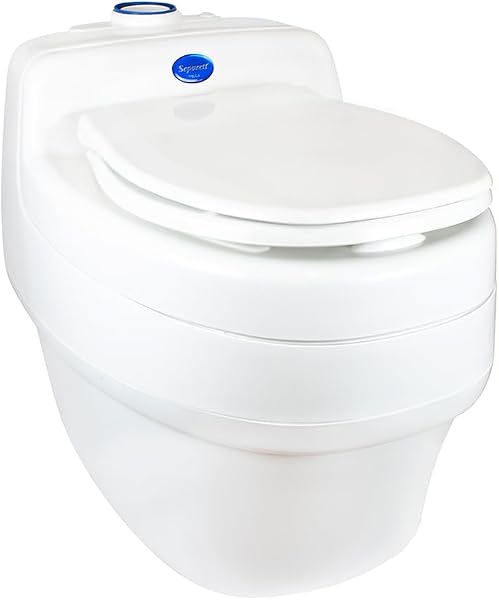
The Separett Villa is a larger, high-capacity urine-separating toilet suited to tiny homes with more space and to families. Like the Tiny, it needs no additives or mixing.
It is completely waterless with no plumbing connections, making it popular for homesteads, cottages and converted buses.
Key features:
- Urine-separating, no additives or mixing
- High-capacity solids container
- Waterless
- Suited to homesteads, cottages and buses
Pros
- Large capacity for more users
- Very low maintenance
- No stirring
Cons
- Larger footprint
- Needs vent and urine outlet
Best for: Larger tiny homes and families.
5. Compo Closet Cuddy Composting Toilet

The Cuddy is a compact self-contained composting toilet with a 12V fan and carbon filter for odor control. You add composting material before use and mix with a built-in manual handle.
The removable solids bin is emptied about every 2–3 weeks, and the liquids container has a no-spill valve. External venting is optional, which simplifies installation in a finished tiny home.
Key features:
- 3.9-gallon capacity (per listing)
- 12V fan and carbon filter
- Manual mixer
- Optional external venting
- Works without power when needed
Pros
- Optional venting
- Compact
- Easy-clean removable bin
Cons
- More frequent emptying
- Manual mixing
Best for: Part-time tiny homes, guest cabins and builds where venting is difficult.
Buying Guide: Composting Toilets for Tiny Homes
Measure your space
Tiny-house bathrooms are tight. Check the toilet’s footprint, seat height and clearance for any crank handle. Compact models like the OGO Origin save several inches.
Urine handling
Urine is the main source of odor and weight. Bottles must be emptied every day or two with full-time use. A tube to a greywater system or tank (like the Separett Tiny) eliminates that chore.
Mixing vs. drying
Nature’s Head and Cuddy mix solids with bulking material. Separett models dry solids with airflow and need no additives. Electric agitators like the OGO remove the cranking.
Venting and power
Most composting toilets run a small 12V fan through a vent to the outside. Plan the vent route through a wall or roof, and confirm your solar or battery system can run the fan continuously.
Local rules
Check local codes, especially for permanent tiny homes. Some areas regulate how compost and urine can be disposed of.
Frequently Asked Questions
Do composting toilets smell in a tiny house?
A properly vented, urine-diverting toilet should not smell. Odor usually means the fan is off, the vent is blocked or the solids are too wet.
How often do you empty a composting toilet?
Liquids every 1–3 days with a bottle; solids every few weeks depending on the model and number of users.
What do you use as bulking material?
Coco coir and peat moss are common. Some models, like Separett, need none.
Can I use a composting toilet in winter?
Yes, if the toilet is inside the heated space. Cold slows composting but separated, dried solids stay manageable.
Final Thoughts
For most tiny homes, the Nature’s Head is the proven all-rounder. If you have a greywater system, the Separett Tiny removes the daily urine-bottle chore, and the OGO Origin fits the tightest bathrooms. Measure carefully and check current details on Amazon before you buy.
Related post
