
Choosing the best bathroom grab bars for seniors starts with matching the bar to the person, the bathroom layout, and the wall where it will be mounted. A properly installed wall-mounted bar can provide a steady handhold near a tub or shower, while a suction-cup handle is better treated as a removable balance aid—not a substitute for a securely anchored grab bar. Here are five options, plus practical tips for choosing and installing one.
Table of Contents
Quick Comparison
| Product | Size and pack | Grip and installation | Best for |
|---|---|---|---|
| Ravinte 16-Inch Textured Grab Bars, 2-Pack | 16 inches; 2 bars | Textured stainless steel; wall-mounted | A matching pair of bars with a knurled grip |
| Moen Home Care 24-Inch Grab Bar | 24 inches; 1 bar | Stainless steel; wall-mounted | A longer bar from an established bathroom hardware brand |
| Moen Home Care 18-Inch Peened Grab Bar | 18 inches; 1 bar | Textured stainless steel; wall-mounted | A shorter bar with a slip-resistant surface |
| Gotega 16-Inch Textured Grab Bars, 2-Pack | 16 inches; 2 bars | Knurled stainless steel; wall-mounted | Adding handholds in two locations |
| TAILI 16.8-Inch Suction Grab Bars, 2-Pack | 16.8 inches; 2 handles | Suction cups with locking latches | A removable aid on compatible, smooth surfaces |
Our Picks: best bathroom grab bars for seniors reviews
Ravinte 16-Inch Textured Grab Bars: A Two-Bar Set for Key Spots

This two-pack of stainless steel bars offers a practical way to add handholds at more than one point, such as near a shower entrance and beside a tub. Each bar is about 16 inches long and has a one-inch diameter. The knurled surface is designed to provide extra grip when hands are wet.
The polished nickel finish has a more decorative look than a plain utility bar, and the bars can also be used to hang towels or clothes. That second use should not be confused with a safety installation: for support, mount each bar securely according to its instructions and the wall construction.
Owners have found the bars useful in different parts of the home, not only in the bathroom, and have described the grip as stable once installed. One practical consideration is that two bars require two suitable mounting locations. The product listing also offers other lengths, so check that you are ordering the size that fits your space.
Pros:
- Two bars can provide support in separate locations.
- Textured, one-inch-diameter grip is designed to help with wet hands.
- Stainless steel construction and polished nickel finish.
- Other lengths are listed for different layouts.
Cons:
- The listing does not provide a clear weight-capacity figure for this set.
- Secure mounting depends on the wall and correct installation.
Verdict: Choose this set if you want two textured, wall-mounted bars in a coordinated finish, and confirm the mounting plan before installation.
Moen Home Care 24-Inch Bar: A Longer Stainless Steel Option

This 24-inch Moen Home Care bar is the longest fixed bar in this selection. Its stainless steel construction and lightly brushed finish suit many bathroom fixtures, while the longer length gives you more room to position a hand along the bar. It has a 1.25-inch diameter.
Moen states that the bar supports up to 500 pounds when installed in a stud or with SecureMounts, which are sold separately. The product is listed as ADA compliant and comes with installation instructions and mounting hardware. That capacity depends on the specified installation; it is not a reason to skip checking the wall or mounting instructions. Moen also backs it with a limited lifetime warranty.
A longer bar can be useful where someone needs support across a wider area, but it may not fit every wall or placement. Measure first and make sure the mounting points can be secured properly. Compared with the textured 18-inch Moen model below, this bar offers more length but has a larger diameter and does not list a peened handle texture.
Pros:
- 24-inch length offers an extended handhold.
- Stainless steel construction with a brushed finish.
- Includes installation instructions and mounting hardware.
- Listed as ADA compliant and backed by a limited lifetime warranty.
Cons:
- SecureMounts are sold separately if you plan to use that mounting method.
- The 24-inch size may be too long for some installation spots.
Verdict: This is a strong option if you need a longer fixed bar and can install it in a stud or with the specified SecureMount system.
Moen Home Care 18-Inch Peened Bar: A Textured Single Handle
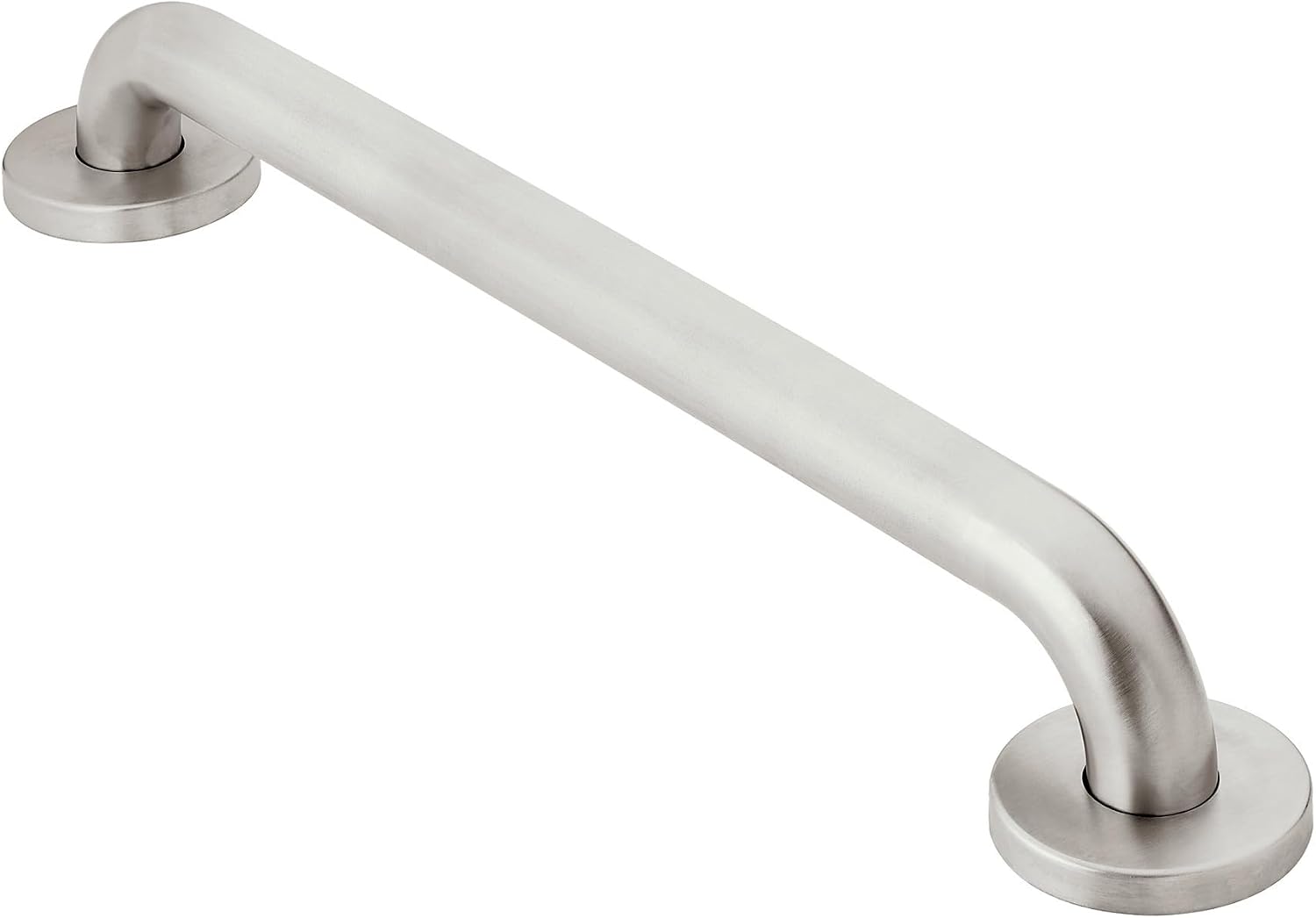
This 18-inch Moen Home Care bar has a peened, slip-resistant surface intended to help provide grip and control. Its stainless steel construction and 1.5-inch diameter make it a different feel from the slimmer one-inch Ravinte and Gotega bars. The listing describes a polished brass finish, so check that finish detail against your bathroom hardware before ordering.
Moen states that the bar supports up to 500 pounds when installed in a stud or with SecureMounts, which are sold separately. It is listed as ADA compliant and has a limited lifetime warranty. The bar comes with installation instructions and mounting hardware, but the appropriate installation method still depends on your wall.
At 18 inches, it can suit a tighter space than the 24-inch Moen bar while still providing a fixed handhold. Its larger diameter may feel more comfortable for some hands and less so for others, so consider the user’s grip before choosing. This is a single bar rather than a two-pack.
Pros:
- Peened surface is designed for a slip-resistant grip.
- 18-inch size fits spaces where a longer bar may not.
- Listed as ADA compliant, with a limited lifetime warranty.
- Stainless steel construction.
Cons:
- SecureMounts are sold separately when using that mounting option.
- The 1.5-inch diameter may not suit every person’s grip.
Verdict: Consider this Moen if you want one fixed, textured bar in a compact length and its larger diameter and brass finish suit your needs.
Gotega 16-Inch Grab Bars: Two Knurled Bars for Multiple Locations

Gotega’s set includes two 16-inch stainless steel bars with a knurled surface and concealed-screw design. The textured finish is intended to make the bars easier to hold with wet hands, and the two-bar format lets you plan separate support points around a bathroom or elsewhere in the home.
The listing states a capacity of up to 500 pounds of pulling force. Treat that as a manufacturer claim that depends on secure installation—not as a guarantee for every wall or mounting setup. The concealed-screw design gives the bars a cleaner appearance, but you will need to make sure the mounting method suits the wall and follow the provided instructions.
Compared with the Moen options, Gotega offers two shorter bars rather than one longer bar. That can be useful if you need handholds in more than one spot, but it is less convenient if you want a single continuous grip along a longer wall. The product listing does not identify a brand-backed lifetime warranty like the Moen options do.
Pros:
- Two bars provide flexibility for different locations.
- Knurled surface is designed to improve grip when wet.
- Stainless steel construction with concealed screws.
- Can be considered for locations beyond the shower when installed appropriately.
Cons:
- Each bar is only 16 inches long.
- Safe support depends on correct mounting in a suitable wall.
Verdict: Pick this set if two textured, fixed bars are more useful to you than one longer bar, and have the mounting plan checked before relying on them for support.
TAILI Suction Handles: Removable Aids for Compatible Surfaces

Unlike the wall-mounted bars above, these 16.8-inch TAILI handles use suction cups and locking latches. They are removable and reusable, so they can be repositioned without drilling. The top has an anti-slip strip, and the underside has a curved shape for fingers.
Surface compatibility is critical. The manufacturer says these handles work only on smooth, nonporous, airtight surfaces such as suitable glass, tile, marble, stainless steel, or acrylic. They are not for uneven tile, drywall, painted walls, wallpaper, or porous surfaces. The listing states a limit of up to 240 pounds per handle and specifically warns not to put all body weight on them.
That warning makes these a poor choice as the main safety support for someone who needs to pull their full weight up or steady themselves during a fall. They may suit a person seeking a removable aid for light balance support on a compatible surface, but suction can depend on the surface and installation. Check the hold as directed before each use, and choose a permanently mounted bar for dependable weight-bearing support.
Pros:
- Removable and reusable without drilling into the wall.
- Two handles are included.
- Locking latches and grip details are part of the design.
- Can fit suitable smooth, nonporous surfaces.
Cons:
- Not suitable for many wall types, including drywall and uneven tile.
- The manufacturer warns against putting full body weight on the handles.
Verdict: Choose TAILI only as a removable balance aid for a compatible surface—not as a replacement for a securely installed, weight-bearing grab bar.
How to Choose a Bathroom Grab Bar
Decide Where the Handhold Is Needed
Think about the moments when support would help most: stepping over a tub edge, standing in the shower, or moving from sitting to standing. The best location depends on the person’s movement and bathroom layout. If you are unsure where a bar should go, ask an occupational therapist or another qualified professional to assess the space and the user’s needs.
Choose a Fixed Bar for Weight-Bearing Support
Wall-mounted bars are designed to be secured to the building structure or installed with a mounting system specified by the manufacturer. A bar’s stated weight capacity depends on how it is installed and what it is attached to. Suction-cup handles have surface limits and may not be intended for full body-weight support. Read the product’s warnings and do not treat suction as a substitute for secure structural mounting.
Check the Wall and Installation Method
Before buying, find out what is behind the intended mounting area and whether the bar’s installation method works there. Follow the manufacturer’s instructions for studs, anchors, or any compatible mounting system. Tile and other finished surfaces can make installation more involved, so a qualified installer can help avoid a loose bar or damage to the wall. Do not rely on a grab bar until it has been installed and checked properly.
Match the Length to the Space
A longer bar can provide a handhold across a wider area, while a shorter one may fit beside a tub or in a tighter location. Measure the available wall space and consider where the mounting points will land. A two-pack can add support in separate places, but each bar still needs an appropriate installation location.
Consider Diameter, Texture, and Finish
The person using the bar should be able to wrap their hand around it comfortably. These options range from a one-inch diameter to a 1.5-inch diameter, and their surfaces include knurled or peened textures. A textured surface may be easier to grip with wet hands, but the best size and feel are personal. Also check the finish so the bar coordinates with—or stands out clearly from—your bathroom fixtures.
Read Capacity Claims and Warnings Carefully
Compare the stated capacity with the exact installation conditions in the product information. A capacity claim does not mean a bar is safe when attached to an unsuitable surface or mounted incorrectly. Pay special attention to warnings: the TAILI handles, for example, are described as supporting up to 240 pounds per handle, but the manufacturer says not to put all body weight on them.
Frequently Asked Questions
Are suction grab bars safe for seniors?
They may help with light balance support when installed on a surface the manufacturer approves, but suction handles are not the right choice for every person or wall. Follow the product’s limits and warnings. If the user needs to pull up or put full body weight on a bar, choose a securely installed fixed bar instead.
Where should a bathroom grab bar be installed?
The right location depends on the person’s needs and the bathroom layout. Common areas to assess include the shower or tub area and places where the user changes position. A qualified professional can help determine placement that supports the person’s usual movements.
Can I install a grab bar on tile?
Some bars can be installed on a tiled wall, but the correct method depends on the bar, the wall behind the tile, and the manufacturer’s instructions. Do not assume that the tile alone provides secure support. If you are unsure how to mount through tile, hire a qualified installer.
How long should a shower grab bar be?
Choose a length that fits the planned location and gives the user a useful handhold. These options range from 16 to 24 inches, with other lengths listed for the Ravinte bar. Measure the space and confirm the mounting points before ordering.
Do textured grab bars help with wet hands?
Textured surfaces are designed to provide extra grip, and several bars here use knurled or peened finishes. Texture may help, but it cannot replace a secure installation or a comfortable fit. The user should be able to hold the bar firmly.
Do bathroom grab bars need to be installed by a professional?
Not every installation requires a professional, but the bar must be mounted using a method suitable for the wall and the product. If you cannot identify the structure behind the wall, are working through tile, or have any doubt about the installation, ask a qualified installer.
Final Recommendation
For a fixed, everyday support bar, the Moen Home Care 24-inch model is a practical choice if its longer size fits and you can use the specified mounting method. Choose the Moen 18-inch peened bar when you want a shorter textured option, or consider the Ravinte and Gotega two-packs if you need bars in separate locations. The TAILI suction handles are best reserved for compatible surfaces and light balance support—not full body-weight assistance. Above all, select a bar that suits the user and have it installed securely before relying on it.






