A borescope can help you inspect a drain, duct, wall cavity, or engine area without opening up more than necessary. The right camera depends on where you need to look: a long push cable suits pipes, while a slim or articulating probe can be easier to guide through tight turns. The five options below range from simple handheld scopes to a long-reach sewer inspection system, with important differences in maneuverability, recording, and probe length.
Use the comparison table to narrow down your choices, then consider the buying guide before choosing a camera for your plumbing or HVAC work.
| Camera | Best suited for | Probe or cable | Standout feature |
|---|---|---|---|
| TGJOR Dual-Lens Inspection Borescope | General plumbing and HVAC checks | 16.4 ft | Front and side views; standalone screen |
| Teslong Articulating Borescope | Tight spaces and directional viewing | 5 ft | Two-way articulating probe |
| Teslong 5-Inch Dual-Lens Borescope | Wall cavities, ducts, and drains | 16.5 ft | Dual cameras and a large built-in screen |
| Hialemi 3.9 mm 4-Way Articulating Borescope | Narrow openings and complex routes | 3.94 ft | Very slim probe with four-way articulation |
| Sanyipace 230 ft Sewer Inspection Camera | Long sewer and drain inspections | 230 ft | Self-leveling camera and 512 Hz transmitter |
Table of Contents
Our Picks: Best Borescope Inspection Cameras For Plumbing And Hvac reviews
1. TGJOR Dual-Lens Borescope: A Long-Reach Handheld Pick
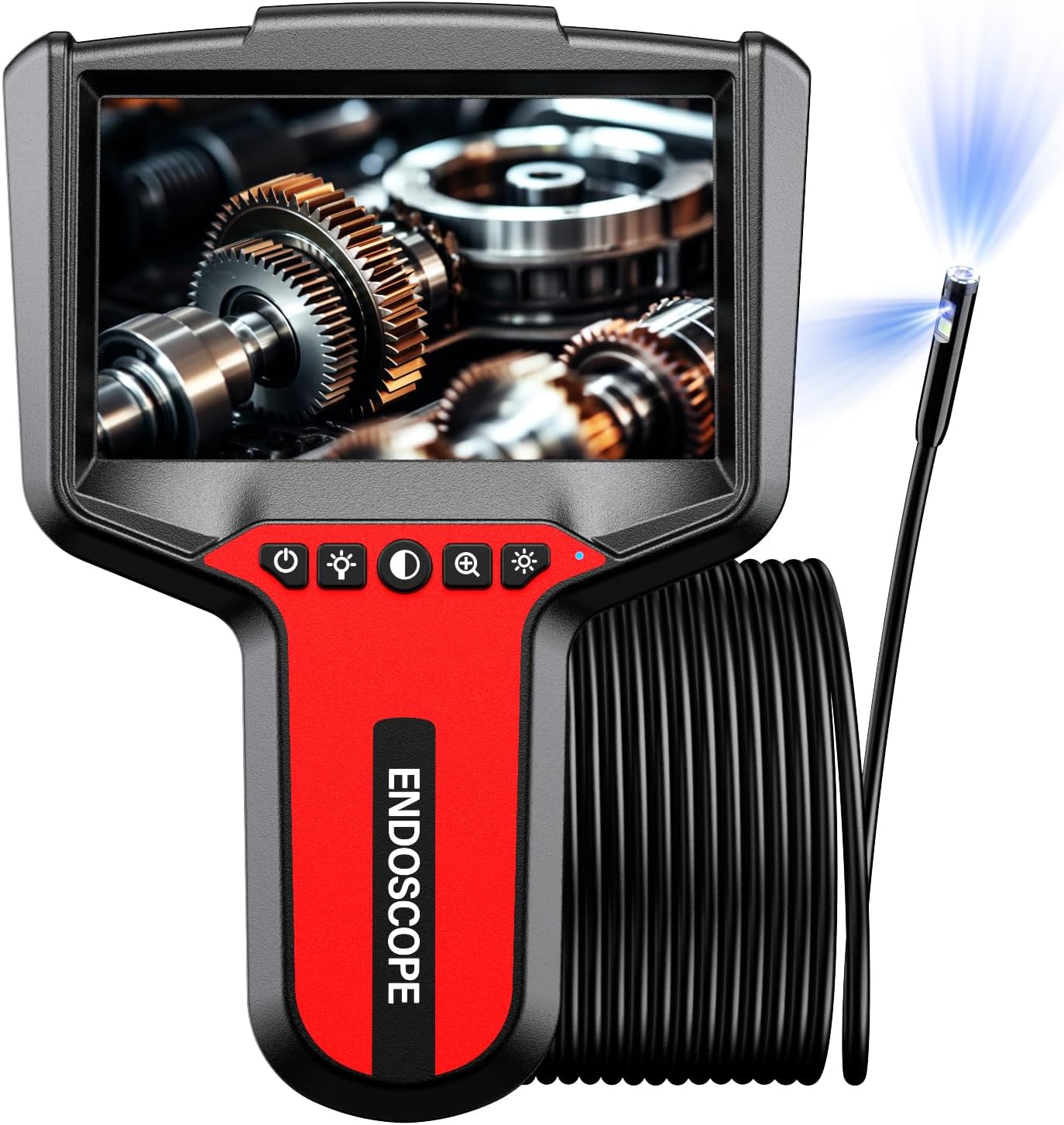
This TGJOR scope pairs a 5-inch screen with a 16.4-foot semi-rigid probe. Its dual-lens design lets you switch between a forward-facing view and a side view, which can help when you need to look along a pipe wall or inspect an area that is not directly in front of the camera. The self-contained screen also means you do not need a phone, app, or Wi-Fi connection to use it.
The probe has eight adjustable LEDs and an IP67 waterproof rating, making it suited to damp inspection work. The stated focus range is 1.2 to 4 inches, so it is intended for close-up viewing rather than broad, distant scenes. Its 2,000mAh battery is listed for three to four hours of runtime.
A key limitation is easy to miss: the supplied product details state that this model cannot take photos or videos. That makes it less useful if you need to document a defect for a client or save images for later comparison. Its dual views and longer probe still make it a practical option for visual checks where seeing the area live is enough.
Pros:
- Long semi-rigid probe for reaching into pipes, ducts, and cavities
- Switchable front and side camera views
- Built-in screen requires no app or wireless connection
- Waterproof probe and adjustable LED lighting
Cons:
- Does not capture photos or videos
- Close focus range may not suit inspections that need a wider view
Verdict: Choose this TGJOR if you want a straightforward, long-reach scope for live plumbing or HVAC inspections and do not need saved images or video.
2. Teslong Articulating Borescope: Better Control in Tight Spaces

This Teslong model is designed for steering the camera head around obstacles rather than pushing a probe far down a long pipe. Its two-way articulation is controlled with a joystick, giving you more control over the viewing direction than a fixed-head camera. The 5-foot semi-rigid gooseneck holds its shape as you guide it, which can be helpful when inspecting a wall cavity, HVAC area, or cramped mechanical space.
A 4.5-inch IPS screen provides a direct view without requiring an app. Built-in adjustable LEDs light the inspection area, and the product information lists 1080p video capture with Micro SD card media. A conveniently placed photo button supports capturing images or video during an inspection.
The shorter probe is the main trade-off. It can be a good match for nearby components and tight turns, but it is not a substitute for a long sewer push camera. Some users also find the menu and controls easy to work with, which can matter when you are trying to guide the probe one-handed.
Pros:
- Two-way articulation helps aim the camera around obstructions
- Semi-rigid 5-foot cable can hold a guided shape
- Built-in screen and adjustable probe lighting
- Photo and video capture are listed in the product information
Cons:
- Shorter reach than the long-cable options in this list
- Articulation adds control but does not make it a long-range sewer camera
Verdict: Pick this Teslong for nearby inspections where directing the camera head matters more than reaching deep into a long pipe.
3. Teslong Dual-Lens Borescope: A Versatile Choice for Walls and Ducts

This Teslong combines a 16.5-foot semi-rigid cable with forward and side camera views. You can switch views to inspect the path ahead or look across a pipe, duct, or wall cavity. The 5-inch display is built into the unit, so setup does not depend on a compatible phone or wireless connection.
The probe has six front LEDs and one side LED, with brightness control to help manage dark spaces and reflective surfaces. The camera probe is listed as IP67 waterproof, and the rechargeable 5,000mAh battery is rated for approximately four and a half hours of continuous use. A hard carrying case and accessories, including a hook, magnet, and mirror, are listed as included.
This model is a useful middle ground between basic fixed-view scopes and shorter articulating cameras. The cable is long enough for many household inspections, but it is not designed to travel hundreds of feet through a sewer line. Product details list 720p video capture, so do not assume that the 1080p wording in the title means that saved footage is recorded at that resolution.
Some owners find a dual-camera setup useful for reaching around obstructions or viewing an area without removing parts. It can also help with wall and ceiling cavities, where saved images or video may be useful for documenting what you find.
Pros:
- Two camera views with separate LEDs
- Long semi-rigid cable for home, duct, and engine-bay checks
- Large built-in 5-inch screen with no app required
- Includes a carrying case and inspection accessories
Cons:
- Saved video is listed as 720p in the product details
- Not as easy to steer precisely as an articulating-head scope
Verdict: This Teslong is a strong all-around choice if you need a longer probe, dual views, and the option to save inspection footage.
4. Hialemi 3.9 mm Borescope: A Slim Probe with Four-Way Steering

The Hialemi is built around access and control. Its 3.9 mm probe is slimmer than the 8 mm probes described for some other models here, and a four-way joystick lets you steer the camera head. That combination can help when you need to look through a narrow opening or change viewing direction inside a complicated space.
The product has a 5-inch IPS display and is listed as capable of capturing photos and video. Its stainless steel flexible cable is 3.94 feet long, making this a short-reach inspection tool rather than a camera for tracing a long drain run. The probe has adjustable LEDs and an IP67 waterproof rating. The product description also says the device can alert you if the environment exceeds its stated safe temperature range, though it does not provide a specific temperature limit in the supplied details.
Compared with the longer dual-lens scopes, this model trades reach for a narrow probe and active steering. Those features may be valuable for HVAC components, tight mechanical spaces, and plumbing access points, but they do not eliminate the need to create an appropriate access opening. Keep the camera’s heat warning in mind around warm equipment, and follow the manufacturer’s instructions for safe use.
Pros:
- Slim 3.9 mm probe for narrow access points
- Four-way articulation offers fine control of the camera direction
- Built-in screen and listed photo and video capture
- Waterproof probe with adjustable camera lighting
Cons:
- Short cable limits reach compared with long plumbing scopes
- Requires more careful steering than a basic fixed-view camera
Verdict: Choose the Hialemi when a slim, steerable probe is more important than cable length, especially for confined HVAC or mechanical inspections.
5. Sanyipace 230 ft Sewer Camera: A Long-Reach System for Drain Lines

This Sanyipace is a dedicated sewer inspection system rather than a small handheld borescope. Its 230-foot cable is designed for long pipe runs, and the 9-inch IPS screen provides a larger viewing area than the compact displays on the other picks. A self-leveling camera keeps the image upright as the probe moves through the pipe, while the IP68 camera head is designed for wet inspection conditions.
The camera has 24 adjustable lights and a 145-degree viewing angle. The system includes a 512 Hz transmitter for helping locate the camera head, but a compatible locator is sold separately. It also comes with a 16GB TF card, supports cards up to 128GB, and is listed with a 4,500mAh battery rated for up to 10 hours of use. Audio notes and playback are also part of the listed console features.
This is the most specialized option in the group. The long cable, reel-style design, and locating capability make it better suited to plumbing contractors, inspectors, or property owners facing recurring drain problems than to someone who only needs to check a short HVAC duct or wall cavity. It can also be more equipment than you need for routine close-range diagnostics.
Pros:
- 230-foot cable for long sewer and drain inspections
- Self-leveling camera helps keep footage upright
- 512 Hz transmitter can assist with locating the camera head
- Large 9-inch screen, included memory card, and long listed battery runtime
Cons:
- A compatible locator for the transmitter is sold separately
- Its long-reach system is less practical for simple close-up inspections
Verdict: Choose the Sanyipace for long sewer lines and professional-style drain inspections; for a short duct or wall check, a handheld scope is more suitable.
How to Choose a Borescope for Plumbing and HVAC
Match the probe length to the inspection
Think about how far the camera needs to travel, not just the longest probe available. A 5-foot scope can be easier to handle around an appliance or inside a nearby wall cavity. A cable around 16 feet can reach farther into a duct or drain. For long underground runs, a dedicated reel system such as the 230-foot Sanyipace is designed for a different job than a handheld camera. Extra length can add bulk and may be harder to guide in a cramped space.
Consider probe diameter and articulation
A slimmer probe can fit through smaller access points, but the opening still needs to be large enough for the camera and cable to pass through safely. Articulation is useful when you need to aim around a bend or inspect a particular surface. A dual-lens scope gives you alternate forward and side views, while an articulating head lets you steer the camera. These features solve different problems, so choose based on the route and the view you need.
Check whether you need photos or video
Live viewing may be enough to check for a blockage or see whether a space is clear. If you need to show a finding to a client, compare conditions later, or keep a record, look for explicit photo and video capture details. Do not rely on a general resolution claim alone: the supplied information for the Teslong dual-lens model lists 720p video capture, and the TGJOR listing says it cannot take photos or videos.
Look at screen and control design
A built-in screen avoids app setup and lets you view the camera feed directly. Larger screens can be more comfortable for longer inspections, while a compact unit may be easier to carry into a tight work area. If you expect to steer the camera while holding the display, consider whether joystick controls and buttons are easy to reach with one hand.
Check lighting and focus
Pipe interiors and HVAC cavities can be very dark, so adjustable LEDs are useful. More light is not always better: shiny surfaces can reflect it back into the camera and make details harder to see. A camera’s focus range also matters. A scope made for close-up viewing may not provide a useful image when the target is farther away, so check the listed focus information when available.
Use the correct water-resistance rating
Water resistance is important for plumbing work, but ratings are not interchangeable. The handheld options here list IP67 probes, while the Sanyipace camera is listed as IP68. Check the product instructions for the limits of use, and do not assume that a water-resistant probe makes the screen or control unit safe to submerge.
Think about cable handling, power, and accessories
A semi-rigid cable can hold a shape as you guide it, but it still takes practice to push it through turns without forcing it. For repeated long drain inspections, a reel system and cable management features may be more practical. Compare stated battery runtimes, charging needs, and included storage. Also check whether accessories that matter to your work, such as a locator, memory card, or retrieval tool, are included or sold separately.
FAQs
What type of borescope is best for plumbing?
For short, close-range checks, a handheld scope with a semi-rigid probe can be convenient. For a long underground drain or sewer run, a dedicated pipe camera with a long cable, self-leveling view, and locating transmitter is more suitable. Choose based on the length and shape of the pipe you need to inspect.
Can these cameras inspect HVAC ducts?
Several of these models are described for HVAC or duct inspections. A long semi-rigid cable can help reach into a duct, while a slim or articulating probe may be better when access is narrow or the camera needs to turn toward a specific area. Confirm the probe dimensions and access opening before use.
Do I need an articulating camera head?
Not for every inspection. A fixed camera or dual-lens model can be enough when you mainly need to see straight ahead or switch to a side view. Articulation is useful when you need to steer the camera around an obstruction or aim it at a specific surface.
Can a borescope record video?
Some can, but features vary by model. The Teslong articulating and Hialemi product information lists photo or video capture, and the Teslong dual-lens details list video capture. The TGJOR listing specifically says it cannot take photos or videos. Check the exact product details before buying if recording is essential.
What does IP67 or IP68 mean for a camera probe?
These ratings indicate levels of protection against dust and water, but they do not mean every part of the device can be submerged or exposed to water in any situation. Follow the manufacturer’s instructions for the specific probe and keep the screen, controls, and charging connections dry unless the product information says otherwise.
Is a very long sewer camera useful for HVAC work?
Usually, a long sewer reel is more equipment than you need for a typical duct or wall-cavity check. A handheld scope is generally easier to carry and position for close-range HVAC work. A long-reach system makes more sense when your main task is inspecting extended drain or sewer lines.
Conclusion
For a versatile household scope with a long probe and two viewing angles, the Teslong dual-lens model is a balanced choice, provided its listed 720p video capture meets your needs. The Teslong articulating model is better for nearby obstacles, while the Hialemi stands out for narrow openings and four-way steering. If you only need live viewing, the TGJOR offers a straightforward setup but cannot save images or video. For long sewer runs, the Sanyipace is the purpose-built option, with the important note that its compatible 512 Hz locator is separate.