For a large family, an electric tankless water heater needs to do more than provide hot water on demand: it must deliver enough flow at your home’s incoming water temperature while several people use hot water. Of these five options, the Rheem RTEX-24 is the strongest whole-home candidate, but its high electrical demand and your local groundwater temperature matter. The smaller units are better suited to one fixture or a smaller household, and the VEVOR is a fuel-powered RV heater—not an electric home water heater.
Use the comparison below as a starting point, then check the electrical requirements and likely hot-water demand for your home before choosing. Maximum flow figures are not a promise of that flow at every temperature; the colder your incoming water, the more the heater has to raise its temperature, which can reduce usable flow.
| Product | Listed capacity | Best suited for | Large-family fit |
|---|---|---|---|
| VEVOR RV Tankless Water Heater | 42,000 BTU; fuel-powered | RV use and outdoor washing | Not an electric whole-home option |
| 110V 3,000W Under-Sink Heater | 3,000W; up to 0.5 GPM listed | One low-flow point of use | Not suitable for a shower |
| Rheem RTEX-24 | 24 kW; up to 5.9 GPM listed | Potential whole-home use | Best candidate here, if sized and wired correctly |
| NOVIEEX 18kW Tankless Heater | 18 kW; up to 4.9 GPM listed | Small-to-medium homes | May be limiting for a large household |
| Ranein 8kW Tankless Heater | 8 kW; up to 1.9 GPM listed | One or two low-demand fixtures | Too small for typical whole-home family use |
Table of Contents
Our Picks: Best Electric Tankless Water Heater For Large Family reviews
1. Rheem RTEX-24: Best Whole-Home Candidate for a Large Family

The Rheem RTEX-24 is the most capable match in this group for a family looking for an electric whole-home heater. It is a 24 kW, 240-volt unit with a listed maximum flow of up to 5.9 GPM. Its digital temperature control adjusts in one-degree steps from 80°F to 140°F, and its compact wall-mounted design does not need venting.
That listed flow rate needs context. Actual output depends on the temperature rise required and how many fixtures are running. A home with cold incoming water may get less usable flow than a home with warmer groundwater. For a household with several showers, laundry, or dishwashing happening at once, have the expected demand checked against local inlet-water temperatures before buying.
The electrical requirements are substantial: the product information calls for three 40-amp double-pole breakers, three sets of #8 AWG copper conductors with ground, and a recommended minimum 200-amp household service panel. A qualified electrician should confirm that your panel and wiring can support it. Owners have noted the benefit of continuous hot water for a busy household, while others point out that colder groundwater can limit performance. As with any electric tankless heater, it also stops heating during a power outage.
Pros:
- Highest listed flow rate among the electric home models here
- Temperature control adjusts in one-degree increments
- Compact design with no venting required
- Can provide continuous hot water when properly sized and installed
Cons:
- Requires substantial electrical capacity and professional installation
- Cold incoming water can reduce the flow available for simultaneous use
Verdict: Choose the Rheem RTEX-24 if you want the strongest whole-home option in this lineup and an electrician confirms your home can support it.
2. NOVIEEX 18kW: A Mid-Range Choice for Lower Household Demand

The NOVIEEX is an 18 kW, 240-volt electric heater described for small-to-medium homes, condos, and apartments. It lists a maximum flow of 4.9 GPM and supports a set temperature from 77°F to 140°F in one-degree steps. The slim wall-mounted unit has 3/4-inch NPT water connections.
The manufacturer describes it as able to serve two or three simultaneous water needs. That may suit a household with modest overlapping use, but a larger family with multiple showers and appliances running together should be careful not to treat the maximum flow as guaranteed. As with the Rheem, the real-world flow depends on incoming water temperature and the temperature rise needed. The stated electrical requirements are two 40-amp double-pole breakers and two sets of 8 AWG wires with ground; confirm compatibility with a qualified electrician before purchase.
Compared with the Rheem, the NOVIEEX has a lower listed maximum flow and is positioned for smaller homes. It could be a practical space-saving option where demand is limited, but the available product information does not include owner-use details that would help judge long-term performance.
Pros:
- Higher listed flow than the smaller point-of-use models
- Temperature adjusts in one-degree steps
- Slim wall-mounted design
- Provides a stated option for multiple fixtures in a smaller home
Cons:
- Listed for small-to-medium homes, not specifically large households
- Requires a dedicated, high-capacity 240-volt electrical setup
Verdict: Consider the NOVIEEX if your household’s simultaneous hot-water demand is moderate and its electrical requirements fit your home; for a large family, compare its capacity carefully with the Rheem.
3. Ranein 8kW: Compact Heater for a Single Hot-Water Zone

The Ranein is a small 8 kW, 240-volt heater with a listed flow of up to 1.9 GPM. It has knob controls, an LED display, and a temperature range of 86°F to 131°F. Its compact size may make it useful where you need hot water at a particular sink or a limited number of low-demand fixtures.
Ranein describes the unit as suitable for one or two usage points, but its modest power and flow make it a poor fit as the sole heater for a large family. It is not comparable to the 24 kW Rheem or 18 kW NOVIEEX for whole-home demand. The listed electrical requirement is a 240-volt supply with a 40-amp breaker. Owners have appreciated the compact footprint and uninterrupted hot water for their needs, though some have experienced breaker-tripping issues. Correct installation and a suitable circuit are essential.
Pros:
- Compact design for a point-of-use installation
- LED temperature display and simple knob controls
- Temperature adjustment in one-degree increments
- Can provide on-demand hot water for limited use
Cons:
- Listed flow is too low for typical large-family whole-home demand
- Some owners report electrical interruptions, so installation and troubleshooting support matter
Verdict: Pick the Ranein for a small, targeted hot-water need—not as the main electric tankless heater for a large family.
4. 110V 3,000W Heater: An Under-Sink Option, Not a Family Shower Heater
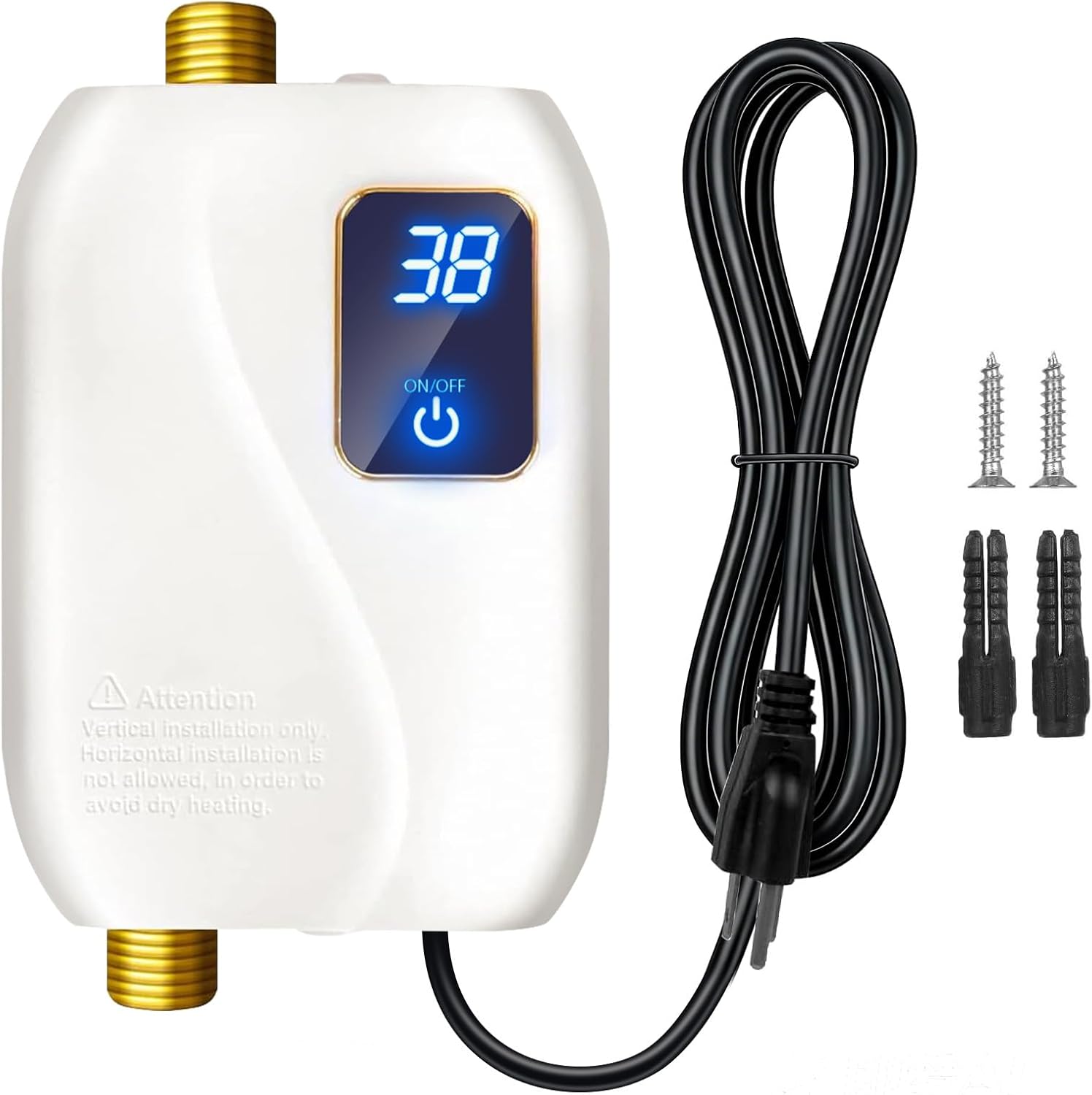
This 3,000-watt, 110-volt unit is a compact point-of-use heater intended for places such as a kitchen sink, bathroom sink, or small space. It has an LED display and listed safety features that include leakage protection, dry-boil protection, overheating shutoff, and an IPX4 waterproof rating. The supplied specifications list a temperature rise of 82°F at 0.3 GPM and 131°F at 0.5 GPM.
The product information specifically says it is not suitable for showers, which typically require at least 1.8 GPM. That makes it a poor choice for a large family’s main hot-water supply, even if the low-voltage installation and small size seem convenient. It is intended for vertical installation only. Some users value its compact under-sink format, while others have reported that the hot-water output did not meet their needs, so it is best treated as a limited-use fixture heater.
Pros:
- Compact wall-mounted design for a sink or small space
- Uses a 110-volt supply
- LED temperature display and multiple listed safety protections
- No tank to preheat for a suitable low-flow task
Cons:
- Not designed for showers or large-family whole-home use
- Must be installed vertically
Verdict: Choose this unit only for a small point-of-use job, such as handwashing, and rule it out if you need to supply family showers.
5. VEVOR RV Heater: A Fuel-Powered Option for RVs, Not an Electric Home Unit

The VEVOR is an RV tankless water heater that produces heat using fuel; it is not an electric tankless water heater for a home. Its listed heat output is 42,000 BTU, and it includes a 15-by-15-inch black access door, a remote controller, and an outdoor water outlet. The listed flow rate is 2.8 liters per minute, and its maximum temperature is 123°F.
Its design is intended for RV installation, with specified water and gas connections and an exhaust pipe. The additional exterior outlet may be useful for washing pets or gear at a campsite. Some owners have found setup straightforward and appreciate hot water without waiting for a tank to heat, while another reported difficulty getting the unit to operate. For a home shopping specifically for electric whole-home capacity, the fuel source and RV fit make this the wrong category.
Pros:
- Designed for RV use with a matching access door
- Includes a remote controller and LED touch controls
- Has an exterior outlet for outdoor washing
- Offers listed protections such as anti-freeze and flame-out protection
Cons:
- Fuel-powered, not an electric home water heater
- RV-specific connections and installation requirements limit its use in a house
Verdict: Consider the VEVOR only if you need an RV water heater; it does not meet the target need for an electric heater for a large family’s home.
How to Choose an Electric Tankless Water Heater for a Large Family
Estimate how many fixtures may run at once
Think about your household’s busiest moments, not just average use. A shower running while someone washes dishes or uses the laundry can create more demand than one fixture at a time. Make a realistic list of the hot-water fixtures you expect to use together. Then compare that demand with the unit’s rated flow, keeping in mind that the maximum listed GPM may not be available at the temperature rise your home needs.
Account for incoming water temperature
Electric tankless heaters have to raise cold incoming water to your chosen output temperature. A larger temperature rise can mean less flow from the heater. This is why location matters: a heater that keeps up in an area with warmer groundwater may struggle to supply the same number of fixtures in a colder area. Check local inlet-water conditions and the manufacturer’s sizing information before relying on a maximum-flow number.
Confirm your electrical service and wiring
High-output electric tankless heaters can require several dedicated breakers, heavy-gauge wiring, and enough capacity in your electrical service panel. For example, the Rheem RTEX-24 lists three 40-amp double-pole breakers and a recommended minimum 200-amp household service panel. The NOVIEEX 18 kW lists two 40-amp double-pole breakers. Ask a qualified electrician to check your panel, wiring, and installation plan before you buy. Do not assume a standard outlet can power a whole-home model.
Choose whole-home power or point-of-use convenience
A point-of-use heater can be useful when you want hot water at one sink or another limited-use location. It is not the same as a whole-home heater. The 3,000-watt 110-volt model is specifically not suitable for showers, and the Ranein 8 kW is listed for one or two usage points. For a large family, focus first on models designed for broader household demand, such as the Rheem or NOVIEEX, and verify whether their capacity fits your home.
Check installation details and water connections
Compare the heater’s voltage, breaker requirements, wire size, and water connection size with your home’s setup. Also check the required mounting position and location. The 110-volt model must be installed vertically, while the VEVOR has RV-specific gas, water, and exhaust requirements. A product may look compact and simple, but the electrical and plumbing work can still call for professional installation.
Consider what happens during a power outage
Electric tankless heaters rely on electricity to heat water, so a power outage means no hot water from the unit while power is off. A tank-style heater may hold some stored hot water, but a tankless unit does not provide that same reserve. Consider how important stored hot water is to your household when comparing heater types.
Read the product category and intended use carefully
Not every item marketed as tankless is intended for a family home, and not every tankless heater is electric. The VEVOR in this list is a fuel-powered RV model. The smaller 110-volt and 8 kW units are better understood as limited-use options. Confirm that the product is meant for the setting and demand you have before comparing features or dimensions.
Frequently Asked Questions
Which option in this list is the best fit for a large family?
The Rheem RTEX-24 is the strongest whole-home candidate in this group based on its listed 24 kW power and flow of up to 5.9 GPM. Whether it can serve your family depends on your incoming water temperature, simultaneous fixture use, and electrical service.
Can an electric tankless heater run several showers at once?
It depends on the heater’s output, the temperature rise required, and the flow rate of each shower. Check the manufacturer’s sizing guidance and have your expected demand assessed rather than assuming the maximum listed GPM will cover several showers.
Is the 110-volt model suitable for a shower?
No. Its supplied product information says it is not suitable for showers and notes a typical shower needs at least 1.8 GPM. It is better suited to a low-flow point-of-use task.
Does a tankless heater provide unlimited hot water?
A properly sized tankless heater can keep heating water while it is flowing, but it has a limit on how much water it can heat at once. If demand exceeds its capacity, flow or delivered temperature may fall. “Continuous” hot water does not mean unlimited simultaneous flow.
Will the Rheem RTEX-24 work in a home with a 100-amp electrical panel?
The product information recommends a minimum 200-amp household service panel and lists three 40-amp double-pole breakers. A 100-amp panel should not be assumed to support it. Have a qualified electrician assess your service and installation needs.
Is the VEVOR an electric tankless water heater?
No. It is a fuel-powered RV water heater with gas and exhaust connections. It is not a match for someone seeking an electric whole-home unit.
Do electric tankless water heaters need venting?
The Rheem RTEX-24 product information says it does not require venting. Requirements differ by product type, and the VEVOR RV model has an exhaust pipe requirement. Always follow the installation instructions for the specific unit.
Conclusion
For a large family choosing from these five products, the Rheem RTEX-24 is the most plausible whole-home electric option, provided your electrical system can support it and its capacity matches your local water temperature and peak demand. The NOVIEEX 18 kW is a possible alternative for a smaller household or more moderate simultaneous use. The Ranein and 110-volt models are point-of-use choices, while the VEVOR is an RV unit that uses fuel. Before ordering a whole-home heater, confirm sizing and electrical requirements with a qualified professional.