Choosing the best electric tankless water heater for a mobile home starts with your electrical service, not just the heater’s size. A compact 110-volt unit may work for a sink, but it is not designed to run a shower. A larger whole-home model can supply more hot water, yet may need substantial electrical capacity that a mobile home does not have. The options below include two small point-of-use heaters, a whole-home tankless model, and a compact tank-style alternative so you can compare the trade-offs.
Important: Check your home’s electrical service, wiring, and available breaker space before choosing a heater. Have a qualified electrician confirm that the unit is compatible with your setup, and follow the manufacturer’s installation instructions.
Table of Contents
Quick Comparison
| Product | Type and power | Best fit | Key consideration |
|---|---|---|---|
| xwdzswgs 110V 3,000W Tankless Water Heater | Point-of-use, 110V | Handwashing or a small sink | Not intended for showers |
| GE Appliances 18-Gallon Electric Water Heater | Tank-style, 120V | A small home or a hot-water boost | Not a tankless heater |
| xwdzswgs 110V 3,000W Digital Tankless Heater | Point-of-use, 110V | Small sinks and limited hot-water needs | Not intended for showers |
| Rheem RTEX-24 24kW Tankless Water Heater | Whole-home tankless, 240V | Homes with suitable electrical service | Requires major electrical capacity |
| ThermoMate 4.5kW Under-Sink Tankless Heater | Point-of-use, 120V hardwired | A sink close to the heater | Needs a dedicated 40A double-pole breaker |
Our Picks: Best Electric Tankless Water Heater For Mobile Home reviews
1. xwdzswgs 110V 3,000W: A Compact Pick for One Sink
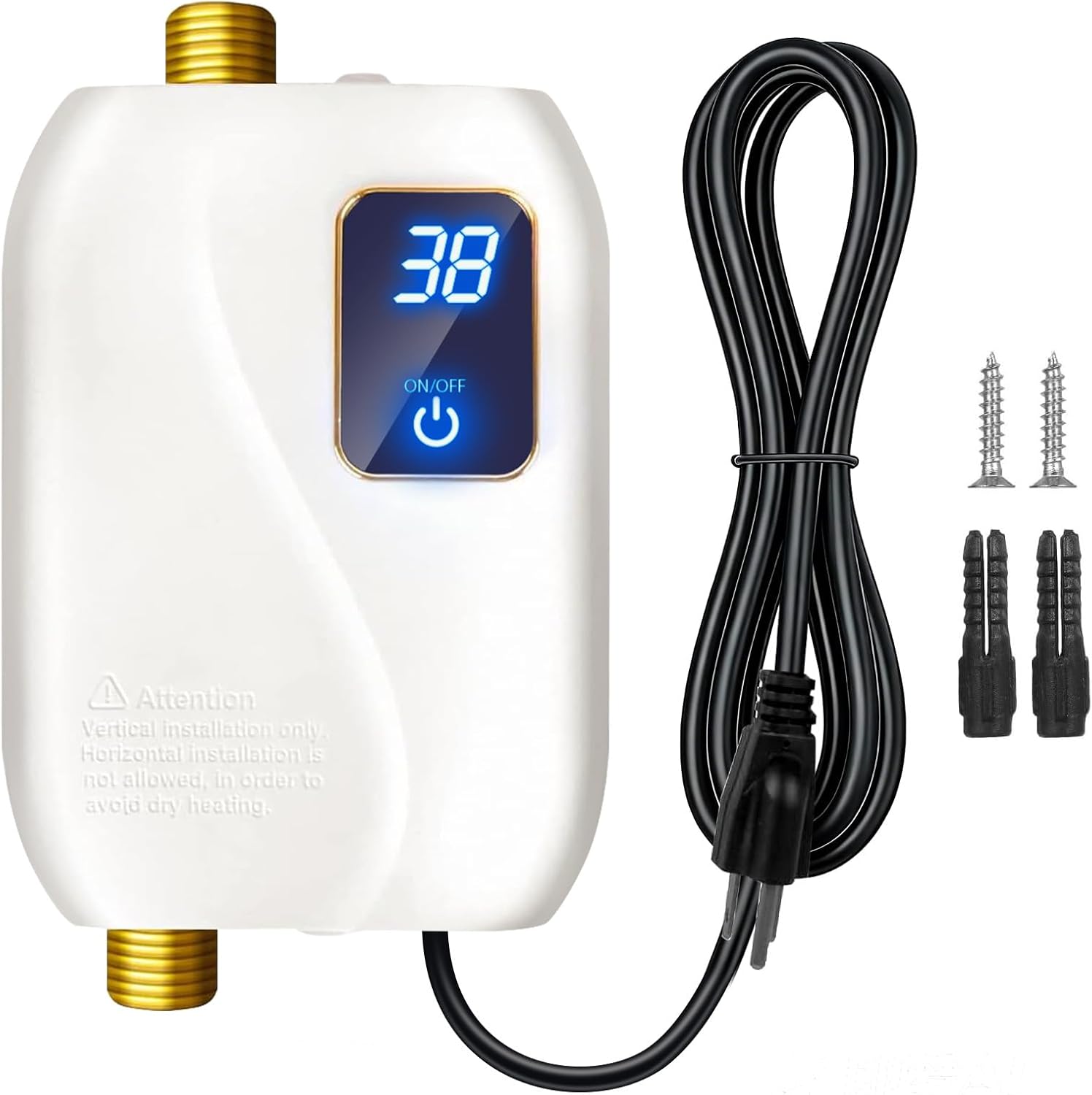
This small 110-volt heater is designed for point-of-use hot water, such as at a bathroom or kitchen sink. Its 3,000-watt heating system and digital display offer a simple way to get hot water close to the faucet without keeping a storage tank warm.
The product details estimate a temperature increase of 82°F at 0.3 gallons per minute and 131°F at 0.5 gallons per minute. Those figures show the main limitation: as water flow increases, the temperature rise falls. The manufacturer says the unit is not suitable for showers, which normally need at least 1.8 gallons per minute.
For a mobile home, its small size and 110-volt supply may be easier to consider than a high-power whole-home heater, but you still need to verify the circuit requirements and installation conditions. It must be installed vertically. This is a targeted sink solution, not a way to replace a full-size water heater for multiple fixtures.
Pros:
- Compact wall-mounted design for tight spaces
- Digital display with Fahrenheit and Celsius settings
- Designed to provide hot water on demand at a point of use
- Includes listed protection features such as dry-boil and overheating protection
Cons:
- Not designed for shower flow or whole-home use
- Must be installed vertically, and wiring needs should be checked before purchase
Verdict: Choose this model only if you need modest hot-water flow at a single sink and have confirmed that its electrical and plumbing requirements fit your home.
2. GE Appliances 18-Gallon Heater: A Compact Tank Alternative

This GE model is an electric storage water heater, not a tankless unit. Its 18-gallon tank stores heated water, and its adjustable thermostat lets you set the desired temperature. The product is described as suitable for a single hookup or for a small house, condo, or apartment, and it can also work inline as a hot-water booster.
Its compact format may be useful when a mobile home needs a smaller storage heater or extra hot water near a long pipe run. The manufacturer lists 120-volt power and standard 3/4-inch NPT water connections. It weighs 54 pounds, so make sure the planned floor location can support it and that there is room for the unit and plumbing.
Unlike a tankless heater, this model has a finite supply of stored hot water and needs time to reheat after use. The product information describes a plug-and-play installation, but you should still confirm that the outlet, plumbing, location, and local requirements are suitable. It is included here as a practical alternative, not as a match for shoppers who specifically need tankless operation.
Pros:
- 18-gallon capacity for a small home or single hookup
- Can be used as a standalone heater or as a hot-water booster
- Adjustable thermostat and stainless-steel heating element
- Compact design for locations such as a laundry room, cabin, or RV
Cons:
- It is a tank-style heater, not tankless
- Stored hot water is limited and must be reheated after use
Verdict: Consider this GE model if you are open to a compact storage heater; skip it if instant, continuous tankless operation is essential.
3. xwdzswgs Digital 110V Heater: Another Sink-Side Option

This 3,000-watt, 110-volt model is also a point-of-use heater intended for a sink or similarly limited application. It has an LED display, standard 1/2-inch NPT connections, and safety features listed by the manufacturer, including leakage and dry-boil protection.
As with the other 3,000-watt option, the published temperature-rise figures depend on low flow: the description gives a rise of 82°F at 0.3 gallons per minute and 131°F at 0.5 gallons per minute. It is explicitly not intended for a shower. That makes it better suited to handwashing or similar short uses than to bathing or running several fixtures.
The manufacturer calls for vertical installation and cautions against horizontal mounting. Before buying, check the full installation instructions and have the electrical requirements confirmed. The product details provided do not establish that this heater can serve as the main hot-water system for a mobile home.
Pros:
- Small point-of-use design for limited spaces
- LED temperature display
- Standard 1/2-inch NPT connections
- Listed safety functions include overheating and dry-boil protection
Cons:
- Not suitable for shower flow or simultaneous fixture use
- Vertical installation is required; confirm circuit needs before installation
Verdict: This is a reasonable candidate for a single low-flow sink, but it is not a whole-home solution for a mobile home.
4. Rheem RTEX-24: A Whole-Home Model With High Electrical Demands

The Rheem RTEX-24 is the only clearly whole-home tankless option in this group. It runs on 240-volt power and has digital temperature controls adjustable in one-degree increments from 80°F to 140°F. Rheem lists a maximum flow rate of up to 5.9 gallons per minute, but actual performance depends on the incoming water temperature and how much water you need at once.
The electrical requirements are substantial: the product information calls for three 40-amp double-pole breakers, three sets of #8 AWG copper conductors with ground, and a recommended minimum 200-amp household electrical service panel. Those requirements can be a major hurdle in a mobile home. Do not assume your existing service can support it; ask a qualified electrician to assess the panel, wiring, and other electrical loads first.
The unit has a compact wall-mounted design and does not require venting. Owners’ reported experiences point to the importance of sizing the heater for local groundwater temperature: colder incoming water leaves less capacity for raising the temperature at a given flow. Some owners also value the continuous hot-water supply when the unit is properly sized, while the lack of stored hot water means an outage stops heating.
Pros:
- Whole-home tankless design with digital temperature control
- Compact wall-mounted unit with no venting requirement
- Can provide continuous hot water while power and water are available
- Adjusts temperature in one-degree increments
Cons:
- Electrical requirements may exceed what a mobile home can support
- Cold incoming water can reduce the hot-water flow available
Verdict: This is the strongest whole-home tankless candidate here, but buy it only after an electrician confirms that your mobile home can safely meet its demanding electrical requirements.
5. ThermoMate 4.5kW: A Hardwired Heater for a Nearby Sink

The ThermoMate is a compact, under-sink tankless heater for point-of-use hot water. Its 4.5kW heating system has a digital temperature display and touch controls, and the product information lists a temperature range of 85°F to 131°F. It is designed for a sink, not as a general replacement for a mobile home’s main water heater.
Although the listing describes it as 120-volt, it is not a simple plug-in appliance. The manufacturer specifies hardwiring, a 40-amp double-pole circuit breaker, a minimum 8 AWG wire size, and 1/2-inch NPT water connections. That electrical setup needs to be checked by a qualified professional before purchase. The listed maximum flow range is 0.26 to 1.0 gallons per minute, so it is not a good match for a standard shower.
Its small footprint can help when a sink is far from the main heater and you want hot water closer to the faucet. Owners’ reported use suggests that point-of-use heaters can be convenient for light sink tasks, but performance depends on flow and setup. Compared with the 3,000-watt models, this unit has more listed wattage, but it still has limited flow and a specific hardwired circuit requirement.
Pros:
- Compact size for installation near a sink
- Digital controls with one-degree temperature adjustment
- Self-modulating power is listed in the product details
- Designed for point-of-use hot water without a storage tank
Cons:
- Requires hardwiring and a 40-amp double-pole breaker
- Its flow range makes it unsuitable for a typical shower
Verdict: Pick the ThermoMate for a nearby sink if its hardwired electrical requirements are suitable; do not choose it to supply a mobile home’s entire hot-water system.
How to Choose an Electric Tankless Water Heater for a Mobile Home
Decide Whether You Need Point-of-Use or Whole-Home Hot Water
A point-of-use heater warms water for one nearby fixture, such as a sink. These smaller models can help when you need hot water at a low flow, but they are not substitutes for a whole-home unit. If you need hot water for showers, laundry, and more than one tap, look for a heater designed for that demand and confirm its real-world capacity for your incoming water temperature.
Check Your Electrical Service Before Comparing Wattage
Electric tankless heaters can draw a large amount of power while heating water. Compare the unit’s voltage, breaker requirements, wire size, and service-panel recommendations with your mobile home’s electrical system. A 240-volt whole-home heater may require multiple large circuits, while even a smaller point-of-use model can have dedicated wiring requirements. Have a qualified electrician verify compatibility before you buy.
Match Flow Rate to Your Fixtures
Flow rate tells you how much water the heater can supply while raising its temperature. A small heater may provide a strong temperature rise at a slow trickle but deliver cooler water as flow increases. Think about which fixtures may run at the same time, and do not rely on a maximum flow figure alone. Check the manufacturer’s stated flow and temperature-rise conditions.
Account for Incoming Water Temperature
The colder the water entering the heater, the more work the unit must do to reach your desired temperature. This can reduce the flow of hot water a tankless heater can provide, especially in colder climates. Consider the coldest typical conditions in your area, not just the warmest season, when judging whether a model can handle your needs.
Consider the Installation Location and Plumbing
Measure the available wall or floor space, and check the required mounting position, water connections, and access for servicing. Some small models must be installed vertically. A tank-style alternative also needs a suitable floor location and room for its connections. Follow the product instructions and local rules rather than assuming a compact heater is automatically easy to install.
Understand What Happens During a Power Outage
A tankless electric heater needs power to heat water, so it cannot keep supplying newly heated water during an outage. A tank model stores hot water, though its supply is limited and it will not reheat while power is off. Consider how important a reserve of hot water is for your household when comparing the two designs.
Confirm the Product Is Actually Tankless
Product listings can include different kinds of electric water heaters in similar searches. A tankless unit heats water as it flows through the heater; a storage unit keeps a supply of heated water in a tank. The GE model in this guide is a tank-style alternative, not a tankless heater. Check the product type carefully so it matches your needs.
Frequently Asked Questions
Can an electric tankless water heater run a mobile-home shower?
It depends on the heater’s capacity, the incoming water temperature, and your electrical service. The two 3,000-watt models listed here are explicitly not suitable for showers. The ThermoMate is also a point-of-use model with a listed maximum flow of 1.0 gallon per minute, so it is not intended for typical shower use.
Which option in this guide is designed for whole-home use?
The Rheem RTEX-24 is the whole-home tankless model in this selection. Its electrical requirements are substantial, including three 40-amp double-pole breakers and a recommended minimum 200-amp service panel. Have an electrician confirm that your mobile home can support it before considering installation.
Are the 110-volt models a good replacement for a mobile home’s main water heater?
Not based on the supplied product details. The 3,000-watt models are intended for low-flow, point-of-use needs and are not suitable for showers. Treat them as sink-side heaters rather than full-home replacements.
Is the GE 18-gallon model tankless?
No. It is a storage water heater with an 18-gallon tank. It may suit shoppers who want a compact tank-style heater or a hot-water booster, but it does not provide tankless operation.
Does a higher wattage guarantee more hot water?
No. Wattage is only one part of the picture. The heater’s flow rate, incoming water temperature, electrical supply, and the number of fixtures in use all affect performance. Compare the manufacturer’s flow and temperature-rise information for the conditions that matter in your home.
Can I install an electric tankless heater myself?
Installation needs vary by model, but electrical requirements can be significant. The ThermoMate calls for hardwiring and a 40-amp double-pole breaker, while the Rheem has multiple large-circuit requirements. Use the manufacturer’s instructions and have a qualified electrician or plumber handle work that requires professional skills or permits.
Final Recommendation
For a true whole-home electric tankless option, the Rheem RTEX-24 is the most relevant model in this group, but its electrical demands may make it unsuitable for many mobile homes. For a single sink, the xwdzswgs 110-volt models and the ThermoMate offer compact point-of-use designs, each with important flow and wiring limits. If you are open to a storage heater, the GE 18-gallon model is a separate alternative—not a tankless pick. Before choosing any model, confirm electrical capacity, fixture demand, and installation requirements for your specific home.