
Choosing the best electric tankless water heater for a tiny house means balancing hot-water demand with limited space and electrical capacity. A compact unit can free up room, but it still needs the right 240-volt circuit—and a small heater may not keep up with a shower when incoming water is very cold. Compare the flow ratings and wiring needs below, then confirm the fit with a licensed electrician before you buy.
Table of Contents
Quick Comparison
| Product | Rated flow | Electrical needs listed | Best suited for |
|---|---|---|---|
| Rheem RTEX-24 24kW | Up to 5.9 GPM | 240V; three 40A double-pole breakers; recommended 200A service | Higher demand where the electrical system can support it |
| Rheem RTEX-11 11kW | Up to 2.68 GPM | 240V; one 50A double-pole breaker; recommended 100A service | One main hot-water use at a time |
| Rheem RTEX-18 18kW | Up to 4.4 GPM | 240V; confirm circuit and service requirements with the manufacturer | More flow, if the tiny house has sufficient electrical capacity |
| EcoSmart ECO 8 | Up to 2 GPM | 240V; check the manual for circuit requirements | Low-demand or limited-use hot water |
| Ranein 8kW | Up to 1.9 GPM | 240V; one 40A breaker listed | One modest hot-water use at a time |
Flow rates are product specifications, not a guarantee of the same flow in every home. The colder the incoming water, the harder the heater must work to raise it to your chosen temperature. Check the manufacturer’s sizing guidance for your climate and planned uses.
Our Picks: Best Electric Tankless Water Heater For Tiny House reviews
Rheem RTEX-24: Highest Listed Flow for a Capable Electrical System

The Rheem RTEX-24 is the highest-output option in this group. Its listed maximum flow is up to 5.9 GPM, and its digital control adjusts the set temperature in one-degree steps from 80°F to 140°F. The wall-mounted design is compact compared with a traditional tank, and it does not need venting.
That performance comes with a major electrical requirement: the listing calls for 240V single-phase power, three 40-amp double-pole breakers, three sets of #8 AWG copper conductors with ground, and a recommended household service panel of at least 200 amps. That can be a difficult fit for a tiny house, especially one with a smaller panel, limited shore power, or an off-grid system. The advertised flow also depends on how much the water needs to be heated.
Choose the RTEX-24 only if a qualified electrician confirms that your service and wiring can support it. For most tiny homes, its capacity may be more than you need—and the electrical work may outweigh the space savings.
Pros:
- Highest listed flow rate in this comparison
- Temperature control adjusts in one-degree increments
- Compact, wall-mounted design with no venting required
- Heats water on demand rather than maintaining a tank of hot water
Cons:
- Requires multiple dedicated circuits and substantial service capacity
- May be an impractical or oversized choice for many tiny houses
Verdict: Consider the RTEX-24 only for a tiny house with high hot-water demand and an electrical system that has been verified to handle its substantial load.
Rheem RTEX-11: A Smaller Whole-Home Option for Careful Use

The RTEX-11 offers a middle ground between small point-of-use heaters and higher-output whole-home models. Rheem lists up to 2.68 GPM, digital temperature adjustment from 80°F to 140°F, and a compact wall-mounted body. It may suit a tiny house where hot-water tasks are usually spaced out rather than happening at several fixtures at once.
Its electrical needs still deserve close attention: the listing specifies 240V, one 50-amp double-pole breaker, #8 AWG copper conductors with ground, and a recommended minimum 100-amp service panel. Those requirements can be a limiting factor in a compact home. Some owners have also described unit or parts problems, so check the warranty terms and service options before relying on it as your only source of hot water.
Compared with the 8kW choices, the RTEX-11 has a higher listed flow rate, but it requires a stronger circuit. In cold climates, simultaneous shower and sink use may still exceed what it can comfortably deliver.
Pros:
- Higher listed flow than the two 8kW models here
- Temperature control adjusts in one-degree increments
- Compact design for wall installation
- No tank to keep heated between uses
Cons:
- Requires a dedicated 50-amp circuit and recommended 100-amp service
- May not support multiple high-demand fixtures at once, particularly with cold inlet water
Verdict: The RTEX-11 is a reasonable candidate when you need more flow than an 8kW unit offers and your tiny house can meet its electrical requirements.
Rheem RTEX-18: A Higher-Flow Choice Between the 11kW and 24kW Models
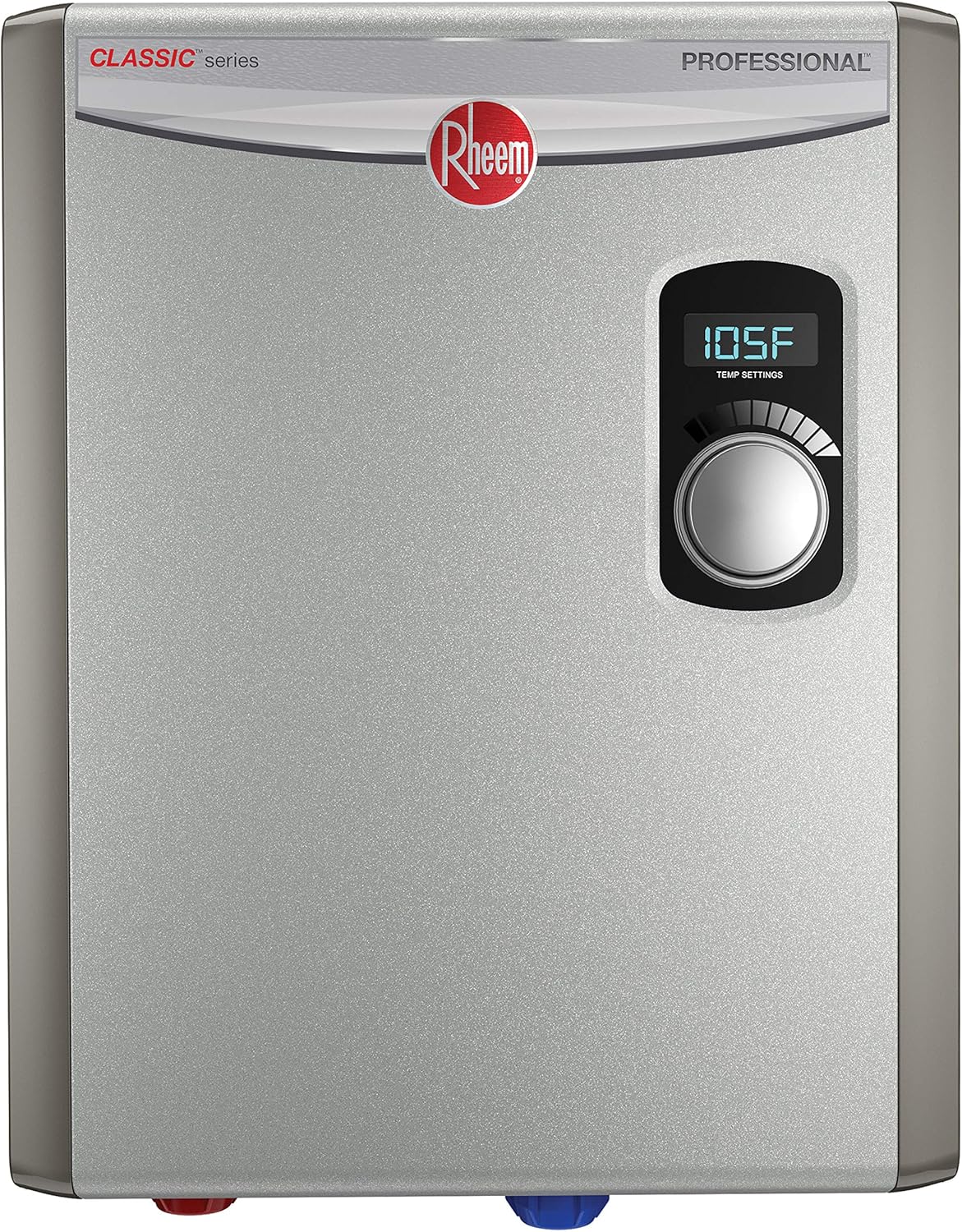
The Rheem RTEX-18 is rated for up to 4.4 GPM and has an external digital control with an LED display. Its self-modulating system adjusts power to meet hot-water demand, and the listing describes copper immersion heating elements that can be serviced in the field. At 14.8 pounds and with a compact wall-mount format, it can help preserve floor space.
This model sits between the 11kW and 24kW Rheems in rated output, which may make it appealing if your household needs more flow than the RTEX-11 can provide. However, the supplied product details do not give its breaker, conductor, or minimum service-panel requirements. Do not assume it will fit your electrical system based on its size alone; confirm the full specifications with Rheem and an electrician.
Some owners have described trouble with temperature-sensing parts or obtaining replacements. That does not establish how often such issues occur, but it makes warranty coverage and local service access worth checking. The higher flow rating also should not be treated as a promise of several simultaneous hot-water uses in cold conditions.
Pros:
- Listed flow of up to 4.4 GPM
- Digital temperature control with an LED display
- Self-modulating operation adjusts power to demand
- Wall-mounted design helps save floor space
Cons:
- Electrical circuit and service requirements need to be confirmed before purchase
- Some owners have reported parts or repair challenges
Verdict: Pick the RTEX-18 if you need more potential flow than the 11kW model and can verify that its electrical and service needs fit your home.
EcoSmart ECO 8: Compact and Better Suited to Modest Hot-Water Demand

The EcoSmart ECO 8 is an 8kW wall-mounted electric heater with a listed maximum flow of 2 GPM. Its small body measures 8 inches wide by 11.5 inches high, making it a space-conscious option for a tiny home. It has an LED display and a listed efficiency of 99.8%.
That 2 GPM maximum makes this a better match for light or carefully scheduled use than for several fixtures running together. One owner described using a similar-sized unit for sinks and appliances that were unlikely to run at the same time; that approach reflects the key trade-off with an 8kW heater. In colder regions, a shower may require more heat than the unit can provide at a comfortable flow rate. The supplied specifications list 240V but do not state a breaker size, so consult the product instructions and a qualified electrician.
Some owners have also encountered connection leaks during installation. Follow the installation instructions, use compatible fittings, and have the connections checked before putting the heater into regular service. Its listed warranty covers the heater but excludes labor and incidental damages, so read the terms carefully.
Pros:
- Small, lightweight wall-mounted design
- Listed maximum flow of up to 2 GPM
- LED display and self-contained electric operation
- May work well when hot-water uses are limited or staggered
Cons:
- Lower flow capacity may be restrictive for showers and overlapping uses
- Check circuit requirements and installation details before buying
Verdict: The ECO 8 can suit a tiny house with modest, planned hot-water use, but choose a larger model if you need a stronger shower flow or frequent simultaneous use.
Ranein 8kW: A Compact Option with Clear Listed Circuit Needs

This Ranein unit is an 8kW, 240V heater with a listed maximum flow of 1.9 GPM. It measures about 9.06 by 6.7 by 2.34 inches, has knob controls and an LED temperature display, and lets you set temperatures from 86°F to 131°F. The listing specifies one 40-amp breaker, which gives shoppers a useful starting point for checking electrical fit.
Its modest flow rating makes it most suitable for one limited hot-water use at a time, rather than a busy household using a shower and other fixtures together. The 131°F maximum setting is also lower than the listed maximums of the Rheem models. Some owners have reported units that stopped working or breakers that tripped, so careful installation and access to support matter. A qualified electrician should confirm the wiring, breaker, and any applicable installation requirements before use.
Compared with the EcoSmart ECO 8, the Ranein is similarly sized and has a slightly lower listed flow, but it provides a stated breaker requirement and a digital temperature display. The product listing also describes leakage and overheat protection; those features do not replace correct installation or electrical protection required by local code.
Pros:
- Very compact wall-mounted design
- Listing specifies a 240V supply and one 40-amp breaker
- LED temperature display with knob controls
- Designed to heat water on demand
Cons:
- Listed flow is limited to up to 1.9 GPM
- Some owners have reported breaker trips or unit problems
Verdict: The Ranein is worth considering for low-demand use when its circuit requirements fit, but its limited flow makes it a poor match for multiple simultaneous hot-water needs.
How to Choose an Electric Tankless Water Heater for a Tiny House
Start with your electrical service
Before comparing heater size, find out how much electrical service your tiny house has and what other appliances use it. A tankless heater draws substantial power while heating water. The RTEX-24, for example, calls for three 40-amp double-pole breakers and recommends a 200-amp service panel. The RTEX-11 specifies a 50-amp double-pole breaker and recommends at least 100-amp service. The Ranein listing specifies a 40-amp breaker. Have an electrician compare the exact heater requirements with your panel, wiring, and expected loads.
Size for incoming water temperature and flow
A heater’s maximum GPM rating does not tell the whole story. It must raise the incoming water to your desired temperature, and colder water requires a larger temperature increase. That can reduce the flow available at the tap. Consider the coldest water temperatures your home is likely to experience, the temperature you want at the shower, and the heater’s sizing guidance. Do not assume the advertised maximum flow will be available in every season.
Decide which fixtures may run at once
List the hot-water uses you expect: a shower, kitchen sink, bathroom sink, or appliances. Then decide which ones might be used at the same time. The 8kW models are limited to roughly 2 GPM in their listings, so they are better suited to modest demand than overlapping uses. The Rheem models list higher maximum flows, but their greater output comes with more demanding electrical requirements. If you can schedule uses, a smaller unit may be enough; if not, size for realistic overlap.
Check whether the heater is for the whole home or one fixture
Tankless heaters are often used as whole-home units or as point-of-use heaters near a sink or shower. A compact unit can save floor space, but its available flow still needs to suit the fixture it serves. For a tiny house, think about where you can mount it, the distance to the hot-water outlets, and whether one centrally placed heater or a dedicated unit near a fixture makes more sense for your layout.
Review installation, plumbing, and service needs
Check water connection sizes, clearance needs, installation instructions, and local code before ordering. The supplied details list 3/4-inch NPT connections for the RTEX-18 and 1/2-inch NPT connections for the Ranein. Confirm that your plumbing matches the selected model and that the required fittings are suitable. Also check warranty coverage, who pays for labor, and whether replacement parts or service are available where you live.
Plan for your power source
If your tiny house is off-grid, runs from a generator, or connects to a limited shore-power supply, confirm that the system can support the heater’s electrical demand while other loads are running. The product specifications alone do not establish compatibility with a particular inverter, generator, or battery setup. Ask your system designer or electrician to assess the full load before choosing a model.
Frequently Asked Questions
Can an electric tankless water heater work in a tiny house?
Yes, if the unit’s electrical requirements, flow capacity, and installation needs match the home. Tankless models can save space, but they are not automatically a good fit for a small electrical service. Confirm the load before purchasing.
Which model is the best fit for most tiny houses?
There is no single best choice for every tiny house. The 8kW models are compact and suited to modest demand, while the Rheem models offer higher listed flow but require more electrical capacity. A good choice is the smallest model that can meet your real hot-water needs without exceeding your service limits.
Will an 8kW heater provide enough hot water for a shower?
It depends on incoming water temperature, desired shower temperature, and the flow rate you expect. The EcoSmart ECO 8 lists up to 2 GPM, and the Ranein lists up to 1.9 GPM. Check the manufacturer’s sizing guidance for your local conditions rather than treating those maximums as guaranteed shower performance.
Can I run a shower and kitchen sink at the same time?
That depends on the combined flow demand and the amount of heating required. A lower-output heater may struggle when two fixtures draw hot water at once, especially if the incoming water is cold. Compare the total flow you need with the model’s sizing information and plan for your most demanding likely use.
Do electric tankless water heaters need venting?
The Rheem RTEX product details say these electric models do not require venting. They still need proper electrical and plumbing installation, and local requirements may apply. Follow the model’s installation instructions.
Is a larger-kilowatt heater always better?
No. A higher-output model may deliver more flow, but it can require more circuits and greater service capacity. In a tiny house, an oversized heater can be a poor choice if the panel or power source cannot support it. Match the model to both your water demand and your electrical system.
Should I install the heater myself?
Do not take on electrical work unless you are qualified and local rules allow it. These units can require dedicated high-amperage circuits, and incorrect wiring can create serious hazards. Have a licensed electrician confirm the electrical design and follow the manufacturer’s installation instructions.
Final Recommendation
For a tiny house with limited hot-water use, the EcoSmart ECO 8 or Ranein 8kW may be more practical than a high-output model, provided the selected unit can meet your flow needs and its electrical requirements fit. If you need more flow, the Rheem RTEX-11 is a possible step up, but its 50-amp circuit and recommended 100-amp service are important constraints. The RTEX-18 and RTEX-24 offer higher listed flow, yet they should only be considered after an electrician verifies that the home can support them. Compare your cold-water conditions, fixture use, and available power before choosing.






