Finding the best electric tankless water heater for a large home starts with a reality check: heating capacity matters more than a compact design or smart features. The electric models in this roundup range from small under-sink units to 11kW and 14kW heaters. Based on their listed flow rates, the 14kW model is the strongest electric option here, but even it may not keep up with several showers or fixtures across a large home at once. Check your incoming water temperature, expected hot-water demand, and electrical service before choosing.
One product below is a natural-gas or propane model, not an electric heater. It is included as a higher-capacity alternative for shoppers whose home needs more hot water than the listed electric options can provide.
Table of Contents
Quick Comparison
| Product | Power type and capacity | Best suited for |
|---|---|---|
| Westinghouse 14kW Wi-Fi Tankless Water Heater | 240V electric; up to 3.4 GPM under stated test conditions | One or two nearby uses, where the electrical service supports it |
| Westinghouse 11kW Wi-Fi Tankless Water Heater | 240V electric; up to 2.56 GPM | A point of use or limited hot-water demand |
| xwdzswgs 3000W 110V Under-Sink Heater | 110V electric; 3,000W | Handwashing or a small sink, not a shower or whole home |
| xwdzswgs 3000W 110V Digital Under-Sink Heater | 110V electric; 3,000W | Small point-of-use applications |
| Rinnai RX180iN Condensing Tankless Water Heater | Natural gas or propane; up to 10 GPM as listed | A high-demand home considering a non-electric alternative |
Our Picks: Best Electric Tankless Water Heaters For Large Homes reviews
1. Westinghouse 14kW Wi-Fi Tankless Water Heater: The Most Capable Electric Pick Here

This is the strongest electric model in the supplied selection, but its listed output still calls for careful sizing in a large home. Westinghouse states that it can deliver up to 3.4 GPM when incoming water is 62°F and the outlet is set to 105°F. Under those conditions, the product description says it can support two water points at once. Flow and temperature rise depend on your actual incoming water temperature and desired outlet temperature, so treat that figure as a specific operating example rather than a guarantee for every household.
The compact, wall-mounted unit has Wi-Fi and voice-control compatibility, a temperature-memory feature, and a stated 98% thermal efficiency. Its listed safety features include protection against leaks, overheating, dry firing, and over-voltage. Those features may be convenient, but they do not change the unit’s heating capacity.
Installation is a major consideration: the product calls for a dedicated 60A double-pole breaker and 6 AWG wire at 240V. Have an electrician confirm your panel capacity, wiring, and local requirements before buying. For a large household with several showers or high simultaneous demand, this 14kW model may be better as a limited-demand or point-of-use heater than as the only hot-water source.
Pros:
- Highest listed electric output among the electric models here
- Up to 3.4 GPM under the stated inlet and outlet temperature conditions
- Wi-Fi, app, and voice-control compatibility
- Includes listed protections for leaks, overheating, dry firing, and over-voltage
Cons:
- May not meet the simultaneous hot-water needs of a large household
- Requires substantial dedicated electrical capacity and professional installation
Verdict: Choose this as the leading electric option in this group only if its calculated output and your electrical service match your needs; do not assume it can serve every fixture in a large home at once.
2. Westinghouse 11kW Wi-Fi Tankless Water Heater: A Smaller 240V Option

This 11kW model is a hard-wired, 240V electric heater with a listed maximum flow rate of 2.56 GPM. Its activation flow is 0.4 GPM, and the product describes it as suitable for up to one shower. It also mentions one to three points of use, but that should not be read as a promise that several high-flow fixtures can run simultaneously; available flow depends on temperature rise and demand.
The heater offers Wi-Fi and voice control, temperature adjustment from 86°F to 140°F, and an LED display. Its compact wall-mounted case has bottom 1/2-inch NPT water connections. The product lists ETL certification and protections against leakage, overheating, dry firing, and high voltage.
Electrical requirements are specific: the listing calls for 46 amps, one 50A double-pole breaker, and 8 AWG wire. That makes an electrician’s assessment important, particularly if the home’s panel is already heavily loaded. Compared with the 14kW Westinghouse, this model has a lower listed maximum flow and is a less compelling choice for a large home’s primary hot-water supply.
Pros:
- Wi-Fi and voice-control features with one-degree temperature adjustments
- Compact wall-mounted design
- Listed safety protections and ETL certification
- 0.4 GPM activation flow
Cons:
- Lower listed flow capacity than the 14kW model
- Its electrical requirements need to be checked before installation
Verdict: Consider it for a smaller demand area or a limited-use setup, but its listed output makes it a weak fit as the sole heater for a large, busy household.
3. xwdzswgs 3000W 110V Under-Sink Heater: For a Single Small Sink
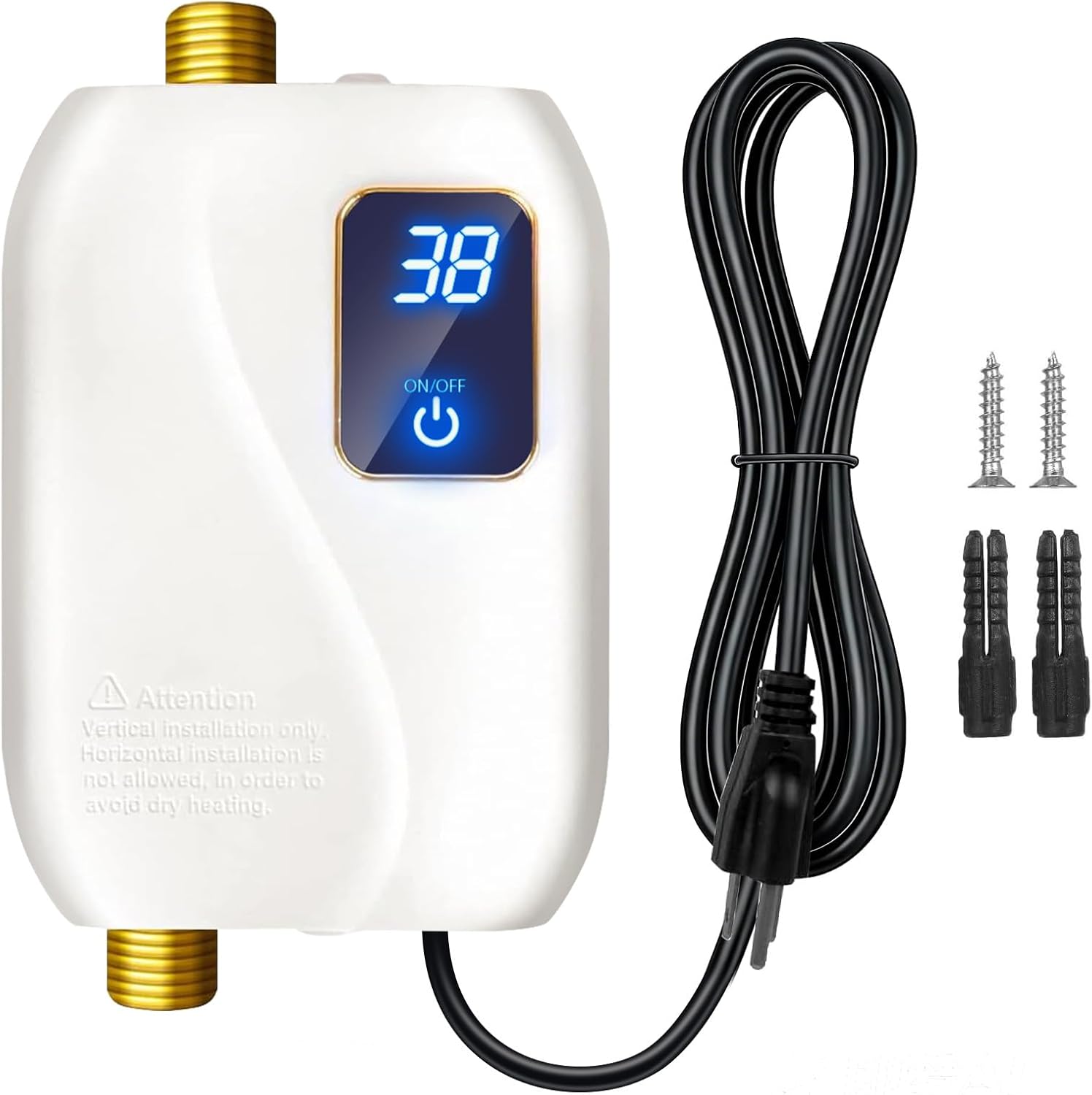
This 3,000W, 110V unit is a point-of-use heater designed for installation near a sink. The product says it can raise water temperature by 82°F at 0.3 GPM and by 131°F at 0.5 GPM. Those figures show why the unit is not a practical choice for a shower or whole-home use: the temperature rise is tied to a very low flow rate, and the listing specifically says it is not suitable for showers.
Its small wall-mounted design, LED display, and selectable Fahrenheit or Celsius display may suit a kitchen, utility sink, or similar low-flow location. The listing describes stainless steel and ABS construction, 1/2-inch NPT connections, and multiple safety functions, including dry-boil protection and automatic shutoff for overheating or inactivity. It also says to mount the heater vertically; follow the supplied installation instructions and have the electrical setup checked for compatibility.
In the supplied user-experience information, some use cases describe it as convenient for a compact sink setup, while another reports breaker trips and difficulty with temperature control. That mixed experience makes correct sizing and installation especially important. It is not a substitute for a large-home water heater, and the stated flow limitations should guide expectations.
Pros:
- Compact format for a small point-of-use installation
- LED display with Fahrenheit and Celsius selection
- Listed safety features include dry-boil and overheat protection
- Standard 1/2-inch NPT connections
Cons:
- Not suitable for showers, according to the product listing
- Low flow makes it unsuitable for whole-home hot-water demand
Verdict: Buy it only for a small sink application where its low flow is acceptable; it is not a large-home tankless solution.
4. xwdzswgs 3000W Digital Heater: Another Compact Under-Sink Choice

This is another 110V, 3,000W point-of-use heater with an LED display. Its listed temperature rise is 82°F at 0.3 GPM and 131°F at 0.5 GPM, and the product notes that higher water flow lowers the outlet temperature. Like the other 3,000W option in this roundup, it is not suitable for typical shower flow and should not be considered a whole-home heater.
The listing describes a slim design, ABS construction, 1/2-inch NPT connections, and protections such as leakage protection, dry-boil protection, and automatic shutoff for overheating or inactivity. It specifies vertical installation. Its compact size may help where a small sink needs hot water without a storage tank, but its limited flow and heating capacity define its role.
The supplied user-experience information is mixed: some accounts describe useful performance in small spaces, while another reports breaker trips and dissatisfaction with temperature control. This does not establish how every installation will perform, but it is a reason to verify the electrical circuit and installation requirements rather than assuming a simple plug-in setup will work in every home.
Pros:
- Small format for under-sink or other point-of-use applications
- Digital display for viewing water temperature
- Listed protections include leakage, dry-boil, and overheat safeguards
- Vertical mounting and standard 1/2-inch NPT connections are specified
Cons:
- Not intended for showers or high-flow household use
- Supplied user-experience information includes a report of breaker trips
Verdict: This may suit a small sink with modest demand, but choose a properly sized whole-home system for a large house.
5. Rinnai RX180iN Condensing Tankless Heater: A Higher-Capacity Gas Alternative

This Rinnai is not an electric water heater. It runs on natural gas or propane and is included as an alternative for households whose hot-water needs exceed the capacity of the electric models above. The listing gives a maximum flow rate of up to 10 GPM and describes support for as many as six fixtures at once. Actual output depends on the installation and water conditions, so use the manufacturer’s sizing information to confirm suitability.
The condensing unit is designed for indoor or outdoor installation, with an outdoor vent cap required for outdoor use. It has a Quick Flush feature, a Smart Sense gas control system, and a stated energy efficiency factor of UEF .98. The listing notes that Wi-Fi control requires a separate Controlr module, so do not assume Wi-Fi is built in.
Rinnai recommends professional installation. This model brings fuel, venting, and installation needs that do not apply to the electric options, and it will not fit a home that specifically needs an all-electric water heater. It is the highest-capacity choice in this group by the listed flow rate, but only for shoppers open to gas or propane.
Pros:
- Listed capacity of up to 10 GPM
- Supports natural gas or propane, as specified
- Can be installed indoors or outdoors with the required configuration
- Quick Flush feature and stated UEF .98 efficiency factor
Cons:
- Uses gas or propane, so it is not an electric tankless heater
- Professional installation is recommended; Wi-Fi control requires an additional module
Verdict: Consider the Rinnai only if you are open to gas or propane and need more listed flow than these electric picks provide.
How to Choose an Electric Tankless Water Heater for a Large Home
Calculate the hot-water demand you need to cover
Start by listing which fixtures may run at the same time, such as showers, sinks, and a dishwasher. Add their expected flow rates to estimate the total demand. A heater’s maximum flow figure alone is not enough: the amount of temperature rise needed affects how much hot water it can deliver. For a large household, size the system around likely peak use rather than the number of bathrooms alone.
Factor in incoming water temperature
Water entering the heater is colder in some regions and seasons than in others. The colder the incoming water, the harder the heater must work to reach your set temperature, which can reduce available flow. Use your local groundwater temperature or a qualified installer’s measurements when comparing a heater’s output with your household needs.
Check electrical service before choosing a model
Electric tankless heaters can require dedicated circuits, large breakers, and appropriately sized wiring. The 14kW model listed here calls for a 60A double-pole breaker and 6 AWG wire; the 11kW model lists a 50A double-pole breaker and 8 AWG wire. These are product-specific requirements, not a general guide for other heaters. Ask an electrician to confirm the unit’s requirements, your panel’s capacity, and compliance with local codes before purchase.
Be cautious with low-wattage point-of-use units
A small 110V under-sink heater can be useful at one nearby sink, but its listed flow is far below typical shower demand. It is not a smaller version of a whole-home system. Check both the temperature-rise figures and the stated flow limits, and do not rely on a point-of-use unit to supply multiple bathrooms.
Choose between one central heater and multiple units
A central electric tankless heater may be convenient, but a large home can have long pipe runs and several fixtures in use at once. In some layouts, point-of-use heaters can reduce the wait at distant sinks, but they add equipment and installation needs and do not replace an adequately sized primary system. Ask a qualified plumber or electrician to assess the home’s layout and demand before planning a multi-unit setup.
Confirm the installation details and protections
Check connection size, mounting position, activation flow, and required clearances in the product instructions. Look for clearly stated safety features, but remember that built-in protections do not replace correct wiring, plumbing, and installation. Follow the manufacturer’s manual and use qualified professionals where required.
Consider whether electric is a firm requirement
If your home needs more hot-water flow than the electric models you are considering can provide, compare other system types rather than buying an undersized unit. The Rinnai in this roundup uses natural gas or propane, so it is only relevant if you are willing and able to use a fuel-burning heater. Compare installation needs and operating requirements as well as flow capacity.
Frequently Asked Questions
Can an 11kW or 14kW electric tankless heater serve a large home?
It depends on the home’s incoming water temperature, desired outlet temperature, electrical service, and the number of fixtures running at once. The listed 14kW model reaches up to 3.4 GPM under stated test conditions, while the 11kW model lists up to 2.56 GPM. Those figures may not cover several simultaneous showers and other uses in a large household.
Which electric model in this roundup has the greatest listed flow?
The Westinghouse 14kW model has the highest listed flow among the electric options: up to 3.4 GPM with 62°F incoming water and a 105°F outlet setting. Your actual output may differ with water temperature and installation conditions.
Are the 3,000W, 110V models suitable for showers?
No. Both listings describe the 3,000W units as point-of-use heaters and say they are not suitable for showers. Their stated temperature-rise figures are tied to low flow rates.
Does the Rinnai RX180iN run on electricity?
No. It is a natural-gas or propane tankless heater. It is included as a higher-capacity alternative, not as an electric pick.
Will I need an electrician to install an electric tankless heater?
Have an electrician assess the installation before buying. The 11kW and 14kW models list dedicated circuit, breaker, and wire requirements, and your panel must be able to support the load. Always follow the product manual and local code requirements.
Does “tankless” mean the heater can provide unlimited hot water?
It means the unit heats water on demand rather than storing a tank of hot water. It does not mean unlimited flow: each heater has a capacity that can be exceeded when demand is high or the incoming water is cold.
What is the safest first step when sizing a heater for a large home?
Estimate simultaneous fixture demand, account for incoming water temperature, and have a qualified professional check the electrical service and installation. Compare the calculated need with the manufacturer’s capacity information before choosing a unit.
Final Recommendation
Among the electric products listed here, the Westinghouse 14kW model is the most capable by stated flow, but its output may still be too limited for a large home with multiple simultaneous hot-water demands. The 11kW Westinghouse is better suited to a smaller or more limited-use setup, while both 3,000W units are for small point-of-use applications only. If you need substantially more flow and are open to another fuel, the Rinnai gas model is a higher-capacity alternative—not an electric heater. For a large household, make the final choice only after matching fixture demand, incoming water temperature, and electrical or fuel requirements with a qualified installer.