
Choosing an electric tankless water heater for radiant heat takes more than comparing kilowatts. Radiant systems need a heater that can meet the home’s heat loss at the required water temperature and flow, and not every tankless water heater designed for household hot water is approved for closed-loop heating. The five models below offer different power levels and controls, but confirm compatibility with your radiant system and local code before buying. A heating professional can help determine whether a dedicated heat exchanger or other system components are needed.
Table of Contents
Quick Comparison
| Product | Power | Listed flow rate | Notable feature |
|---|---|---|---|
| Rheem RTEX-06T | 6.5 kW | 1.5 GPM | Compact, thermostatic point-of-use design |
| Rheem RTEX-24 | 24 kW | Up to 5.9 GPM | Whole-home format with digital temperature control |
| Rheem RTEX-18 | 18 kW | Up to 4.4 GPM | Self-modulating power and LED display |
| Westinghouse 14kW WiFi Tankless Water Heater | 14 kW | Up to 3.4 GPM under stated test conditions | WiFi and voice control |
| SIVUATEK 14kW Tankless Water Heater | 14 kW | Up to 3.3 GPM | LED display and adjustable temperature control |
Flow figures are product specifications, not a guarantee of performance in a radiant heating loop. Actual output depends on system design and operating conditions.
Our Picks: Best Electric Tankless Water Heaters For Radiant Heat reviews
1. Rheem RTEX-06T: Compact Option for a Small, Dedicated Application

The RTEX-06T is a small 6.5 kW, 240V point-of-use heater with thermostatic control. Its listed maximum flow rate is 1.5 GPM, and its compact case measures about 10.88 inches wide by 5.88 inches high. Rheem describes it as a wall-mounted unit that heats water on demand.
Its modest power makes it more plausible for a small, carefully sized heating application than for a large radiant floor system. However, the product information presents it as a point-of-use water heater, not as a purpose-built hydronic boiler. Before considering it for radiant heat, confirm that the manufacturer and your installer approve the proposed use and system arrangement.
Some users report that the unit works well when installed near a distant point of use, and that installation is manageable for people familiar with the required electrical work. For radiant heat, though, ease of installation should not replace checking heat load, flow, water temperature, and electrical capacity.
Pros:
- Small, wall-mounted design can fit in a tight space.
- Thermostatic control is intended to keep output temperature consistent.
- On-demand operation avoids keeping a storage tank hot.
Cons:
- Its 6.5 kW output and listed 1.5 GPM flow limit the scale of applications it can serve.
- It is described as a point-of-use water heater, so radiant-loop compatibility needs careful confirmation.
Verdict: Consider the RTEX-06T only for a small, professionally sized application where its limited output is sufficient and the installation is confirmed compatible.
2. Rheem RTEX-24: Highest Listed Output in This Lineup

The RTEX-24 is a 24 kW, 240V wall-mounted electric tankless water heater. Rheem lists a flow rate of up to 5.9 GPM and temperature settings from 80°F to 140°F in one-degree increments. It is the highest-output model in this group, which may make it worth examining for a larger load—but the listed flow rate is not a radiant-system capacity rating.
Electrical planning is a major factor. The supplied specifications call for three 40-amp double-pole breakers, three sets of #8 AWG copper conductors with ground, and a recommended minimum 200-amp household service panel. Have an electrician check the panel and wiring before purchase. The unit’s compact wall-mounted design saves floor space, but the electrical requirements are substantial.
This model is intended for on-demand household hot water. Its power and adjustable controls may look attractive for heating, but they do not establish that it is approved for a closed-loop radiant system. Ask the manufacturer or a qualified hydronic professional about the intended application and any required separation or controls.
Pros:
- Highest listed power and flow rate among these five options.
- Temperature control adjusts in one-degree increments.
- Compact wall-mounted form and no venting requirement.
- Self-contained on-demand design does not require a storage tank.
Cons:
- Electrical service and circuit requirements can make installation demanding.
- Household hot-water specifications do not confirm suitability for radiant heating.
Verdict: The RTEX-24 is the strongest candidate here when output is a priority, but choose it only after confirming both the electrical upgrade needs and hydronic compatibility.
3. Rheem RTEX-18: Midrange Power with Self-Modulating Heat
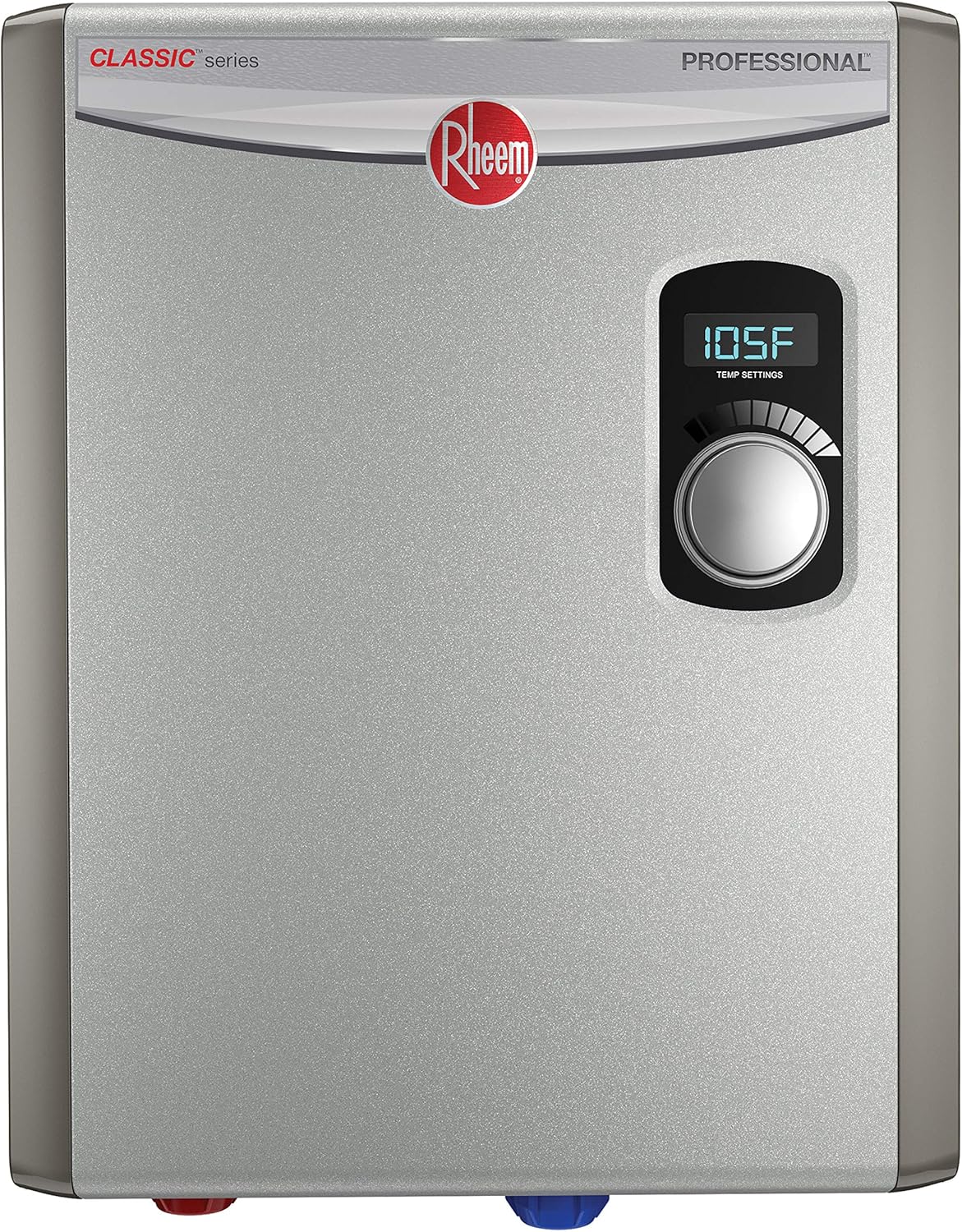
The RTEX-18 provides 18 kW of power at 240V, with a listed flow rate of up to 4.4 GPM. Its digital thermostatic control has an LED display, and Rheem describes the unit as self-modulating: it adjusts power to match hot-water demand. Copper immersion heating elements are described as field-serviceable.
At a glance, the RTEX-18 sits between the 6.5 kW point-of-use model and the 24 kW whole-home model. That middle position may suit a smaller or moderate load if a professional’s calculations support it. Still, radiant heat needs steady performance at the system’s required flow and temperature, so compare those design needs with the heater’s approved operating range rather than relying on the GPM figure alone.
The unit has threaded 3/4-inch NPT water connections and a digital temperature display. Its product details do not provide the electrical circuit requirements in the supplied information, so confirm those with Rheem and an electrician before installation.
Pros:
- 18 kW output offers a middle ground between the smaller and larger Rheem models.
- Self-modulating operation adjusts power to demand.
- LED display and digital temperature control.
- Heating elements are described as field-serviceable.
Cons:
- Radiant-loop approval and electrical requirements need to be verified.
- Its listed flow rate is not a substitute for hydronic system sizing.
Verdict: The RTEX-18 is a reasonable model to investigate for a mid-sized load, provided your installer confirms its output, electrical needs, and suitability for the specific radiant system.
4. Westinghouse 14kW WiFi Heater: Connected Controls in a Compact Package

This 14 kW, 240V Westinghouse unit adds WiFi and voice control to a compact wall-mounted design. Its product information lists a 60-amp double-pole breaker and 6 AWG wire requirement, 1/2-inch NPT water connections, and dimensions of about 12.59 inches high by 9.56 inches wide by 3.28 inches deep. It is described as ETL certified and includes several listed safety protections.
The stated maximum flow is 3.4 GPM with 62°F inlet water and a 105°F outlet setting. That figure depends on those specific conditions and should not be treated as the flow available in every installation or as a radiant heating rating. WiFi features can make temperature adjustments more convenient, but they do not replace the controls a hydronic system may require.
For radiant use, the key question is whether the manufacturer approves this water heater for the intended loop and operating conditions. The supplied product details describe household hot-water use, so get that confirmation before treating it as a heating appliance.
Pros:
- WiFi and voice-control compatibility provide remote adjustment options.
- Compact wall-mounted dimensions save floor space.
- Product details list ETL certification and multiple safety protections.
- Includes a temperature-memory feature for restoring the preset after a power outage.
Cons:
- Its 14 kW rating may not meet the needs of a larger radiant load.
- Radiant-loop approval and control-system compatibility are not established by the supplied details.
Verdict: Consider this Westinghouse if connected controls matter and its 14 kW output fits your calculated load, but verify that its intended use matches your radiant system.
5. SIVUATEK 14kW: Straightforward Display and Temperature Settings

The SIVUATEK TSB-140 is a 14 kW, 240V tankless water heater with a listed maximum flow rate of 3.3 GPM. Its LED display shows inlet and outlet temperature, flow, and power use, according to the product details. The temperature setting range is 86°F to 131°F, and the listed electrical requirement is one 60-amp circuit breaker.
The display may help you monitor operating conditions, while the adjustable temperature control offers a clear way to set the desired output. Its listed flow and output place it in the lower-power range compared with the Rheem 18 kW and 24 kW options. As with the other models, the GPM figure is not enough to establish whether it can heat a radiant loop.
The product is described for sink and shower use, so it should not be treated as a radiant boiler without explicit approval. Check the temperature needs of your flooring and system, and ask whether the heater is compatible with the loop’s water quality, circulation, and controls.
Pros:
- LED display provides several operating readings.
- Temperature adjusts in one-degree increments within the listed range.
- Product information lists overheat protection and automatic shutoff features.
- 14 kW rating may fit a modest load when properly sized.
Cons:
- Its listed maximum temperature is 131°F, which may not suit every system design.
- It is marketed for sink and shower use, so radiant compatibility must be confirmed.
Verdict: The SIVUATEK is worth considering for a modest, carefully sized application if its temperature range and intended use are approved for your radiant setup.
How to Choose an Electric Tankless Water Heater for Radiant Heat
Confirm the heater is approved for the application
Start by checking the manufacturer’s instructions and asking whether the model is approved for hydronic radiant heating. A product described as a household water heater is not automatically suitable for a closed-loop heating system. Your installer may recommend a heat exchanger or other components to separate the radiant loop from the heater. Do not assume that matching the connection size is enough to make a unit compatible.
Size the heater to the actual heat load
Have a heating professional calculate the building’s heat loss and the radiant system’s required water flow and temperature. Kilowatts indicate electrical heating power, while a product’s listed GPM figure describes flow under stated conditions; neither number alone proves that the heater can meet your home’s needs. A model that is too small may struggle to maintain the required heat, while a larger unit can require more electrical capacity than your home has available.
Check water temperature and system limits
Radiant floors often need carefully controlled water temperatures, and the right setting depends on the floor, tubing, controls, and heat-loss calculation. Compare the heater’s temperature range with the system designer’s requirements. Make sure the chosen unit and control setup can maintain the temperatures needed without exceeding the limits of the floor materials or radiant components.
Review electrical service and installation needs
Electric tankless heaters can place a significant load on a home’s electrical system. Check the product’s voltage, breaker, conductor, and service-panel requirements with a licensed electrician. The RTEX-24, for example, specifies three 40-amp double-pole breakers and recommends at least a 200-amp household service panel. Requirements differ by model, so do not use one unit’s wiring details to plan for another.
Consider the loop, water quality, and controls
Ask your installer whether the system will use treated water or a heat-transfer fluid, and whether the heater permits it. Confirm that the proposed piping, circulation pump, expansion control, safety devices, and temperature controls fit the heater’s instructions and local code. If you want WiFi or smart-home control, verify that those features work with the overall heating design rather than just the heater’s temperature setting.
Compare convenience with long-term service needs
Look beyond the compact size and on-demand operation. Check the manufacturer’s warranty, recommended maintenance, service access, and availability of replacement parts. Features such as a digital display or self-modulation can be useful, but they should come after compatibility, heat-load sizing, electrical capacity, and safe system design.
FAQs
Can a tankless electric water heater be used for radiant floor heat?
Sometimes, but not every household tankless water heater is approved for hydronic heating. Confirm the intended use with the manufacturer and have a qualified radiant-heating professional review the system design before installation.
How many kilowatts do I need for radiant heat?
There is no single size that fits every home. The required output depends on the building’s heat loss and the radiant system’s design flow and water temperature. Ask a heating professional to calculate the load instead of choosing by floor area or a product’s household GPM figure alone.
Does a higher GPM rating mean a heater is better for radiant heat?
Not by itself. GPM is one part of the product’s hot-water specification and depends on operating conditions. Radiant system performance also depends on required water temperature, heat load, loop design, and whether the heater is approved for that use.
Will I need a heat exchanger?
Possibly. A heat exchanger can separate a radiant loop from a heater, but whether one is needed depends on the heater’s instructions and the system design. Have your installer confirm the correct arrangement before purchasing equipment.
Can I install an electric tankless heater myself?
These units can have demanding electrical requirements, and radiant systems need proper controls and safety components. Use qualified professionals for electrical work and hydronic design, and follow local codes and the manufacturer’s instructions.
Which model in this list has the most power?
The Rheem RTEX-24 has the highest listed output at 24 kW. That does not automatically make it the best choice: its electrical requirements are substantial, and its suitability for a radiant loop must still be confirmed.
Conclusion
For a radiant heating project, start with system compatibility and a professional heat-load calculation—not the product’s headline flow rate. The Rheem RTEX-24 offers the highest listed power in this group, while the RTEX-18 provides a middle option and the smaller models may suit only modest, well-defined applications. The Westinghouse and SIVUATEK add useful control features at 14 kW, but their household-water positioning makes compatibility checks essential. Before buying any of these heaters, confirm the intended use, electrical requirements, and complete hydronic design with the manufacturer and a qualified installer.






